How to Strengthen Our Arctic Security
Keep our promises to the Inuit. An Arctic dispatch.
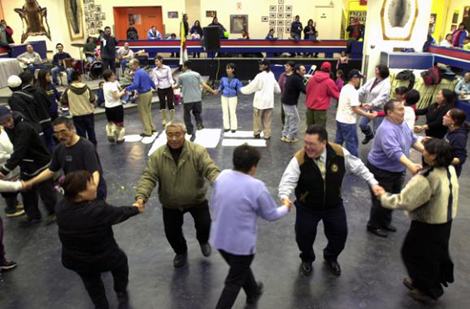
Celebration in Iqualuit,
Prime Minister Harper is increasing Canada's military presence in the Arctic. But he's yet to address the other bulwarks of sovereignty: social and economic development, environmental stewardship, and -- above all -- honouring our commitments to the people of the North.
Last week, we travelled from Baffin Bay to the Beaufort Sea. We spent our time listening and learning, not preaching and proclaiming.
We met with Paul Kaludjak, the president of the Inuit land claims organization Nunavut Tunngavik. He told us how, in the 1993 Nunavut Land Claims Agreement, the Inuit transferred their claim to aboriginal title over one-fifth of Canada. In doing so, they explicitly sought to strengthen this country's sovereignty there.
In return, the federal government made a number of commitments that have not yet been fulfilled.
For instance, the agreement requires that the per centage of government jobs held by Inuit match their share of the population. But though the Inuit currently account for 85 per cent of the population, only 45 per cent of the jobs are held by them.
Justice Thomas Berger, acting as a conciliator for the federal and territorial governments, has identified the root of the problem as being that only 25 per cent of Inuit children graduate from high school. He concluded that the situation demands bilingual Inuktitut-English education from Kindergarten to Grade 12, regardless of any increased cost.
Economic negligence
The education crisis is exacerbated by a housing crisis -- as was poignantly explained to us by Elisapee Sheutiapik, the mayor of Iqaluit. A burgeoning population, high construction costs, inadequate funding and federal foot-dragging have created a situation where as many as 14 people are crowded into small, poorly ventilated homes.
Imagine trying to do homework under those circumstances. And consider the health and social consequences, including astonishingly high rates of tuberculosis, lung cancer, depression and domestic violence.
We met with Paul Okalik, the premier of Nunavut, who told us how successive federal governments have ignored requests for a deepwater dock at Iqaluit, the largest community in the territory. Such a facility, by facilitating the off-loading of construction supplies, fuel oil, gasoline and dry goods, would substantially reduce the astronomical cost of living.
A deepwater dock would also attract cruise ships, many of which currently bypass Iqaluit. This would enable the further development of Nunavut's tourist and artisan industries.
A melting future?
In Auyuittuq National Park, park manager David Argument showed us dramatic evidence of climate change: rapidly retreating glaciers, melting permafrost and new forms of vegetation.
In nearby Pangnirtung, we met with Mayor Manasa Evic, who told us how caribou have all but disappeared from the area, and how rising ocean temperatures have led to the collapse of a multi-million dollar commercial ice fishery.
Across the North, existing infrastructure is creaking at the seams. Mr. Evic explained how successive federal governments have ignored pleas to extend and, ideally, move Pangnirtung's runway. The current airstrip -- at 2920 feet -- is painfully short and surrounded by houses, fuel tanks and a school.
He also told us of his community's unsuccessful campaign for a small vessel harbour to enable fishing boats to offload their catches directly on shore. This would greatly improve safety while reducing costs at the local fish plant, which prepares and packages shrimp and Arctic Char for the U.S. market, and employees 40 Inuit.
In Rankin Inlet, we met with Mayor Lorne Kusugak, and learned how the municipal and territorial governments have been working with Manitoba on a plan to build a 400 kilometre long transmission line to bring hydropower from Churchill. Yet the plan, which would eliminate the need to ship in large quantities of diesel, has run into a brick wall in Ottawa.
Arresting Norwegians
In Cambridge Bay, we met with Mayor Michelle Gillis. She led us to the local RCMP who had just arrested five Norwegian adventurers intent on challenging Canada's authority over the Northwest Passage. The adventurers sailed their yacht, the Berserk II, into the waterway without seeking permission.
Fortunately, two members of the crew snuck onto shore, thus setting foot on indisputably sovereign Canadian soil. They -- and the rest of the crew -- were promptly arrested.
The incident demonstrated how our civilian authorities are fully capable of upholding Canadian laws in the Northwest Passage -- if they have appropriate equipment and political support.
In this instance, the light icebreaker used in the operation, the 21 year-old CCGS Sir Wilfrid Laurier, was up to the task. But our older, heavier icebreakers are at the end of their life-span.
True Arctic security
Instead of supporting the Coast Guard, Mr. Harper is building ice-strengthened patrol ships for the Navy. Yet armed naval vessels are not suitable for dealing with the actual threats associated with international shipping, which range from illegal immigrants to oil spills. Nor are they able to fulfill the other roles played by Coast Guard icebreakers, from maintaining navigation aids to supporting Arctic research.
Again, sovereignty is only partly a military issue. In each of the five communities we visited, we heard about the problems suffocating Inuit youth, including depression, drug and alcohol abuse, and a staggeringly high suicide rate. We learned about the limited funding available for prevention and rehabilitation programmes in Canada's largest, most remote and impoverished region.
Despite having a population of only 32 million, Canada has the world's eighth largest economy. This is a phenomenally wealthy country. Until the Inuit are able to live at developed country standards, our claims to Arctic sovereignty will impress no-one.
'Oh Canada'
Still, there were many positive aspects to our trip. We witnessed the strong protective instinct that the Inuit have for the flora and fauna of the North.
We sang "Oh Canada" in Inuktitut with 100 school children and felt their deep love for this country.
We met community and territorial leaders of intelligence and integrity, all of whom have a clear sense of all that Nunavut could -- and must -- be.
Mr. Harper is wrong to assert that Arctic sovereignty is a question of "use it or lose it." The Inuit have been using the Arctic for thousands of years.
It's their historic use and occupancy of the sea-ice that provides the basis for Canada's claim in the Northwest Passage. It's they who have given us all that they have, in pursuit of a quintessentially Canadian dream.
Related Tyee stories:
- The Need to Defend Our New Northwest Passage
Harper has made arctic sovereignty a hot button. The stakes for Canada. - Cold Reality in the High Arctic
North of Greenland, climate apocalypse glimpsed. - Defrost, Drill, Guzzle
Oil companies have a recipe for the Arctic. Enjoy!


Cycling Commuter
06-09-2007
Fishing safety enhancement a good investment.
Good point. Fishing is a vital industry - much more important than the beef industry. But fishing one of the most dangerous professions. Anything that improves fishing safety is a good investment.
A recent study published in the Journal of the American Medical Association found that colon cancer survivors who eat diets heavy in red meat and fatty foods are more than three times as likely to suffer a recurrence of their disease or die from it than those who avoid such foods.
See: http://jama.ama-assn.org/cgi/content/short/298/7/754 and
http://www.reuters.com/article/healthNews/idUSN1444602620070814
Fish is much healthier than beef.
Despite the negative health impacts of excessive beef consumption, beef farmers received a billion dollar government handout recently. Meanwhile, the fishing industry gets shafted over and over again.
Cycling Commuter
06-09-2007
Artic Greenhouses for fresh, low-cost veggies, local jobs.
A community greenhouse is now up and running producing fresh vegetables at Iqaluit, a couple of hundred km from the artic circle. Because of transportation costs, veggies in the arctic cost four times as much as in the south. And they arrive soggy with less nutrition. Northern greenhouse production can provider fresher, more nutritious produce at a lower cost. It can also provide much needed local employment.
See:
http://news.yahoo.com/s/afp/lifestylecanadaarcticfarmfood
http://www.nunatsiaq.com/archives/nunavut010731/nvt10706_06.html
http://news.yahoo.com/photos/ss/events/wl/070907canadaarctic/im:/070819/photos_lf_afp/4914283155c2b9368668c24a367bed6d;_ylt=AqUb.ecAaeRK6dyFNONyrXImWccF
http://news.yahoo.com/photos/ss/events/wl/070907canadaarctic/im:/070819/photos_lf_afp/ec2a3ffc309d26226942d026b65aa5e5;_ylt=ArFuH2U9IIfrEy3oyjHHg2sZO7gF
http://news.yahoo.com/photos/ss/events/wl/070907canadaarctic/im:/070819/photos_lf_afp/b4de0525b562e22bffe09017ee21168d;_ylt=Ao.Bwn_FfQscjSc7QtNq_0MmWccF
http://www.breitbart.com/image.php?id=iafp070819054659.7adm2u52p0&show_article=1&catnum=0&ch=BNImagesAll&image=large
http://img.breitbart.com/images/2007/8/18/070819054659.7adm2u52/SGE.LZW95.190807054650.photo00.photo.jpg
http://www.breitbart.com/image.php?id=iafp070819054659.7adm2u52p2&show_article=1&catnum=0&ch=BNImagesAll&image=large
http://img.breitbart.com/images/2007/8/18/070819054659.7adm2u52/SGE.LZW95.190807054650.photo02.photo.jpg
http://www.breitbart.com/image.php?id=iafp070819054659.7adm2u52p1&show_article=1&catnum=0&ch=BNImagesAll&image=large
http://img.breitbart.com/images/2007/8/18/070819054659.7adm2u52/SGE.LZW95.190807054650.photo01.photo.jpg
A similar venture in Inuvik became self-sustaining after only five years:
http://www.nunatsiaq.com/archives/50708/news/features/50708_01.html
A 100-by-200-foot greenhouse in Inuvik has 76 garden plots rented by families, schools and business plus a commercial garden that sells plants and vegetables to local restaurants, businesses and offices.
See: http://www.nunatsiaq.com/archives/nunavut010731/nvt10706_06.html
Similar work has been done in Alaska:
http://biorealis.com/resumes/projects.html
Northern summers provide 24 hours of moderate sunlight per day. The moderate light can produce an explosion of growth. A lot of people don't realize that plant photosynthesis shuts down when sunshine is too intense.
In southern climates, most of the growth occurs in the mornings and late afternoons. The plants have a siesta during mid-day to escape the excessive sunlight.
In the land of the midnight sun, plants can grow 24 hours a day in the summer due to the moderate nature of sunlight that passes through a lot of atmosphere at a steep angle. But plants in the arctic need the protection of a greenhouse because crop-destroying snowfalls can occur during every month of the year.
skeptikool
06-09-2007
Transmission line questioned
From the article:
Cynics might believe that serving oilpatch friends has taken priority.
At the same time, is that proposed transmission line from Churchill the best option? I would think there would be huge transmission losses. Can not power be produced closer to its end use? Even though back-up generators may be necessary, what is the wind potential, solar, tidal, river run, thermal etc.?
jwstewart
06-09-2007
Local investment
One of the things I wonder about is why the infrastructure requests are directed at the Federal Government.
How come the Inuit (et al) don't develop their own infrastrucure within their local municipal/provincial governments as does the rest of Canada ?
The power that would come from Manitoba is generated by a provincially owned utility, which was created with local resources. Most provinces have done the same.
Is there no such thing as NWT Hydro ?
Aren't there local Airport Authorities ?
How about NWT Dept of Nat Resources to develop fishing infrastructure ?
I suspect they could also form their own police forces similar to OPP, Surete du Quebec, etc.
If the North is to be an integral part of Canada, shouldn't they operate as provinces instead of territories ?
Birch
06-09-2007
Opposition Pressure
Given that our northern territories have miniscule clout in the House of Commons without the assistance of the rest of us, those of us in the rest of the country should be pressuring their MP's to demand meaningful action with respect to the North (aside from military posturing).
Opposition MP's, get your act in gear. Even if you do not directly represent our northern communities, they clearly will not get assistance commensurate with their importance to Canada without your assistance.
The brain
06-09-2007
Responses just for you!
One of the things I wonder about is why the infrastructure requests are directed at the Federal Government. - jwstewart
Well, why not? Perhaps you should think about where they live (the middle of nowhere), their previous history (which is culture shocked by current tech which takes time to adjust to) and their population (which is small in relation to the rest of Canada).
How come the Inuit (et al) don't develop their own infrastrucure within their local municipal/provincial governments as does the rest of Canada ? - jwstewart
They have developed it. And what do municipalities and territories/provinces normally do when it comes to governance? They ask, "what can the feds do". Wouldn't you?
The power that would come from Manitoba is generated by a provincially owned utility, which was created with local resources. Most provinces have done the same.
Is there no such thing as NWT Hydro?
- jwstewart
No. Populations and cost of infrastructure happen to have alot to do with why. Think about it.
Aren't there local Airport Authorities?
- jwstewart
Again, think about it.
How about NWT Dept of Nat Resources to develop fishing infrastructure?
Lets try... fishing and wildlife? Think about it.
I suspect they could also form their own police forces similar to OPP, Surete du Quebec, etc. - jwstewart
As well as the rest of the provinces, as Stephen Harper has suggested, allow the RCMP contracts to end and privatize all law inforcement... like they have in the states. Geez, I wonder where that idea came from. It wouldn't be because Harper was a former U.S. lobbiest who presidented the NCC for 5 years before becoming Con leader. And if anyone's paying attention to deregulation, we can thank the Bush administration or the Republican lobbiest corporation (same thing) for the up and coming subprime mess that is sure to lead to the next U.S. recession. Isn't it great that we have corporate lobbiests now running the show here in Canada?
Perhaps you should just... think about it.
If the North is to be an integral part of Canada, shouldn't they operate as provinces instead of territories ?
With their current population base, perhaps you should just... you know... think about it. No offense, but these sound like questions a grade 8 student would ask. Yah know?
Any time I can be of further assistance, jwstewart, you just let me know. :-)
Canis Latrans
09-09-2007
Instead of...
Excellent points in the article, and indicating one aspect of an essential development direction-, honouring and adding to our aboriginal commitments in the North.
There is as well, however, another parallel aspect of strengthening our northern claims and boundaries in the North: Instead of throwing away good defence spending dollars after bad, kissing US Empire butt in the Middle East, for example (Which has been going on since I was in the military, many a y'ar ago-, to my great embarrassment at the time.) we should be building and concentrating military structure and presence where this same goddamn US Empire, as well as others who sense our weakness and timidity,is challenging us as much as the Russians or Danes-, in our true north.
And hereby demonstrating our seriousness and national chutzpah with regards to our northern boundary claim.
What has and continues to undermine this commitment is firstly a timid ruling economic and political class, which more often than not has tended to identify its', and thereby the nations of Canada's interest set with that of this very same "imperial" US Empire everywhere else. Which effectively assists the US in stabbing ourselves in the back.
That the people of the nations of Canada themselves, especially Anglo-Canada, tend also to lack a strong commitment to our independent "national interest and development" and is likewise timid and colonially mind-set conflicted, completes the perceived weakness, which invites challenge, with regards our sovereignty and national claims. In short, Canada's historical national servility to the imperial interests of first Great Britain, and in more recent times those of the US Empire, is what most undermines the strength of our credibility and claims on any national and international issue.
As I say, it is a fundamental weakness that invites challenge. And until or unless we can turn this around and discover some self-interest national balls, the north is likely to be eventually lost, for all our eunuched whining , along with the rest of the country, consumed in the US Empire maw disguised as "deep continental integration."
Can you say "Canada has Bootlick State credibility"?