Opinion

Sawing off Our Future

BC's wide open timber industry is killing jobs, and people.

By Bill Routley, 13 Jun 2007, TheTyee.ca

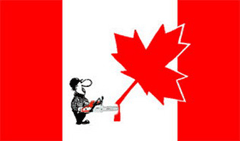
Lumberjack cutting down maple leaf (illustration)

Benefits flowing to U.S.

After years as the backbone of many coastal communities, the forestry industry is currently undergoing rapid change.

With the provincial government's blessing, corporations have broken the industry into pieces. Our valuable forest lands no longer provide benefits to the best advantage of all British Columbians. Instead of providing high-quality logs to B.C. sawmills as a matter of course, companies can now take millions of cubic metres of raw logs from both public and private lands and sell them to the highest bidder outside B.C. While some companies are closing profitable sawmills for lack of timber, others are making millions by exporting raw logs or have invested in the U.S. while their B.C. mills languish. All over the coast we're losing jobs, processing opportunities and other economic benefits.

The B.C. government has allowed corporations to impose long, more physically-taxing shifts in many workplaces. Under a contract the government imposed on our union in 2003, employers can unilaterally impose virtually any 40-hour a week shift schedule they like, even shifts up to 12 hours a day -- despite research showing that long working hours cause serious fatigue and accidents.

The province has also allowed companies to contract out more work, again contributing to higher accident rates -- in 2005, 43 workers died working in the B.C. forest sector. On the coast, most of them were in contracted-out logging operations. With our Forest Fatalities Summit in December 2005 and a Forest Fatalities Lobby in Victoria early in 2006, my union, the Steelworkers, publicized the carnage and pushed for action; the fatality rate has fallen but there are still far too many serious accidents, especially in non-union operations. The recent Ted Gramlich inquest revealed how unsafe work can be in non-union logging shows; the recent $297,000 fine levied against Weyerhaeuser after the death of New Westminster sawmill worker Lyle Hewer shows that our mills are also hardly as safe as they could be, either.

Tougher rules needed

Companies can now do what's best for their bottom lines and their shareholders without being required to provide maximum benefits to British Columbians. Steelworkers agree with citizens of our province; in addition to profits for forest companies, they want our forests to provide good-paying jobs, a wide range of economic benefits, support communities and help pay for quality services like health care, education and child care.

In our current negotiations with the coastal forest industry we are pushing companies for better safety standards and less contracting out. Recently we sent lobbyists from across British Columbia to fight for a halt to the flood of log exports so that more benefits can again flow to people and communities. We are pushing the B.C. government for tougher rules on log exports and safety, more B.C. manufacturing and more benefits to communities. In bargaining, companies want concessions that will mean that ever fewer benefits flow to communities.

We want to work with the B.C. public, our members and with reasoned employers to build a more secure stable and prosperous industry that provides a fair return to companies, citizens and our members. In spite of its problems, with a buoyant Asian market, overall the industry is in fact making money. Firms that export logs are extremely profitable. It's only fair that they share their good fortune with British Columbians.

To get there though, we will need strong support from people who live and work in our communities. B.C. coastal residents must tell companies they want more of the benefits to flow back to workers and communities. We need to let them know we want both industry and communities to flourish. We care about our industry and we care about our coastal communities' way of life. Today we are fighting to put them both on a more secure footing.

Related Tyee stories:

 [Tyee]

19  Comments:

Login or register to post comments

  • morechatter

    4 years ago

    How will more rules help?

    How will more rules help when no one is listening to the rules? Today the premier of the province openly commented on his disregard for the Highest Court of Canada and its ruling and is that not breaking the law or what and if so how will more laws help when this government is selective of which laws it feels meets its needs? We need our governments to give their focus back to the committees and the people that live in them and their cities and not big corporations as they have their marketing companies and lobbyist to do their bidding. Its people who need governments and small business and not big business. People vote in governments not big corporations and its big business that greatly influences governments decisions and thats scary and whats big business know about the regular guys needs nothing as far as I'm concerned and that is even scarier. We need government who plays by the rules is more like it.

  • Right to Bear

    4 years ago

    Out of Control on many levels...

    Good comments morechatter...!

    The forestry industry in B.C.is out of control. In areas such as the Coast, logging has been and still is clear cutting huge valleys and salmon streams. The large logging co.s are no less than raping and pillaging this beautiful area relentlessly. One need only go there to see this. It is Earth Abuse of the highest order.

    Now, Human Abuse... If the logging and processing is done by local communities only, and done in a way which is sustainable (No Clear Cuts), then the forests of B.C. would benefit, as well so would the citizens of B.C. The local communities need the work, and most of them deeply consider the future of their children when-ever they chop a tree down. This is the deep ecology ethic that needs to be encouraged in this abusive industy.

    This type of foresty is what the people of B.C. want, so why is it not being done...?? Industry is in bed with government therefore government is NOT looking out for the best interests of its people once again. This is reflected clearly by the B.C. forest Industry practise. We have a seriously compromised democratic system here in Canada, and it is getting worse... This in truth, is our biggest problem.

    Peace,

    Bear

  • Grumpy

    4 years ago

    $ by $

    Campbell and his Quisling crew are selling off BC at fire-sale prices to his corporate friends, with hopes of -deleted for fear of libel-.

    How can Campbell and his Quisling crew get away with it? The Asper press. Global/CTV strangle hold on the electronic media. CORUS radio and the likes of Bill Boring and other elitist radio hosts.

    Even the Tyee now censors any hint of -deleted for fear of libel-. And this is how Campbell and his Quisling crew get away with it. Evil is as evil does!

  • freebear

    4 years ago

    80 year old tree farms on forests!

    My concern about the coastal logging industry is that despite ebm, it seems to me that the plan is to harvest trees at younger ages (80-100 years old).

    In other words, besides protected areas that prohibit commercial logging, the remainder of the landscapes will be likely aged only as much as 100 years before they cut it down.

    No more old growth forest. Of course the criteria for coastal old growth has changed. Too many it means 300-1000 year old trees. To the province it is 180 years (may be wrong as it seems to fluctuate!).

    So when coastal old growth was being cut down in the past and the public was told the forests are being managed sustainably, it wasn't really because today you can not log that same volume of 300-1000 year old trees!

    Fence posts and 2 x 4's seems to be what this 'new' forest is and will be producing!

    As to raw log exports, I agree that they should be valued in this province and should have value added here, rather than some U.S. state.

    On the other hand, for those coastal First Nations that are attempting to establish forestry companies, provide livlihoods, and own source revenues; they may initially need to sell raw logs (would be nice if purchased by BC manufacturers of course) in order to raise capital to jump start the new business.

    The existing coastal forestry companies do not have that excuse!

  • freebear

    4 years ago

    EBM=Ecosystem Based Management

    Sorry I should have explained what EBM stood for!

    Ecosystem Based Management. In other words managing human use so that ecosystems maintain their integrity and resilience.

    Interesting this sory comes out today and there is also a news stroy about a possible forest worker strike. Coincidence?

  • paddy74

    4 years ago

    proactive vs reactive

    The BC Forest Industry is a classic example of BC politics, reactive to the quick and easy dollar, not proactively looking for the best long term solutions. This industry is continually hindered by the 'this is the way we have always done it' syndrome. As a former forest worker, I think the biggest challenge isn't so much management regimes, clearcutting vs selective, it is more the sheer amount, or AAC. I personally think it is disgusting that we are harvesting anything other than beetle wood at the moment, this creates a surplus of wood on the market that drives timber prices down - not to mention the considerable age class gap in merchantable timber. We have diminished old growth to the point we are pushing into the alpine to access old, slow grown trees. The forest doesn't belong to the taxpayer anymore, it belongs to the handful of companies who front the dollars and secure the commitment of access to BC's trees. It is a quick and easy dollar for the provincial coffers. I can already see Commercial Recreation folowing the same pattern - the companies are shaping the industry, the government agencies are just reactively agreeing, maybe revising a little to obvious flaws, but are clinging to the short term easy solutions, such as clinging to the rapidly approaching Olympics. Don't even get me started on the mutli-billion dollar road to nowhere, Intrawest really lucked out with that one.

  • boondocker

    4 years ago

    Log Sales

    Here's an idea for off-shore log sales: The government should value the log AS IF IT HAD BEEN PROCESSED IN BC. If the buyer is still willing to pay that price for it, then the seller should go ahead and sell it. The seller will then have to remit the difference between whatever price they initally offered the log for and the price that the buyer actually ended up paying. Government could then turn around and invest those new revenues in ways that will support BC communities and to create jobs for BC residents.

  • Fiat lux

    4 years ago

    The whole mess still boils

    The whole mess still boils down to fraudulent economic calculations where waste is accounted as "growth of the GDP", the destruction of jobs and communities as "productivity" and the sale of capital as "income", much, if not most of it, going abroad to service overcapitalized inefficiency, called "hi tech".

    Logging can be done in environmentally friendly and acceptable ways. Some of my neighbours, including next door, have and licenced with the highest environmentally friendly ratings while logging on their Crown owned woodlots.

    If anybody wants to write up on this, I'd be happy to supply the names and contacts.
    My address is

    Only serious, professional writers please.

    Ed Deak, Big Lake.

  • Right to Bear

    4 years ago

    No defininiton of EBM to date...

    Hey Freebear,

    "They" also haven't defined EBM. That is to be done in 2009 as I understand it. A little LATE I would say. So until than there is no protection for these forests. It is a real problem...

    Peace,

    Bear

  • paddy74

    4 years ago

    EBM sounds good in theory...

    I find these wholistic approaches often overlook the real source of the problem. BC lands are multi-use, and this does call for an integrated resource management approach, but I find they fail to give teeth to real world regulations that actually could make a difference. Larger machine free buffers around trails and watercourses, no more harvesting age class 9 (old growth is too vague in ecological terms), reduce the amount of annual cut, fewer breaks in stumpage for roadbuilding... and there are many more necessary steps to making the industry truly sustainable. Trees will keep on growing, it is the habitat we are destroying. Just look at the Mountain Caribou and Spotted Owl. Excess cutting of old growth Douglas Fir stands is to blame for that, not hikers, snowmobilers, or atv's.

  • Right to Bear

    4 years ago

    Caribou and Owls...Pain in the arse to industy

    Good post brother.

    On the issue of Spotted Owls and Mountain Caribou, the government has put a "hit" out on all predators in B.C. to ensure the survival of the Mountain Caribou. This was late last year, and the hunting community is in full support of it, as it will increase their annual yields of moose, elk and so on. Twisted reasoning...Less wolves, more moose. That is what the hunting community has been doing in Alaska for 7 years...sic.

    Understand, the issue of Mountain Caribou loss is 98% on the logging industry, yet "the powers that be" are shirking responsibility on the wolf...again. We are losing species every day because why... Because we do not hold them dear enough. Industry doesn't care as it is all about profits, and yes, the voted in government is letting them away with it, and in fact, encouraging them.

    The logging industry isn't any different than mining or oil\gas industries; they do not want an endangered species to hold them up in court for 2-3 years. Time is $$$. If industry didn't care about court costs on this issue, than the almighty Grizzly Bear would be on the endangered species list right now.... They are not. Reason: They would just be another thorn in industry\governments side. After all, they already are having to painfully deal with the Spotted Owl and the Mountain Caribou…hmmmmm No indeed, lets just stop-gap the caribou loss by shooting all the predators in B.C. Reality, this is simply a strategy to shut down\up the environmentalist and the public who care about the predators in B.C., in order they can just keep on loggin'. We will see if this works...

    Really, the way it is now, nobody wins, not the people, the forests, nor the animals, or the Earth...

    These logging“giants” practice a self-destructive and short sited approach to our existence; we need to implement a sustainable, caring approach soon, before our own “existence” is in past tense too.

    I agree Ed, there are approaches to logging that is sustainable, and not abusive to our Mother. And I know people too who are implementing this approach today. There is no choice…this is where we need to focus our energy. Exploiting the Earth is archaic. Today with the information that is accessible to us all, now or soon to come will be no excuse acceptable to abuse the Earth. Humans need only to find a way to harmoniously work within the Earth and her laws, both now and in the future... It is too late to compromise.

    Peace,

    Bear

  • Fiat lux

    4 years ago

    One of these days people may

    One of these days people may just realize that wealth can only be taken and the presently used definition of economic efficiency is a crime. I hope it won't be too late for the human race as well!

    Ed Deak.

    British Columbia Field Ornithologists take a position
    on the fundamental conflict between economic growth and biodiversity conservation

    At their Annual General Meeting in Lillooet on 26 May 2007, the BC Field Ornithologists (BCFO) adopted a position on the fundamental conflict between economic growth and biodiversity conservation. The BCFO addresses the study and enjoyment of wild birds in British Columbia through research and conservation efforts to preserve birds and their habitats.

    The timing of the vote was opportune as Birdlife International announced the previous week that 22% of the planet’s birds are now at increased risk of extinction. A total of 1,221 bird species are presently considered threatened with extinction and an additional 812 species are considered Near Threatened, an increase of 28 species from last year. In British Columbia, 43 avian taxa are considered extirpated, endangered, or threatened and a further 48 species are of special concern.

    Dr. James Ginns, BCFO President, noted that “Our position statement is precedent setting in that the BCFO is one of the first conservation organizations in British Columbia to focus attention on the causes of biodiversity declines rather than simply focusing on the symptoms as most environmental organizations are doing today. Unless the causes of the problem are addressed, biodiversity declines are likely to continue.”

    One of the causes for these declines is economic growth. The economy grows by appropriating natural capital from the economy of nature (ecosystems) and using it for the human economy. As the human economy expands it removes resources, displaces healthy ecosystems, and degrades remaining ecosystems with waste. Thus, economic growth reduces the quality and quantity of bird habitat when it’s converted as throughput to the human economy. It’s this growth that tends to swamp any gains made through conservation and policy efforts.

    Similar positions on economic growth have been sanctioned by a number of professional scientific organizations in North America including The Society for Conservation Biology, The United States Society for Ecological Economics, The Wildlife Society, and The Center for the Advancement of the Steady State Economy.

    The BCFO position explains not only the fundamental conflict between economic growth and biodiversity conservation, but identifies an alternative: the steady state economy.

    There are more details on the BC Field Ornithologists web page: http://www.bcfo.ca/index.php.

    -30-

    Contact: Neil K. Dawe, R.P.Bio. 250-248-0150
    E-mail:

    _

  • Right to Bear

    4 years ago

    Exactly Ed...

    Exactly Ed. Thanks for the site my friend...

    Peace,

    Bear

  • munroe

    4 years ago

    Good column, Brother Routley

    I really feel for those in your industry with these blind mice in Victoria. The singular focus on what the owners and contractors want has always cost the working class dearly - in every way including their health and lives.

    My sense of it is there are two tendencies in the right's response. The first is (as always) to blame the victim, increasingly pushing that safety is everyone's concern by which they mean its not the contractor's. The second way is to wring their hands about youth and inexperience, without really addressing the obvious training needs. The solution they seem to have hit on is to appoint a failed Liberal MLA, Roger Harris, as forestry safety Czar.

    Much of my experience in safety comes from construction. As a safety rep on a major project, I watched what happened when the overtime increased dramatically. Injuries went through the roof. There was a lock step between increased hours and lost time.

    Keep up the struggle, my friend, as I know you will.

  • Frank

    4 years ago

    Liberals

    I kinda miss the Liberal-paid media-monitors we used to have here :-)

  • munroe

    4 years ago

    Liberal monitors

    It is a shame, but what with court appearances and all.....

  • RickW

    4 years ago

    Campbell: The Grant Devine of BC

    http://en.wikipedia.org/wiki/Canadian_political_scandals#Saskatchewan
    The Socreds re-branded themselves "Liberals", and with a cleverly orchestrated campaign that made the Fast Ferries out to be some sort of scandal, (whereas in fact, the workers and the technology were snapped up by Austal USA in Mobile, Alabama:
    http://homepage.mac.com/juanwilson/islandbreath/%20Year%202007/09-access&transport/0709-01SuperferryLaunch.html which ended up building ships virtually identical to the Pacificats)
    the "Liberals" ousted the NDP, and began their "Devine-ation" of BC. And, just as with the Devine government, the scandals began emerging in their second term. But of course, we cannot read much about them, because "they are before the courts". How convenient for the media, as well as this government!

  • freebear

    4 years ago

    EBM is being defined as we speak

    Hi Right to Bear.

    Actually EBM on the coast is being defined right now by First Nations, ENGOs and Industry.

    A lot of the defining is being done through trial logging operations by industry and First Nation forestry activities.

    Unfortunately I do not think they are going far enough in terms of, as was pointed out by Paddy74, the Annual Allowable Cut is not being reduced enough (we will still be logging unsustainably).

    Also 'we' will be harvesting at such a rate and volume that it is unlikely that any landscape (unless a protected area) will have trees over 200 years old and maybe only as old as 80-100 years.

  • Right to Bear

    4 years ago

    Running out of Time and Forests...

    Hi Freebear :-)

    Always good to hear from you, and thanks for the note. I was unaware of the present situation going on which will determine what EBM looks like. I understood 2009 was the year to define EBM. Good it is being worked on, but now it worries me as to what EBM will look like when it is done. What I have witnessed is there is not enough being done to create a sustainable situation for the Coastal Forestry projects yet, and time and forests are running out. There are big gapping holes of "empty" everywhere in these Primordial Rainforests and "Old Growth" sounds like it is getting younger... Pathetic.

    From what I see, the GBR is a perfect example of a land that has been protected in order that it be logged. A strange twist where the land is actually "protected" against being protected. Is this what "protected" look like now. Is this the new standard; Industry trumps protection?? Clearly, the tail is wagging the dog methinks.

    The GBR is so special that it should be rated with the highest level of protection allowable. A little looser, but not so different than the Kutzamateen. As as sits now, the ENGO’s efforts have been pathetic. Good people who made bad mistakes…Clearly the ENGO's have done a poor job so far at defending the GBR. They sold out on too much in order to get this deal "wrapped up", and now they are trying to renege on it...

    At this point Freebear, the coast is certainly a sad sight. My hopes, like yours, are for change towards the sustainable approach, but so far I see no view of this in sight, and we are running out of time and forests…

    Peace Freebear :-)

    Bear

    • The discussion for this story is closed. No more comments can be added.