

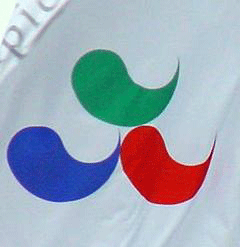
Today the Paralympic flag will be raised over Vancouver city hall.
There’s a history to the current design, which speaks of the uneasy, unequal relationship between the International Paralympic Committee (IPC) and the International Olympic Committee (IOC).
The Koreans came up with a flag that looked much different when they unfurled a new Paralympic banner for the 1988 games in Seoul. However, the IOC complained that flag was too similar in colour and design to the renowned Olympic rings (and we all know how sensitive the IOC is when it comes to protecting its image). One of the major opponents of the Paralympic flag was Canadian Dick Pound. Further collaboration between the IOC and IPC was halted until the flag was changed significantly to what you see today.
The story of the flag represents a history that took a controversial turn 20 years ago after the International Paralympic Committee entered into a close relationship with the International Olympic Committee. The teaming of the IPC and IOC went high-profile after the first wheelchair track demonstration at the 1984 Olympics in Los Angeles.
Prior to 1988, the Paralympic and Olympic games were hosted in completely different venues, different cities and even completely different countries. However, the 1988 games in Seoul marked the first time Paralympians had the opportunity to use the same venues as their Olympic counterparts. Such cooperation has been a doubled-edged sword for the International Paralympic movement and its athletes.
Ideal team?
At the beginning, the teaming of these two big international sports organizations seemed like a natural fit, removing the obvious duplication of services. Plus the IOC offered large monetary incentives to the Paralympic movement, access to lucrative sponsorships and other trickle-down benefits of being associated with the world’s largest sporting organization.
But the IOC has pushed for the Paralympics to change in many areas.
Specifically, in the field of play, the IOC has advocated less inclusion and more competition. The IOC has directly influenced the disability-based class system which was originally designed to group athletes with similar levels of disability so they could compete on an equal basis.
While the IOC would argue the class system created confusion in many sports, reducing the number of classes has stopped certain levels of disability from competing altogether. Class groups have morphed, with the less functional athletes being forced to compete with athletes with higher function.
The increased competitiveness has come from direct pressure from the IOC to make the Paralympics more marketable as a competitive sport event. The IOC sees the former class system as being too complicated a concept for the average Olympic TV viewer to grasp. The class system also complicated event management in terms of the number of medals being given out per event; a less complicated class system reduced the overall number of medals being awarded.
There are many arguments for and against an "open" class system. Certainly, in a true competitive arena the best athletes should rise to the top. However, in the Paralympics not all athletes are created equally; a swimmer with no legs cannot compete fairly against a swimmer missing one foot at any level. Why should the swimmer with no legs be unfairly penalised by having to compete against athletes missing a foot?
Sharing the controversies
In terms of infrastructure, the Paralympics might seem to be in a win-win situation. However, when the Paralympics were a completely separate entity, no one demanded a highway expansion, a new transit system to the airport or even a new permanent stadium. You would be hard-pressed to find any remaining indication of the event at the last autonomous Paralympic venue in New York (located near Nassau County Colosseum on Long Island). The 1984 Paralympics used existing structures and temporary facilities, not out of political correctness, but out of sheer budgetary restraint and long before anyone thought of a "sustainable" Olympics.
Indeed, prior to forming a relationship with the IOC, the Paralympics were possibly the "greenest" international multi-sport event on the planet. The same can't be said for the Olympic movement, which in B.C. finds itself again miring a government in controversies about environmental and fiscal messes in the making.
The Paralympics joined with the Olympics partly in the hope of reaping greater exposure to world TV audiences. In this, the Paralympics have failed miserably. Whether TV audiences find the sight of a wheelchair track event, in comparison to a major league baseball or hockey game, purely unappealing as sporting spectacle or because of a general, societal lack of acceptance of disability is hard to determine. However, the revenues generated from TV contracts (a major source of funds for the Olympics) have yet to become a reality for the Paralympics.
Equal or not?
That's not the only inequality likely to surface as the 2010 Olympics and Paralympics are held here.
None of the Paralympic events will be taking place in Vancouver. At this time all Paralympic events will take place in the Whistler area, hardly equal access to venues and capacity audiences. You will have to travel the two hours to Whistler to catch any Paralympic event.
In a recent 2010 public display held at the Vancouver Art Gallery and sponsored by a major bank promoting Canadian athletes, the Paralympic section, unbeknownst to the volunteers present, featured a massive photo of an American wheelchair athlete.
Granted these are small issues in light of freeway expansion, apparent heightened security threats, abuse of migrant workers and the like. However, the relationship between the International Paralympic Committee and the International Olympic Committee serves as a measure of how people with disabilities in general can often lose sight of their own agendas in order to fit in with society at large. One might wonder why the Paralympics are associated with Olympics at all.
Ian Gregson competed for Canada at the 1984 and 1988 Paralympic
Games. His book Irresistible Force: Disability
Sport in Canada is published by Raincoast books. He currently manages
the web site at 2010watch.com. ![[Tyee]](/design-article.thetyee.ca/ui/img/yellowblob.png)
Read more: 2010 Olympics











Tyee Commenting Guidelines
Comments that violate guidelines risk being deleted, and violations may result in a temporary or permanent user ban. Maintain the spirit of good conversation to stay in the discussion.
*Please note The Tyee is not a forum for spreading misinformation about COVID-19, denying its existence or minimizing its risk to public health.
Do:
Do not: