Opinion

Nasty Business

Hollinger's Radler was small fry in sea of CEO sharks.

By Murray Dobbin, 7 Oct 2005, TheTyee.ca

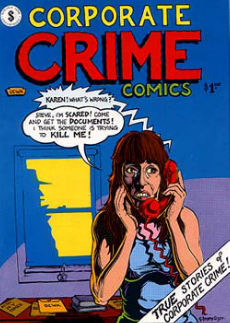
Corporate Crime

"Capitalism is the extraordinary belief that the nastiest of men, for the nastiest of reasons, will somehow work for the benefit of us all." - John Maynard Keynes

Any number of recent developments in the corporate world could have prompted my memory of this quote by one of the most famous capitalist economists in history. But in fact it was David Radler pleading guilty to fraud which actually did the trick. It would be difficult to find - even in fiction - a capitalist more deliberately and gleefully nasty. As a result, it is equally hard to imagine how anyone, even his long time partner and capitalist windbag extraordinaire, Conrad Black, could be more deserving of jail time.

But even these two millionaire miscreants are bit players - cartoon figures, almost - compared to the parade of really big-time CEO liars, cheats, crooks and sub-criminal psychopaths in the US who ruined the lives of hundreds of thousands of employees, retirees and small shareholders. And far from being a few bad apples, these societal misfits are so rotten they simply make the bad apples look a little better by comparison. It's the corporate culture itself that's rotten.

What is notable is that despite the exposes and jail sentences, nothing has really changed in corporate culture. It is clear that it will never change until citizens, through their governments, force it to. The modern corporation is what we have made it, over decades, through our laws and regulations. And it is naive to expect that it will voluntarily transform itself. As Henry Lloyd, a US anti-corporate organizer of the last century put it "We are asking them to not be what we have made them to be. We have put power into their hands and ask them not to use it as power."

Savage capitalism

In this era of savage capitalism, the rare ethical corporation is too often a sitting duck for its ruthless cousins. One such cousin was the Amerimex Maquiladora Fund in the US which bought up good companies - with high wages, good pension funds, and capital for funding growth - and moved their operations to Mexico. This saved the companies on average $17,000 per employee and temporarily drove the share prices up. Then, after three to eight years, they sold the company for a huge profit (after draining the pension and capital funds).

The roots of this perverse corporate culture - which, if you care, is actually bad for capitalism - go back to the mid-seventies when government intervention in the economy got a bad name. The temporary failure of Keynesian economic tools gave prominent US capitalists the opportunity to move against the post war political consensus which included social programs, tough regulation, fair corporate taxes and the promotion of full employment. To attack this consensus they established a score of right-wing think tanks which then targeted the media. And they were assisted by key figures in academia.

One, of course, was Milton Friedman, of the Chicago School of Economics, the most prominent promoter of neo-liberal economics. But the immorality of the new order was only implied by Friedman. It was two of his fellow professors across the campus who made it explicit. Frank Easterbrook and Daniel Fischel wrote that, when it came to making profits, not even the law should be a barrier. In short, the two men (Easterbrook has also been a federal appeals court judge for two decades) argued that CEOs actually had a fiduciary duty to break the law, if it was profitable to do so. This included anti-trust laws, corruption, polluting the environment, price-fixing, breaking labour laws, and bribery. Any fines - if you got caught - were simply the cost of doing business.

Is it any wonder that so many modern CEOs can barely grasp the notion of ethical behaviour, let alone make it the operating principle of their businesses? Typical of this betrayal of ethics is CEO compensation in Canada. CEO's sense of entitlement has gone to such absurd heights that even those executives who have nearly destroyed their companies through sheer incompetence walk away with eye-popping severance packages.

Paid for his crimes

The most recent and outrageous Canadian example is John Hunkin, until his recent resignation the CEO of CIBC . That bank just agreed to pay a $2.5 billion (U.S.) class-action settlement with Enron investors. The enormous payment related to deals made on Hunkin's watch, which allowed Enron to disguise the true state of its finances. His punishment? Hunkin walked away with $67 million.

Of course it is not just Hunkin and other CEOs - it is the boards of directors who sign these criminally negligent contracts. And this kind of legal raiding of corporate coffers by often laughably inept CEOs has been going on for at least fifteen years. In my 1998 book The Myth of the Good Corporation, I referred to a Globe and Mail study of the 100 top paid Canadian CEOs in 1996. Of the 22 who delivered decreased profits in that year, only four received pay cuts. The rest got increases, several in the range of 150 percent. Sixteen received bonuses.

This is simple corruption, for surely this is a perversion not only of shareholder rights but of the merit principle preached by these same executives to their employees. But in the corporate world, as in the natural world, rot does not excise itself. It just continues until someone acts. The solution is ridiculously simple. We made the laws that allowed the rot. We need to change them. A small but symbolic start would be a law on CEO compensation.

Murray Dobbin's 'State of the Nation' column appears twice monthly on The Tyee.  [Tyee]

26  Comments:

Login or register to post comments

  • kurt

    6 years ago

    Comments on "Nasty Business"

    The lack of harsh sentences for corporate crime (so-called white collar) is outrageous, although the Americans are starting to get serious about cracking down and slamming them hard. This crime is not a new phenomena, it's been with us forever, but it's getting worse.

  • seanjones

    6 years ago

    Let's start by changing the limited liability laws for shareholders. If shareholders could be held personally responsible, beyond the value of their investment, for corporate malfeasance perpetrated by their companies, the behaviour of corporations would change.

    The only way to get evil people to behave morally is to compell them to.

  • Grumpy

    6 years ago

    Where is Erwin? I thought he would rush in and defend Radler. Capitalsim, as we know it, will ultimately fail, simply because we do not have the resources to sustain it. The pure greed which our system operates on will collapse, then what?

    The outlook is very bleak and I'm afraid of the chaos that will follow. We are living in dangerous times, being led by nutters!

  • alexwh

    6 years ago

    This is an excellent essay on the Radler mess. There is no reason why it should answer the question I will ask here: How could you David Radler? To begin with I think I understand some crimes of passion and even bank robbery. But I have a problem with what motivates people to commit white collar crimes like Radler's. Having photographed David Radler many times, even for a an annual report, I came to like the man's paradoxical tastes. He always drove a Cadillac but his office building was really a dump. His office had photos of American jet fighters, framed snapshots with the likes of Richard Nixon and Spiro Agnew (and yes someone will point out that both were crooks!). I was present during a delightful interview with Vancouver writer John Lekich. Lekich and Radler talked about baseball. Radler even talked of his paper route as a boy. In short I like the man. Since he didn't steal my money I don't have a feeling of financial betrayal. I simply cannot understand the man's motives. I feel betrayed because of that lack understanding. Radler did make, in my opinion, an excellent judgment call and I damn him for it. He took away John Cruickshank and sent him to the Chicago Sun Times. This was the Sun's loss and ultimately our loss. As Editor-in-Chief, Cruickshank gave free reign to the Tyee's editor David Beers , then editor of the Vancouver Sun's Saturday Mix, to transform a moribund Saturday magazine into an exciting one. How could you David Radler?

  • BC Mary

    6 years ago

    Capitalism has its winners but it also requires losers. Lots of losers.

    Capitalism means giving as little as possible and getting as much as possible.

    Capitalism could never continue without a mighty propaganda arm making free-dumb and de-mockracy sound realistic while social responsibility is made to sound subversive. CanWest, which owns most of B.C.'s newspapers and TV stations, does its part faithfully.

    "Capitalism is the extraordinary belief that the nastiest of men, for the nastiest of reasons, will somehow work for the benefit of us all."
    - John Maynard Keynes.

    Thanks for this nudge, Murray Dobbin.

  • jesterjogger

    6 years ago

    Grumpy
    If you think things are bad here with gordo and his gang of corporate thieves just be glad you don't live in the US. The level of corruption and madness there is unprecendented.
    Today I heard that the mad-man bush was, according to him, told by god to invade Iraq!!!Good grief, what's next teaching christianity voodoo in public schools.
    And how come these so-called christian types are so eager to go out and murder innocent people? I thought that the bible frowned upon that activity.
    Note that the bc liberals threw a party last year for the national conservative party who themselves sent the dark one, john reynolds, to the republican national convention in 2004.
    Are these right wing-nut fascists actually invading aliens who have disguised themselves to look like human-beings?

  • cobbeth

    6 years ago

    I guess you forgot to mention that the US government was extremely critical of the Amerimex Maquiladora Fund and that a Mexican bank's financing of the fund nearly derailed NAFTA. But that would involve praising the US...

  • Bailey

    6 years ago

    This is a good opportunity to talk about alternatives. What could we do to replace the criminal version of capitalism we seem to have allowed our leaders to foist on us?

    We need an economic system, based on theories that achieve balance, provide for all the needs of all the humans, protect their true environmental capital, permit personal achievement to be rewarded, allow people to pursue their dreams without oppressive interference. And given the growth rate in the population, it had better really promote increases in production.

    So what would do all that?

  • BC Mary

    6 years ago

    Please, Bailey, no more "increases in production."

    Otherwise, I give up: tell us (quick!), what would allow us to provide for all the needs of all the humans, for cryin' out loud?

  • Bailey

    6 years ago

    I don't claim to know, I was asking for ideas.
    We need something.

    As far as production goes, until we stop producing humans, we will have to produce the means of sustaining them.

    Barring some sort of catastrophe.

  • KWD

    6 years ago

    What would do all that? If economic theory starts with the (faulty) premise – if profit is good, obviously more profit is better – microanalysis of economic systems will prove to be a dead end.

    However, since folks have little interest in digging deeper into social constructs, and they continually avoid examining their thinking – how it is directly linked to pleasure and pain, how it is being manipulated to comply with the wishes of those that seek to “manufacture consent”, and the fact that it is our distortional thinking (the way we are trained to think) which is essentially at the heart of all sociopolitical, economic and environmental woes – examining economic theory is as good a place as any.

    It allows folks to postulate theories structured on the premise that “economic efficiency” actually exists, and profit (which is essentially the belief that it is possible to create something from nothing, and to do it endlessly) is acceptable so long as it’s reasonable (whatever reasonable means).

    This is not to say that an economic theory that tries to achieve efficiency by incorporating the laws of physics isn’t workable; it’s just that implementation requires the creation of a whole new mindset.

    What would do all that? Changing one economic theory for another is only part of the remedy, a very small part; environmental capital, human rewards and dreams need to be redefined.

  • Bailey

    6 years ago

    I'm not altogether sure I'm following all that, but at least I don't think economic theory actually does start with profit.

    For our purposes we should start with the creation of a medium of exchange; a way to achieve balance, and allow us to specialize while still fulfilling a wide range of needs.

    If changing one economic theory for another is of small moment, why change theories at all? Perhaps all that's needed is a change in control mechanisms.

    There's always been criminality, probably always will be, given human nature. What seems different lately is that it's no longer punished. The criminals are changing the laws to exempt their crimes. The governments seem to be co-opted by these psychopathic corporations and the distorted reasoning that arises from their structures. Huge amounts of money are being transferred without a commensurate transfer of value.

    What about this; change corporate charter rules to reflect social values, re-establish legal sanctions for corrupt dealings, tie profit to the cost of production, make excessive wealth something to be embarrassed about. In short, slowly rebuild the current economy to a higher standard.

    Do you think that would do it?

  • scylla

    6 years ago

    Dobbin has written a fine article and the tenor of the postings make it clear we all know what the answer to the problem is - political power. That answer's been around a long time:

    Quote:
    "One of the penalties for refusing to participate in politics is that you end up being governed by your inferiors." Plato (quoted by Orwell)

    On another TYEE thread I offered the comment that having been burnt once, I'd not join the NDP again. It may be that I've allowed personal pride to override common sense.

    So I'll throw this back at BC Mary, who is looking for solutions. Do you think that if enough of us joined the NDP, we could get the unions out of its backrooms? The checkoff of union dues has NOT provided the financial muscle for winning a propaganda war with the Corporations and their political toadies. Word of mouth is a far more effective political tool, which can be delivered only by dedicated people.

    Don't get me wrong. I don't mean we should stop supporting Labour, that would be insane. I'm just saying that unions should not control political parties, any more than should religions, corporations or governments. The role of gov't is, among other things, to mediate between all parties so that nobody gets an upper hand. We cannot logically complain of the obvious hookups between the corporations and other parties if we do essentially the same thing ourselves.

    After all, it's the public we're appealing to, and believe it or not, most people are fair-minded and not stupid.

  • KWD

    6 years ago

    Some interesting suggestions Bailey. Do I think that would do it? Economics, excessive wealth and embarrassments aside, perhaps you could elaborate on “social values”. Whose values? Which society? Yours? Mine? Conrad Black’s? Enron’s? Paul Martin’s? Who decides?

    Apologies for the fact that I’m not getting back to you in a timely manner. I’ll be spending a good part of the next few days giving thanks for a great many things, not the least of which is the privilege of being able to access alternate media such as the Tyee, but also the fact that my corner of the planet has, for the moment, escaped major climactic and social catastrophe and the fact that I’ve lived to see another day without police guarding entrances to every transportation facility and the fact that mushroom clouds haven’t appeared on the horizon …

  • Bailey

    6 years ago

    Thanks. I think social values can be somewhat more objective than that. I wouldn't actually call what passed for culture at Enron a value, social or any other kind.

    No. Let's say you narrow it down to things all people require to thrive. You could start with Maslow's pyramid. Air, Water, Food, Shelter, Family, etc, on a descending scale based on how quick the lack of it will kill you. Those are pretty universal values.

    Then add in more intangible things health, human rights, civil rights, access to meaningful work. access to meaningful amounts of money.

    Things all need to be alive with dignity and meaning.

  • Bailey

    6 years ago

    Sorry if that was a bit obscure. There's anice little piece in Wikipedia about Maslow's hierarchy of needs.

    http://en.wikipedia.org/wiki/Maslow's_hierarchy_of_needs

  • scylla

    6 years ago

    Sorry, folks, Capitalism is only an economic system, not a political system. On top of that, it is the first - since everyone cannot be a farmer or subsist on wild bounty, a situation which has existed for millennia - to provide the potential for the hoi polloi such as ourselves for genuine economic freedom.

    I've yet to see anyone suggest a viable replacement.

    The means to control Capital, to ensure it works for the good of all, is provided through the Democratic system. This offers us a choice - in our modern times - between forms of Socialism and Fascism.

    Thus, the means to control the excrescences of the neoconservative Fascist corporatist (sorry to slip into jargon) are available to us simply because contrary to appearances, the Corporation is constructed merely of slips of paper, fiats bestowed upon it by OUR governments.

    Quote:
    “Fascism should more properly be called corporatism, since it is the merger of state and corporate power.” —Benito Mussolini (cited by Lewis Lapham in Harper's, January 2002)

    Since the debate above appears to involve a philosophical approach for a mobilisation of a public ethos, at the risk of incurring more wrath from MC Mary for "sweeping generalisations" and outside of writing a book to avoid them, let me venture this:

    Bailey suggests "Maslow's hierarchy of needs" as a starting point. From my admittedly biased perspective, this is merely another justiication for the NeoLiberal's consumerist approach to human values, (a la Leo Strauss) placing the individual's creature comforts ahead of the commonweal.

    The simple fact is that the human ego is that of a child, always seeking self-gratification, and never satisfied. OTOH, it is my understanding that all the great religious thinkers have stressed the suppression of the ego though self-denial, preaching the mastering of control over this self-gratification through service to others - which of course, is a key concept in Socialism.

    Quote:
    Self-transcendence refers to connecting to something beyond the ego or to help others find self-fulfillment and realize their potential.

    Although Maslow tentatively placed transcendence at the top of his hierarchy, this element has been discounted by most modern psychologists because they feel it really belongs in the domain of religious belief.

    Since it seems we've been betrayed by modern Christianity, in its partnering with economic elites, (always a problem with religions), it appears to me that if we're looking for a value system, that of service to our fellows is a good place to start, since it recognises we are indeed a herd animal, and most people subscribe to the old saw "What comes around, goes around."

    Sorry for the generalisations BC Mary.

  • scylla

    6 years ago

    As usual, got something backasswards. It's "What
    goes around, comes around"

  • Sunny Samson

    6 years ago

    Interesting, passionate discussion. I'm currently reading a book I'd urge Canadians (and any interested Americans) to pick up (just head over to your friendly local library and reserve it, or reserve it online from them). It's called The Canadian Revolution, From Deference to Defiance (and back again, I'd say) which chronicles a whole bunch of different things that occurred in Canada from 1985-1995. Although it was written in 1995, it reads like it was written yesterday. It's the most enlightening discourse on where our country (and we people ...wee people?)are headed and why.

    Oh yes, it's written by Peter C. Newman, someone whose thoughts and general stance on business and politics I thought I generally knew. Not, not at all. This book should be a companion read for every business, poli-sci and history student in Canada. Want to know why we're fast becoming Maquiladora North? Want to know why business is politics and politics is business -- in your very corner of the world, well, I won't give any more away.

    And, best of all, he's a great (and funny) writer. No nodding off here. I'd just finished reading his autobiography at the urging of a friend (before the Mulroney bru-hah-hah arose), and could hardly put the book down. In it, he said he thought that The Canadian Revolution was his best book (out of the 30 or so he's written). I can see why he thinks that. So, grab it from your library, or better yet lay down the money at your local bookstore if you can. It's worth it.

  • BC Mary

    6 years ago

    About the New Democrats, scylla. You ask:

    Quote:
    Do you think that if enough of us joined the NDP, we could get the unions out of its backrooms?

    You might as well ask if we could teach the world to sing in perfect harmony. I wish.

    Although I have never belonged to a union, I'm profoundly grateful that there are unions. It's repugnant to think of naming them as undesirables. (That'd be so WalMart, wouldn't it?)

    Me, I'm concerned about the electoral warp caused by block voting. Why isn't there the same outcry against the effects of David Basi's ability to shift the electoral process by means of block voting?

    At least, within unions, the membership gets to vote as they please.

  • scylla

    6 years ago

    What makes you think I'm anti-union? I can give you all kinds of reasons we would be fools not to support them however we can.

    But I don't want them in political control any more than I want Walmart or Brascan. Nor do most people who know anything about politics.

    Sorry BC Mary, the unions are the albatross tied to the Party's neck. That's why the only times it can get elected are when the carpetbaggers become so arrogant and so in-your-face the electors just want to see them gone.

  • BC Mary

    6 years ago

    Scylla, nothing in Nature is perfect. And union members are entirely free to vote as they please in any election. To portray them as robots, each voting as ordered, is really awfully CanWest, isn't it? (Hey. You're speaking to me again!)

    Unions in political control? You mean, unions make a political donation to New Democrat's coffers? Do you also advocate that no corporations may donate to the LINO coffers? Lest it gives them political control over what the sitting government does? Ha ha ha ha ...

    I'm not in the least afraid of unions. What I fear is block voting of the kind which ousted a sitting M.P. (Herb Dhaliwal), for example. Now that is what you can certainly call political control. It's also such arrogant and in-your-face control (as in "We don't give a damn about your democratic system") that I just want to see them gone ... to trial.

    I hope you are supporting the B.C.T.F. right now? And Media Democracy Day on 22nd October, too, eh??

  • allan

    6 years ago

    I realize that David Radler is small fry, but his conviction, especially for anyone who has met him in a situation where he is boss and they are (lowly) employee, is unlikely a dieappointment.

    We can also take some pleasure in the fact that he also turned rat and is now assisting at gnawing away at ol' Tubby's withering defence.

    I surely hope that somewhere in Ontario aging former employees of Dominion Stores get to dance a jig over this turn of events.

  • scylla

    6 years ago

    BC Mary, you delight in accusing me of things I've never said OR implied.

    You had better learn your history, or start using Wikipedia before you make rash statements.

    The NDP was formed in 1961, as a coalition of the CCF and the CLC. The idea was to create an openly labour-friendly Party which could win at the polls, using checkoff dues for the advertising necessary to win a Federal election.

    However many uncommitted votes the advertising has yielded, one can only guess, but it is for sure that union leadership has never delivered the votes votes of its membership, otherwise we would have had an NDP Federal win by now. Thus, as you say, the average unionist thinks for him/herself. And so we see the sad situation we have today, since it is clear they have poor "thinking" abilities, perhaps too dependant upon your friend CanWest for info.

    IMHO, the blame lies with union leadership.

    In return for checkoff dues, unions were given the right to seats on Provincial Councils (I'm not too sure how it works Federally). On these Councils, which analyze resolutions from Annual Conventions (among other policy matters), they have a major say in how Party Policy will affect their respective industrial sectors.

    It was because the IWA merely parroted pro-COFI
    TFL-protective forest policy that after seeing this in action, I quit the NDP. If Harcourt had been successful, I may have rejoined.

    The bottom line is, BC Mary, that Government is supposed to be a mediator and regulator of Policy that ensures all sectors of society are managed for the common good, and not just for one sector, such as has happened with the overwhelming Grit and Tory support for the Corporation.

    Now, try and twist that one around - surely you can do it better than our trolls?

  • BC Mary

    6 years ago

    scylla: this is ridiculous. Finger-wagging, for god's sake. And your style of trying to hurt anyone who (you think) disagrees with you. Have you noticed how often you leap to that conclusion, only to be mistaken? You're sliding into Sirj and Erwin territory.

    "My friend CanWest"? ... I should "try and twist" something around? ... and so the discussion is lost.

  • scylla

    6 years ago

    Here, just for you, BC Mary.

    Schank's Law

    "For some people, failure to comprehend is the beginning of understanding. For most, of course, it is the beginning of dismissal."

    • No best comments selected by an editor for this story yet. To see all comments, click the All Comments tab, above.
    • The discussion for this story is closed. No more comments can be added.