Opinion

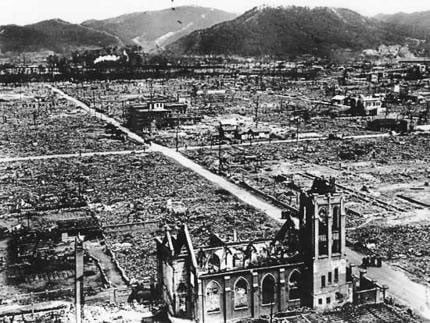
Revisiting the Hiroshima Horror

Did US have to use the Bomb? And wipe out Nagasaki?

By Rafe Mair, 8 Aug 2005, TheTyee.ca

Hiroshima

On Saturday, it was the 60th anniversary of the bombing of Hiroshima – tomorrow it will be the same anniversary of the bomb on Nagasaki. Over the past few days, there has been a lot written and said about these bombs and whether or not they were justified.

One positive point we must make is the horror was so great that no one has dropped one since. The continuation of humanity depends on the lessons of 60 years ago being remembered.

When making judgments, it’s critical that one goes back, as best one can, to the mood of the moment.

In August 1945, the worst war in history was ending. It was not only a soldier’s war but one where the public bore the brunt of the terrors of bombardment. The public had been inculcated with extraordinary doses of propaganda. As the Germans had de-humanized the Jews, so Americans – and Canadians – had done the same to the Japanese. They were yellow slanty-eyed little bastards who couldn’t do anything original and could only copy. They had weak eyesight which would not allow them to become decent aviators. Many an American found out that the Japanese could be very innovative indeed and, in their marvelous war plane, the Zero, could fly very well too.

Troubling questions

To this sense of contempt and hatred was added the horrors of the war practiced Japanese style. The treatment of China, especially in the Rape of Nanking, by the Japanese was unbelievably wicked. The Bataan Death March of American prisoners in the Philippines was indescribably brutal. The prison camps were inhuman. This added to the American hatred.

The presence of the atom bomb wasn’t known to the public so, in the summer of 1945 after the European war was over, people generally believed that the taking of the Japanese Islands by force could cost up to a half a million American lives. If the decision whether or not to drop the bomb was left to the American public I doubt that more than a handful would have shown any mercy. In fact, neither the public in the UK nor in the United States had any qualms about the fire bombing of Hamburg, the destruction of Dresden or the flattening of Tokyo.

President Truman, who didn’t himself know anything about the bomb until he became President on April 12, 1945, ordered the bombing and said later that he didn’t lose a moment’s sleep over it.

There are, however, some troubling questions.

Why weren’t the Japanese shown the power of the atom bomb by detonating it over the ocean?

There are two answers given. First:What if it didn’t work? Secondly, the Americans only had two bombs.

A more serious question is this: With the Russians entering the war, by the Yalta agreement, on August 15th, and with the destitute Japanese blockaded, why not simply starve them out?

There were a couple of answers. While getting the Russians into the Asian war seemed like such a good idea at Yalta and Potsdam, it didn’t look so hot an idea by August. The Russians had some scores to settle from the Russian Japanese war of 1904-5 when the Japanese trounced them. With the bomb, the United States scarcely needed Russia in what the Americans deemed their sphere of influence.

Visit to Hiroshima

Should the Americans have used the bomb?

I wrestle with this question because I’ve been to Hiroshima. I’ve seen the replica of the bomb nicknamed “Little Boy”.

I’ve been in the museum and seen the granite step into which is etched the shadow of the man who was sitting there waiting for the bank to open.

I’ve walked through the Peace Park and seen the mound of 10,000 souls, the last resting place of 10,000 mostly unidentified bodies.

I’ve walked down the main road in the park where stands the building known as Atom Bomb Dome, the stripped, exposed ribs of that dome still intact.

I’ve spoken to survivors and spent some time with the mayor of the city. It’s hard to do these things and be objective about the question at hand. Just as it was difficult for those in 1945 to look that the matter objectively.

I personally don’t think the bombs needed to be dropped. Certainly after what happened to Hiroshima it’s hard to justify Nagasaki. I think Japan was on the ropes soon to be hemmed in and blockaded by both American and Russian troops. I believe she would have been forced to surrender.

The decision was taken and it no doubt saved many American troops. But I’m troubled when I consider that the lives of Japanese civilians weren’t a factor at all.

As I said at the outset, at least the horror of these two horrifying examples of mass destruction have kept us – so far – from ever using them again.

Rafe Mair’s column for The Tyee runs every Monday. He can be heard every weekday morning from 8:30-10:30 on 600AM. His website is www.rafeonline.com.  [Tyee]

33  Comments:

Login or register to post comments

  • Maximillan

    6 years ago

    Comments on "Revisiting the Hiroshima Horror"

    I agree with Rafe Mair that the bomb should never have been used. The argument that it saved lives is specious. The Russians had informed the Americans that the Japanese were feeling them out for assistance in ending the war. At that time Russia was not in the war. The main impediment was the status of the Emperor. The Japanese did not want unconditional surrender, they wanted to ensure that their Emperor would remain as head of state.
    This impediment was finally addressed by the Americans, in a typical American fashion, by imposing an unconditional surrender but with no comment allowing Japan to retain the Emperor.
    The purpose of the bombings was not to end the war with Japan, it was to give the Russians an object lesson about the strength of America. It definitely did that, it spurred them on to producing in 1949 their version of the A bomb.
    Rafe Mair is right in that at the time there was not much sympathy for the Japanese amongst the public. There definitely was a sense of vengence in the dropping of the bomb. In the American cabinet, there was a lot of opposition from some of the scientist who build the weapon and people in the military, in particular, the American navy. As an example, future President Eisenhower was against the use of this weapon. He considered it an obscenity. That sentiment is what more than anything else kept the peace for so many years.
    Where I disagree with Rafe Mair is that I see absolutely no use in dropping the bomb. It did not end the war, as the war was over for any real purpose. What it did was spur the Russians to create their own weapon and it definitely delivered the vengenance of Americans for what happened at Pearl Harbour.
    The cause for and outcome of the bombing of Japan should serve as a good object lesson for what is now revealing itself in our affairs in the Middle East!

  • beyond dualism

    6 years ago

    in war, we need to examine the loss of civilian life closely, which we still do not do to this day. i will never refer to the loss of even one civilian life as 'collateral damage' and i cannot agree with any argument that casts the lives of thousands of innocents aside in favour of some allegedly greater (ideological, political, economic) cause.

    the bombs were a grotesque display of power. and the world has been fearful of the might of the united states ever since.

    is there any real doubt surrounding the question of why the bombs were dropped? as far as i'm concerned, any arguments that avoid the tremendous loss of human lives is merely a distraction from the real truth.

    i hereby declare that nobody has a right to kill to save my life. the logic is flawed.

    so, i agree with raif when he says the bombs didn't need to be dropped. they didn't and they don't. that goes for all those fancy suckers they use to blow up cave systems. that goes for the little yellow ones that don't explode and look like relief packages, killing more innocent people.

  • Fish-counter

    6 years ago

    Why waste time debating whether nuclear weapons should have been used on Hiroshima and Nagasaki? Fact is, that happened 60 years ago. A lot has happened since then, including the wars in Korea, Vietnam, Yugoslavia, half of Africa and Desert Storms I and II. And those are just a few examples.

    The more current issues of today include the use of Agent Orange in Vietnam - which is still affecting the population - and depleted uranium shells in the Middle East. Both are
    "dirty" weapons, and they will affect human health and the environment decades from now. Neither can be justified, nor can they be cleaned up.

    Instead of reconstructing history, we should think about the problems of today and work towards a better future. Maybe one without 100 million active landmines, for example.

  • kurt

    6 years ago

    I'm with thirkill: let's ban landmines and dig up the existing ones first.

  • tommymoore

    6 years ago

    The use of 2,4 D and 2,4,5 T (Agents Orange, Purple) in Laos, Cambodia, Vietnam pales compared with these products' daily use by the citizenry in their back yards. And municipalities - recently a patch of blackberries (adjacent to a bird sanctuary!) was sprayed with Roundup here in this burg - just as the berries were perfectly ripe, with no warning signs posted, and the Blackberry festival here approaching. The rationale the city gave was that these blackberry bushes were covering a chain link fence. No explanation was offered regarding a lack of warning signs.
    Check it out:

    http://www.zwire.com/site/news.cfm?BRD=1998&dept_id=499599&newsid=14973304&PAG=461&rfi=9

    My take on the dropping of Little Boy and Fat Man: Those fucks. Those absolute fucking assholes. There was no need, and I concur with a previous poster that this was a prime example of Uncle Sam waving a big stick around.

  • Yammer

    6 years ago

    The reason this topic is relevant now is because it postulates a moral: that when you have your foot on the throat of the enemy, you should let them up instead of getting in a couple of extra shots.

    That is the principle being enunciated here.

    Personally I don't know if I agree with it. Mercy shows greatness but it is not necessarily the smartest thing to do. My experience is that you let the other kid have it a couple more times so that they don't think of coming after you. By giving Japan those extra thousands of deaths and doing "shock and awe," the United States definitively defanged the Japanese military. They didn't even think of doing an uprising.

    Consequently Japan willingly accepted the imposition of a Western-style constitution and the liberal assumptions being the same, and thenceforward became an economic power.

    On the other hand, the consequences here are not wounded pride on the schoolyard but actual people's lives. If Japan really was suing for peace, then dropping bombs on it (partly for reasons of scientific curiousity) is incredibly uncivilized.

  • runningdog

    6 years ago

    I in broad agreement with Maximillian, thirkill, tommymoore, beyond dualism.

    I think that Agents Orange and Purple can be classified as WMD. Note that they (and/or their chemical relatives) are being used in Latin and South America (Columbia primarily) in the so-called war on drugs.

    Yammer:
    I do not know for sure where/when the mercy should start but it has to start sometime in order for the conflict to end.

    Remember that the Germans were shown no economic mercy after World War I. This lead to economic collapse which in turn allowed the seeds of Naziism to germinate and propelled Hitler to power ... (Of course that isn´t the whole story ... )

    I think that if we have (what we call) civilized ideals then we must be true to them. If we stray, even temporarily, then we have lost those ideals in all except the politician´s rhetoric. If the schoolyard bully gets up and attacks us again then we have to knock him down again and give him another chance at redemption else we become the new bully in the schoolyard. (I don really know if i would let the bully up again myself - but i may not be civilized.)

    There is a price to be paid for freedom and democracy.

    Ben Franklin said: ¨Those who would sacrifice democracy for security deserve neither.¨

  • runningdog

    6 years ago

    whoops!

    Franklin´s comment is more accurately ...

    ¨Those who would sacrifice FREEDOM for security deserve neither."

    ... or something like that ...

  • tommymoore

    6 years ago

    Um...

    "They that can give up essential liberty to obtain a little temporary safety deserve neither liberty nor safety."
    Benjamin Franklin, Historical Review of Pennsylvania, 1759

  • runningdog

    6 years ago

    thanks tommymoore ..

    i was too lazy to google up the exact quote ...

  • Camgra

    6 years ago

    Thirkill,

    The subject of nuclear bombing anyone is always up for current debate. We cannot sweep events under the rug by saying they happened sixty years ago and a lot has happened since.
    War crimes trials were carefully calibrated to ensure that no person from an allied country would be held accountable. An American judge was the senior judge at Nuremburg.
    Inherent racism drove the decision making process to bomb Japan, twice.
    George 7 is evidently not the first pres. to use excessive, hasty, force.

  • mikev

    6 years ago

    Yammer said:

    Quote:
    Consequently Japan willingly accepted...

    Mostly. There was actually a coup attempt before the surrender. Not much I can find about it, but here's a link:
    http://yarchive.net/mil/japanese_surrender.html

    So some people say that the bombs ended the war, but in many there was still the will to fight on, even then. So what really was acheived? How many minds were actually changed? If someone prides themself on being a warrior, does a serious beating turn that person into a pacifist? Not in my experience. IMHO the bombs didn't make any real difference in the course of the war. If Japan was going to surrender then they were going to surrender. A blow like that might have actually made surrender less likely, even though it still did happen. They could tell that they had lost already. I really don't think the extra kicks were necessary. But then that's easy for me to say here and now.

  • willy

    6 years ago

    Anybody have any thoughts or a memorial for the 15 plus million that died as a direct result of Japanese occupation of Asia Pacific area.
    Death was by execution, torture, starvation, imprisonment, worked to death. Look at how Canadian soldiers where treated, the Baatan death march.
    People where just a little pissed at the Japanese back then and I don't think mercy was in the cards. If you try to rewrite history, it will only be repeated. Want a history lesson check out this web site just to get an idea of the mindset of the day http://www.historylearningsite.co.uk/fall_of_singapore.htm

  • seymour

    6 years ago

    There's a very interesting bit in the movie "The Fog Of War". Robert McNamara explains how many of the cities in Japan which were built of wood had been almost totally destroyed by systematic firebombing. And pictures sre shown of the damage. Didn't look like the bomb was really very necessary.

  • Camgra

    6 years ago

    This is not a question of mercy, it seems like a question of genocide.
    The innocent civilians involved were not the parties guilty of the brutalities perpetrated by a war administration.
    Using another's brutality to justify brutality is cowardly and criminal.

  • Yammer

    6 years ago

    There's a difference between civilians taking casualties and deliberately targeting civilians, as the US did by the firebombing of Tokyo, Britain did in Dresden, or Germany did with the V-rockets.

    On the other hand, it's all bad of course. Attempts to conduct war civilly do run the risk of being absurd, as well as ineffective.

    Here's an interesting quote from General Curtis Lemay, who instigated the Tokyo firebombing:

    "Killing Japanese didn't bother me very much at that time... I suppose if I had lost the war, I would have been tried as a war criminal.... Every soldier thinks something of the moral aspects of what he is doing. But all war is immoral and if you let that bother you, you're not a good soldier."

  • herbie

    6 years ago

    Rafe pointed out the USA only had two bombs, but didn't expand on it. One of the objectives was to point out that there wasn't just one. Hiroshima, a few days to think. Nagasaki, a few day to think.
    Remember the firebombings were far more destructive, yet Japan was not even considering surrender. After Hiroshima, they were still pissing about. After Nagasaki, the Emperor hmself said surrender was better than annihalation and the surrender proceeded. The bombs worked.
    Once they were designed, they would have been used somewhere on someone. They ended the war, they halted the USSR long enough for true intentions to be known. Nuclear weapons were/are terrifying, horrible and beyond the scope of human morals. So the victims of Hiroshima and Nagasaki did not die in vain.
    Consider:
    America fired one of it's greatest generals because he wanted to use nukes in Korea.
    History's two greatest military powers were held to a 'Mexican standoff' for fifty years until something other than warfare changed the situation. If the nukes were never developed, we would be fighting WW3 probably to this day.
    The biggest threat to civilization is that the people who remember this horror as reality are dying off and there is a current generation so removed from things that they would consider these weapons as valid instruments of terror or warfare.

  • Camgra

    6 years ago

    The US targetted innocent civilians, twice. All involved are guilty of war crimes. Starting with Truman.

  • skeptikool

    6 years ago

    ".... Every soldier thinks something of the moral aspects of what he is doing. But all war is immoral and if you let that bother you, you're not a good soldier." General Curtis Lemay

    With a philoshophy like that he would have made a good general for the Nazi side.

    Let's cut the crap. They wanted to try it out against a human population. Bigotry allowed the action against a bunch of "Nips" portrayed as sub-human - little different than the Iraq "shock and awe" slaughter of Aye-rabs at which the U.S. has found itself so proficient.

  • Yammer

    6 years ago

    Yes, I first read that theory in Shibumi by Trevanian. That, essentially, the bombs were dropped for reasons of scientific curiosity, mixed with the racism that allowed Time Magazine to celebrate the incineration of Tokyo as a "dream come true."

  • Colin

    6 years ago

    Firebombing actually killed more Japanese citizens than the two nukes. The Japanese played the same propaganda games and many of the Japanese citizens felt that they would be tortured and raped if the country was invaded.

    The Allies had decided on a unconditional surrender policy and there had been no formal attempts to negotiate. I doubt the US/UK took seriously what the Russian were saying about the Japanese as they may have felt the Russian were trying to forestall Allied advances in order to gain more ground for themselves. The allies and the Russian had pretty much fallen out by this time and only stayed together long enough to defeat the Japanese.

    It is hard for us to imagine what the world would have looked like by then. Millions had already died, evidence of large number of Japanese atrocities had already been uncovered, although I don’t think the Allies had discovered Unit 731 yet. You also had governments that were looking at the prospect of invading a defended Japan, with the possibility of a 100,000 of allied deaths in the process.
    Only a handful of people had any witnessed a nuclear blast and I doubt the rest really understood what it really could do. It is my belief that if the bombs had not been dropped in Japan, that they would have been used in another conflict, possibly against Russia.

    Did the future prospect of a war with Russia play a part, quite likely. I have little doubt that the effect of the two bombs prevented Stalin from openly confronting the Allies over Germany. As pointed out the lasting memorial to these people is that no other nuclear bomb has been dropped in anger. The evidence was enough to convince even the most hardened of governments that it was not worth it.

  • Colin

    6 years ago

    By the way those “Nips” would have executed my wife’s mother if she didn’t bow properly when their soldiers passed and I just had coffee with a friend who grew up in a Japanese internment camp in Manila. Think of all your complaints of the US military and multiple them by around the power of 10 to get to where the Japanese military was at that time. There is a real reason why the Japanese are hated in most of Asia.

  • kent

    6 years ago

    I found this interesting since I was in Greenwood, N.S. waiting to go with my Squadron, # 405 Pathfinders, which flew Lancaster bombers, to the far east. We had just returned from Britain after participating in the bombing of untold targets, yes, including Dresden. Unfortunately in war you do everything you can to destroy your enemy.
    The moral issues will be judged by history.

  • Yammer

    6 years ago

    Being a Jap myself and having nothing to do with, say, the rape of Nanking, has greatly influenced my opinion of ethnic solidarity, racila pride, and the enduring wonderfulness of ancient cultural traditions. (In short, they are all bullshit concepts.)

    I just want to add to kent's comment above, that you have to destroy the enemy by any means. This is both true and not true. On the battlefield, I would expect soldiers to give each other no quarter. But also to respect the rules of war - no poison gas, humane treatment of prisoners, etc. And more importantly, to discern foe from civilian. Sometimes this cannot be helped (it is not unknown to disguise a munitions dump as a hospital) but the planners also have to think about winning the peace as well as the battle. If you win by extreme methods, you are likely to engender a pervasive resistance in the survivors, and there are always survivors.

  • SMitchell

    6 years ago

    Herbie, I hate to break it to you, but MacArthur was far from America's greatest general. In fact, his legend could best be described as the triumph of style over substance. MacArthur screwed up the defense of the Phillipines, insisting he could defend it with only it's own hopelessly outclassed military. And, as you've pointed out, he was dismissed during the Korean War - but by that time, the military leaders of practically every other Allied country involved had already begged Truman to remove him. MacArthur's bungling was blamed for the involvement of the Chinese, and the retreat of Allied forces.

    But, back to the point at hand, I think there was really no alternative to dropping the bomb. Every hour the war dragged on cost the lives of hundreds of Chinese civilians, to say nothing of Allied POW's kept in horrid conditions. As it's pointed out, they only had a limited number of bombs (although Tokyo wasn't to know that), and let's face it, no matter what happened civilians were going to die (the Japanese government was training it's civilians to fight off invaders with broomsticks, if need be). Nothing short of the prospect of living in a country of irradiated rubble would have convinced Japan to surrender. Also, I believe no one was prepared for the sheer horror of the bomb. Remember, there had only been the one test, and no one knew the full extent of the effects of fallout. The final death toll was higher than anyone expected.

  • rockyvoids

    6 years ago

    I can't remember where I read this quote, but
    it would fit the times of the dropping of the
    bombs.
    "The stupidest thing you could do to your
    mortal enemy is to almost kill him."

  • mgeoghegan

    6 years ago

    To Bomb or not to Bomb

    The military junta that was running Japan at the time had in Japan an army of 3 million soldiers.

    The planned invasion of Japan in late October/early November of 1945 had been approved by President Truman on June 15 1945. It's code name was operation Olympic.

    The invasion of Japan was expected to result in the death of 1 million Allied soldiers and at least 10 million Japanese soldiers and civilians.

    The bombs were also dropped at a time when events like the Dresden fire raids in Germany and the Tokyo fire raids had each killed hundreds of thousands of civilians.

    What was unexpected was the lingering effects of radiation on the population.

    It is likely for that reason that despite General MacArthur's urging a few years later President Truman refused to drop nuclear weapons on the Chinese when their armies swarmed over the Korean border.

    I also suspect that without the lingering horror of Hiroshima and Nagasaki the cuban missile crisis could easily have gone nuclear and the result would have been the deaths of hundreds of millions of people in a nuclear Armagedon.

    So it was a tough call but I along with most historians believe that President Truman made the correct decision to authorise the dropping of two bobmbs and thus ending the Second World War a year earlier and in so doing saving millions of Allied and Japanese lives.

  • Colin

    6 years ago

    Yammer
    It is unfortunate that the later generations have to pay for the misdeeds of the previous. From my reading, the average Japanese citizen did not really have a clue as to what was going on during the war or how it was going. I suspect that Doolittle’s raid was a real surprise to them.
    Reading the journals of Japanese citizens in Okinawa about the US invasion of the Island, so just how pervasive the fear of the US was. Mothers killing their children, jumping off of cliffs, etc. The Japanese citizen of pre-WWII was the perfect audience for propaganda.

    I think if the Japanese had gone through the rather painful cleansing process the Germans went through, there would not be the same level of animosity towards them from the rest of Asia. Of course Japan’s economic success plays a part in it as well.

  • asher

    6 years ago

    Of course it was overkill. In fact, after the Japanese surrendered, the Americans dropped leaflets announcing such and then fire bombed them killing another 50,000.

    Interestingly, the factory in which those Mitsubishi Zero airplanes were made are now producing Subaru cars with exploited migrant workers from Burma, Brazil and Peru. Japan does not grant visas for blue-collar workers and so many migrant workers are expected to come in on visitor visas and then illegally overstay. Working conditions for these outsourced workers are terrible since the constitution that Japan adopted after the war only gave rights to Japanese nationals (kokumin). So if one is not born in Japan, you actually have no guarantee of rights.

    You can find out more (in English) at the Solidarity Network for Migrant Workers

    http://www.jca.apc.org/migrant-net/

  • Bailey

    6 years ago

    Interestingly, the American government just declared that foreign nationals in the United States for any reason have no rights at all.

    No civil rights, no human rights, no rights at all. According to CNN this afternoon.

    This was in reference to the lawsuit by Meher Arar, the Canadian national who was kidnapped by American authorities and sold to Syria for torture while on an airport stop, switching planes in NY.

  • benisjammin

    6 years ago

    Rafe fails to mention the battles for both Iwo Jima and Okinawa - where an est. 13,000 marines lost their lives. These were small islands - and look at the human cost on the American side (I'm not sure what the Japanese death toll was). These were seen as pre-cursors to a possible invasion of Japan - and the Japanese were ready to battle until the bitter end. Not to justify the bombing - however you can understand that Truman was probably more willing to use the bomb than fight a war which could have killed many more.

  • Camgra

    6 years ago

    By the time August came, in 1945, the Japanese were pretty well cut off from supplies of fuel to run an aggressive war machine. A siege would probably have cost the fewest lives, but American history shows that they like late starts and fast endings.
    It is not necessary to kill hundreds of thousands of innocents to demonstrate the awesome killing ability of a nuke. Interested observers could be invited to a "private screening" and watch an empty island disappear.
    Racism and revenge drove the decision making.
    Utilitarian arguments purporting that nuking innocents will save even more soldiers' lives ignores the distinction between soldiers and civilians.
    These bombings were the most hideous illegal acts in a series carried out by all sides in a horrific war.

  • Colin

    6 years ago

    Camgra

    I agree that the bombing was horrific, but curious as to how it was illegal, the League of Nation was gone and I don’t think they had any way of making international law?

    • No best comments selected by an editor for this story yet. To see all comments, click the All Comments tab, above.
    • The discussion for this story is closed. No more comments can be added.