


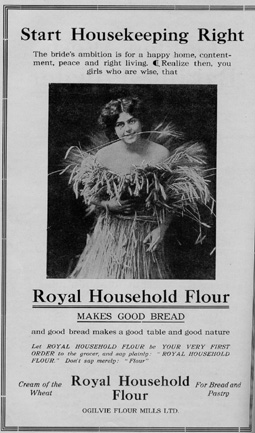
If you were a new bride in the Vancouver of 1913, you had serious responsibilities. You had to make sure both you and your husband looked your best, you had to decide on home furnishings (and on moving smartly from a rented apartment to a house of your own), and you had to know how to deal with a range of medical crises, and even with a death in the family.
And you had to cook.
These were the messages, explicit and implicit, in a 240-page hardbound book given away to newlyweds just before the war. The Real Home Keeper: A Perpetual Honeymoon for the Vancouver Bride. (View this article's gallery of images to see some pages from the book).
Almost a century later, "The Real Home Keeper" shows how much has changed in Vancouver--and how much hasn't. The book was really a kind of elaborate advertising flyer, with articles written by the advertisers themselves. Like today's advertisers, Vancouver's 1913 merchants wanted to sell not just useful goods and services, but a sense of status. They literally had to speak the bride's language, and to offer her a vision of domestic and social success.
"To have your home faultlessly equipped according to the requirements of etiquette and the canons of good taste, and to be a success as wife and hostess, are not the least of your ambitions."
That 34-word sentence in an ad for O.B. Allan, a jeweller, tells us a great deal about the 1913 bride. She wasn't interested in self-expression, but in conforming to requirements and canons. The advertiser expected her to be able to read a long, involuted sentence and to agree with its content. Today's advertisers would expect much less.
The Butler Did It
While the bride was likely middle-class and therefore concerned about saving money, she also aspired to an upper-class elegance. So she learned about the butler's duties even if she couldn't afford one. (Among other tasks, "He prepares the salad. He attends to the bell, to the fires, to the lighting of the house. He makes and serves afternoon tea and sets the table for dinner. He announces all the meals, serves the dinner, does all the carving.")
She also learned what was involved in hosting a formal dinner: "Name cards should be placed on each cover. Each gentleman should be given a card, on entering the dressing-room, with the name of the lady whom he is to escort to the dining-room, and the letter R or L, also on the card, indicating to the right or left of the hostess." At an informal dinner, the bride as hostess would serve the soup, dessert and coffee, while her husband as host would serve the fish and the roast.
Such events would require a large house with an ample kitchen. By 1913 Vancouver had enjoyed a long real-estate boom, so newlyweds were urged to consider buying a lot and building a bungalow. The Maritime Trust Company said: "We will sell you a nice, cozy bungalow, inside city limits and close to our car line, for $100 cash and the balance as rent, $25 per month. South Vancouver lots, $425 each." (In 2004 dollars, that would be about $7,400.) For the more adventurous, a lot in Port Alberni was going for "$150 to $175--$10 down and $10 per month" when $10 was worth 175 of our dollars.
If she'd been a hard bargainer, the 1913 bride might have driven the price down still more. The boom had busted, and Vancouver was suffering a serious depression.
The Need for Good Eats
Once settled in her home, the 1913 bride's chief obligation was to feed her family. The title page of "The Real Home Keeper" summarized her situation:
If you would enjoy distinction
As a cook for the elite
Just turn the leaves of R.H.K.;
Your success will be complete.
One ad spoke to the husband:
You know very well, Daddy, that every man has a weakness for good cooking, but you cannot expect to get "good eats" unless your wife is fully equipped with a line of Modern Cooking Utensils.
The time to start fitting your kitchen is NOW before you call a biscuit a "sinker" and defame the qualities of the pie crust.
"Good eats" were, by today's standards, an orgy that could lead only to stupefaction and premature cardiac arrest. One ad described "a typical Canadian breakfast":
Oatmeal, with Butter (or Cream) and Sugar;
Buttered Toast;
Soft-boiled Eggs, with a lump of Butter;
Griddle Cakes, with Butter.
"If the Butter is not first-class, the meal is spoiled, because the Butter is everything; all the other good things depend upon it to make them appetizing."
A formal ten-course dinner was even more daunting:
First Course: Oysters or Clams in Shells, Brown Bread Sandwiches
Second Course: Consomme, Croutons
Third Course: Broiled Trout, Cucumbers, Maitre d'Hotel Butter
Fourth Course: Croquettes or Sweetbreads
Fifth Course: Saddle of Mutton, Currant Jelly, Potatoes, Peas in Fontage Cups
Sixth Course: Punch
Seventh Course: Broiled Quail and Chestnut Puree, Tomato Salad
Eighth Course: Bombe Glace, Sponge Cake
Ninth Course: Fruit and Bonbons
Tenth Course: Fagan's Gold Crown Coffee (Black)
Salted almonds and bonbons to be on the table all the time. Celery to be passed with oysters. Radishes or olives to be passed with fish course.
Guests would wash down this meal with a variety of wines:
Sauterne, slightly cold, with oysters
Sherry, slightly cold, with soup
Rhine Wine, not very cold, with fish
Claret, slightly cold, with entrees
Champagne, very cold, with poultry and meat
Burgundy and Champagne, with salads
Burgundy, a little warm, with game
Port Wine or Madeira, temperature of wine cellar, with desserts
Cordials and Brandies, with Fagan's Gold Crown coffee
After which, presumably, everyone could crawl home down Georgia Street or simply sleep it off under the dining-room table.
The Real Home Keeper also advised the bride on how to cook all these dishes. We might wonder how any nourishment remained in these gargantuan feasts, because green peas were to be boiled 20 to 40 minutes. String beans had to boil for one to two hours, just like tomatoes, spinach, cauliflower, and onions. Husbands who liked their cabbage al dente could eat it after just 45 minutes in the pot, but it could sit there for up to two hours. Making a batch of doughnuts took 24 hours. A ham was another overnight project. Cooking might be done on a gas range, but more likely on a coal-burner.
If the challenge of cooking and cleaning was simply too much, the bride could phone Mrs. Maloney on Homer Street, "For a Maid, Nurse-girl, Cook, or any First-class Female Help, supplied on the shortest notice."
The 1913 Hi-Tech Household
Vancouver newlyweds in 1913 were evidently no market for theatre or films, and still less for outdoor activities or books. But they did not lack culture: "Your home will not be complete without music," warned Hicks & Lovick Piano. A piano would cost just $275 ($4,800 in our dollars), on easy terms, and a Victrola record player could be as little as $20 ($350). Or the bride could visit Waitt & Co.'s Talking Machine Parlors on Granville, where she could choose between Edison phonographs using cylinder recordings or revolutionary new discs.
Chances are she'd go for the high-tech choice every time. B.C. Electric offered a wide range of electrical appliances, including toasters and even ranges. Furniture and appliances were always marketed as "up to date." The price could be high: a 100-watt tungsten light bulb cost $1.50 ($26 in our dollars) and was guaranteed for only 60 days. But if the bride couldn't afford an electric washing machine, the Model Steam Laundry on West Third urged her: "Your Duds and Our Suds--Get Them Together." Prompt deliveries by horse-drawn wagon covered the whole city.
Dealing with Drugs
The Vancouver housewife had to worry about health matters. George Evans offered chiropractic services, G.W. Grimmett examined eyes, and Professor H.G. Clemens treated scalp diseases, made undetectable wigs, and also removed corns and bunions. The Winnitoba Private Nursing Home on Burrard looked after the new mother in "the great and highest crisis of her life," giving birth. Professor Stranack, a "mentalist" using "suggestive therapeutics" in his Richards Street office, offered permanent cures for drinking, smoking, and chewing-- without drugs or medicine.
The book also offered advice on treating cholera morbus ("30 drops of laudanum"), convulsions in children ("give warm water or a lobelia emetic"), and diarrhea ("a large cup of strong, hot tea, with sugar and milk"). The young wife got almost no advice on raising children, apart from recipes for dealing with their ailments. For colds and fever, the recipe called for potash, dilute nitro-muriatic acid, tincture of aconite, spirits of nitrate, tincture of henbane, and glycerine. Heidelberg Beer was "just what the doctor ordered."
If more sophisticated treatments were required, Knowlton's Drug Store, at the corner of Hastings and Carrall, was open all night to fill prescriptions. "The Modern and Safe Remedy for all Female Disorders" was Pond's Tampons, guaranteed to cure "inflammations, displacements, etc. etc." She could also make her own "woman's suppositories" out of zinc sulphate, alum, cocoa butter, white wax, oil of sweet almonds, and extract of henbane.
And if health care failed, Harron Brothers would look after the funeral "when you have not the heart to think of details."
It's striking to see how rarely emotion was expected to influence the bride's decisions. "The Real Home Keeper" is essentially an administrative guide for new managers. They would have to look after everything from wallpaper choices to their husbands' neckties (not to mention their children's convulsions), and their chief concerns would be saving money, keeping up family morale, and impressing guests. Would they find any personal reward in this role?
The Values of a Loyal British Subject
To ask such a question is to comment the historian's sin of "presentism"-- judging the past by our own standards. It was taken for granted that the young wife would rule her household, but only so she could better serve her husband and children, and the community. That service would be its own reward.
Nor was this just a convenient system rigged for the benefit of the husband. Less than 18 months after The Real Home Keeper appeared, many such husbands swarmed into recruiting offices to help fight World War I. Some did so just for three square meals and a place to sleep, or to escape some boring job (or wife). But most went out of a sense of duty, and endured years of misery, fear, and death in the trenches. It was simply what they had to do because of what they were: loyal subjects of the king. So were their wives.
Ninety years ago, the genteel world of bourgeois Vancouver was staggered by the depression and then almost depopulated by the war. Out of 55,000 British Columbians who served in the war, 26,000 came from Vancouver. With peace would come the pandemic of the Spanish flu.
Yet if their life was no perpetual honeymoon, Vancouverites' values endowed them with a spiritual toughness that got them through all that, and a second world war as well. Whether we, their descendants, could cope with such challenges is a question we should hope we never have to answer.
Crawford Kilian teaches at Capilano College.
Also today: Modern Marriage and Its Discontents
Tomorrow: Patricia Robertson on 'status wife envy.' And excerpts from The Bitch in the House and Bastards on the Couch. ![[Tyee]](/design-article.thetyee.ca/ui/img/yellowblob.png)










Tyee Commenting Guidelines
Comments that violate guidelines risk being deleted, and violations may result in a temporary or permanent user ban. Maintain the spirit of good conversation to stay in the discussion.
*Please note The Tyee is not a forum for spreading misinformation about COVID-19, denying its existence or minimizing its risk to public health.
Do:
Do not: