
Vancouver Oil Sands Tanker Spill Could Cause Evacuation Nightmare
Diluted bitumen creates toxic cloud public would be forced to flee, as occurred in Kalamazoo.



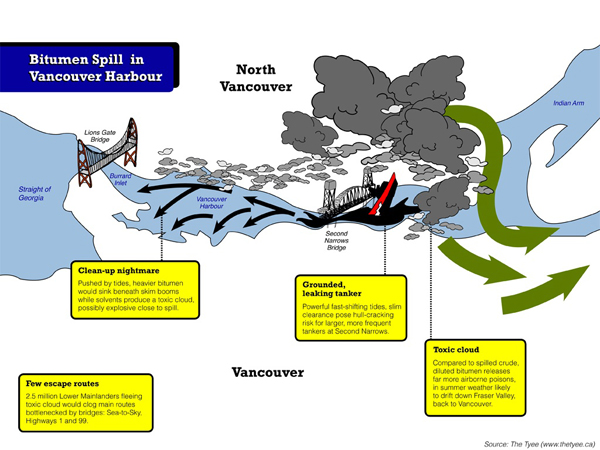
To view larger click here. What experts say could happen if a tanker laden with diluted bitumen from Alberta's oil sands ran aground and leaked in Vancouver's harbour. Illustration by April Alayon for The Tyee.
To view larger click here. What experts say could happen if a tanker laden with diluted bitumen from Alberta's oil sands ran aground and leaked in Vancouver's harbour. Illustration by April Alayon for The Tyee.
Stinking. Toxic. Explosive. These words could describe the cloud of fumes filling the airshed of the Lower Mainland if there was a tanker spill of diluted bitumen in Vancouver harbour. The public health emergency and potential evacuation of large parts of the city might easily overshadow the more well known consequences of an oil spill as local authorities struggle to move hundreds of thousands of people out of harm's way.
This nightmare scenario for Vancouver residents and local emergency planners has been created by a confluence of global forces, corporate decisions and lack of government oversight that may result in a steep increase in tanker shipments of hazardous cargo through the "greenest city in the world" and regional home to more than two million people.
Companies operating in the oil sands are increasingly shipping unrefined bitumen because it is more profitable for them to refine it elsewhere. This lack of value-added processing, supported by the Harper government, not only limits the long-term employment and economic benefits of bitumen extraction, it also creates enormous public safety hazards downstream.
Bitumen is too thick to pump through a pipeline so it must be diluted with a variety of volatile and toxic chemicals imported from elsewhere around the world. This mixture is called "diluted bitumen" and is more abrasive, corrosive and acidic than conventional crude, and typically must be piped under higher temperatures and pressures -- raising the risk of pipeline failures.
The additional risk is that the toxic solvents used to dilute bitumen can quickly evaporate when released into the environment, increasing public safety risks and complicating clean-up efforts if the heavy bitumen sinks into water.
When the pipeline carrying diluted bitumen ruptured near Kalamazoo, Michigan in 2010, these chemicals began off-gassing into the local area, acutely impacting the health of almost 60 per cent of residents living within a mile of the spill.
People reported nausea, vomiting, nosebleeds, headaches, coughing and dizziness from exposure to chemicals such as benzene and toluene, which are known carcinogens.
Local authorities implemented a three-week voluntary evacuation of residents to limit exposure to dangerous levels of benzene detected in the air more than a mile from the creek where the spill occurred.
Even weeks after the accident local residents reported smelling strong chemical odors up to 50 kilometres away.
Few escape routes
The challenges of responding to tanker spill of diluted bitumen in Vancouver harbour would be far more daunting [click here for a visual explanation created by The Tyee].
There are more than 2.5 million people in the Lower Mainland. The area has limited escape routes that are choked with cars even during normal rush hour traffic. The prevailing winds are also from the west, which would blow the volatile chemicals used to dilute bitumen into the confined airshed of the Fraser Valley.
This scenario would be worse in the summer when the Fraser Valley acts like a "closed circulation cell," as a meteorologist contacted by The Tyee explained. Summer winds tend to carry pollution from the city up the Fraser Valley to Abbotsford, which often endures the worst air quality in the Lower Mainland. Rather than quickly dissipate beyond Abbotsford, the pollution tends to stagnate and cycle back towards Vancouver under closed circulation cell conditions.
Emergency planners might be forced to choose between advising people to stay indoors and risk dangerous exposure to airborne chemicals, or try and organize an evacuation on a massive scale into areas which might not be any safer. Put another way, there are not that many motel rooms in Hope, and the plume of poison would be blowing that way anyway.
This situation is not far-fetched. Kinder Morgan is proposing to more than double the pipeline capacity from Alberta to Burnaby by 2017 to 750,000 barrels per day. This would result in up to 20 tankers per month moving through Vancouver harbour. Each of these ships must transit under the Second Narrows bridge during a 20-minute high tide window, with less than two metres of under-keel clearance.
If a loaded tanker became grounded in the channel, assist tugs would have little time to free the vessel before it became perched on a portion of the hull in a fast falling tide, as the 20-km long Indian Arm fjord drains towards the ocean.
Vancouver Oil Sands Tanker Spill Could Cause Evacuation Nightmare: Page 1 of 2
What have we missed? What do you think? We want to know. Comment below. Keep in mind:
Do:
Do not: