
Who Cares If Some Planet Is Inhabitable?
Sorry, no one's moving to Gliese 581g. Why even imagine we're getting off this priceless planet?
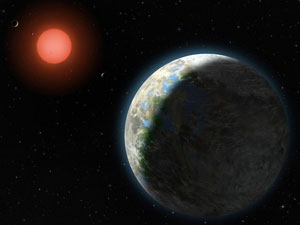
NASA artist’s impression of Gliese 581, with red dwarf star in distance.
Science websites lit up last week with the news that astronomers have found the first earthlike planet orbiting within the "life zone" of its star.
Before you Google "interstellar emigration," with visions of Pandora and sexy blue giants dancing before you, take a deep breath and get a grip.
The planet in question orbits a red dwarf called Gliese 581, 20 light-years away. The planet itself is Gliese 581g, the sixth world found in the star's system. It's as close to its sun as Mercury is to ours, which is close enough to permit liquid water on its surface.
It doesn't really sound like a nice place. It's three times the mass of Earth, so you'd weigh about three times what you do here. What's more, 581g is tidally locked, with one side always facing its star and the other facing the dark of outer space. You'd have to find a place to live in its twilight zone.
I'm delighted that we've found this planet, and the hundreds of other worlds orbiting other stars. As a kid growing up on the pulp science-fiction magazines of the 1940s and '50s, I wrote my first SF story, about an interstellar expedition, when I was 11.
Half a century of delusion
But the implication of the reports on Gliese 581g is that this is a place worth travelling to and maybe even colonizing. That's what happens when kids grow up for half a century on stories that just retell the European conquest of this planet.
Back in the 1980s, my editor suggested I write a space opera. I did, but it wasn't easy. For the life of me, I couldn't imagine an advanced civilization that would bother to travel between stars. Better to send just information. Then your interstellar pen pals could grow their own humans from our genome, and you could grow your own aliens right here at home. I did include an interstellar invasion, by a species that was out to convert everyone else to its own religion. In other words, the species was crazy.
Nonetheless, SF is still full of star fleets, galactic empires, and aliens who are a lot like us. And we still dream of starships spreading human beings to exotic worlds.
We're kidding ourselves. The Scottish SF writer Charles Stross, probably the best writer in the genre today, has demolished the whole idea of Star Trek-style interstellar travel -- just by crunching the numbers.
420 years on a BC ferry
In a post on his blog in 2007, Stross calculated that it would take 420 years to send a ship the four light-years from Earth to Proxima Centauri at one per cent of the speed of light. Each astronaut would live in a space the size of a trailer home for life. Moving that astronaut would require about 21.6 megatons of energy, and another 380 megatons to move the trailer home.
Within such tiny spaces, about 200 people would have to reproduce themselves, educate their children, and repeat the process. If a starship launched in 2050, it wouldn't arrive until the year 2470. Don't even think about the space and energy needed to transport 420 years' worth of shampoo and conditioner.
"And remember," said Stross back in 2007, "this is only what it takes to go to Proxima Centauri, our nearest neighbour. Gliese 581 is five times as far away."
So we're absolutely right to look for exoplanets orbiting other stars -- but not because we're house-hunting. Whether those planets are gas giants or airless rocks or something in between, we'll never land on them or set up colonies. If we did have the energy and technology to do so, we'd be better off building space habitats designed perfectly for our needs, orbiting conveniently close to downtown Earth.
But the more we learn about those worlds, the more we'll know about our own. In 2003, two American scientists published Rare Earth, arguing that planets like ours are rare indeed. And so, therefore, is complex life.
If we go into deep space, we're not going to find the wookies of Star Wars or the prawns of District 9. At best, we might find something like bacteria under the sands of Mars, or plankton in the deep oceans of Europa.
And when we realize we really have nowhere else to go, we might start to take proper care of this literally priceless planet. ![]()


27
Login or register to post comments
North of Hope
1 year ago
Who Cares If Some Planet Is Inhabitable?
I do. If people had this attitude, we would still be living in caves. Some of the most exciting discoveries we make are scientific and Ah ha moments make us progress. science is a natural way of examining our universe, from the tip of our nose to the outer reaches of the universe. Why does the baby keep dropping something from his/her high chair? If I remember correctly, to find out why things fall. Our lives as children are filled with experiments and some continue on this voyage of discovery into their adult lives, thankfully for all of us. If they didn't, you wouldn't be reading this now.
poetician
1 year ago
nearby inhabitable planets
Thanks CK for killing an entire genre of SF horror (Orson Welles is bloating in his grave). Now that I know we should just appreciate digital copies of the universe, I might as well put all my savings in AI stock and spend the rest of my money on more guns just to protect myself from the zombies.
Glen Murtz
1 year ago
EDITED FOR BAITING AND INSULTING ANOTHER COMMENTER -- MODERATOR
"...If people had this attitude, we would still be living in caves."
What attitude is that?
Being a grown up? Recognizing limits?
In all seriousness, your comment EDITED FOR PERSONAL INSULT -- TYEE EDITOR
If you'd take the time to notice the world that's around you, instead of blearily wandering off into childlike, day-dream land full of robo-cars and automats, you might notice that there *ARE* people in this province living outdoors.
Oh. Right.
Wakey wakey.
Time to be a grown up.
Thanks to Mr. Kilian for corking the techno-fetishist delusional doofuses.
promisedplanet
1 year ago
If you're going to write a
If you're going to write a cynical, sarcastic article, at least get your facts right. The mass of the planet doesn't fully indicate the gravitational pull; you also need to take into account its radius. Scientists estimate (as far as anyone can tell) that the gravitational pull of the planet is about 1.8 times that of Earth.
In any case, if something doesn't capture your interest because you can't physically come in contact with it, I feel very sorry for you, EDITED FOR PERSONAL INSULTS TO WRITER -- MODERATOR
seth
1 year ago
Dull witted?
"..also encourage you to keep your writing career.."
This incompetant writer shuld exclude himself forever from the news field and instead write boilerplate for arty niche magazines.
The 1930's encyclopedias that I had to read as a child claimed spaceships were impossible as there was no air for propellers to grip or rocket exhaust to push on. This was what 300 years after Issac Newton's for every action there is an equal and opposite reaction - how rockets work in outer space.
There is all kinds of theoretical science on how to exceed the speed of light, as there is all sorts on how to gain enough energy to hit 99% of the speed of light. What is lacking is the engineering know how.
Chris Keam
1 year ago
"The 1930's encyclopedias
"The 1930's encyclopedias that I had to read as a child claimed spaceships were impossible as there was no air for propellers to grip or rocket exhaust to push on. "
Citation needed.
Anyway, the most common argument for space travel is to invoke the age of discovery as some kind of altruistic search for knowledge. The reality is that there was a strong business case for sending small groups of men on relatively short voyages using current technology. Columbus didn't look for a secret passage to India because he thought we would one day have airplanes.
I think we should worry about keeping Spaceship Earth provisioned and properly equipped for its instellar voyage. We're going to be here a while yet. Maybe we should turn our telescopes towards the slums and refugee camps on this planet, and then worry about sending people to infinity and beyond.
freebear
1 year ago
No excuses for trashing Earth!
"And when we realize we really have nowhere else to go, we might start to take proper care of this literally priceless planet"
No thanks to Steven Hawking !
Greg in Calgary
1 year ago
Think twice about polluting this planet
...it's the only one we've got. I agree that Stephen Hawking has lost it.
As a lover of science fiction, it's too bad that much of it is wishful thinking, and/or propaganda for a space age that will probably never happen.
Have a listen to this 2007 segment from CBC's Quirks and Quarks: Mars or Bust, where a NASA program manager describes the truly overwhelming obstacles to a manned Mars mission. And Mars is close to Earth - roughly 55 million kilometers. Proxima Centauri is 3.97 × 10^13 km away.
We've all been watching too much Star Trek and not paying enough attention to what's happening on Earth. I'm afraid that we've come to believe that we have some kind of divine right to explore space, when we haven't demonstrated that we can live sustainably on the only habitable planet we know of.
snert
1 year ago
Here's a start for some
Britain has just recognized Druidry As Religion.
Booker
1 year ago
media coverage
Mr. Killian is correct to point out that media speculations about Gliese 581g being habitable for humans are silly. I think it's equally incorrect to speculate that deep space may only offer bacteria-like organisms. That could be true, but we really haven't got a clue. Complex life could be widespread, or it may be rare. There is no data. We do know that there are planets where organic life could conceivably exist given what we know about life existing on earth.
KEITH_W.
1 year ago
Reply to "Who Cares If some Planet Is Inhabitable?"
Sir,
Probably not many, but a few DO. In Mr. Kilian's opinion essay, he gives two arguments to negate any attempt by humanity to reach the distant stars in order to focus our attention on planet Earth instead. His first argument is that Gliese 581g is not a suitable candidate, which is correct. His second argument is that traveling to the stars is too difficult, to which I disagree. He concludes by saying humanity therefore has no place to go and should stay home.
His conclusion is false if the reader is willing to believe that faster means of propulsion are going to be possible one day in the near future. This assertion is not impossible.
I find it ironic that India, a country that has one of the still highest child malnutrition rates in the world, is willing to develop a space industry in order to "look towards their future". Can not Earth do the same?
Jesper Haaps
1 year ago
The Real Point
Many (including Mr Kilian) are missing the real point of these extrasolar planetary studies—that being the dawning realisation, backed now by evidence, that there may be many hundreds of thousands or even hundreds of millions of earthlike planets in systems throughout our galaxy, which in turn massively increases the likelihood that life has developed (or will develop) elsewhere. In other words, as a result of these discoveries, the Drake Equation may have a lot more specific numbers with which to fine tune its answer.
thickets
1 year ago
Somebody mispelled Wookiee
We can look to the stars and work to fix our problems at home at the same time. Who's saying we can't?
Crawford
1 year ago
Thanks for these comments
As one who's been reading SF since 1948 or thereabouts, I yield to no one in my love of the idea of interstellar travel. And as I said in my article, we should certainly pursue the search for extrasolar planets--a search that 60 years ago seemed impossible.
Of course many other worlds may be hospitable to our kind of life, and we will likely find many of them in the next few years. But just because you see lights go on in a condo across Pacific Boulevard, that's no reason to go over there and move in. Those folks are trying to get on with their lives, not deal with uninvited visitors who want to go home with their granite kitchen counter.
Until someone comes along who does to Einstein what Einstein did to Newton, we have no means of propulsion convenient to short-lived humans that will put us on extrasolar planets in less than centuries if not millennia.
Those planets, after billions of years of independent evolution, are more likely to be utterly hostile to us than to be welcoming; H. G. Wells in The War of the Worlds was on to something, with his Martians succumbing to our bacteria.
Keith W. mentions India's space program; those malnourished Indian children are in effect subsidizing that program, which may advance India's future (though I doubt it) at the cost of their own shortened lives. The same is true of every other space program, including the Americans' and ours.
The interstellar SF we've grown up with is really just a retelling of the European conquest of the Americas, so it's a familiar and comforting narrative. But if Christopher Columbus's expedition had taken 420 years to cross the Atlantic, his descendants would have arrived in 1912. If he'd pitched Ferdinand and Isabella on those terms, they'd have sent him not west across the sea but directly to the Madrid insane asylum.
samuidave (not verified)
1 year ago
According to the Drake formula
... the chance of extra-terrestrial life elsewhere in the cosmos is almost certain although the extent is unknown.
For those worrying about protecting this planet -- which I whole-heartedly endorse -- consider how our religion from scriptures has caused our ruinous mindset where we are master of our world and all flora and fauna have been put here just for us, and for us to do with them what we please. Also consider how life on earth is effectively meaningless, ergo what we do here is effectively meaningless, to those who believe they will live in heaven for eternity. Maybe it will taking finding life elsewhere to awake the religious from their stupor and change the way humanity looks at things.
As far as offering a person a sense of proportionality on our planet, nothing rivals the cosmos in my opinion. Building on Darwin and evolution, the understanding made by Einstein with E=mc2 in 1905, the discovery of the expanding universe by Hubble in 1929, the discovery of background radiation in 1964, the moon landing in 1969, the work of the Voyageur, the expansionary Big Bang theory and string theory, and quite notably tying this together over the last 20 years with the space exploration made by the Hubble telescope which allows us to scientifically travel back in time to the singularity 13.7 billion years ago -- nothing offers us a sense of our good fortune to have won the cosmic lottery. And nothing drives home the point how inconsequential we are to it all, and how we must embark on being in balance with nature if we plan on surviving for more than a flash.
As for the expense in arriving at all this, well, if it was my planetary household, I would eliminate military warfare expenses, fictional bank expenses, and corporatism before I worried about man using his mind productively to find reason in this world.
samuidave (not verified)
1 year ago
'inflationary' Big Bang is what I meant...
but I get so excited thinking about this stuff :)
YCSTS
1 year ago
Interplanetary Space Exploration & Development is our Duty.
Kilian, your entire article is annihilated right here:
http://nextbigfuture.com/2010/10/nuclear-fission-nuclear-fusion.html
Interstellar Space Colonization is quite likely feasible in a century or so, by Nuclear Fusion, Mach Drive, Artificial Black Holes or Anti-Matter. It just would be enormously expensive, and would likely mean a huge spacecraft in which generations of humans would live comfortable lives in an environment far superior to most on this Earth. But the expenditure of the resources needed to achieve Interstellar Colonization would be comparable with the Ancient Pharaohs spending most of their nations wealth on giant monuments. Total exploration & colonization of our Solar System is however entirely practical, well within our present technology, a minor expenditure, far less than what we spend protecting the Wealth of Oil Interests on our planet.
Contrary to what Kilian states, BY-FAR-AND-AWAY the greatest and most Responsible Actions Human Civilization can do for Mother Earth is to carry Terrestrial Life to other planets & moons in this Solar System. The #1 goal of Life is to expand to new environments. In order for Life on Earth to expand it needs the help of humans, who can Terraform other planets to make them suitable for Terrestrial life. Mars is actually an easy planet to Terraform, and can actually be done in a trivial one hundred years. Expanding Terrestrial Eco-systems to another World, makes all the damage humans have done to the Earth, so trivial as to be not even worth discussing. We have abandoned our duty to Mother Earth by our failure to embrace Space Exploration. A run-of-the-mill, Nuclear Powered Transport would get to Mars in 39 days. Terraforming Mars would be the greatest achievement in the History of Human Civilization, and the most Environmentally Responsible Act Humans have EVER Undertaken.
http://nextbigfuture.com/2010/10/nuclear-fission-nuclear-fusion.html
Another inexpensive method to mission to explore Mars. Once again proves that Kilian did ZERO Research on his Article:
http://nextbigfuture.com/2010/08/reaction-engines-of-uk-who-is.html
Kilian is also forgetting that every 100 million years a large asteroid destroys 90% of the life on Earth. A mere 10,000 yrs ago a comet destroyed most large animal life in North America, including wiping out the Clovis people. This is Eco-Destruction on a scale that makes everything humans have done look minor. Only humans can prevent these disasters from happening by traveling into Space where we can protect the Earth. And mining resources on the Moon & Asteroids is actually highly economical, once the infrastructure is in place. This will avoid the destructive mining of low grade minerals on the Earth.
Humans could also seed Terrestrial Life on other Solar Systems by sending drones.
YCSTS
1 year ago
Terraforming Mars
Wrong link on Terraforming Mars. Here is the correct one, detailing how fast & easy it would be to Terraform Mars:
http://www.users.globalnet.co.uk/~mfogg/zubrin.htm
VivianLea Doubt
1 year ago
we are all in the gutter...
but some of us are looking at the stars - so said Oscar Wilde, although I do think he meant it more metaphorically than otherwise.
The human quest for knowledge is a beautiful thing, but I have to draw the line at the "irony" of India looking to develop a space industry to secure their future...or any other country, for that matter, (which certainly includes Canada and the US) that cannot feed, house, and clothe their own citizens...
It is most certainly much more than ironic, decidedly moronic, perhaps...
Somewhere in the neighbourhood of 3 million Canadians lack the money to secure adequate food...and the malnourished of India have already been mentioned, and then, of course, there are the outright starving of other developing (and developed) nations... The majority of these are children, which are the very definition of the future. Personally, I am fascinated by the cosmos and the discoveries of science...but the future of any nation, and the world, is best secured by ensuring the next generation is healthy and happy.But in light of some of the commentary here, I might go a little further and say I believe that caring for the well-being of all is essential - is the essence - of our humanness.
I suppose we could always put a few thousand of the starving and malnourished on a voyage of space exploration and see how they fare. I'd prefer it if some of you here might volunteer, though, since you seem extraneous to humanity.
YCSTS
1 year ago
VivianLea you need to learn abit about the Real World.
Yeah, right. That's why 100's of billions of dollars are being thrown down the sewer on NUTTY Renewable Energy SCAMs, whose only purpose it to prevent any serious alternatives to Fossil Fuel Hegemony.
Just take one SCAM, Wacky Corn Ethanol. The USA alone subsidizes it by $7B per yr. This takes food right out of the mouths of children, as do most of the $100B Biofuel SCAMs. And it uses just as much Fossil Fuel inputs as it produces in Energy = ZERO ENERGY GAIN = ZERO CO2 Reduction. And Rapes the Soil of nutrients, depletes precious Fresh Water supplies, pollutes the environment (the ocean dead zones) and according to a leaked UN report caused a 70% increase in Food Prices. That's just one of the LET'S MAKE THE FILTHY RICH EVEN RICHER SCAMS - I could list a whole lot more.
So don't give me this Crapola about blaming Space Exploration for Poverty in the World. Funding is Peanuts. It has ZERO significance in World Poverty. And it actually produces something, unlike the $trillions that have been thrown down the sewer to pay Wall St Types to shuffle paper. $40Trillion lost in their last criminal SCAM.
North of Hope
1 year ago
Discovery in science
Sorry Glen, I didn't mean to be so subtle. Discovery in science comes about because certain people are passionate about what they do. That why we make advances in science from finding the acceleration of a falling object to discovering insulin to finding a planet that may be habitable by humans.
You should study some science and study the lives of scientists to find out what drove them to make their discoveries. If they didn't do it ,we would still be living in caves.
CanadianLatitude
1 year ago
Humanity will of destroyed
Humanity will of destroyed ourselves long before we figure out how to get to another planet.
freebear
1 year ago
Development Permit Application for Gliese 581g
Lets find another planet to consume, trash, and then leave for the next one!
And on the way we can discover things lioke Tang, velcro and pens that write in zero gravity!
At least the Russians used pencils and saved some rubles!
seth
1 year ago
Mars/Moon no problemo
We have figured out how to get to another planet. It's well within our current engineering expertise - almost trivial.
It's the brainless attorneys that run government that keep us grounded.
Since its the same moronic corrut politicians that are blocking the solution to global warmong/peak oil civilization ending crisis, we might need some of that going to another planet technology to buiild us a giant space based sunshade.
Think about it.
Umslopogaas
1 year ago
Next?
Crawford will write about how many angels can dance on the head of a pin.
TaiCleis
1 year ago
Backwater and provincialized
If we don't destroy ourselves first, we will one day travel between stars as easily as we now travel between cities. If you think we won't, you must be working on the assumption that mankind already knows everything about how the laws of physics work. Any reasonable person has to doubt that.
And as for why we should care whether Gliese 581 is habitable, consider that we found it so soon, and so nearby. Out of hundreds of billions of stars in our lonely little galaxy, we've already found one with planets that may look much like our own. A very pressing question has been answered: is the Earth special? Many of us knew it couldn't be, but we had no proof. Now the likelihood of earth-like planets is becoming clearer.
If our ease in finding Gliese is any indication, then there could be tens of billions of earths in the Milky Way alone.
vera gottlieb
1 year ago
Who cares of some planet is inhabitable?
Those who are so very busy destroying our planet might be VERY interested in moving to another planet - and then destroy that one too.