Biggest Tax Shift in BC History: Why Did Campbell Do It?
On the basis of a single flawed study, apparently.
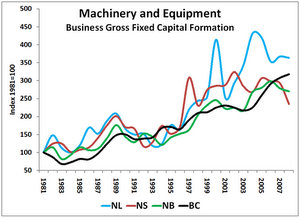
Business gross fixed capital formation in machinery and equipment for Newfoundland and Labrador, Nova Scotia, New Brunswick and British Columbia.
Premier Campbell and Finance Minister Colin Hansen admit that their harmonized sales tax (HST) shifts $1.9 billion in tax from businesses to B.C. families. That's what it means when they say the tax saves businesses $1.9 billion per year while keeping the government revenue-neutral; in other words, you pay more to make up for what businesses will save. You will do that by paying a 12 per cent HST on almost everything that currently attracts only a 5 per cent GST (children's clothing, gasoline and diesel fuel are exceptions).
A shift of $1.9 billion per year from businesses to B.C. families makes the HST the biggest tax shift in B.C. history.
Campbell's radical 2001 tax cuts cost $1.5 billion with just 8,000 people receiving 14 per cent of the benefits. His 2002 50 per cent increase in MSP premiums cost B.C. families about $450 million per year. It is hard to find anything that comes close to the $1.9 billion per year HST tax shift. Dividing that by B.C.'s population of 4.4 million produces an average tax shift of $428 for each person, infant to senior; it is $1,714 for a family of four. Of course all families are not equal. As a proportion of their income, high-income families will devote less to paying the HST than middle income families, so the HST is regressive.
Why would the B.C. Liberals shift $1.9 billion per year in taxes from businesses to B.C. families? Some apologists argue that businesses never end up paying taxes because they can pass them on to their customers, but that ignores how taxes impact profits and dividends and it ignores how prices are determined in various industries. That argument is not used in the government's news release, but it does claim that the HST tax shift will boost new business investment. What evidence exists to prove that claim?
Apparently, like Ontario, the Campbell government relied on just one flawed study, not published in a peer-reviewed journal but as a 2007 Commentary from the C.D. Howe Institute. That study, by Professor Michael Smart of the University of Toronto, looked at Nova Scotia, New Brunswick, and Newfoundland, all of which replaced their provincial sales tax with the HST on April 1, 1997.
How smart is the Smart study?
The HST is called a value-added tax because it applies only to final consumption, not to business inputs like machinery and equipment. By contrast, the tax it replaces goes by several names: provincial sales tax (PST), retail sales tax (RST) and social services tax. Those are three names for the same thing, and that is a tax that applies to both businesses and consumers.
In its March 26, 2009 budget, Ontario announced that effective July 1, 2010 it would replace its RST with the HST. Its announcement included details on a host of transition measures, from assistance to businesses that will have to change their cash registers to as much as $1,000 per eligible family for transition assistance.
On July 23, when the legislature was not sitting and only two months after the provincial election, British Columbia announced that effective July 1, 2010 it would replace its PST with the HST. B.C.'s announcement was short on details; however, a Ministry of Finance HST website has been established which includes quick contact phone numbers to both the Canada Revenue Agency and the Ministry of Finance.
Campbell and Hansen argue that tax savings by businesses will probably be passed on to consumers. The Michael Smart study, cited by the Campbell government to defend its surprise announcement, reported (p. 12) that "...CPI prices fell by about 0.3 percent in HST provinces after 1997, compared to the corresponding change in RST provinces. This difference is statistically insignificant but extremely close to the estimated 0.5 percent reduction in taxes under the reform." In this context "statistically insignificant" means that there is an equal chance that the implementation of HST could have caused prices to go up or had no effect at all. In other words, nothing was proven.
The study went on to report details on eight components of expenditures, with a footnote regarding statistical significance. Five of the eight components of expenditure were not significant at the '5 per cent or less' level. Shelter showed a statistically significant (1 per cent level) increase of 1.4 per cent. That is one of the reasons the study concluded that the implementation of HST was "mildly" regressive.
Where Smart went wrong
Smart's conclusion that the adoption of HST produced increased investment is wrong. In discussing a graph (p. 8) which showed investment per person in HST and RST provinces, he admitted it didn't really prove that differences are caused by the adoption of the HST. He wrote: "Certainly, investment in Newfoundland has risen with the development in recent years of the offshore oil sector." He should have paid much more attention to investment in both Newfoundland and Labrador and Nova Scotia due to offshore oil and gas activity -- Hibernia, Terra Nova and White Rose have nothing to do with HST, nor does Nova Scotia's Sable Island energy development, described as "the largest construction project ever undertaken in Nova Scotia."
Smart attempted to adjust for the obvious distortion caused by the offshore oil and gas activity by running a regression analysis of per capita investment on per capita GDP with a variable designed to measure the change when the HST was implemented (what economists call a 'dummy variable'). Smart's dummy variable could have measured other factors, including the period when the offshore play was most intense, instead of measuring any effect of HST. He attempted to adjust for this by using data by industry and excluding mining (which includes oil and gas), but those data were only available for 1992 through 2005 -- just five years of observation before the HST was implemented. Even if mining is excluded, spinoff activity in other industries would still reflect the offshore play -- hence, his dummy variable could have measured that rather than anything to do with the HST. There are fundamental flaws in Smart's model, the period he choose for analysis and his interpretation of statistically insignificant results. Nevertheless, his study is being used in both Ontario and B.C. as justification for a massive tax shift.
Relevant historical data left out
As shown in the graph illustrating this article, the provinces which adopted the HST in 1997 also had a spurt of investment growth in the 1980s. By not including that period in his analysis, Smart is not on solid ground with claims that investment growth was due to the switch to the HST rather than due to offshore oil and gas development. Most importantly, even Smart emphasized that if there were increased investment due to the switch to the HST, it would be a short-term phenomenon (p. 1).
In the system of National Accounts, investment is measured by gross fixed capital formation, which includes government investment in structures, machinery and equipment as well as business investment in residential construction, non-residential construction and machinery. The item of interest when discussing the stimulation of investment due to a tax change is business investment in machinery and equipment. Those data are available from Statistics Canada on an annual basis for the provinces from 1981 through 2008, and the 1986-2006 portion of those data was used by Smart in part of his study.
The graph shows business gross fixed capital formation in machinery and equipment for Newfoundland and Labrador, Nova Scotia, New Brunswick and British Columbia relative to what it was in each province in 1981. For example, it was $3.572 billion for B.C. in 1981 and $11.331 billion in 2008, so the B.C. index for 1981 is 100 and for 2008 it is 317. By converting to an index like this it is possible to compare B.C. with the smaller provinces, which together have only once had even half as much investment in business machinery and equipment as B.C.
Notice that throughout the '80s, the three Atlantic provinces had higher investment relative to what they experienced in 1981 than B.C. did. In the early '90s, the four provinces were in roughly the same relative position and then investment in Nova Scotia and Newfoundland and Labrador took off relative to B.C. and New Brunswick. Of course, that was the period when Newfoundland and Labrador and Nova Scotia had high levels of offshore oil and gas investment.
Progress Board warned of ‘highly visible shift of tax burden’
In December 2008, the B.C. Progress Board published a report, prepared by three researchers from the Centre for the Study of Living Standards, on Investment in British Columbia in which it recommended the adoption of the HST. It stated (p. 2):
"Evidence from the Atlantic provinces, which harmonized their sales taxes with the federal Goods and Services Tax, suggest British Columbia could experience a 12.1 percent increase in trend M&E investment as a result of adopting a value-added tax. These results imply that adopting a value-added tax could result in M&E investment as a share of GDP in B.C. of 6.8 percent in 2007 (as opposed to 6.1 percent), thus closing 70 percent of the M&E investment gap between B.C. and the national average (7.1 percent). The potential public opposition to this measure should not be underestimated, however, and there could be a protracted adjustment period."
Protracted adjustment period might be a euphemism meaning that the claimed benefits might not be seen for a very long time. The Progress Board didn't say how long the adjustment period might be, but page 31 of its report made it clear that its claims about 12.1 percent higher investment came from Smart's study published by the C.D. Howe Institute in 2007. The report went on to say: "Moving from a tax on business inputs to a tax on consumer goods and services entails a substantial and highly visible shift of the tax burden from businesses to consumers, even if the reduced input costs are eventually passed on to consumers in the form of lower prices."
According to the government's July 23rd news release, "substantial" means a tax shift of $1.9 billion from business to consumers.
If the Campbell government had done its homework prior to making its post-election announcement, it might have learned that the HST is regressive, that it might not stimulate investment in the short or medium term, and that business cost savings are unlikely to be passed on to consumers. Perhaps the most accurate comment offered to the premier by his Progress Board was about the angry reaction of voters. ![]()


RickW
17-08-2009
"If the Campbell government had done its homework...."
I would suggest that the Campbell government HAS dones its homework, and knows EXACTLY what it is doing. Using the Smart study was simply the handiest "excuse" to push its agenda -- similar to the excuse that these 2010 Games will be the first ones to turn a profit......
sunshine coast girl
17-08-2009
NO BC HST
Rally
Date: Saturday, September 19, 2009
Time: 12:00pm - 2:00pm
Location: Vancouver Art Gallery front lawn
Street: 750 Hornby Street
City/Town: Vancouver, BC
Join former BC Premier Bill Vander Zalm, NO BC HST creator and 24 hours columnist Bill Tieleman and other political and community leaders for a protest rally against the Harmonized Sales Tax! Start taking action to stop the HST!
crh
17-08-2009
cash is king
Fight back. Pay cash and avoid this tax. If the store/business wont co-operate find another one who will. Cheat, cheat, cheat.
Campbell is nothing more than a modern day global capitalist who doesn't recognize that it is killing its' own goose! Lose all your consumer base and what do you have?
Skywalker
17-08-2009
Well done David!
I'm with RickW on this. Campbell knew exactly what he was doing and so did the BC Progress Board. As you point out this is a tax shift plain a simple and it is a subtle way for Campbell to confuse the issue enough so the blatant gift to big corporations (all well represented on the BC Progress Board) will not be noticed by the consumer paying the extra. Campbell gets out of his fudged budget dilemma.
The big question is, "Is the voter that stupid?"
onthebay
17-08-2009
Cascading PST
Thank you for the insightful article. It sounds like there was a pretty shaky foundation for a major decision!
Can someone please enlighten me regarding one of the many, many concerns / questions I have about HST.
One of the reasons cited in favour of the HST is that the current system of PST increases business costs. The reasoning goes something like this... Businesses pay PST at multiple stages to produce / manufacture products. These cascading PST costs are passed off to the consumer at the final point of sale. Getting rid of businesses’ cascading PST costs will mean lower prices for the consumer because businesses won’t have to recover the PST they previously paid along the way.
I would like to know what types of products consumed in the average non house building BC household involve these cascading PST costs. With so many imported items being sold in BC I can’t really think of that many items I purchase on a daily, weekly, monthly, or even yearly basis that are even produced / manufactured in BC let alone involve cascading PST costs. If someone out there has examples of products containing cascading PST costs please post them so we know the extent of these costs and also know what businesses should be lowering their prices should the HST be implemented.
macsasquatch
17-08-2009
shifting tax burden
Chambers and Can Fed of Independent Businesses are working municipality by municipality to shift the local property tax burden from business on to residents.
Main approach is to roll out some local business people to complain about the property tax burden. Major corporations, big box stores, and such stay in the background. So municipal government claims it wants to be business friendly. Lowers multiple on local business tax, and, since residential rate is always called '1' the shift is partially hidden from the residents.
So Schreck's suggestion that the harmonization is a province wide shift is complemented by the business community's municipal lobbying for a shift at the municipal level.
Isabella2
17-08-2009
Well done David!
I agree with everything Skywalker said until the last question/comment. Just because people cannot follow the deceitful convolutions of the BC government, doesn't mean they're stupid. Those people may have other talents, like integrity for example. What I would have agreed with is a question that asked, "Will the HST scam manage to get the apathetics off their duffs and down to the Art Gallery protest? Or will they just shrug, say "What can you do, they're all the same," and go back to the tube to see if the BC Lions can string a few together.
Rubber stamp
17-08-2009
Nova Scotia ex-Liberal goverment cooked the books
I read this story and I was shocked,,I guess the HST ain`t working for Nova Scotia.....The brand New NDP goverment that won the election are in shock over cooked books,hidden debt everywhere,revenue projections falsified,over spending liberal.....Just like BC....read about it here..
http://www.ctv.ca/servlet/ArticleNews/story/CTVNews/20090817/ns_money_090817/20090817?hub=Canada
Isabella2
17-08-2009
Rubber stamp no substitute for truth in budgeting
To answer the comment from the Liberal: How can you expect an NDP campaigner to make intelligent election promises, if the data has been contaminated by an outgoing administration? It's long past time to increase the penalties for politicians who lie. And by that I mean lie in fact, by deed, or by implication. In fact, it's past time for Canadians to take back their country!
Skywalker
17-08-2009
Voter apathy is only part of the problem.
How did we ever get to the stage in our democracy where a lie told by a politician is not really a lie but "spin" or a fraud perpetrated by a Premier is not really fraud just the same old electioneering? Most of that can be traced right to the corporate media which once was were truth and facts were the standards in reporting. Now they are the purveyors of the same lies and the whole democracy is as shallow as a Campbell promise.
We have been fooled by these thugs before. How many more times will be allow ourselves to be sucked in by their phoney sincerity?
asp
17-08-2009
All taxes tax the consumer
Anybody here read Filthy Lucre - Economics for people who hate Capitalism?
Joseph Heath claims that all taxes ultimately tax the consumer, so raising corporate taxes and lowering consumer taxes does not make any difference.
Anybody seen a serious and detailed critic of that book, and this subject?
Moonbug
17-08-2009
@onthebay
You will find the answer to your question is "not much" of what we consume has those embedded costs - which is one reason why the whole "businesses will lower their prices" argument is so bunkum.
The HST is mostly a handout to export oriented industries. How much money do you think Alcan will save if it actually builds that new smelter in Kitimat (thus eliminating hundreds of jobs and freeing up more practically-free electricity for export)? The answer is - lots and lots.
I can't wait till the updated campaign donations are released on Monday. I wonder how much Teck and Alcan chipped into the Liberal war chest.
Too bad bribery isn't ACTUALLY against the law.
mary jane
17-08-2009
shift or shaft
This tax turns the tax payers into cash cows nothing more. BUT where will the money go? If the liar is up to his usual none will go to the things we need.
cw
17-08-2009
Still stuck in Rogernomics
Seems to me he's still stuck in the 1980s playbook of New Zealand's Sir Roger Douglas and his Rogernomics that left the country stripped of its resources while the international business community "invested" in the country by removing 94% of its return(s) on investment, leaving the cupboards bare.
It was disastrous then and there, and it'll be disastrous here.
asp
17-08-2009
stupid tax cuts/increases
If I understand it correctly, Campbell is stupid for cutting sales tax and increasing value-added tax. Harper was stupid for cutting the GST, Campbell was stupid for cutting income taxes and increasing carbon taxes.
These guys can't win.
But seriously, I think we are getting distracted from the important issues. We need governments to provide more and better and services in those parts of the economy where the private sector does a lousy job. Fiddling with tax base here and there is not that significant. They should just raise everyones taxes.
Dan the socialist
17-08-2009
So will business then pass
So will business then pass on savings to consumers? Give their employees a raise or encourage a hike in the min wage?
ha ha I should know better as the answers are no.
Badger Billy
17-08-2009
Mulroney "recanted" on GST
About a decade back I was an invited guest at an Ogilvie Renault law firm noontime bun toss in Vancouver. Brian Mulroney (rhymes with 'money'), an OR principal, was given the task to drone out the customary post-prandial farrago to the usual swill of willing clappers in the crowd. I came away modestly impressed, regardless. Asked what, if any, "regret" he may harbour over his ultimately failed administration, he responded quickly : "I should have reduced personal income tax by an amount proportionate to reflect the introduction of GST." So now we have in BC the sight of Bill VanderZalm of Faye Leung / Fantasy Gardens / False Creek $141 Million fame lining up with shillmeister Bill Tieleman (he the former chief of staff of fast ferries and back porch fame ex-premier Glen Clarke) to rally the great unwashed to oppose HST. If Gordon Campbell were to read tea leaves rather than juniper berries he might think twice. But if you would know The Premier I invite you to google on the expression "dry drunk". George W. Bush's name will appear in the first five hits. The parallel with GC doesn't take considerable imagination.
asp
17-08-2009
pass the savings
Yes. Prices are determined by consumers, not vendors.
zalm
17-08-2009
Bwaaahahahahaaaa!
you should try that line at your local Safeway as you pay for your jug of milk with six new coppers and a pocketful of lint.
what a maroon!
Luceo
17-08-2009
Do YOU believe it?
According to the BC Ministry of Finance, British Columbia business will pay approximately two billion fewer dollars per year as a result of the upcoming HST, yet the average consumer will NOT pay more than he/she is experiencing with PST at present.
So what is this economythic miracle? Is it that the government has suddenly discovered that it was collecting two billion dollars that it doesn't need now and will not require in future years? ... or ... is it that the working BC taxpayer is going to pay the two billion from now on, for ever and ever, amen?
What do you think?
DNA
17-08-2009
Smart states: "[W]hen firms
Smart states: "[W]hen firms have market power and consumers are not fully informed about taxes, it may be reasonable to suppose that business markups rise when hidden taxes on business inputs are replaced by explicit taxes on consumers (Chetty, Looney, and Kroft 2006)." He then tries to prove that this didn't happen when the Atlantic provinces adopted the HST. But Dave's analysis points out that Smart's empirical evidence is not all that straightforward.
I do wish competition was so keen in British Columbia that firms didn't have significant market power... that is, power to impose prices... but they do. It seems to me unlikely that many consumer prices will be cut, but that businesses will simply have larger profits.
crankypants
17-08-2009
Taxation Scams
There is a saying that is very appropriate for the HST & GST. "Figures make liars and liars make figures" Any person with a minimal knowledge of math and stats can pretty much prove any theory. The theorist will use various data with a result in mind, then manipulate said data to validate their theory. Economists and so called think tanks are great doing this. They will bring forth theories that under very rigid controls will produce their desired result. Unfortunately real life scenarios cannot be controlled in the manner they suggest and the results they espouse become unattainable, and therefore just another useless report.
The HST is no doubt a tax that is based on such useless reports. It is nothing more than a vehicle to shift 1.9 billion dollars of tax burden from big corporations onto the backs of consumers. It will no doubt be a windfall for these big corporations and increase their profits. Unfortunately it will be at the expense of every British Columbian. The exemptions we enjoy under the current PST will be all but eradicated. This will leave less disposable income in the pockets of consumers which will lead to less money being spent throughout the economy. After all, every dollar taken in taxes is one less dollar that can be used to drive the economy. Less money spent by consumers will cause many small businesses to either reduce staff, if they have any, and ultimately go the way of the dinosaur. Mid-sized businesses will also feel the pinch and start by eliminating jobs until they too will find it difficult to survive.
The government asserts that the HST will be good for the economy, but to date has not given us any concrete evidence to support this view. At best they speak in generalities that are based on some skewed theories. This is not the time for any crackpot ideas.
margot
17-08-2009
cigars
Last time I checked, a few years ago, the tax on cigars (compared with rolling tobacco etc) maxed at $5 a cigar. Unbelievable.
Rubber stamp
17-08-2009
Voodoo economics......
My take on the HST and at the end of my article,the solution to Campbells tax shortfall.......
Read it here....
http://powellriverpersuader.blogspot.com/2009/08/great-canadian-mythssasquatchoogo.html
Fiat lux
18-08-2009
The whole thing is a a
The whole thing is a a Fraser Inst. inspired fraud to pass more taxes on the public's back.
Businesses have tax numbers and can buy goods and services without having to pay provincial taxes if they can prove that the products are for resale.
There never have been any PST on services, but there will be now. How about for repairs, especially automotive? I've never seen any mention on this.
I've been in the manufacturing business in Vancouver from 1957 to 79 and then locally until my retirement. Had my tax number and could buy anything tax free, or sell to others for resale
The PST, or originally the SS&MA tax is only applied on sales to the end users. Any claim to the contrary is a lie.
Ed Deak.
b8909xh
18-08-2009
ABSOLUTEY NO
I as a pensioner with only pension income of &1398 a month is going to find this very difficult.The revenue neutral carbon tax has pushed my grocery costs up 30 dollars a week..This means there is one week a month that I just cannot afford them..I am at a loss as to how we are supposed to survive.I have no ides how they are reelected.All of this for a one time trnsfer payment.Wake up people..This all makes me very sad.
onthebay
18-08-2009
Ouch in small town too
Small town / rural BC folks will really take a hit with the HST. The basic price of an item there is much higher than in urban areas due to things like lower sales volumes, lack of competition, higher transportation costs, etc, let alone when the HST is added on top. A small example: if a meal is about $14.00 in big town it is about $20.00 in small town. For eating the same meal the additional tax (7%) will be $.98 on big town’s bill and $1.40 on small town’s bill. Multiply that by the hundreds of items the HST will be charged on and small town’s HST tax bill will be staggeringly higher than that of big town’s HST tax bill.
freebear
18-08-2009
1.6 Billion dollar bribe
Remember when Gordo Campbell said that the deficit would be 465 million, he was already laying the cards to enable him to keep his word!
So if the deficit is 2.65 billion dollars minus $1.6 = 465 million
'I kept my word folks'!
Scheming bastards!
Katatak
18-08-2009
Lies and poverty
@ crankypants: The phrase, "There's three kinds of lies: lies, damned lies, and statistics" would be appropriate. (I often add a fourth lie to that list: political promises.)
The people I most sympathize with are the b8909xh's of the world. When you step back and look at the bigger picture - the society and communities we live in - such regressive tax policies are not in harmony with efforts to reduce homelessness and poverty. It's no surprise, then, that HST won't come into effect until after the Olympics.
dave49
18-08-2009
Hidden Olpmpic cost over-runs
The more people I talk to, the more stories I hear about scandalous cost over-runs on Olympic facilities and related projects that have so far been hidden from the public. I predict this bad news will come out a few months after the Olympics. Are we ready for the delayed "Sticker shock"? Who will we blame? Will anyone really suffer any consequences?
morechatter
18-08-2009
dave49
Hidden Olympic cost over-runs will stay in the dark as I am positive the Canadian Line is costing the public a great deal more than the billion that lying Campbell says it cost. And buyer beware should be voter beware as what next as why should British Colombians believe anything they are told as Crafty premier sits in office despite the fact he would have been ousted. And this is from a man who got in office because he and Can west rode political corruption for all it was worth while BC residents left with the spoils.
I bet the Canadian Line has cost BC residents dearly like in billions and not a couple either and in more ways than one as Translink leaves passengers late for work as shortage of buses causes much stress while residents wonder where the money went and are put on hold.
morechatter
18-08-2009
Simply Unbelievable?
Like everything else British Columbins are told if Campbell should come under controversay then its going to be a lie as public not entitled to the truth. I'm sure its like everything else Campbell's government has done, simply unbelievable as Canadian Line boasts of 2 billion costs despite no one else coming in on budget. How stupid does Campbell think British Columibians really are?
http://www2.canada.com/nanaimodailynews/news/story.html?id=3eb9ba7e-92bf-4d36-8b6e-ec470488530c
kevinmilligan
18-08-2009
Michael Smart's study
I am happy that Mr. Schreck dug into the details of an economic study underlying the government's justifications. I wish more in the media would do so more frequently on other policy topics as well.
That said, I disagree with Mr. Schreck's analysis.
Three points:
1) While the BC government may indeed be citing only Prof. Smart's study, there is in fact a great weight of evidence, both theoretical and empirical, supporting a move to a VAT from an old-fashioned RST. Take or leave Smart's study; there is a lot more evidence than his to justify the move to a VAT. (See Stephen Gordon for more on this.)
2) The CDHowe publication is not a peer-reviewed journal to be sure. But Prof. Smart has published two other papers on the HST in Canada in good peer reviewed journals (CV). If Mr. Schreck's idea here is to throw mud at Prof. Smart's credibility, I don't think that would be a successful strategy. Smart is one of the best in Canada, and an international authority on taxation.
3) On the substantive criticism about methodology, Mr. Schreck is mistaken about Prof. Smart's approach. He employs a common estimating strategy that controls for things (like the natural resource boom) that affect some provinces in some periods but not others. He does this by comparing across industries, finding that (within province and year) industries where you'd expect a big investment change because of the RST-HST switch had a larger change in investment than those industries where you wouldn't expect a big change.
To sum up, Mr. Schreck is to be lauded for digging into the research. He is correct to point out that relying on one study to undergird a policy change would be ill-advised. However, I would encourage him to take more caution in interpreting econometric methodologies of which he is apparently not terribly familiar.
Kevin Milligan
UBC Economics
nutsnbolts
19-08-2009
HST rally
Bill and Bill,
Pleeeze hold a second rally in Surrey, preferably located more towards the south end. There are many seniors living in this area who will be on the streets because of this Banana Republic Campbell government.
snert
19-08-2009
Here's a response from the Premier's office.FWIW
"Thank you for your email regarding the harmonized sales tax. We appreciate that you have made us aware of your concerns and are pleased to provide you with some additional background information. We do want you to know that discussions on this matter are ongoing as we prepare the necessary legislation for presentation in the Legislature. Please be assured that your comments will be included in those discussions.
Here is a link that might be of interest to you: http://www.fin.gov.bc.ca/scp/hst/
Again, we appreciate your taking the time to write."
Send him an e-mail. As a matter of fact get all of the people in your address books to send him one.
Premier@gov.bc.ca
DSchreck
20-08-2009
Reply to Kevin Milligan (1 of 2 parts)
Kevin Milligan’s comments on my article require a reply as he concluded with an offensive personal attack: “To sum up, Mr. Schreck is to be lauded for digging into the research. He is correct to point out that relying on one study to undergird a policy change would be ill-advised. However, I would encourage him to take more caution in interpreting econometric methodologies of which he is apparently not terribly familiar.” Had Milligan bothered to check my cv he would have seen that I graduated with a Ph.D. in economic from UBC with specialization in mathematical economics and econometrics.
Milligan criticized my analysis of Smart’s paper on three grounds.
First, Milligan argued that there is a great deal of argument in favour of VAT as opposed to retail sales taxes other than the single study the government and its supporters quote (C.D. Howe’s 2007 publication of Michael Smart’s paper). Unfortunately, he didn’t provide any references to studies similar to Smart’s, e.g. empirical work on the effect of the 1997 implementation of the HST in Atlantic Canada or even on the 1991 implementation of the GST in Canada. Milligan’s only reference is to another opinion piece in an economics blog. The question for Milligan, is not what theorists claim, but what the evidence shows. My point is the evidence is statistically insignificant on the issue of price reductions and is confused with offshore oil and gas investment on the issue of the HST stimulating gross business capital formation in machinery and equipment.
DSchreck
20-08-2009
Reply to Kevin Milligan (2 of 2 parts)
Second, Milligan supported Smart’s credentials on the GST saying that Smart’s cv shows two other publications in peer reviewed journals on the issue. If he is referring to Smart’s work with Bird published in Canadian Public Policy 35 (March, 2009), 85–98, it is basically the same work on prices that is in the 2007 C.D. Howe Institute paper, and like it the majority of the results are statistically insignificant. A notable exception being the increase in the cost of shelter that followed implementation of the HST. The only other relevant study I see noted on Smart’s cv is a forthcoming piece, also with Bird, in the National Tax Journal. I expect that we can look forward to more massaging of the statistically insignificant results. If British Columbian’s are expected to absorb a $1.9 billion per year tax shift from business to B.C. families, we should be able to see something other than theoretical work backed by statistically insignificant empirical analysis.
Third, Milligan argued that I was mistaken about Milligan’s work which, in Milligan’s terms, used “a common estimating strategy that controls for things (like the natural resource boom) that affect some provinces in some periods but not others”. It may be common to do things wrong and misinterpret the results, but a proper analysis would not have depended on a reduced form equation in which it is impossible to determine what a dummy variable is actually measuring, especially since that dummy is highly correlated with the offshore oil and gas activity and, hence, picking up the direct and indirect investment effects of that boom. It doesn’t take a full model to see the fundamental flaw in Smart’s work on investment. Simply compare investment in New Brunswick with investment in Nova Scotia and Newfoundland and Labrador. Business investment in machinery and equipment in New Brunswick (as shown in the graph that accompanies my article – a larger version of which is on my website) follows the same path as in BC despite one having the HST and one having the PST. The data show that Smart is wrong in his interpretation.
Unfortunately, as we are seeing in BC and Ontario, depending on bad advice doesn’t stop governments from implementing bad policy. Public backlash may since ordinary people understand that shifting $1.9 billion in taxes from businesses to their families is unacceptable.
Stephen Gordon
20-08-2009
Reply to DShreck
"Milligan’s only reference is to another opinion piece in an economics blog."
Why should Kevin be obliged to provide you with a reading list? You've got an economics PhD; why haven't you done your homework?
There's a *vast* literature on this subject; I cited a recent study in one of the posts to which I linked (Roubin et al); the references therein would be a good place to start.
And what is your objection to the VAT? That it's regressive? As has been explained time and time again, we can correct for that. Seriously: pay attention.
Skywalker
20-08-2009
Why should Kevin be obliged....???
Seriously pay attention Dude. It's about proof not a reading list. If you are going to refute someone's contribution YOU are obliged to provide the evidence> Got it?
Stephen Gordon
20-08-2009
The eternal cry of the crank is:
Prove me wrong!
kevinmilligan
20-08-2009
Schreck
A few comments.
First, if you want some reasearch on VATs, have a look. 880,000 hits on google scholar--and I suspect very few of them have anything good to say about a Retail Sales tax over a VAT. Most of these require a subscription though, so I don't know that I can provide useful links. If you want someplace to start, how about Gil Metcalfe in J. Economic Perspectives 1995. But, I can't link to it.
Second, is Mr. Schreck really arguing that a retail sales tax is more efficient than a VAT? Given the choice between the two, he would really prefer the RST? I would encourage him to write up those results because I would be fascinated to see that analysis--given that it contradicts most of the theoretical developments in this area over the past 50 years. That isn't to say that the analysis of the last 50 years is right--economists (me included) are open to being proven wrong. But I'd need to see that analysis before I overturned the last 50 years of work in this area. Send it along.
Third, I challenged Mr. Schreck's assertion that Smart's research had not been peer reviewed. I didn't link to Smart's CV to show his credentials--although they certainly are impressive, aren't they! I linked to show that his work had indeed been peer reviewed. Mr. Schreck now moves the goal posts and dismisses the two peer reviewed studies by Michael Smart on the topic.
Finally, Mr. Schreck is barking up the right tree in the last paragraph when he talks about the potential impact on consumers. Here, I will be very curious to see the form and size of the refundable tax credit. If it is not well designed, low income families could be hurt. If it is well designed, they would not be. But we have no details. This is something on which the government should be pressed.
DSchreck
20-08-2009
Milligan
Why can’t Kevin answer a simple question? What quantitative work has been done on the issues proponents use the Smart study for to “prove” their case? The evidence in Smart’s study on price reductions is statistically insignificant and the evidence on investment confuses offshore drilling with the HST change.
To deal with Mr. Mulligan’s second point, this isn’t about the extensive theoretical literature on taxes. It is about providing some credible evidence that will allow British Columbians to predict what the consequences will be of adopting the HST. An old joke is that economists can prove that demand curves slope down except when they slope up. The issue here is not about theory but about what specific evidence exists so as to quantify the consequences of adopting the HST.
Finance Minister Colin Hansen has already specified the details regarding the refundable HST tax credit. Is it too much to expect those advocating the HST to read what the government has published with respect to the tax? According to the government’s HST website: “The maximum amount of the credit would be $230 for individuals with income up to $20,000, and $230 per family member for families with incomes up to $25,000.”
A family with income over $25,000 per year will get hit with over $1,000 per year in increased taxes just because of the tax shift from businesses, not counting any additional tax grab if the tax really isn’t revenue neutral for government.
Skywalker
20-08-2009
The eternal cry of the Stephen Gordon
I'll make any statement I want and claim it as fact. You prove it wrong but I don't have to prove it is correct. Yeah sounds fair.
kevinmilligan
20-08-2009
Reading list
Skywalker: I agree with you. Both in internet and academic discussions, we are better off with evidence than bald assertion. Mr. Schreck asserted that there was only one piece of research underlying the BC government's move to the HST. This claim was so risible, I frankly didn't know where to start. The 880,000 articles on Google Scholar provide some non-specific evidence against Mr. Schreck's claim.
But, I agree with Skywalker that I should provide more specific evidence. Me, if I were reading up on this topic, I'd start with this book, written by (among others) Mick Keen who likely knows more about VATs than anyone.
Ok, but you can't look that up for free, so I guess that doesn't count as 'internet proof.'
How about this article by UofT's Richard Bird, another eminent tax policy expert. He compares the case for an RST vs a VAT. Here's the short version: VATs are better.
Here on page 19, Kleven Kreiner and Saez argue that the VAT is one of the reasons that government spending has been able to grow so much over the past 50 years--so if you like big government you should love the VAT!
Here is a nice book chapter by Cijbren Cnossen on retail sales taxes vs VATs. Again, VATs win.
I'm not being selective here--it is simply **really** hard to find research supporting an RST. There is a reason why almost no developed or developing country uses RSTs anymore. It's only grumpy slow to change places like the US and Canada where RSTs have persisted.
Ok--Skywalker--how am I doing? Have I successfully (in internet terms) refuted Mr. Schreck's claim that there is no research other than Smart's to support the switch to the HST?
kevinmilligan
20-08-2009
Ok, we've moved the goalposts again
I see we now want to see empirical evidence saying exactly what will happen in a case like BC's.
That's hard. Why? Because there haven't been many switches from RSTs to VATs in Canada that we can analyze. There have been some--and Smart did analyze them.
If your question is, "How many em empirical studies of Canadian provinces look at the impact of a switch from an RST to a VAT" then you might be stuck with the three that Smart has written.
If you accept no evidence, theory, or expert opinion from elsewhere, then I guess Mr. Schreck is correct!