Lower Mainland could be lab for innovative financing, planning, say Buildex panelists.
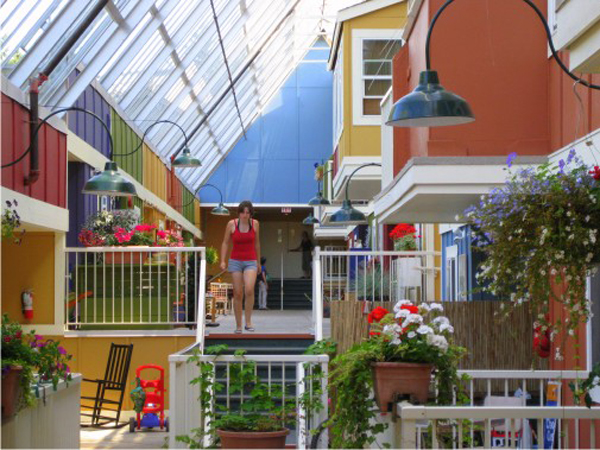
Windsong in Langley: Cited as one promising affordable housing prototype by Dane Jansen of dys architects, who helped design it.
The words "affordable home ownership" and "Vancouver" aren't frequently uttered in the same breath, but some innovative local projects suggest the tides are turning -- slowly. The discussions emerging from the Feb. 14 BuildEX Vancouver panel on living affordably in Greater Vancouver reflected what it is to live in this region; it's a place of infinite, Russian doll-style contradictions underscored by a widely felt, sometimes cloudily articulated notion that somehow things can be better.
The panelists disagreed with one another at times, but Brent Toderian, Sean McEwen, Dane Jansen, and Heather Tremain put forward a host of ideas on how to improve housing affordability, based on their extensive and varied experiences with building, planning, and designing housing in all forms.
The many specific idea cited by the four experts fall under three headings of "opportunities" the building, design and policy making community should seize, according to the panelists.
Opportunity 1: Creative affordable ownership initiatives
The Verdant town homes on Simon Fraser University's Burnaby campus are proof that a special alchemy of community-minded partnerships and creativity can create affordability when there may otherwise be none to be found.
Heather Tremain, principal of Urban Fabric Group, was involved with Verdant, a 60-unit wood frame development completed in 2007. She says it's a model for affordable home ownership that can and should be applied elsewhere. The units were designed primarily for families, a demographic often priced out of Vancouver's real estate market.
Verdant's smallest unit, at 518 square feet, sold for $129,000. Its largest, three-bedroom units, at 1,247 square feet, sold for $311,000. SFU Community Trust provided the lower-cost land, and Vancity Enterprises Ltd. handled the development instead of a standard high-profit developer. As well, the project eschewed traditional marketing strategies like expensive newspaper advertising campaigns, which can cost tens of thousands of dollars. Instead, marketers focused on more modest door-to-door campaigns, and achieved the same goals at a much lower cost.
"The objective of the work was to create family-focused, multi-unit residential building that would provide an affordable option in the university community," Tremain said.
SFU purchased some units to hold as rental stock, but most were sold to families. It was both an environmentally- and economically-sustainable project. While the objective was to create community and affordability, it was never treated like a charity.
"Everybody got paid," Tremain said. "We didn't squeeze the architects or whomever. It was a market project."
Tremain also points to Toronto's Options for Homes as a model for affordable ownership that could take shape in Greater Vancouver. The non-profit facilitates development and has since helped build more than 3,000 units of affordable real estate in the Greater Toronto area. How it works: Options creates a co-op, the co-op buys land, and then Options works for the co-op, alongside related professionals such as architects and planners. Homeownership Alternatives, a separate entity, finances the co-op. Homeownership Alternatives operates on the proceeds from previous Options projects.
"The market might deliver it at $290,000 a unit. They can deliver it at $190,000," Tremain said of Options for Homes projects. "One of the interesting things about them is they buy land in areas that are kind of the 'next' area. They wouldn't buy on Main Street right now in Vancouver. They'd buy on Fraser Street, they'd buy on Victoria Drive. So they get a benefit for being the new group into the market."
A no-frills approach to building and marketing the units also keeps costs down, she added.
Opportunity 2: Growing the non-market sector
Sean McEwen, a longtime community housing activist and Vancouver architect with an independent practice, called for architects and developers to re-prioritize the non-market housing sector.
"It's something we used to do much better 30 or 25 years ago. But we've forgotten how to do that, and it hasn't been a priority in society," he said.
"It's created a system where we told certain groups that you will have some difficulties, but maybe you'll have to move somewhere else," McEwen continued. "Rather than consider ourselves as closed systems, closed neighbourhoods where we want to protect what we have, we have to think of integrating the needs of others in society, especially the less fortunate."
McEwen was critical of the Vancouver Mayor's Task Force on Housing Affordability, which did not articulate many opportunities for non-market housing. To grow non-market housing in the current political and economic climate, he suggested using the conditional use zoning bylaw to leverage affordable housing opportunities; taking housing units as exaction for rezoning benefits rather than 'pay in lieu' scenarios; and finally, ensuring the voices of local groups are heard at city hall.
"We have too much of a top-down process in terms of planning our communities," he said.
Opportunity 3: Evolving more ways to share space, cost, amenities
Reducing the cost of living in areas like transportation and food is key to tackling the affordable housing conundrum.
"We have a double whammy here in Metro Vancouver," panelist Brent Toderian said. "We have the highest housing costs and below average national incomes."
To Toderian, affordable living means affordable food access, land that supports high-paying jobs, and strong purpose-built rental stocks. He suggests strategically mixing purpose-built rental housing into mixed employment areas close to transit hubs.
"There's nothing incompatible with rental housing and office space," he says. He noted, however, that Vancouver's supply of live-work spaces leaves much to be desired.
Car sharing has seen great success in the city of Vancouver, but it's enjoyed less traction in outlying areas. Dane Jansen, principal of dys architects, suggests Vancouver suburbs adopt peer-to-peer car sharing initiatives in which car owners rent their cars to neighbours. He points to Getaround, a peer-to-peer car rental program in San Francisco, California, in which users rent each others' cars for an average of $8 an hour.
For architects, Jansen says, "Building [housing complexes] with co-op cars in mind reduces the cost of the built form and reduces costs for residents."
A single stall of parking is about $35,000, and one car-sharing spot can save four to five stalls in a new development.
Jansen also supports alternative ownership and tenancy models, such as co-housing, joint-purchasing, and joint tenancy. To co-own living spaces like living rooms and kitchens can reduce the cost of buying a home. Tremain said such arrangements may gain ground among younger adults in their 20s and 30s.
"Maybe these new housing forms could start to solve a couple of our issues," Tremain said, referring to a 2011 Vancouver Foundation survey that found the top concern among interviewees was a growing sense of isolation.
Shared tenancy, shared ownership, co-housing, and car sharing could present solutions to some foundational ingredients for living well: living in community, and living within one's means. ![[Tyee]](http://thetyee.cachefly.net/ui/img/ico_fishie.png)
Jackie Wong reports on affordable housing issues for The Tyee Solution Society. This article is part of a year-long reporting project on affordable housing in the Lower Mainland produced by Tyee Solutions Society in collaboration with Tides Canada Initiatives Society. This series was made possible through the support of Real Estate Foundation and BC Non-Profit Housing Association. TSS funders and Tides Canada Initiatives neither influence nor endorse the particular content of TSS' reporting.
20
Login or register to post comments
Story
13 weeks ago
Fooling ourselves over and over . . .
I was never a math junkie but suffer me while I try . . .
Sale price of a three-bed unit, (assuming it to be a family unit), is C$311,000.
To move in a family needs to acquire a mortgage (less a 25% down payment of C$77,750: that alone, a family challenge) of C$233,250.
According to Scotiabank mortgage calculator, amortizing that figure over a twenty-five year period at 4.99% (a reasonable assumption for the future) would require monthly payments of C$1,355.27.
When CMHC started these shenanigans it recommended family mortgage payments at 25% of income. Now it recommends 30%.
BC median, (50% above, 50% below), family income 2010 = C$66,970. Yet, according to Scotiabank a family would require an annual income of C$54,000 to qualify for this three-bed unit which seems reasonable until the down payment is brought into the picture (and rates start rising as they surely must).
Then enter the second and third mortgages and loan sharks and that is where the system breaks down. Grand parents can help but sometimes they are under water too!
At that price Mummy goes to work, the kids are shunted off to school early and Mummy and Daddy are so pooped at the end of the day families have no other option, (as they watch units sit empty for the convenience of off-shore speculators), than to collapse in front of the telly before bed time with a good nite kiss!
Rather than scrambling around for superficial solutions sooner than later fractional reserve loan-outs and ponzi lending must come into focus. Until then . . .
Architects play with colours . . .
ModestyBlaise
13 weeks ago
Story
The Verdant project is an abnormality and is really only useful as a, pun intended, academic example. Verdant has almost no value in any general discussion vis-a-vis Vancouver area real estate pricing or legal status.
Verdant is on 99 year lease land from the Simon Fraser University Trust. Re-sale units have to be appraised by an SFU approved appraiser, then first offered to SFU faculty and staff for purchase at 20% below the appraised value, before the general market.
The prices noted were at sale time in 2007. Then, the project sold at around $200 sq'. Now, five and a half years later, you would expect to pay ~ $320 sq'. That is what unit there have been going for (June 2012 unit #125 sale). So your 1,247 sq' unit is now going for around $400,000.
The article doesn't mention how many of the 60 units were retained and owned by SFU Properties Trust. We presume that Verdant is managed as a strata. SFU's ownership of a number of units would give them a concurrent number of votes on the strata council. If they own more than 30 units then they can decide everything and they will control all budgetary decisions.
Hugh
13 weeks ago
Total interest paid in the
Total interest paid in the above example over the 25 years:
$173,000
or an average of $6,900 per year, or $575 per month.
Hugh
13 weeks ago
I used this mortgage
I used this mortgage calculator:
http://www.canadamortgage.com/calculators/amortization.cgi
gilbert marks
13 weeks ago
traylers n'containers n'prefab
You can buy a container home fully outfitted and mass produced for less than $10K in China. We should be able to do the same here.
There are hundreds of thousands of older trailers in BC,Alberta, and the US West readily available for under $10K.
All that is needed in to park these units on a steel structure or using temporary services on land held back for future residential/industrial/agricultural expansion.
Using the $35K cost of a parking stall as a worst case since the containing structure is just a steel frame, the maximum cost $50K per unit avg 500 sq feet, $100 per sq foot.
The containing structures would be mass produced and collapsible allowing the land beneath to be repurposed later on as needs be.
Right now the Chinese are building prefabbed 30 story hotels in 15 days at $100 a sq foot.
If we don't stop listening to the worthless artsies that make up our political class and start listening to our engineers like those that lead China, we are going to be an economic basket case in 30 years.
Hakuin
13 weeks ago
Glad we all see the only solution
Is government subsidy of housing for young families.
Hakuin
13 weeks ago
Uh Gilbert
A whole lot of Chinese are extremely dead right now from shoddy, corrupt construction. You SURE you want to use them as an example?
ModestyBlaise
13 weeks ago
Gilbert
Green home building policies
All new one- and two-family homes must comply to Vancouver's new green building requirements. By 2020, all new homes will be carbon neutral.
City of Vancouver.
wiley
13 weeks ago
go to the root of the problem
Instead of social sardine engineering, why not just prohibit absentee and foreign ownership of residential property in BC? Prices would soon come down to an affordable level.
This wont happen of course, as long as the boomers keep playing the ponzi realty scheme at the expense of future generations.
Hakuin
13 weeks ago
and how do you feel, Wiley,
about all that farmland being sold to China too?
gilbert marks
13 weeks ago
carbon neutral
Homes built out of recycled traylers and containers would be a greenies dream.
Bob Watts
13 weeks ago
Prices?
Even a cheap home in this story is working out to $248. per sq ft.
So you build a square room 25'X25'=625' that would cost $155,000
Sorry these numbers are all BS someone is stealing the farm here.
I built a new master bedroom which is 12'X30=360'ft it cost me under $9,000 but useing your numbers of $248.sq ft it would have cost me $89,280.
My new bedroom has an all new foundation, new roof, door, windows, it's own heating, lights etc outdoor light, gutters, carpet.
Ya, Ya a house has a bathroom, new toilet cost $99. bath tub $400.
To me all these so called social housing projects are overseen by public government workers, that really think lunch cost $85. per meal.
How about this, has anyone ever seen an appartment building on a First Nations Reserve?
Why not house 30 families under the same roof?
I talked with an RCMP captain that told me, to build one jail cell for two people cost over $340,000. that's a concrete closet with a stainless steel toilet!
Social housing is very simple to fix, just double welfare and senior shelter, rates and the free market will house everyone.
Welfare shelter rate of $375. per month was good money 35 years ago. Inflation happened to all of us but not to welfare and senior rates.
Bob Watts
13 weeks ago
More housing.
Our leaders do know that we have 70,000 foriegn workers in BC right now, not one of them in a homeless shelter, well maybe one!
Fact is our own citizen can't compete against foriegn workers.
Crusty does know it cost $60,000 per year to keep a person homeless.
This is done because an employer does not want to hire a BC citizen, that needs $600. in dental work.
Crusty is spending $17. million on talking about jobs training, yet we can't do a little dental work and teach a person how to serve coffee and donuts.
We have big expensive problems that could be solved if our leaders knew that could hire a person on welfare that really know how to balance a budget!!!
Hakuin
13 weeks ago
you can't be spending money on the poor Bob.
If you do that you lose the criminal class and then you risk having the working/middle class losing focus on the safe contempt-target and then who knows? They might even start looking at the one percent's doings. And we can't be having that now, can we?
Bob Watts
13 weeks ago
Yes Victims.
Funny that once you get to the higher levels of University Psychology it starts talking about society’s need for Victims. I love that!
I love how people who are only one or two pay cheques away from being homeless, sit and tell you how well off they are, and what losers the homeless are.
Last year we took a exbusiness woman to a Food bank lineup, she cried the whole time. In the years that I have known her she had nothing but contempt for the poor.
Yes the need for victims… I would love to think I don’t need victims… but maybe I do…. Because I do not need the Food Bank.
I think I maybe just more PO’d because the solutions are so simple, but to have no victims is contrary to human nature…..
Hakuin
12 weeks ago
here Bob, some bathroom reading:
http://books.google.ca/books?id=JtOl4At9OHEC&pg=PA83&lpg=PA83&dq=definition+of+the+unworthy+poor&source=bl&ots=7RUuyDEUAO&sig=tIZC55yvsSTND1Ma-4cdxS6zWbg&hl=en&sa=X&ei=HYMgUdH1EqH9igLj8oHABA&ved=0CGEQ6AEwBw#v=onepage&q=definition%20of%20the%20unworthy%20poor&f=false
Bob Watts
12 weeks ago
Hakuin
You have too much time on your hands, LOL.
Ah the 1730's where the chruch cared for the sick for a month, it was stated at the time that the chruch was richer than the king.
Today the chruch is on the government payroll, to supply services. The big change is in the past it was small pocks and yellow fever, today it is meth and crack.
In the past the USA had the great line of bring me your hungry, cold and huddled masses. The poor had a value in the past. Today poverty has become a billion dollar industry.
When it is said that a homeless person cost society over $60k per year that is a real number. The money never goes to the poor person but to all the service providers, and there in lies the problem. Providing homes and food to a poor person is socialism,OHOOOOOOOO NOOOOOOOOOOO!!!!!!
In Ottawa for 40 years now they have known that ending poverty in canada would save society over $60 billion per year.
NOT WITH MY TAX DOLLAR YOU DON"T!!!!
What if the Sally Ann had no one on their mats? No one to pray for! Hell with that, LOL.
reddy7
12 weeks ago
Most people agree that access to affordable housing is a right
Most people agree that access to affordable housing is a right, but housing where you want it is not a right to my opinion. Build lower cost housing near transit stations in the suburbs and blighted areas and you solve this issue: when it is easy to get anywhere in the city people are more willing to live anywhere. Transit oriented high density development is a no brainer.
Reddy from Speedy Loan Search
Bob Watts
12 weeks ago
After 3 million years....
After 3 million years and millions of generations of humans, and most of us, arrive in present day canada owning nothing!!!
They say the average welfare client owns $1,200 worth of cloths, bedding, TV, pots&pans, etc.
I have 300 X that amount, but that is because I had it all before I got sick.
I think the First Nations people are the most screwd, they own canada and all the trillions of dollars in natural resorces, yet most are on welfare and are regulars at Food Banks and Pay Day Loans stores.
To not own anything after our families have been on earth for over 3 million years, this is so very Wrong!!!
morechatter
12 weeks ago
Doctors, Lawyers, etc can't afford Vancouver's Real Estate
It is out of whack and will have to adjust or market will have to find buyers with plenty of cash to blow on their million dollar shacks. Building permits are down, immigrant continues at accelerated pace using up valuable resources like housing which is out of reach for many Canadians. Rents will continue to climb because fewer will be buying and immigration will add to the demand driving up rents.