How the leaderless movement reignited to fill gaps in New York City's hurricane recovery effort.
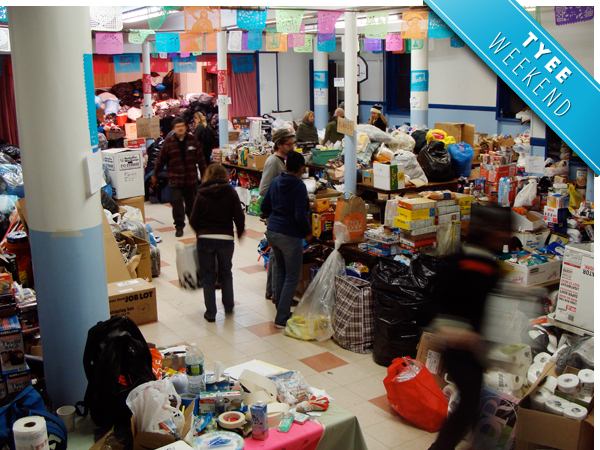
Even at night, the epicentre of Occupy Sandy, located in a central Brooklyn church basement, is bustling with volunteer activity. Photo by Sarah Berman.

-
One year after the movement sparked, The Tyee talks to two members still fired up.
-
Hundreds of meals a day dished up to all comers as donated food rolls in.
-
Vancouver site's open-source, collaborative style shows the might of a web-modelled world.
Nearly two weeks after Hurricane Sandy hit the East Coast, many New Yorkers are struggling to understand why parts of the city are still in crisis. By the time the lights in my East Village apartment returned, the citywide death toll had crept north of 40, thousands were still displaced and hundreds of thousands remained without basic utilities like electricity, water and heat.
Amid this darkness and uncertainty, a once-familiar movement reignited. Long before the first subway tunnels were pumped dry, members of Occupy Wall Street sprang into action, assessing the needs of people who lost everything in the storm.
"One of the core values of the Occupy movement is neighbours helping neighbours," explains Michael Premo, who also worked in New Orleans in the wake of Hurricane Katrina.
Premo says there wasn't a discussion about whether or not Occupy should help New York City recover from the superstorm; he and four friends who met in Zuccotti immediately began collecting donations for flooded communities in Red Hook, Brooklyn. "We already had the Occupy networks in place. The network was already abuzz checking on friends and relatives. We asked 'How can we help? What do you need?' and it grew from there."
Occupiers reached out through social media under the Twitter handle @OccupySandy. Locals responded. Tech and environmental organizations plugged in. By the weekend, volunteer turnout had ballooned well into the thousands, as ad hoc relief and distribution sites popped up in over a dozen neighbourhoods across Brooklyn, Manhattan, Queens and Staten Island.
In these still-early days of storm recovery, Occupy Sandy has been the first to reach many of New York's poorest and most ravaged communities. Volunteers muck out debris from family basements and deliver meals to seniors trapped in high-rise apartments without elevator service.
I followed several grassroots relief efforts from donation hubs out to heavily-impacted coastal communities. While this type of horizontal action cannot work alone (building inspection and search-and-rescue are best done by professionals), Occupiers are filling early gaps in the relief industry, making disaster recovery a human experience rather than a bureaucratic one.
The hive
By the time I arrive at St. Jacobi Church in Brooklyn -- now the buzzing epicentre of Occupy Sandy -- the chapel pews are piled high with garbage bags of donated clothes. Group orientations take place in 15-minute intervals. Volunteers wear nametags scribbled on duct tape. On the second floor, a tangle of laptops and phone chargers represent the movement's social media hub.
Whereas institutions like the Red Cross encourage monetary donations, Occupy accepts all supplies and skill levels. Batteries, flashlights, diapers, toilet paper, blankets, canned soup, candles, crackers, dog food and toothpaste are arranged and rearranged by size and category in the basement.
About a minute into my arrival, I am back outside packing a Honda with dinner trays bound for weather-beaten Staten Island. Other volunteers sort jackets, load flashlights with fresh batteries, prepare hot meals and haul heavy-duty cleaning supplies into vans.
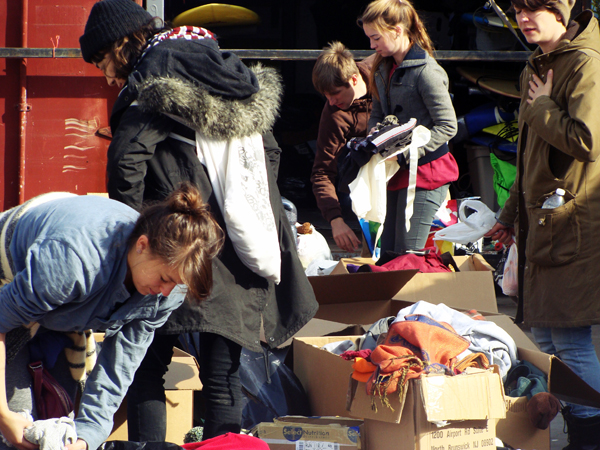
A surf club in the Rockaways transforms into an improvised food and clothing distribution centre in the wake of Superstorm Sandy. Photo by Sarah Berman.
To my surprise, many 20- and 30-somethings I speak with say they didn't protest against the banks in 2011. They told me Occupy Sandy was simply more accessible and hands-on than New York Cares or the Red Cross.
"The bulk of people that are driving, cutting vegetables, sorting clothes, those are just people that walked in this week," says Patricia González Ramírez, an organizer with an active Spanish-language newspaper for the Occupy movement called IndigNation. "But some of the cooks used to cook in Zuccotti, logistics and communications -- a lot of those people have experienced Occupy."
Responding to requests for more hot food, González helped open a second kitchen down the block, where Burt Wartell, a silver-haired Occupier hailing from Maine, hovers over a sink draining chickpeas. "My background is in hotel and food management, so I thought I could be of use here," says Wartell, who came to New York to visit his daughter Becky after the storm.
"The movement has had a year of experience building infrastructure from nothing," he says of the speedy, contagious response. The Occupy kitchen has sent out upwards of 10,000 meals every day of the week. "In the '60s we had the fire burning, but these kids have got the skills to get things done."
Success of self-organizing
Driving out to New York's Rockaway peninsula, a strip of beach decimated by flooding and fire, police direct intersections in the absence of working traffic lights. The National Guard patrols the main drag in camo-painted Hummers.
But further west, where public housing complexes tower over the horizon, Occupy was the first to respond with supplies.
"Past a certain point, we stopped seeing those services," says Billy Voermann, a video producer who ran cases of water up darkened stairwells to elderly residents. "In the nice parts of Rockaway there's already a dump truck on every street hauling debris off the roads. But further up the peninsula, in the poorer neighbourhoods, we were the only ones out there."
Voermann attributes Occupy's early effectiveness to a lack of bureaucracy. "They cut through any red tape," he says. "The Red Cross would have to wash all the clothes before sending them out -- it's just a slower moving organization."
Near downtown Rockaway, where grocery stores are still shuttered, a surf club has transformed into an improvised resource centre for residents. A club organizer notices my penchant for asking questions, and puts me to work conducting needs assessment interviews (a "delicate job" according to my orientation).
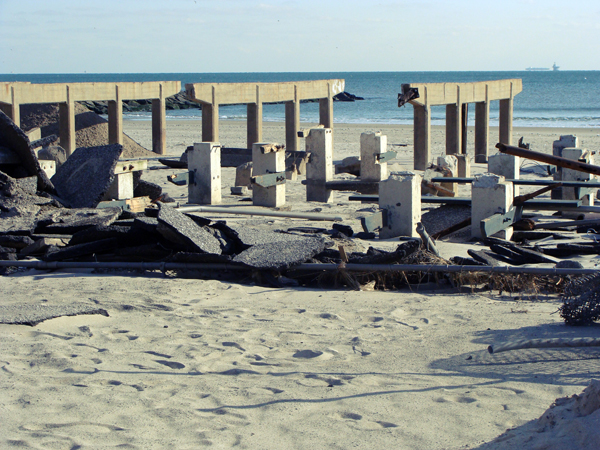
A popular boardwalk destroyed by Hurricane Sandy in Rockaway Beach, NY. Photo by Sarah Berman.
I ask some residents whether they are able to boil water at home and if they have any food allergies. Others focus on cleaning needs. This info allows other volunteers to assemble meaningful care packages that account for family size and level of damage.
Personalizing relief in this way defies the militarized traditions of Red Cross and America's Federal Emergency Management Agency (FEMA). The boxed rations these organizations distribute come with English instructions only; many immigrants do not realize the meals are "self-heating."
In this sense, FEMA is one kind of disaster Occupy has already rallied against: a top-down government agency offering victims more debt (albeit at reduced interest rates). "The problem with FEMA or the Red Cross is they come and impose a model and that's not what Occupy is about," says González. "It's more of a network to see how people can self-organize and access resources to rebuild their own communities."
Occupy's quick response in the week following Sandy earned shining press coverage across various media. But as Nick Pinto of the Village Voice points out, Occupiers can't restore power to the blackened stairwells or inspect houses for structural weakness; there's a wider institutional failure at play. ![[Tyee]](http://thetyee.cachefly.net/ui/img/ico_fishie.png)
Sarah Berman is a freelance journalist based in Brooklyn, NY.
14
Login or register to post comments
Hakuin
27 weeks ago
makes sense
the vacuum has to be filled. The bankster mortgage fraud that created so many homeless is just a preview for what climate change is going to do. It's not like any government is going to look after the people.
Okanagan Orchardist
27 weeks ago
Where are they??
Where are the rich Wall Street bankers who should be pouring money into this disaster??
At home, watching it all on TV?
FatherTheo
27 weeks ago
Not Paul Ryan's vision of America.
The defeated Republican candidate for vice-president was a follower of Ayn Rand, who despised this kind of altruistic behaviour. These are the people disparaged by Mitt Romney as the 47%--who only wanted a handout.
No, they didn't want a hand out. They wanted an America where, if someone was in trouble, they had a hand up--and here it was. Looking after each other. Nothing to do with laziness.
Bankers, billionaires, they're the lazy ones. Won't get out of bed unless you're paying them $100 a minute. That's lazy.
Hakuin
27 weeks ago
think about it:
http://en.wikipedia.org/wiki/Vagrancy_%28people%29
carfreecity
27 weeks ago
twitter
it gives me a good feeling to follow their twitter feed which they update frequently on what is needed and what is happening
they know how to be spontaneous, be here now and communicate well
this is Occupy 2 and they learned much during Occupy 1
alive
27 weeks ago
Watering down a good name!
Sorry, this is diluting the whole idea of the original occupy movement!
You can keep finding worthy causes for your volunteer instincts, but each time you drag the occupy name into it you also make that idea less significant!
The obvious next step for the occupy movement is a revolution, because that is the only thing left to do --- nothing else works!
Bailey
27 weeks ago
This is a great thing for the Occupy Movement
First off, it proves they are who they say they are; good neighbours fed up with bureaucratic ineptitude.
Second, it demonstrates to all and sundry the effectiveness of their organizational structure.
Third, it gives hope that the general corruption of the elitist governments has not stamped out all vestiges of human decency among the people. As these citizens step right in to restore or at least recreate normal social functions, they demonstrate the truth that all society belongs to all social beings who are alive in it, not to the so-called owners who believe they have successfully stolen it and cannot be dislodged.
It also, indirectly I concede, demonstrates that anytime the putative government fails to function, there is another alternative that can and will step right in to perform whatever is necessary to keep our society functioning as we wish it to.
How's that for democracy? Makes me proud!
alive
27 weeks ago
Bailey
So, what you are saying is, that we should get used to creating alternative solutions to the problems that government fails to do properly?
Is that not the same as throving in the towel and admitting that we cannot make government and democracy work?
My idea is that we pay taxes and elect leaders to handle all these problems; I see it as a declaration of failure when my hospital has to arrange for a fundraiser or the foodbank has to even exist
I realize there are people who need a venue for their need to make a difference, but I hate the idea that we should have to rely on that kind of "generosity"!
catchingupagain
27 weeks ago
occupy disaster relief, neighborliness & infrastructure failure
It is the height of humaneness to assist, and super of Occupy to jump to the real needs when others are busy bean counting...
A great opportunity to see how disfunctional the neoliberal/neocon dismantling of 'crown corporations' and their American variant is.
BC government just signed a Disaster Relief Agreement with the Red Cross. Lets tear that contract up and start a technology institute to train/mentor our local capacity to get real supplies to the real needs; create skills, careers and know where the supplies are at hand when needed. http://www.nytimes.com/2012/11/03/nyregion/anger-grows-at-the-red-cross-response-to-the-storm.html Leaving essential emergency services to the grace of individuals, or paying an NGO to do the work of 'civilization picking itself up after disaster' is a recipe for continued civic helplessness and arbitrary intervention. Kudos to Occupy for helping show this shortfall. But let's not institutionalize our current leader's drive for civic anemia.
Hakuin
27 weeks ago
Disaster? Here? In BC?
We damned well BETTER be making our own disaster relief organization. Quake's a comin' and if you think for a minute Stevie-Boy is going to pass up a chance to utterly crush western resistance to his feudal corporatist plots you're in greater denial than a republican in New Jersey.
There will be no help for us from anywhere east of Hope. The highways, the airports, the ports all will be unusable. No help from the military and certainly no help from the Americans since Seattle will be in ashes too. We are on our own and more; we will be under attack as well. No way in hell Harper will pass up the chance to break us into utter peonage. Any aid that does finally arrive will be to cronies and quislings and the timing will be arranged to consolidate power the way he wants it. Complete devastaion gives him the opportunity to rewrite our social contract as well as build whatever oil pumping stations he desires.
Stand on guard for thyselves, no one else will.
Hakuin
27 weeks ago
Ooh, a different spambot
This one looks like it defeats filters by running block text quotes through an autotranslator.
Can' t we at least agree spamming ought to be a capital crime? I still look wistfully back at Vardan Kushnir.
Bailey
27 weeks ago
Convergence
Alive asks me what I'm saying. A difficult question, since I say so much. Let me say this.
Recently here I've read stories about Julian Asange, stories about the intelligent organization of the Occupy movement, about the leaked lists of secret Greek and Spanish money laundering accounts with HSBC and Swiss banks, about the nature and structure of the frauds and corrupt practices that have become commonplace and the absolute failure of government or police to even start to do anything about it.
On the CBC News today I heard about some crooked public official in Montreal who doesn't feel the need to apologize for taking hundreds of big bribes because it was part of his job, everybody was doing it and besides, it was fun. What could be wrong with that?
I read a story about the way the Stasi acculturated the German psyche to create an almost universal spy system based on denunciations of everybody by anybody.
I know that failure to prosecute grievous crime is complicity. To allow, say for example, huge drug cartels to operate with police protection automatically tells us the police are not really police. When government not only allows fraud and criminal behaviour in banks and other corporations, but removes laws and regulations to make prosecution impossible, they are not really government at all, just more crooks pretending to be.
Basic democracy says that government can only proceed with the consent of the governed. It's not a law that can be repealed, it's a basic condition. If the governed withdraw their consent, it then becomes the duty of the citizen to create new structures to replace the corrupted ones. Honest structures to which we can consent safely.
Cyndi Lindley
24 weeks ago
On the CBC News today I heard
On the CBC News today I heard about some crooked public official in Montreal who doesn't feel the need to apologize for taking hundreds of big bribes because it was part of his job, everybody was doing it and besides, it was fun. What could be wrong with that?
http://www.webics.com.au/web-hosting
ayomi
16 weeks ago
Recruitment to Recruitment Sydney
Important engineering jobs are all over around the world & you can locate lots of recruitment agents to help you find jobs in this neighborhood. http://www.carlinhall.co.uk/