
How Much Is One Killer Airplane Worth?
The $475 million price of one F-35 could buy a lot of social good. What would you have government spend it on?



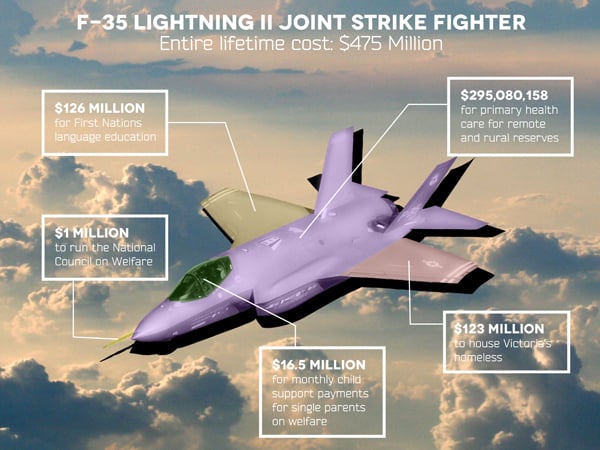
Illustration by April Alayon for The Tyee Solutions Society.
Illustration by April Alayon for The Tyee Solutions Society.
Two years ago the federal government announced its intent to purchase 65 F-35 Lightning II Joint Strike Fighter aircraft for the Canadian military. The Department of National Defense justified the $9-billion expense as part of the Conservative government's plan to renew military infrastructure, and "defend against the threats of the 21st century at home."
In 2011 Parliamentary Budget Officer Kevin Page took another look at the purchase, and put the lifetime cost of the planes at over $29 billion -- about $450 million per plane, including the upgrades and maintenance required over a 30-year period. That's in 2009 numbers, though, meaning the total in 2012 dollars is $475 million.
It may go higher. A contract outlining a set fee for the planes has yet to be signed. And Page reported significant delays in the planes' production, increasing costs that meant prices could be subject to change. The government claims Page's estimate is inflated, but has handed responsibility for the acquisition over to the Department of Public Works and Government Services from the Department of Defense. A House of Commons committee is now re-analyzing the procurement numbers and hopes to reveal a new official cost in the fall.
But let's take the Parliament's Budget Officer, a man enlisted for his ability to understand numbers, at his word: let's say one F-35 Lighting II Joint Strike Fighter will cost Canadians $475 million.
We want our Canadian pilots to be well equipped (although there's a lively debate over whether the single-engine F-35 meets that test in the Canadian arctic). But so often we hear that just a little money would keep the lights on in this community service or that social program. Three million Canadians live below the low-income cut-off line. As many more again are at risk of being without shelter.
That prompted us to wonder: What if we only bought 64 planes instead of 65? What if we targeted the other $475 million at some of the harms not just threatening but often defeating millions of Canadians, "in the 21st century at home?" What other kinds of security could the price of a single jet plane buy?
We asked economists, anti-poverty organizations, and social policy thinkers for a wish list of what $475 million could buy in the way of programs to help neutralize the risk of low-income Canadians breaching our social safety net and falling into homelessness and a life of poverty. Here's just a sampling of what that money, deployed for civilian instead of military causes, could afford.
A room of one's own
In 2010, urban health think tank the Wellesley Institute estimated that 3.1 million Canadian households were "housing insecure," meaning they spent more than 30 per cent of their income on shelter. At the same time, about 300,000 people were visibly homeless at least once that year, while as many as 900,000 were "hidden" homeless: staying with friends or family, sleeping on couches.
Megan Yarema, director of education and outreach with the national charity Canada Without Poverty, estimates that for an extra $2 billion the federal government could create or repair enough social housing to give secure accommodation to every Canadian. But that would also mean foregoing four new planes. So how much housing could the $475 million price of a single plane buy?
Spread across the country, perhaps not a great deal. According to the Wellesley Institute, a new unit of social housing in Canada would cost on average $180,000. Spread across 10 provinces and three territories, $475 million would only cover 203 units of housing each, whereas B.C. alone needs 2,000 new units of social housing right now to meet needs.
That average price doesn't take into account larger units for families with more than one or two kids, either. Bigger units would cost more, bringing the total number of people helped below 150 -- or a few more "if cities already had land,” Yarema says, "as that would bring down the cost."
Targeted in one place, however, $475 million could do rather more. It might, for example: put a roof over the head of every homeless person in Victoria, with money to spare to operate its supportive housing for almost 27 years; provide 4,750 new social housing units for employable homeless in Alberta, a province that needs 8,000 new affordable housing units to end homelessness. The same $475 million could build 3,167 new houses on Aboriginal reserves, which sounds like a lot but would in fact address only four per cent of the identified housing need there.
Even a small investment in housing can make a difference though. The Community Social Planning Council estimates that each new unit of social housing in B.C. will cost $200,000 to build. But the federal government has all but retired its social housing program, spending less and less over the past 20 years, while the B.C. government has been notoriously slow in breaking ground on new social housing.
This leaves non-profits searching for ways to secure housing for those in need. But without equity of their own, borrowing to build social housing means mortgage payments that may be too high for affordable rental rates. Alice Sundberg of Vibrant Surrey Poverty Reduction Society says if the federal government put $475 million into providing non-profits with capital grants of $50,000 per unit for housing -- and the provincial government matched it -- non-profits could leverage the support to build 9,500 new units.
"You'll have 50 per cent of the equity that you'll need for your units," Sundberg told The Tyee Solutions Society.
"What governments are really trying to avoid are these long-term commitments to pay a (rental) subsidy for a term of the mortgage. So if they can instead provide a capital grant, it allows the society to leverage more dollars and still provide affordable rent. Then there's no further requirement of the government to be involved."
Put that in context: one foregone fighter jet could end housing insecurity for almost 70 per cent of the 13,500 families and individuals on BC Housing's wait list -- more than 1,000 of them listed as a priority because of homelessness, medical need or other emergency situations.
And Sundeberg isn't talking about people with addiction or mental health issues that require extra support, like life skills training, 24-hour onsite staff or meal programs. Rather, she says, "it's [housing for] people who can live in the community. Many of them are working poor," who can't afford clean and safe shelter suitable for their individual or families' needs.
Taking care of children
Stable housing gives families a chance to disrupt the cycle of poverty. But in order to stay out of poverty, families also need an adequate income. For parents of young children without affordable childcare, that's hard to achieve.
Childcare spaces are a scarce commodity in B.C. Families shell out anywhere from $600 to $2,000 a month for childcare of varying quality. The Canadian Centre for Policy Alternatives is asking Ottawa to invest $2.3 billion this year alone to meet national childcare needs. The Coalition of Childcare Advocates of B.C. meanwhile puts the additional cost to taxpayers of introducing good quality, affordable childcare here for one to 12 year-olds, at $1.2 billion over five years.
If B.C. were to adopt a provincial childcare strategy for just three to five-year-olds, into which government put $4 for every $1 that parents were required to pay, $475 million would keep more than 45,238 children in care spaces for a year or support two years of care for 22,619 children.
The investment would pay for itself, Yarema says.
"Publically funded childcare not only helps families economically, but it also allows more women to enter and stay in the workforce," she said. "In Quebec, where a universal childcare program is in place, labour force participation of women has increased. This means more financial stability for families and more money into the economy."
Buoying the poorest
Economist Iglika Ivanova spoke for almost everyone we recruited for this article when she pointed out the mismatch between the price of the world's most advanced production warplane, and the cost of helping people through social programs. In short, flying war machines are a lot cheaper than programs designed to help people.
Said Ivanova: "If you're going to actually look into reducing poverty, [$475 million] is a small amount for the country as a whole."
But again, it's a number that could make a big difference to a province, says Ivanova, who works for the B.C. office of the Canadian Centre for Policy Alternatives. It could, for example, increase welfare rates in this province for a year, by $200 for individuals, $300 for couples without children, and $400 for couples and single people with children. Equivalent to a monthly raise of between 32 and 42 per cent, the extra generosity would cost $383 million per year.
It won't bring individuals or families above the poverty line, but Ivanova says it's a start. "What that money would do for the families, is increase the embarrassingly low rates we have now," she told The Tyee Solutions Society.
The leftover funds could return some money to single parents on social assistance whose child support payments are now being clawed back through deductions in their monthly cheques. In B.C., the amount of child support a non-custodial parent owes depends on their annual income (although a judge ultimately determines the payment). For example, a father who makes an annual gross income of $36,000 would likely have to pay $327 per month in support for one child. But if the mother is on welfare, that $327 is deducted from her monthly cheque as unearned income, leaving her no further ahead.
Before welfare reforms in 2002, parents could keep up to $100 of their monthly child support payments. Ivanova would like to see that returned for the 13,760 single parent families on welfare as of June 2012: "If every single-parent family has $100 a month exempt [from clawback] that would be $16 million (per year)."
With $475 million, minus the $383 million to buoy up monthly welfare payments, we could support that payment for five years.
The lifetime costs of one jet could also ensure food security for over 13,000 people on disability assistance. While higher than B.C.'s welfare rates, disability assistance still falls below the low-income cut-off line in most areas of the province after tax. A single person on disability receives just $10,872 annually, not including GST/HST or carbon tax rebates, or any other benefits like Canada Pension Plan Disability Benefits.
Someone on disability in B.C. who is able to work may earn up to an additional $800 per month, enough to put a single person just over the poverty line in a city the size of Vancouver. But if you can't work or find a job, you have to make do on $906 a month for housing, clothing, and food.
One foregone F-35 would cover $100 extra per month for 13,194 people on disability assistance for 30 years. It wouldn't be enough to pull them out of poverty, but it might allow for such small quality-of-life improvements as better food.
And that's just one jet.
"If all 65 jets were not purchased and those monies were instead spent on food security for the most vulnerable, some 857,639 people -- almost equal to the number of people using food banks every month -- could be supported over 30 years," Rob Rainer, executive director of Canada Without Poverty told The Tyee Solutions Society via email. "Bombs or bread, indeed."
Support for Aboriginal people
The 2012 federal budget promised new support for Aboriginal Canadians, including a $275 million investment in Aboriginal education. But Aboriginal leaders have dismissed the number as insufficient to meet the underfunded needs of Canada's Aboriginal youth.
An additional $475 million would almost triple resources for Aboriginal education. But the Assembly of First Nations (AFN) points out that the price of one jet could also cover the one-time cost of 38 of the 40 new schools needed on Aboriginal reserves (at an average of $12.5 million each). Or it could pay the $126 million annual cost of funding First Nations language education for three and a half years -- bringing First Nations language instruction up to the same level as public school language programs.
Or how about funding primary healthcare (visits to family doctors, nurse practitioners, pharmacists, etc.) for residents of remote Aboriginal communities? One foregone fighter plane would cover the entire cost of primary healthcare for men, women and children in 70 of the nation's most remote and isolated Aboriginal communities for a year, with almost $180 million left over.
How Much Is One Killer Airplane Worth?: Page 1 of 2
What have we missed? What do you think? We want to know. Comment below. Keep in mind:
Do:
Do not: