
Taking Ferries Private Causes 'Hardship' for Many: Commission
Sweeping recommendations include limiting fare increases, upping gov't contributions.



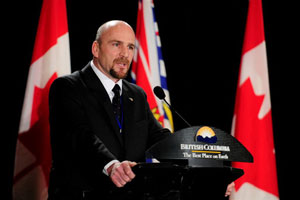
Harsh assessment for Transport Minister Blair Lekstrom: Fare affordability to 'tipping point' says ferry commission.
Harsh assessment for Transport Minister Blair Lekstrom: Fare affordability to 'tipping point' says ferry commission.
A report by the British Columbia Ferry Commission recommends restricting fare increases, increasing the government's contributions and creating a free reservation system for travellers.
It also calls on the government to develop a long-term vision for the ferry service.
"Current ferry fares and the proposed increases have reached the tipping point of affordability and are imposing significant hardship on ferry-dependent communities and the ability of people to visit family members and friends as frequently as they would like," said the 104-page Review of the Coastal Ferry Act written by commissioner Gord Macatee and his deputy Sheldon Stoilen.
The B.C. government passed the Coastal Ferry Act in 2003. It made the financial stability of the ferry company, which moved from being a Crown corporation to a publicly-owned private company, the top priority. It pushed toward a "user pay" system, where the users of each route were to cover more of the cost of the service.
"The issue with this model has been its effect on affordability," said the report released Jan. 24, the day it was legally required to be done. "Due to a combination of factors, including a downturn in the economy, a decline in ridership, reduced tourism and particularly the application of the greater reliance on the user pay principle, ferry fares have risen sharply across the system, especially so in the less populated parts of the B.C. coast."
From 2003 to 2011 the consumer price index (CPI) in B.C. went up by 14 per cent, but fares went up much quicker. The smallest increase, on the major routes between Vancouver Island and the Lower Mainland, was 47 per cent, or more than three times the CPI. On the minor and northern routes, the increase was 80 per cent.
The view ahead showed more of the same, the report said. "Projections for the next performance term currently indicate four more years of high fare increases, with every reason to expect even larger fare increases in the following performance term, when a large bulge in capital spending in relation to planned fleet replacement is scheduled to occur."
The government's contribution, on the other hand, failed to keep pace with inflation.
Make ferry users priority
In preparing the report the commissioners held 27 public meetings in coastal communities, had other meetings with local politicians and stakeholders, and received over 200 written submissions.
They came up with 24 main recommendations, including:
- Making the protection of the taxpayer and ferry users -- defined broadly to also include family members and businesses in ferry-dependent communities -- the commissioner's primary responsibility. Protecting the financial sustainability of the ferry operator would become the commissioner's secondary responsibility. "The commissioner should also have the authority to determine the respective interests of the ferry users, the taxpayers and the ferry operator and how best to balance those interests," it said.
- Eliminating the ban on using money from the major routes to subsidize the other routes and getting away from the user pay philosophy legislated in 2003.
- "The province should work collaboratively with BC Ferries to develop a long-term vision of coastal ferry services in B.C.," it said. "A draft discussion paper should go out for public consultation. The resulting vision should be formally adopted by the province and provide the basis for the long-term capital plan of the ferry operator."
- The commissioner should be given a greater role to approve the long-term capital plan and any major investments such as new vessels, upgrades or terminal improvements. The office would also be given authority to approve changes to service levels.
- The province should consider increasing the taxpayer-funded subsidy it provides to the ferry operator so fare increases can be held to the rate of inflation.
- Municipal or regional governments should be able to contribute funding to keep rates down on a local route, or be able to add a "marketing surcharge" to promote destination tourism that may increase ferry ridership.
As part of the review, the commissioners compared the B.C. system to those in places including Washington State, Alaska and Europe. "All of the comparable ferry systems we've looked at depend on public funding to survive," they wrote. "The B.C. ferry system is presently less dependent than many others, but the re-investment that is needed over the next decade is only going to be possible with more contributions from the taxpayer."
It also suggested turning the reservation system "upside down," so that it would be free to book ahead on a particular sailing but those who arrive at the terminal without a booking would pay more. The change might turn out to be revenue neutral, the report said.
'The gap is wide': commissioner
"It turned into a much bigger project than I ever imagined," said Macatee in an interview.
He'd announced the review last May after just a couple weeks on the job. It ended up including a large amount of public consultation and visits to numerous communities, and there was much to pull together for the report, he said.
On Jan. 23, the day before it was legally required to be submitted, the report was at a printers in Vancouver. It was flown to Victoria on the last floatplane that night so it could be available for release first thing in the morning, a time chosen to line up with Transportation and Infrastructure Minister Blair Lekstrom's schedule.
"I really think the huge challenge is this decline in ridership and the effect it's having on financial sustainability," said Macatee. There is a gap between what comes in as fares, despite the increases, and what the system costs to run. "The gap is wide" and getting wider, he said.
Speaking to reporters earlier in the day, Macatee was asked about the recommendation to increase the government's subsidy to BC Ferries, which is now about $150 million (plus another $27 million from the federal government). "I'm not going to try to pin the government with a specific number," he said. But he noted that for every 10 per cent reduction in fares it costs about $50 million.
There would be little to gain by cancelling sailings, since much of the cost is labour, unless it is possible to cancel whole shifts, he said. Doing so might mean no service for part of a day or a whole day on some routes.
Taking Ferries Private Causes 'Hardship' for Many: Commission: Page 1 of 2
What have we missed? What do you think? We want to know. Comment below. Keep in mind:
Do:
Do not: