

When King Abdullah's speech was released by the Saudi Press Service on Sunday, my first reaction was stunned amazement. The second was to think of Dr. Aisha, a physician I'd met in Riyadh eight years ago.
"Women will be allowed to participate in the Shoura Council as members from the next session onwards," the aging king announced, referring to Saudi Arabia's appointed legislature. They will also be allowed to vote in municipal elections -- and even to stand as candidates, he added.
Given that it remains a crime for women to drive in Saudi Arabia, almost nobody had expected such a development. Except Dr. Aisha, who predicted it in 2003. "In a decade, maybe less, everything will begin to change," she said in an interview at one of the Saudi capital's top hospitals. "The reason is people like me."
What she meant is that a dramatic generational shift has been underway on the Arabian Peninsula for years, obscured by the stubborn longevity of her country's ruling family.
Hidden generational shift
Since its establishment as a state in 1932, Saudi Arabia has never been governed by anyone but its founder, King Abdul-Aziz ibn Saud -- who was born in 1876 -- or one of his 37 sons by 22 wives.
In Canadian terms, it would be as though no one had been prime minister since the Roaring Twenties except Conservative R.B. Bennett and his offspring (had the bachelor married even once and produced any).
"Many of my grandfather's children were raised in Bedouin tents, and retained a very archaic view of how life should be led. Some were barely literate," a third generation prince told me. "But those who were chosen to be kings had an instinctive understanding of power."
Meanwhile, as Dr. Aisha put it, people like her were proliferating in the shadows of their elders' entrenched power. What most distinguishes them is higher education, usually abroad.
Aisha is a graduate of Stanford and an Ivy League medical school. "The experience changed me forever," she said. "I began to see everything through different eyes, and as a woman, I agonized about coming back here. But as a medical professional I felt an obligation to return and do my part to move the country ahead."
In 2011, an estimated 100,000 Saudi citizens are enrolled in foreign colleges and universities, 54,000 of them in the United States, enormous numbers for a nation of 22 million.
The primary motivation of these students is "openness to others," said Khaled al-Anqari, the Saudi minister of higher education, speaking at a gathering in Washington, D.C. on Sunday. He said the kingdom is determined "to build bridges of scientific communication and cultural exchange through a variety of paths, one of the most important of which is the sending of students abroad to study."
The walls of the kingdom
On a six-month assignment to Saudi Arabia in 2003, I met dozens of younger people whose eyes and minds had been opened by their experence overseas. They vastly outnumbered those who, like some of the Sept. 11 terrorists, had embraced violent extremism after living in the West.
The effects reach deep into the ranks of the third and fourth generation of the ruling Saudi family, men and women alike. Many have not only studied overseas, but at the most liberal institutions.
"We know very well that change must come, that we will one day have to build some version of a genuine democracy and give scope to the energies of our talented women," a leading Saudi prince in his forties told me. He was a Yale grad in economics and a Harvard M.B.A., "but above all a Red Sox fan," he laughed.
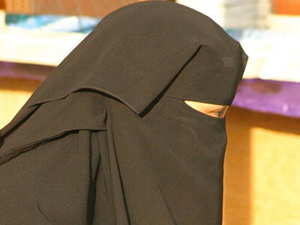
Like Dr. Aisha, the prince asked that I not use his full name. As a guest in his Riyadh home, I was able to speak freely with his wife and daughters, none of whom were veiled in accordance with Saudi law.
It was a breath of fresh air in a tightly compartmentalized society. When I dined at the homes of other, less daring acquaintances, wives were kept behind closed doors in another part of the house. At restaurants, women ate in separate rooms. In the nation's commercial malls, they were obliged to shop on specific days, when men unaccompanied by their families were banned.
Gender is not the only wall. The nation's 6 million imported workers inhabit boxes of their own, laborers from elsewhere in the Middle East and Asia in crowded dormitories, high-paid professionals and entrepreneurs in gated suburban subdivisions outfitted with western-style supermarkets.
What made Dr. Aisha's life even more unusual than the home of the Red Sox royal -- and in retrospect, predictive -- is that it ignored all of these walls. "I've had princes and their wives as my patients, as well as several colleagues from Canada and the States," she said. "But I've also done my best for Sri Lankan maids and Filipino taxi-drivers. There's no difference for me. They were ill and I'm a doctor."
Dr. Aisha is an expert oncologist, with research papers published in the globe's leading medical journals. In a country where men and women are forbidden to shop or dine together, she was tacitly allowed to probe the most intimate secrets of both.
Put simply, her sheer expertise, acquired in California and New England, trumped the kingdom's restraints on female roles and possibilities.
Demographic realities say this is the future. The sons of Abdul-Azziz will soon have to yield to the generation of the Red Sox prince and Dr. Aisha. They are the internal force pressing for reform in Saudi Arabia.
External pressures
The reform agenda has also been accelerated by the startling events of the Arab Spring -- and arguably even more by the prospect of change in Iran, Saudi Arabia's longstanding rival in the Islamic world.
The kingdom grew considerably more repressive during the 1980s, in direct response to the Ayatollah Khomeini’s revolution. "The feeling was that we had to out-fundamental them, or we would lose our influence," a veteran Saudi official said in 2003.
Today the social vectors are pointing in the opposite direction. In addition to the demands of insurgents in Iran and Arab North Africa, Riyadh must acknowledge the example of Turkey, which offers a new and immensely popular model of political Islam that merges pious values with secular democracy.
Nonetheless, the kingdom ruled by Abdul-Azziz's progeny is not just another country, competing on equal terms for global influence. As the birthplace of Islam and the site of its two holiest shrines in Mecca and Medina, Saudi Arabia carries weight -- social and moral -- far beyond the modest size of its population or the astronomical value of its oil reserves. ![[Tyee]](/design-article.thetyee.ca/ui/img/yellowblob.png)
Read more: Gender + Sexuality






Tyee Commenting Guidelines
Comments that violate guidelines risk being deleted, and violations may result in a temporary or permanent user ban. Maintain the spirit of good conversation to stay in the discussion.
*Please note The Tyee is not a forum for spreading misinformation about COVID-19, denying its existence or minimizing its risk to public health.
Do:
Do not: