- Ms Kaye is a Tyee Builder. You can be, too.
- Mary Carlisle is a Tyee Builder. You can be, too.
- Prem Gill is a Tyee Builder. You can be, too.
- Nancy Flight is a Tyee Builder. You can be, too.
- Justin Everett is a Tyee Builder. You can be, too.
- John Westover is a Tyee Builder. You can be, too.
- Nora Etches is a Tyee Builder. You can be, too.
- Edward Henderson is a Tyee Builder. You can be, too.
- Bharadwaj Chandramouli is a Tyee Builder. You can be, too.
- Dean Chatterson is a Tyee Builder. You can be, too.
- Marius Scurtescu is a Tyee Builder. You can be, too.
- Robert Parkes is a Tyee Builder. You can be, too.
- James Murton is a Tyee Builder. You can be, too.
- Susan Doyle is a Tyee Builder. You can be, too.
- Vincent Strgar is a Tyee Builder. You can be, too.
- Helen Spiegelman is a Tyee Builder. You can be, too.
- Subir Guin is a Tyee Builder. You can be, too.
- Kimball Finigan is a Tyee Builder. You can be, too.
- Joanne Manley is a Tyee Builder. You can be, too.
- David Leach is a Tyee Builder. You can be, too.
'Biggest Rollback of Worker Rights in Canadian History'
That's how one scholar terms Campbell-era policies. Part two of the decade's top 10 labour stories.
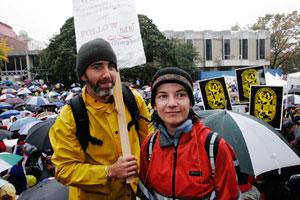
Teachers Mark Beadet and Nicole Beaudet of Maple Ridge at 2005 BCTF support rally. Photo: Nick Westover.
Yesterday we kicked off our Labour Week coverage by presenting five of the top labour stories of the past decade, an era shaped by sweeping policy changes by the Campbell government as well as wider economic forces. Our list is based on conversations with union and business leaders, academics and activists. Yesterday's stories included the changing face of B.C. labour, Bill 29 and the Supreme Court ruling against it, sliding workplace safety, regulatory changes crimping organizers, and B.C.'s lowest minimum wage in the country. Today we round out the top 10 list, followed by some perspectives from people we interviewed to create the list.
6. The Stranger at the Door: Temporary Foreign Workers and Response
One of the stories that just kept coming all decade had to do with the controversial increases in the number of non-Canadian workers brought here as temporary workers, with critical comment focused both on the exploitation these workers were exposed to by their vulnerable status and the impact these labour imports had on the ordinary workings of supply and demand, making it easier for employers to keep wages down and unions weak.
In 2006, controversy swirled around a group of European ironworkers brought in to work on the Golden Ears Bridge project. That same year, a group of Latin American tunnel workers hired on Vancouver's Canada Line project joined the Construction and Specialized Workers Local 1611 after telling union organizers they were being paid substandard wages and provided with housing and other benefits inferior to those the company provided European workmates.
This dispute, which has dragged on through numerous Labour Relations Board hearings, led to a BC Human Rights Tribunal ruling http://www.joconl.com/article/id25136 that held the Latin American workers had experienced wage and benefit discrimination while working on the Vancouver project.
While construction workers made a lot of temporary foreign worker headlines in B.C., the majority of the over 250,000 temporary workers who were in Canada in 2008 worked in Canadian fields. One of the ongoing and important labour stories of the decade has been about attempts to unionize agricultural workers, an effort led by the United Food and Commercial Workers through their Agricultural Workers Alliance, which operates 10 store-front organizing centres across the country, including one in the Fraser Valley, where several successful organizing drives have been conducted this decade.
The most recent example of ways offshore workers can face exploitation in Canada (and what unions can do to counter it) was the revelation this summer by the B.C. Federation of Labour that a group of African workers (in this case recent immigrants) employed by a contractor to do silviculture work for the provincial government were being housed in filthy conditions, subjected to death threats, worked 15-hour days and paid erratically and at a lower rate than promised.
7. The Big Get Together in the Woods
In 2004, the Industrial Wood and Allied Workers union, the industry giant that had represented B.C. loggers and millworkers for decades, voted to merge with the United Steelworkers, forming what was described then as Canada's largest private sector union. The merger represented the end of an era, retiring the IWA identity after a tumultuous history that began in 1937, and came as a combination of difficulties created by trade agreements, struggles with environmentalists, climate-change-induced pine beetle infestations and profligate raw log exports shrank the B.C. work force in the province's woods and mills.
8. Showdowns at the Public Service Corral
Some of our sources saw a trio of public sector strikes, taken together, as one of the decade's big labour stories. The Ferry Workers strike in 2003, the HEU strike in 2004 and the BCTF strike in 2005 all followed a similar pattern. The strikes were defined as "illegal" and elicited strident media coverage about "holding the public to ransom," while other unions (most notably CUPE) and community groups organized mass pickets and other solidarity actions, with some militants hoping the specific strikes could be kicked up into a general strike of all organized workers against a government seen as profoundly anti-labour.
In all three cases, union leadership climbed down (typically at the urging of the B.C. Fed) from any visions of a general strike and cut deals with the employer that were met with accusations of "sell out" from the most militant members and observers, while more centrist commentators said union leadership had settled for the best deals possible with a hostile government.
9. Family Feuds
Organized labour is like a family in some ways, and the B.C. labour movement was not without its moments of internecine conflict. In 2003 and 2004, the soon to be defunct IWA came under fire for what some observers saw as illicit attempts to sign voluntary agreements with private contractors like Compass and Sodexho that were eager to take advantage of the business opportunities created by Bill 29 and its mandate for health-care sector privatization. These "partnership" deals were viewed as collusion with the government in its attacks on the Hospital Employees Union, which had signed valid contracts with public employers to represent the workers.
In 2009, an attempt by the B.C. Nurses Union to raid the licensed practical nurses represented by the Hospital Employees Union brought down disciplinary action by the B.C. Federation of Labour and the Canadian Labour Congress, while the raid was unpopular with some of the BCNU's own membership as well.
Several other B.C. unions found themselves in the uncomfortable role of employers enmeshed in labour disputes with their own unionized employees this decade.
In 2007, the B.C. Teachers' Federation lived through a bitter dispute with its research and professional staff represented by local 464 of the Communications, Energy and Paperworkers.
In 2009, the Telecommunication Workers Union, which represents workers at Telus, faced a labour dispute with 13 office workers represented by the Canadian Office and Professional Workers.
10. Employers Weigh in: Agenda Unfinished
In addition to conversations with union officers, members and staff, as well as union-side lawyers and academic experts, The Tyee spoke with some prominent spokespeople from the other side of the bargaining table, including Jock Finlayson at the B.C. Business Council and Phil Hochstein, of the non-union construction employers' umbrella organization the Independent Contractors and Businesses Association of BC. Both Finlayson and Hochstein agree that the decade has been remarkable for relative labour peace.
For Finlayson, among the decade's key stories are the reductions in union density and the increased role of public sector unions in the movement.
Hochstein highlighted what he saw as the need for expanded immigration and use of temporary foreign workers to meet employers' hiring needs. He also said restrictive labour practices enforced by B.C. union contracts were responsible for what he said were B.C.'s lower-than-Canadian-average productivity figures.
'Biggest rollback of worker rights in Canadian history'
So, what conclusions can we draw from these stories and from the reflections of many seasoned labour relations observers? Here are a few.
The decade has seen the Campbell Liberals radically re-structure the legal and administrative bodies that govern labour relations in B.C., mainly in ways that tilt the regulatory playing field to give employers the home-team advantage on wage rates, employment standards, compensation for injured workers and the creation of new unions and union contracts.
"The removal of union members from Employment Standards protections, the exclusion of farm workers and the other changes in Employment Standards mean that at least a third of the workforce has been removed from ESA protection," noted SFU women's studies, economics and political science Prof. Marjorie Griffin Cohen.
"We are losing union density and that will continue," commented CUPE B.C. President Barry O'Neill. "Limits on union growth have been created by changes in the Labour Relations Code."
"One of the big stories this decade has been the destruction of employment standards in B.C.," HEU media spokeswoman Margi Blamey said.
Bill Saunders, head of the Vancouver and District Labour Council agrees. "The new rules the Liberals have brought in favor the corporations. They want to create a desperate workforce."
Lucy Luna, who organizes farmworkers in the Fraser Valley for the Agricultural Workers Alliance, says that one ruling by the newly employer friendly Labour Relations Board in 2008, which made temporary workers fear that employers can now get away with punishing them for joining a union by sending them home as soon as they unionize "has made my work almost impossible."
Sauder School of Business professor emeritus Mark Thompson calls the changes to the Employment Standards Act "the biggest roll back of worker rights in Canadian history."
Kim Pollack of the United Steelworkers told The Tyee that changes made to the Forestry Act in 2004 created a much more dangerous workplace, with safety de-regulated, increased subcontracting and a race to the bottom on safety procedures, resulting in 43 deaths in the woods the next year.
As evidenced by this testimony from the woods, worker safety continues to be an ongoing and sometimes heartbreaking story, as B.C. workers continue to die or come home crippled while trying to earn a living.
And more and more temporary foreign workers are being brought into B.C. under federally sponsored programs that critics say are consciously designed to drive down local wages and insulate employers both from the law of supply and demand and from collective bargaining.
Seth Klein, of the Canadian Centre for Policy Alternatives, said that the explosive growth in temporary foreign worker programs was breaking a long established social contract, which offered new workers a pathway to citizenship and full rights.
"That contract has been broken, and the quid pro quo is no longer on offer, all in the name of worker discipline," he said.
Several of the experts who spoke with The Tyee noted that the response of organized labour in B.C. to temporary foreign worker issues has been remarkably free of the racism that has blemished union response to off-shore workers in times past. This time round, instead of lobbying to keep foreign workers out, B.C.'s labour movement has enlisted the new workers into existing unions, set up store-front service centres to meet their needs and called on the government to allow guest workers a pathway to citizenship.
Meanwhile, the face of the labour movement is changing, with more and more of its membership concentrated in public-sector bodies, many with predominantly female and visible minority memberships. In another significant change, the IWA, the logger and mill workers' union that was for many years an iconic presence in B.C. labour relations, was absorbed by the United Steel Workers this decade, and union density continued to fall.
Bill 29 and after
Some of the province's key labour stories started in the legislative assembly or the courtrooms of the nation. At the beginning of the tumultuous decade, the provincial government passed Bill 29, a questionable piece of legislation that allowed the biggest mass layoffs of women workers in Canadian history, over 8,000 workers, only to see the Supreme Court of Canada strike down key provisions of the controversial law. In a landmark ruling that almost everyone The Tyee contacted included in their top 10 story list, the court disallowed as unconstitutional legislative language that allegedly gave the government power to unilaterally abandon settled contracts with health-care workers and outsource their jobs to lower paying private contractors.
From a union perspective, a second good news story related to Bill 29 and its partial invalidation is that the HEU has been successful in re-organizing almost all the jobs that were privatized and contracted out under the bill's flawed mandate. So, while health-care workers continue to face challenges, including government supported de-accreditation and contract flipping in the long-term care sector, whatever dreams the Liberals may have had of creating a system free of unions have not been realized.
"Not a week goes by that we aren't still dealing with the consequences of Bill 29," said HEU secretary/business manager Judy Darcy told the Tyee. "The Supreme Court decision, while a huge win, didn't give successorship rights when work is contracted out to private sector employers and still allowed contract flipping and pressure on workers to grant concessions to prevent contracting out. Public sector bargaining in B.C. is now the most restrictive I have seen, and I have bargained in jurisdictions right across Canada."
Changes to laws, regs hurt organizing
Other key Liberal legislative and regulatory initiatives which are still in effect revamped Employment Standards legislation, the functioning of Worksafe BC (the agency formerly known as the WCB) and the Labour Relations Board, all in ways that critics say privilege the agendas of management and employers over workers' rights.
These changes, say the critics, have created a province in which it is shamefully possible to work full time and still not be able to house and feed yourself adequately, where the government has given up on any serious attempts to regulate child labour and worker safety, where child poverty is higher than anywhere else in Canada, where foreign workers are brought in by the thousands to flip burgers and harvest crops but denied a right to settle and make a life in Canada, and where it is harder and harder for workers to organize for better conditions via trade unions.
Within those unions, some rank and file activists are expressing impatience with a leadership they see as insufficiently militant, a story that has been a hardy perennial all through the history of the movement.
Gene McGuckin, for example, a retired CEP member, shop steward, local executive member and contract negotiator, was one of the founders of the Prepare the General Strike organization. He is critical of B.C. Fed leadership during the decade, and identifies as one of the province's key labour stories this decade the "linked defeats and union-brass sell-outs of the ferry workers' strike in 2003, the HEU strike in 2004 and the BCTF strike in 2005.
"In each case the defiant workers had significant-to-huge public support," asserted McGuckin, but the eventual settlements were in his view "capitulations" that cost union members wages and benefits and hurt B.C. citizens by resulting in higher ferry charges and poorer levels of health care and education.
B.C. Fed president Jim Sinclair says he has a different view of history than McGuckin and other critics of his leadership. "The disputes he mentions showed real increases in solidarity."
CUPE B.C.'s Barry O'Neill, while not endorsing McGuckin's criticisms of Fed leadership, did point out that his union had organized the largest solidarity walkouts since the 1980s during the HEU and BCTF strikes McGuckin cites.
"We're in time of transition, with some weakening of militancy," he said. "Times are different but we should be moving toward more militancy. We have been too dependent on friendly governments."
Living wage breakthrough in New West
Darryl Walker, president of the B.C. Government and Service Employees Union, while, like O'Neill, declining to endorse McGuckin's critique of union leadership, said that critical views like those expressed by the veteran rank and file member were "not necessarily unhealthy. We need to hold on to views like this. Sometimes we don't go far enough. However, in 2003-2005, I think each struggle was pushed to the right level. You can be damned in hindsight, and maybe mistakes were made, but I think most members were happy with the decisions made by officers and leadership."
If B.C.'s labour movement took a beating from BC Liberal government policies in the past decade, it gained a victory this year within the council chambers of New Westminster. The campaign for a living wage in B.C., which has been actively supported by organized labour, got a big boost when New Westminster became http://livingwageforfamilies.ca/ the first municipality to commit that all its direct employees and all those who work for significant city contractors must receive a living wage of over $18 an hour.
"New Westminister was a win, and a good one," said the B.C. Fed's Sinclair. "It is only one of the many pieces of evidence that the labour movement is still alive and kicking, and fighting on many fronts, from strikes to regulatory reform to municipal byelaws.
"The Fed has moved more to seeing that we represent all working people, not just our members, although they are, of course, very important," said Sinclair. "We are there for working people in general. Just look at our campaigns to increase the minimum wage and protect public services."
Tomorrow: Working multiple jobs to survive: Inside the lives of B.C.'s most precariously employed. ![]()


22
Login or register to post comments
CanadianLatitude
1 year ago
Pardon the language but F***
Pardon the language but F*** You Hochstein! he would rather exploit people from Latin America than pay descent wages to people here. If it were up to him and the right wing people would be working 80 hours a weak for peanuts with no labour or safety protection. The labour board is basically gutted to nothing. Thanks to Campbell.
BC Mary
1 year ago
Labour Party
Just asking ...
Would the New Democratis do better if they re-labeled themselves the Labour Party?
And committed themselves to labour issues?
.
Jerry Munro
1 year ago
What's In a Name?...
The model being the Labour Party in Britain? :-)
The point being I think that there is more at stake here than what's in a name. It's the bankruptcy of ideas and direction of the NDP in this case, and no credibility left to draw from the bank on... not unlike the BC Fed. (Who tend to be the same or ideologically related folks, in my experience of them.)
More important, to my mind, than what any political party does or does not do, though they can be more or less helpful, is what the working class does itself... and its main class organization, the trade union movement.
As it is, both are adrift upon the current class warfare sea initiated by Capital and its State. What the NDP does, and that looks more like the Liberals than your suggestion Mary, is up to them. My own concern is about the rank and file "class", its organizations, and the policy and action vacuums there, that are doing it the far greater damage than anyone else, including the Capitalist State and the Great Corporations can do.
The current class war phase began with the opening battle against austerity and rollbacks in the early 80s. That battle was lost by the betrayal of "labour's" own. And it's been in major retreat mode and looking for mercy from its enemies ever since... which is not about to happen. ) They, the ruling class are focused on their "Global Quest" and making the advanced capitalist world, and working class wages and conditions there, competitive with the Thailand, China and other "developing world" sweat shops."
Nope. Let the NDP fend for itself. It's doing that anyway. Labour needs its trade unions on the offencive, leading the entire class, union and non-union. And that's going to take some doing all of its own. Which I don't yet see happening. (Though I am retired, and now a tad removed, no doubt.)
Skywalker
1 year ago
Couldn't we see this coming?
Was this outcome not foreseen when we had the debate of Free Trade and then NAFTA? It really doesn't matter what the party in power is, they have to work within a framework set by the followers of capitalism. If you can freely move jobs to a lower cost jurisdiction to increase your profits you will be tempted to do so and to hell with labour. Canada has done it twice and the right still talks about extending freer trade and the liberals are mushy on any position. It is only the left that even thinks about how to stop this trend.
Jerry Munro
1 year ago
On "Have To "and Choices...
"It really doesn't matter what the party in power is, they have to work within a framework set by the followers of capitalism." Skywalker.
They certainly all do "work within a framework set by the followers of capitalism"... without exception, no doubt. That said, I would argue, they do not all, "...have to...". That's a "choice" they make, including the NDP.
They certainly could stand in defiance of all the other parties to capitalism. They could even urge the working class loudly and vociferously, to take to the streets and resist this direction of ruling class chosen development. (Even to occupy plant closures, as a consequence of "globalization".) They could as well be as obstructionist to parliament and the legislatures as all get out, force the debate, taking the heat, and cut through the media blockade.
They CHOOSE not to, and instead to play by the Queensbury Rules established by the ruling class and their parties to governance.
Everybody, the trade union movement, the NDP, if its ambition is really to be a voice of "the little guy", and yes, even the broad masses of the working class themselves, are being way, way too nice, polite and obedient little wage slaves. This needs to change, and the NDP could, if it chose, help lead the way out of this chickenshit present.
They, like the Union "leadership" however, would actually have to be prepared to lead.... instead of following, as they currently are, and take the risks. The overwhelming need of the hour is for backbone.
BCer
1 year ago
workers' rights, what a joke
It used to be there was some dignity in working for a living. The major employers (think Bighealth and construction and forests)treat workers with contempt. Workers are a liability to the bottom line. We are bullied, insulted, being assaulted and dying at work. And I work for a union shop!
Get rid of the GD liberals once and for all.
wisemonkey
1 year ago
Would the New Democratis do
Would the New Democratis do better if they re-labeled themselves the Labour Party?
And committed themselves to labour issues?
=======================
Actually the NDP's close ties to labour is their undoing. The sooner they rid themselves of labour and move to a more central area of the political spectrum the sooner they will be more successful.
Reality is though there are too many ideologues in their party and the gravy train coming from labour is just too hard for them to change.
Gordon Campbell thanks them.
alive
1 year ago
NDP is LABOUR!
"the NDP's close ties to labour is their undoing. "
Really?
And what should they do, join the liberals?
It is about time that people begin to be proud of being workers, and ready to stand up for their rights!
Eventually a lot of the wafflers will realize that they never are going to get that promotion and become "middle class".
It is time to accept one's position in the system and quit dreaming about winning the lottery or getting that fantastic job!
And it is time for the NDP to find its roots and drop the quasi-liberals who infiltrate its leadership now.
BC Mary
1 year ago
Coyote, aren't you (in
Coyote,
aren't you (in your 2nd comment) saying pretty much what I said?
Jerry Munro
1 year ago
Again, Choices and "Labour" Parties....
"...aren't you (in your 2nd comment) saying pretty much what I said?" BC Mary.
Damn. It's been forever since I heard from you, good woman! I hope you are healthy and happy.
But no, I don't think quite so. First, I accept the NDP is what it is, a social democratic party ideologically, past tense, about to morph into another or become part of the Liberal Party.
They've really always been that, just more closeted than presently. :-) Now, they are flaming...
In working class circles however, they are trying to continue to maintain this pretence, as does the Liberal Party by the way, check out the Teamsters (at least in the past. I'm less sure of the present), that they are "the" party of the workingman/ workingwoman. And I'm simply teasing them... pointing out what it would really take for them to live up to their pretence.
But what I am really saying across all that is, it doesn't or shouldn't matter what any of the parties say or do... to the working class itself. It is up to the working class and its class organizations to defend themselves... and to stop relying on third parties to intervene and fight their class struggle for them. They, all political parties, never have, and will not... they have their own axes to grind, without exception, and do so.
I'm simply chiding the NDP about what you have no choice but to do, which is eat, drink, fornicate, sleep and defacate. (Scotch whiskey is the "water of life" as well. A must.) Outside of that which you MUST do, everything else is a matter of choice. And the NDP has made its choice to be another party of capitalism. Right now, the counsel to which they are really listening is, though it embarasses them, and is a love that dare not speak its name... the rwinger, BCer.
If they are seriously going to be otherwise, they had better prepare themselves to be a part of the class war already underway, in which the ruling class is on the offensive and winning... thus far.
samuidave (not verified)
1 year ago
Must I begin the march to the Legislature?
”Every normal man must be tempted at times to spit upon his hands, hoist the black flag and begin slitting throats” ~ H.L. Mencken
DITTO
Skywalker
1 year ago
Coyoteman
You said "They certainly all do "work within a framework set by the followers of capitalism"... without exception, no doubt. That said, I would argue, they do not all, "...have to...". That's a "choice" they make, including the NDP". I should have added "at the federal level" after the followers of capitalism.
If you are trying provincially to effect change which is not sanctioned by the federal government when all the decisions about the relationship of a province to economic pressures influenced by say the U.S. and Canada, then a province is pretty powerless to make that change. You now have the free flow of capital with no means to stop the flow. How can a province operate in isolation. My comments are directed a people who think it is such a simple matter.
Sure I have no use for the present bunch of liberal lights in Victoria and sure I would like them to show some fire and passion but it isn't all as simple as some would like it to be.
There was a damn good reason that Mulroney gave us FTA over the public's objection. It was part of the globalization plan and that is also why we got NAFTA. It is so that provincial governments are hobbled in their attempt to make changes that are more for the people and less for corporate entities. It's also why the media is controlled by corporate interests. They don't give a crap about the truth; its is all about manipulating the masses.
Skywalker
1 year ago
Coyoteman
Furthermore it is much more difficult to make changes at the federal level. So if you can hobble the provinces and their governments then you have the advantage. Short of a revolution in Ottawa, not much will change.
MacKenna
1 year ago
Remember how he ripped up HEU contracts?
That was one of his first acts as Premier and set the stage for union destruction and eroding wages and other gains. Worker bashing went hand in hand with an erosion of health care services, while CEOs of health authorities and private corporations like Sodexho grew richer.
OwlRol
1 year ago
Here and Abroad
It would behoove us to watch what is going on elsewhere in the world, notably the upstart union movements in Latin America, for which many organizers have paid with their lives, and the stumbling union movement in Europe.
I haven't seen such union activity, complete with nonunion support, now taking place in France (although not quite the 1968 movement), here in BC since the Days of Solidarity. Where was that all-out support for the Telus workers, the teachers and the healthcare workers, amongst others, over the last few years?
As one prof said in the early 70s "it's easy to change the leader, it's harder to change the party in charge and its most difficult to change the system." Proportional representation may be one step in the right direction if we can ever get it passed.
I suspect that things will need to get much worse before the working class in BC will organize as a cohesive group to put pressure on for needed changes. The HST has galvanized many people from different social groups, but it is not a big enough issue to tip the scales, surely a new leader, perhaps a new party after an election but not likely more than that.
Internationally, I think that the Scandinavian countries will be the next target of the capitalist elite, because they are quite successful social democratic states, their regulations are far more thought out and egalitarian than ours and they provide a more just, albeit, capitalist role model that many in the NDP party might like to emulate.
Jerry Munro
1 year ago
Of Political Parties I Care Not a Whit I... :-)
"Furthermore it is much more difficult to make changes at the federal level. So if you can hobble the provinces and their governments then you have the advantage. Short of a revolution in Ottawa, not much will change." Skywalker.
Which makes my point Skywalker, that there needs to be a revolution to change current socio-economic realities.
Actually Skywalker, I think this is a useful discussion. Though I think the NDP has used these excuses for its failures and collaborations quite long enough.
Still, like debating the existence of God with religious folks, this is one of those discussions that could go around in circles ad infinitum, where "some" aspects of ideology and religion have a "faith" retreat position.
My central point is, regardless of the divisions of powers and laws, FTA restrictions etc., there is still always a means around such bureaucratic bullshit... where there is the determination to do so... especially where the masses are in motion. (Which is the critical problem in changing the character and the results for the broad working class in the period.)
The NDP, indeed all political parties should, will and do pursue their own perceived electoral interests. And I have no problem with that, save where they profess to speak and not demonstrate in action that they in some way represent the working class. Then they invite criticism.
Again, the working class should rely on its own means, organization and leverage potential to force through recognition of its interests, and to force through change, and garner economic (and through that) political power for itself. It should not rely on/trust third parties, including political parties to do it for them. Where they do, they are ever and will be ever disappointed.
Continued next post...
Jerry Munro
1 year ago
Of Political Parties I Care Not a Whit II...
Continuing...
Again, I really care a whit what political parties of all stripes say or do. It's "the class" as a whole that is the critical player in the piece. And that's wherein there is currently the biggest, most real and relevent problem, frankly. "Tbe class" needs to be set in motion.
The parties per se, alongside this, are only a nuisance issue.
(My own PRIVATE view, as I've said many times here, is that the working class needs to replace the ruling class "within the economy", with itself and its own class organizations, and organize and control economic activity itself "collectively". (The commanding heights of the economy.) For it is from the wealth resources it gathers to itself there, from which flows the real power of ruling classes across history. From there, they can buy any politicians and media attention they wish, without but seldom having to intrude themselves into public life directly... and secure even the obedience of the State.)
The working class needs to be made aware of, and come to understand this central dynamic within class divided societies... and that being excluded from this economic "power" is the central source of their frequent victimhood. Which needs to end... and can only so through a determined revolutionary struggle for power with the ruling class and its State.
THE END
plg
1 year ago
unions split over olympics
I think another note to remember regarding organized labour in this province is how the leadership failed many of its members by not taking a stand against the Olympic Games.
Instead many of the leaders did their best to prevent a discussion and vote saying it would split the movement.
It appears that some of the building trades leadership was pushing for approval and doing their best to prevent discussion and decisions being made.
I remember three gatherings of the Vancouver and District Labour Council which ended with no vote being taken even though those in attendance were not in favour of hosting the Games.
HEU leadership of the day, under direct assault by Campbell and his Gang, would not hold a meeting for the membership to discuss the Olympics.
Hosting the Games and the assault on labour and social capital were not separate items. They were closely connected to the ideology that has seen labour, social capital and profitable public corporations diminished if not crushed.
It's time for Sinclair et al to step down and let younger unionists to take the reigns and create a new vision of the union movement linked to past successful struggles.
The current Labour Day so-called celebrations are evident of a tired leadership.
Jerry Munro
1 year ago
plg...
Read your piece with interest. (The manipulations of union "democracy", which you describe, are of a type not unknown to me, of course.)
A good day, plg. Hamg in there.
dorothy
1 year ago
Coyote, you said
"..the working class needs to replace the ruling class "within the economy", with itself and its own class organizations..
Do you mean as in acquire the controlling interest in the means of production, or by boycotting the established vendors and starting in their own corner, or by barter and spending strike, or all of the above? I remember reading some years ago that if BC'ers would invest in industry instead of buying lottery tickets and chips,then we could have an entire new layer of industry flourishing in this province...
In any case, we need to think of methodologies...you told me once you were no thinking 'revolution' in terms of violence. we never got around to nail down workable alternatives...
Jerry Munro
1 year ago
Replacing the Ruling Class..
Any and all if your suggestions, plus others yet not thought of, up to and including outright workplace occupations and takeovers etc, especially in the case of global industries being shut down and moved off-shore. The best case scenario to my mind however, is that it be done, including negotiated, over a period when working class power is being demonstrated, of sufficient mass, and in motion of a mood, and there are those "friendlies within" the ruling class State who can be relied upon to bring forward legislation and a legal framework for working class forces, through Unions preferably, being given ownership and control of industries/ large scale commercial enterprises etc, and the task of organizing and getting them up and running on a new "democratic" basis.
Those of the "Old Order", including former capitalists prepared to co-operate with the new power, being integrated into assisting and help "counsel" the "New Order" over the doubtless difficult "hump" period. (New Lawbreakers amongst the Old Order get jailed, of course.)
A little over-simplistic an answer from me, I grant, but I'm off and busy today.
dorothy
1 year ago
@coyote
Thanks. I'm fine with simplistic. All I was looking for was the framework, and I got that. I really appreciate you answering when you're busy. I think the future will depend on the level and amount of intelligence we can chase down to apply to the job. But hasn't that always been the case? I see much of the mess we're in now as a result of intelligence and resourcefulness not being in vogue for such a long time, where profits would be maximized based on everyone running with the pack. We need to treasure the fast runners and spearheaders rather than feeding them Ritalin.