News

A Tyee Series

The Decade's Top Labour Stories In BC

Ten key ways working in this province changed in the Campbell era. First of two parts.

By Tom Sandborn, 6 Sep 2010, TheTyee.ca

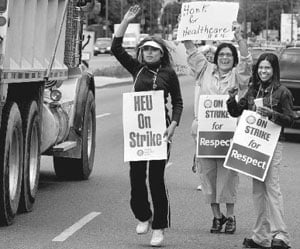
HEU strike

Related

Labour Day? At The Tyee this will be Labour Week, with labour-related special features running today through Friday. And that's just a start for increased labour coverage in the coming months, building as we go an occasional series we're calling Working Ahead: Labour in a New Era of Challenges.

We begin with the first of a two-parter, growing out of weeks spent interviewing union officers and staff, heads of local labour councils, rank-and-file members, union-side labour lawyers, employer spokespeople and academic experts. They were asked to help us identify the decade's 10 most significant B.C. labour stories. Here are the first five, with the rest to run tomorrow, along with a diversity of voices weighing in.

1. The Changing Face of B.C. Labour

In 1983, the percentage of B.C.'s work force in a union (a measure called union density) was at 45.3 per cent while by 2007 it had fallen to around 31 per cent, according to StatsCanada.

Nationally, in 1983 the density figure was 35.7 per cent and in 2007, 30.03 per cent. In 2009, union density fell slightly in B.C. Union density has grown in the public sector and fallen in the private sector in Canada and in B.C., but not so dramatically as in the U.S.

In 2009, the Canadian public sector was 71.3 per cent unionized, while the private sector was only 16.1 per cent. In the U.S., the comparative figures were 7.6 per cent in the private sector and 36.8 per cent in the public sector. While the prototypical unionized worker in B.C. in the 1960s was a white, male logger or mill worker, now the face of labour is much more likely to be a visible minority woman who works in a hospital or government office.

Think of it as the Revenge of Rosie the Riveter. (Rosie was the iconic WW II figure who embodied women's entry into the factory work force during the war, and their being driven back out afterwards. Now she's back and often serving as a union president or shop steward.)

2. I'll See You in Court

It's nearly unanimous. Almost every source The Tyee consulted agreed that Bill 29, the notorious union-busting legislation passed in 2002, was among the decade's top stories, especially when taken together with the precedent-setting judgment by the Supreme Court of Canada in 2007 that struck down some of its key provisions and established free collective bargaining as a charter-protected right.

Despite this huge win for organized labour, sources tell The Tyee, the unions representing B.C. health-care workers face almost weekly challenges as government and employers in the sector take advantage of the provisions of Bill 29 that survived Supreme Court review to privatize and contract out services.

3. Health, Safety and Lethal Workplaces

A list of tragedies prompting criticism of government policies begins with the Sullivan Mine disaster. Between May 15 and 17, 2006, two workers, Doug Erickson and Bob Newcombe, and two B.C. Ambulance paramedics, Kim Weitzel and Shawn Currier, died at Teck Cominco's decommissioned Sullivan Mine site near Cranbrook. They were felled by oxygen-depleted atmosphere inside the tiny water-monitoring structure build over a tailings dump. The tragedy posed serious questions about whether the province adequately regulates mine safety and situations in which workers are isolated on the job site. (Find extensive Tyee coverage here.)

In 2005, Grant De Patie was killed by a drunken teenager driving a stolen car. Grant was dragged to his death in an attempt to stop a "gas and dash" theft at the station where he worked. In 2007, with much fanfare, the provincial government unveiled a new piece of legislation, "Grant's Law," which required pre-payment for nighttime gas purchases, but has, to date, reportedly because of retail-industry lobbying, failed to move on more significant reforms that were also called for, including safety barriers for night workers or mandatory double staffing over the night shift.

Grant's father Doug told The Tyee last year that: "The government is just catering to businessmen. Employers weren't doing anything to prevent gas-and-dash crime, or the dangers it posed to people like Grant working alone overnight. We need even stronger laws, not weaker."

Deaths associated with farm work were big news this decade, with three men killed and another two severely disabled working in an enclosed space on a Langley mushroom farm in 2007 and three women killed while another 13 were injured when an overloaded and under-equipped van belonging to a farm labour contractor flipped over on a rainy highway outside Chilliwack in 2007.

On Aug. 31, 29 charges were laid under worker-safety legislation against two companies and several company owners and directors for offenses connected wih the mushroom farm deaths. In contrast this April, the provincial government declined to implement almost all the 18 safety-for-farm-worker policies recommended by a coroner's jury investigating the 2007 highway deaths.)

By contrast, calls for inquests to mounting logging-industry deaths in the early part of the decade went unheeded by the provincial government. Critics argued that deregulation under the BC Liberal government had created conditions for more risky practices, leading to a string of deadly tragedies in the forests and on logging roads.

4. Changing the Rules, Moving the Goal Posts

Perhaps the biggest and most consequential labour story of the decade in B.C., many of our sources agreed, was transformation by the Campbell Liberals of the basic regulatory bodies that govern labour and labour relations in the province. Rules embodied in the Labour Relations Code and administered through the Labour Relations Board have been revised to make it much harder for new union certifications to be won, with the numbers of new workers organized into unions plummeting from an annual average of more than 8,000 during the 1990s to less than 2,000 a year in the first three full years under the new business-friendly LRB of the 2000s.

Employment Standards Act changes brought in early in the Campbell years excluded many workers from the act's protection altogether, closed offices, almost totally deregulated work by children between 12 and 15, cut the minimum shift from four to two hours, made it harder for workers to get vacation and overtime pay from their employers and obligated workers who experience employer abuse of ESA protections to conduct their own cumbersome and daunting "do-it-yourself" complaint procedures.

And if you are injured at work in B.C., changes brought in during this decade mean that you are likely to qualify for much less compensation than you would have in the 1990s, only one element in a series of changes that critics say make Worksafe BC a much less effective support for injured workers than in times past. (Later this week in another of our Labour Week features, The Tyee will examine in detail the changes made at Worksafe BC and what those changes mean for injured workers. The news on this front is increasingly grim.)

The decade also saw a major revamping of trades training and apprenticeship programs, changes that mean far fewer young B.C. workers are getting the training they need to qualify as journeymen/women in their trades. A source within the building trades referred to this phenomenon as the "de-skilling" of the construction sector.

5. Chump Change

B.C. now has the lowest minimum wage standard in Canada, which allows employers to pay $8 an hour for many low wage workers and provides permission to pay an even lower $6 an hour training wage. These extremely low standards have been the target for ongoing campaigns by the labour movement, including the "Six Bucks Sucks" initiative.

One of the good news stories for B.C. labour this decade has been advances made in the campaign to get the province's employers to commit to paying at least the "living wage." The campaign got a boost in April of 2010 when the City of New Westminster took steps to guarantee that all city employees and all hired by city contractors were paid at least $18.17 an hour, the living wage figure computed by the campaign, which has been actively promoted by unions across the province and the Canadian Centre for Policy Alternatives, a progressive think tank.

Partly as a result of policies linked to the persistence of relatively low wages, child poverty continues to be a major labour story, with B.C. ranking as the province with the highest levels in Canada each year since 2002, and more than half of the children living in poverty experiencing that deprivation despite the fact that one or more of their parents have full time work.

Tomorrow: Temporary foreign workers rise, unions merge and battle each other, business leaders sing of peace and various voices weigh in.  [Tyee]

14  Comments:

Login or register to post comments

  • rantnic

    1 year ago

    UNIONS MUST UNITE

    As a long time union member I have watched the dismantling of union power and structure this province first hand. Not one of the three major political parties are truly union friendly. Unions set the base line for the quality of life that all workers should expect to enjoy in this province. How many so called union jobs fall well below the $18.17 per hour living wage. One can only assume that many of those are part time workers and so don;t really count. Does the "living wage" count benefits as a part of that wage or can they be deducted from the base.

    Lets have what is left of our unions, unite and support a free and democratic government. Or should we continue as is, and watch the further erosion of our security,safety and quality of life for the sake of the shareholder?

  • Skywalker

    1 year ago

    Unions don't always act in their own best interest.

    I'll take some exception to rantnic's comments that "not one of the three major parties are union friendly." I think it depends on what you mean by union friendly. Certainly the NDP has been but since not all union members support the left there has never been a real progressive shift that is sustained for long. Union leadership may recognize that under the NDP they may have less obstacles to unionization but they have never been able to convince their membership. The membership is more interested in how how consistent their job prospects are even if they get paid minimum or lower wages. The membership tends to resent paying union dues to union leaders who behave more like fat cats than they do rank and file membership. Very few union members are interested in the larger struggles of workers around the globe. THey are not interested in equality in the workplace or raises in minimum wage, they are only interested in their own pay check.

    That is not the fault of the political left . On those rare occasions when the left gets into power unions want to see overnight changes not realizing that even if those change occur the membership will still not support the left. The Leftist (NDP) government has to be cognizant of alienation of part of the moderate electorate unless they can rely on increased support from union members. They can't in most cases.

    Yes unions need to unite, but they also need to spend a lot more energy in making sure they are still being followed by the membership. That might mean changing some union practices which isolate the leadership from the rank and file.

    If there is disapointment in the NDP from labour then it cuts both ways. The current crop of NDP which removed labour affiliation must accept some of the blame but it is not all theirs.

  • Jerry Munro

    1 year ago

    Real Power I...

    "Not one of the three major political parties are truly union friendly." complained Ratnic.

    Followed by, of course, " Certainly the NDP has been but since not all union members support the left there has never been a real progressive shift that is sustained for long. Union leadership may recognize that under the NDP they may have less obstacles to unionization but they have never been able to convince their membership. ", written by Skywalker.

    I, of course, am one of those who has remained unconvinced of the serious "labour friendliness" of the NDP, save where they attempted to use it to augment the careerist and political ambitions of their own brand of social democratic capitalism.

    Part of the problem has been, of course, what has long passed for "the left" in this country, and elsewhere more often than not... and in that I include not only the NDP, but what were other, no less equally anti-democratic tendencies on what was perceived as the "harder left". First, you have NDP brand capitalism, and then what you had were the by now clearly understood "authoritarian" left brands of what we now also understand was a kind of State Capitalism. It is now clear, or should be, that "the left" (perhaps outside the anarchists) never really offered anything near approaching real working class power AND democracy at the "bottom levels" of the class, within the economy firstly, where everybody really knows, the real power in society resides. All equated "socialism" or what very often, in the NDP case was never defined other than as a kind of "motherhood view of the state", with more simply what was/is in fact a "bureaucratic state" which either controlled the economy itself, and over time created a new ruling class, or simply left it in the hands of the old capitalist class. All, the entire left proclaiming that they had now rendered "the state" benign and "working class friendly".

    Really it was all more of the same old, same old bullshit, and in some cases actually more repressive... and we in the actual working class knew it, sensed it, or came to know it soon enough. You can only fool some of the people some of the time... unless like the ruling class, you keep doing it differently through shape shifting, of course. (As Russia and China, and their new, by now outright capitalist class are doing.)

    Certainly, other than to the true believers who were in on the ground floor of the New Order, in line to become cadre and bureaucrats themselves, there was and is nothing yet being seriously advanced that was or is going to get "the class as a whole" seriously up and excited about it.

    Continued next post

  • Jerry Munro

    1 year ago

    Real Power II

    Continued from previous post...

    You want working class candy that will seriously begin to get the working class excited, try offering them real ruling power, as a class, over the economy, the plant and factories, retail outlets etc.... in short, their jobs... means of subsistence and existence. Short of that, you ain't talking jackshit.

    Then you will be talking real democracy we understand, with some real meaning and teeth in it, that will empower the working class itself, as a class, a community to begin to take care of and get up for the other issues of more formal and political/state democracy. 'Cause if they don't right away, they'll soon enough come to know "they" have been given serious leverage in society.

    The prize is really the economy, not the state. Which is not to say that the state is irrelevant, of course. :-)

    Short of that, except for brief periods of illusion and delusion that suck us in, they "know" whose real interests are being served. And it's not theirs/ours. And over the greatest amount of time, all you will get is token participation and support, from those who haven't figured it out yet, along with about half the "eligible electorate" not even bothering to participate or even mark an X. Which may not make sense to you politicos, but makes total sense to the likes of me.

    The working class needs real power in society, not more bullshit and purveyors of it.

    I agree with Ratnic. Not one of the political parties, including the Greens, is friendly to the working class... as differentiated from "just" the unions. But including them.

    THE END...

  • Birch

    1 year ago

    Globalism's

    rise in the 1980's and 90's made it plain that First World labour, particularly in North America, was going to take a big hit. The notion that we should all compete with $2 a day workers in Viet Nam is ludicrous, but that is, in fact, the kind of wage structure North American elites would prefer.

    Globalism has functioned precisely to delimit the power of the state. Even when governments might (rarely) wish to treat labour better, they are continually hamstrung by competitive pressures. It is not only a rising dollar that has killed manufacturing in North America. When the owner class was confident that it was safe to remove production from North America and transfer it to Asia without losing North American markets, they leaped at the chance.

    Until there is a more realistic possibility for states to control their own economies with greater vigour, we can anticipate further attacks on organized labour, and wages in general.

    You'll not that campaigns for "six bucks sucks" and raising the minimum wage to $10 went nowhere in BC.

  • Skywalker

    1 year ago

    Coyoteman you keep forgetting...

    ...that all NDP governments have had to operate within a narrow provincial framework. There has never been the advantage of having a national leftist government to add to the effectiveness of a provincial one. The major economic decisions are made nationally and there is often so little a provincial government can do. Think about FTA and NAFTA and how they limit any return to a people interest government. You are not being realistic in your judgments.

  • Jerry Munro

    1 year ago

    Global Capitalism's Undermining of the Nation State...

    "Globalism has functioned precisely to delimit the power of the state." wrote Birch.

    And conversely... pass it (power) direct from the post Social Democratic Capitalist nation state to the newly invigorated, even newly created global corporations of this late capitalist period, without the need for regard of the wishes of national populations everywhere.

    Yes, insightful comments, Birch.

    This IS the much touted and vaunted "New World Order" of the late seventies and eighties, as was used to whip trade unions and the entire working class into line and accept the various "cutback/austerity" regimes. Before which assault "Labour" hastily retreated and sought refurge in becoming "part" of the new "global system", as was signalled by the defeat of Solidarity in the 80s, by the betrayal cut of "official labour".

    It was a strategy, on the part of the leadership of "official Labour" that has failed, and deteriorated the socio-economic positions of the "broader" working class even worse than for unions, who have themselves paid a price on many fronts (though less, to be sure).

    A fight for the "soul" of official Labour needs to arise from within it, to change course, ambitions, the relationship with the ruling class of capitalism, to recover lost ground, and secure meaningful power within and over the economy as a whole. (After that or over the course of the same struggle... the State.)

    Until this occurs, what is will only continue to deteriorate.

  • circle A

    1 year ago

    no one should

    be surprised campbell has declared war on working people and has the support, unfortuneatly of many, what`s really foul is that trade unions such as the teamsters would allow an extreme anti union weasel like kevin falcon to sponsor a portion of their golf tourament, I mean don`t these people have any sense of propriety? further to that, just remember how short sighted the unions were in supporting the then premiere glen clark in the building of the fast ferries when it was known by everyone, and i mean everyone with any knowledge of our waters and vessel constuction that these ships were not suitable in any way , period. But did these same union people ever mention to the ever arrogant clark he was digging his own political grave and handing campbell a club with which to pound the life out of not just the trade unions but ensure that a lot of working people and their children will suffer long term hardship? The answer of course is no.the trade union movement has no vision, just short sighted "whats in it for our people now" mentality. just for the record I was a shop steward prior to being a self employed trademan and small business owner, a lifelong ndp supporter (no more with carole james as leader) and certainly no supporter of what passes for government in victoria, or for that matter Ottawa.

  • jross

    1 year ago

    I quit

    As an HEU worker in 2002, I decided that I had not moved to the middle of nowhere to take a pay cut, and quit as soon as I could find a job doing anything else.

    I loved my work, bosses and coworkers but I felt betrayed and hope to never work in a union job again as long as politicians like Gordon Campbell can just rewrite the rules.

  • beagle

    1 year ago

    BC Fed

    A good jump-start for labour in this province would be getting rid of Jim Sinclair and giving the rest of the BC Fed executive a good kick up the ar*e and a lesson or two in union avtivism in BC. Ginger Goodwin, Joe Naylor and the likes must be turning over in their graves. The BC Fed is all talk and no action over and over and over again.

  • rantnic

    1 year ago

    IS NOT THE B.C. FED A UNION OF UNIONS?

    Why do they sit on their hands while the rank and file members that pay their salaries are Scampbellized. Union activism is one of the few remaining tools we have left to wrest control from the neo liberal and neo socialist politicos that are presently running us.

  • Jerry Munro

    1 year ago

    Self Reliance of Labour...

    "Why do they sit on their hands while the rank and file members that pay their salaries are Scampbellized. Union activism is one of the few remaining tools we have left to wrest control from the neo liberal and Noe socialist politicos that are presently running us." Rantnic wrote.

    Again brother, or sister, as the case may be, I agree with you.

    The working class generally, but in particular the trade union movement, which the class as a whole "should" be able to look to for leadership, needs to start relying more on itself and its own collective activism/action, and less on outside "political party" forces or "the State" to guarantee its interests are served. Too often, indeed invariably the history demonstrates, these outside forces use the working class and their class organizations for their own particular purposes, electoral and other purposes, and in fact sell working people short, if not outright betray them sooner or later. And its into this trap that the current leadership of the labour movement has pretty much led official "Labour", rendering itself but another tool of the State and Management serving the ruling class, in controlling the working class, keeping it passive and serving the interests of corporate capitalism. (Which still gets them no respect, or place at Boards of Directors or participation in actual management of the workplace. Labour-Management co-operation is another one of those things ever talked about and idealized, as it suits the moment, but is never achieved, unless its the working class backing up.)

    This needs to change... the current leadership crop of labour largely removed, and a new, more combative leadership brought forward, prepared to actually lead the broader working class, not just the trade unions per se into the class warfare already being set upon us. And there is nowhere else this can arise from, but within the working class and its trade union movement itself: Its rank and file. If it doesn't arise there, it will never happen, and the current period will only continue to deteriorate, along with the conditions of the working class.

    The neo-socialists and social democrats have nothing to offer. They have already by now proved themselves too timid and policy bankrupt. It is time for them to go. The class must prepare itself to rely on itself, create and control new leadership from its own.

    Neo-liberalism is the enemy. The neo-socialists and social democrats are the collaborators and scaredy-cats.

  • Bruce Pinard

    1 year ago

    unions fault

    If the unions had not caved during heu's May 2004 strike, our province would be happier and healthier. Unfortunately lord campbell has recklessly ruled. Selling out our public resources.Selling out the security and well being for tens of thousands of children all in the name of gordum's God,privatization. A God that only facilitates the few. A God that sucks our souls selling them to private share holders for dividends sake. Once mighty unions now quake having lost credibility. Not with the public but God forbid their own members. Ultimately, the biggest mistake in our B.C. labour history. Hang your heads in shame!

  • Frank

    1 year ago

    Unions R Us

    Unions cannot control the political environment, nor should they. All they can do is try to protect their members. Outside of that the best they can do is raise alarm bells.

    After that its up to the people to decide and unfortunately the people decided Campbell was the best person to run the province the last 3 elections. Or at least about 25% of the population decided that, 50% decided not to vote at all.

    (The government assumes that people that don't vote are happy with the status quo)

    Don't blame unions for Campbell, the people had their chance three times which suggests to me that if labour had fought back harder the people would have stood on the sidelines as government destroyed them altogether.

    • The discussion for this story is closed. No more comments can be added.