
Oil Sands Workers Don't Cry
Toughing it out in the cold, isolated, male world of mobile workers in Alberta's oil patch.
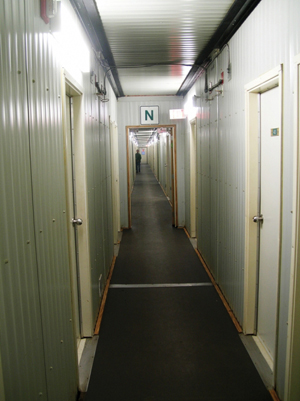
Sociologist studied workers living in quarters like these, in a camp near Fort McMurray, Alberta. Photo: Dru Oja Jay.
Mark Tilley was in pain. He locked eyes with a co-worker across the drilling floor. It was so noisy you'd have to scream to be heard. "Are you okay?" the driller's face seemed to ask.
A 650 kilogram pipe had just crushed Tilley's hand. This was in early 2008. The crew was about an hour outside Peace River, Alberta, exploring for oil in the northern wilderness. Winter was the only time to do it -- when frozen roads could support heavy equipment. Tilley remembered three straight weeks of minus 30 degree cold. There'd been a new guy the day he hurt his hand. Their job was to help feed nine-metre pipes into the ground. The work, as Tilley recalled, was "fast, fast, fast -- really fast." He'd been watching the new guy too closely. They'd swung a pipe into place, and he realized too late his hand was in the way. Now the driller watched as Tilley peeled off his work glove.
"Naw, I'm not alright," Tilley thought. His pinkie finger was hanging all wrong. Two other fingers were broken. An attendant drove him to the hospital in Peace River. Doctors removed the top centimetre or so from his pinkie. A split second difference under that pipe, and his whole arm might have been ripped off.
Tilley went back to work that same day. The crew put him on light duties. He remembered shovelling snow.
'We just assume workers are doing well'
Oil sands workers like Tilley are at the centre of a groundbreaking University of Alberta study. Over the past decade, oil reserves rivalling Saudi Arabia's have transformed Alberta -- and Canada -- into a petro superpower. Yet little academic research has focused on the lives of the labourers who've made that possible.
What's it like to live in an isolated work camp?
Why are so many workers taking hard drugs or drinking?
And what's going through the head of someone blasting 160 kilometres an hour down a crowded highway?
Angela Angell, a graduate student in rural sociology, spent the past several years interviewing oil-patch labourers, addictions counselors and labour experts. Her master's degree thesis paper will likely be ready this fall. The research reveals some troubling trends. In the Fort McMurray region -- where the majority of oil sands projects are located -- about 25,000 mobile workers live in remote clusters of modular trailers, some the size of small cities.
Angell has roughly divided this so-called "shadow population" into two groups. There are those that are thriving. They love the big paycheques -- which range from $100-200,000 a year -- and the way long stints from friends and family make the times together more vivid. But many others struggle. They're haunted by alienation, addiction and feelings of impotent frustration.
"We just assume workers are doing well because they're making lots of money," Angell told The Tyee. "And we assume that because someone has a cocaine addiction that it's because of a personal defect. We don't often look at the larger sphere in which these people work."
Marlboro man of the muskeg
Key to understanding that sphere is the idea of "rural masculinity," Angell argues. Many academics believe gender identities -- what make us masculine or feminine -- aren't a biological given. These identities are learned and performed. They're based on a set of social expectations, which vary from group to group. Deep within the rugged Albertan wilderness, being "manly" means working hard, acting strong and rarely worrying about personal health or safety.
"You're basically invincible," Angell said during a recent presentation. "I would argue that in Fort McMurray, we'd have the Marlboro man but wearing a hardhat and in the muskeg."
That expectation of manliness is certainly not unique to northern Alberta. Travel to any remote resource community to find variants. Little is known, though, about its effect on oil sands workers' well-being. Among these workers -- of whom 92 per cent are male -- a convincing performance of hyper-masculine traits can confer power and prestige. But sometimes, as Angell found, this "Marlboro man" is actually concealing a jagged vulnerability.
Take a worker from Newfoundland, for instance. His friends and family are literally thousands of kilometres away. He's working up to three weeks straight -- often for 12 hours a day -- before his one week off. During winter months, the weather gets as cold as Siberia. And home is little more than an eight foot by eight foot room in a modular trailer.
"It's hard on the worker to live in camp," a labour representative told The Tyee. "The lifestyle is very difficult. It takes a special person to do it."
'Coke and meth and ecstasy'
Rural masculine ideals, as Angell sees them, often discourage labourers from seeking support. Many mobile workers she interviewed described camp life like prison. They'd swipe a card to enter, and swipe out to leave. Legions of low-paid security guards enforced every tiny rule. Grown men -- the majority of mobile workers are 35 years or older -- felt patronized, or like mere cogs in an oil-producing machine. They missed their families. Yet even though counselling services are often available, few workers take advantage.
"Masculinity is very ingrained," Angell said. "There's this whole idea of 'big boys don’t cry.'"
For some, the oblivion of hard drugs or alcohol offers easy escape. A 2009 report from the Shepell-fgi Research Group tracked several social indicators in Canada's oil and gas sector over the past few years. It found that between 2006 and 2008, the amount of workers accessing assistance for alcohol abuse rose 481 per cent. Major expansions in the Alberta oil sands played a significant role. And those are only the reported cases.
One counselor told Angell that 60 per cent of workers with addiction issues don't seek help. Mark Tilley, the worker in Peace River, told The Tyee that hard partying is just part of the mobile worker lifestyle. He remembered finishing the last shift of a five week rotation, and cheering as loud as he could -- nearly screaming "whoo-hoo!" He used words like "mayhem" and "trouble" to describe his nights off.
Tilley's work camp was small, and drugs uncommon. But he's heard all sorts of stories from friends and coworkers.
"Everybody at this one rig, they wouldn't go to bed at night -- they'd do coke and meth and ecstasy and then they'd show up to work," he said. "Everybody's all lit up on something."
Long, angry drives to nowhere
Often, as Angell drove Highway 63 from Edmonton to Fort McMurray, pickup trucks would roar past. She figured some must have been doing 160 kilometres an hour. It seemed reckless, especially on a highway well-known for accidents. Angell learned later it's not uncommon for workers to cope with anger or frustration by going for long, fast drives. She heard about guys getting on their motor-bikes, blasting one direction for hours, then turning around.
Support counsellors called these episodes "time-outs." Bad as camp life may seem, though, not everyone needs gas-pedal adrenaline, Angell stressed. Many mobile workers maintain strong connections to friends and family. Indeed, they make new friendships and meet future spouses. They might play hockey on their downtime or barbeque steaks with their buddies. And certain work camps are clearly better than others. But it's a tough life any way you look at it. Some labourers -- perhaps acting out rural masculine ideals of self-sufficiency and strength -- bottle up stress, loneliness and exhaustion. Eventually the caps pop. They hit the highway.
"What is going through their heads?" Angell said. "Are they really trying to push you off the road because they think they're better than you? Or do they have no sense of self worth and they're angry and they feel disempowered?" ![]()


17
Login or register to post comments
Van Isle
1 year ago
I know a guy who is a
I know a guy who is a security guard up at Fort McMoney and he says the drugs up there is rampant. Of course with drugs there is every other type of sleaze-ball spin-off that goes hand-in-hand with that scene. All lot of the workers go into town with money buldging out of ther pockets and consequentually get rolled. Most of the tradespeople I know who work there just put in there time and get the hell out and don't do any socializing while in camp.
Fiat lux
1 year ago
Much of the time honoured
Much of the time honoured and historical self destruction of people and societies, engaged in harmful activities, is caused by the subconscious at work.
The conscious half of their brains can be persuaded to do anything, even engage in criminal activities, but the subconscious half nags them and forces them to block out their consciences with "faith", or by artificial methods, like booze and drugs. .
Ed Deak.
Jerry Munro
1 year ago
The "Big Bucks"... Extracts a price.
Actually, a very insightful observation Ed.
The system, when it has to pay "relatively" big money to workers, in my experience, first, always extracts a price for it, big-time. And especially in these kinds of "relatively" isolated work situations, a big part of that price is the isolation and the work and living conditions monotony itself, away from home and family, and the loneliness, which few ever admit to, that accompanies that. Which is often resolved in the case of males, with resort to mind altering substances and the other self-destructive behaviours that go with that.
And let's face it, some women too no doubt, but especially (family) males are still under tremendous pressure to bring big bucks to the table. And even for single males, it improves your chances for access to "desirable women" and "breeding" success, and the self-prestige that goes with that.
The capitalists pay a paper price, but workers pay other steep kinds of prices as well for the "relatively" big cash, compared to other workers. (The capitalist doesn't pay that kind of cash, you know damned well, unless there is still way more in it for him/her)
Big money is nice. It's a helluva, even schizophrenic way to live this though. The space-hole it creates has to get filled with lots of "stuff" to make up for it.
alive
1 year ago
reality check!
Reality is that people flock to those jobs, because it beats being a greeter at Wallmart or flipping burgers.
This is not a new problem, BC has had its lumbercamps and construction camps all along, and the male workers have always sought relief at gambling or booze.
That conditions are lousy is not news either, it happens because there is little choice, work here or suck shit in the city looking for any menial job.
miguel
1 year ago
Oil Rush
It was like this in the 70's when I worked in the oil patch. Think of the 'Klondike' and you'll know what the dynamic is.
snert
1 year ago
Alive is right.....
and this is not a new phenomena by any means. I spent a couple of years in a camp in northern BC and it was just the same. People from all over the country and the world for that matter. Most coped but some never could.
freebear
1 year ago
Cry me a river, boo hoo!
Perhaps being homeless and dumpster diving would be less stressful?
Its all about jobs and revenue (see Premier Ed Stelmach) and tough s__t about anything else!
Sockeye
1 year ago
Re:reality check
Alive is correct, where is an uneducated man suppose to find a good paying job? Most people I met up there where there to save up enough money to buy the house, the car that they couldn't even dream of back home. I got a job that paid 90'000 a year, I literally saw the company's office walked in off the street and within 5 mins my yearly income had rose by about 75,000 thousand, where else in Canada can an uneducated young man do this?
The simple fact is drug abuse and alcoholism runs rampant through most of society from grocery store clerks to lawyers to carpenters our society alienates, we're cogs in the machine called consumerism, everyone is isolated and unhappy, I know, I work at a liquor store it's just as bad here as it is up north.
Jerry Munro
1 year ago
It's called capitalism...
" it happens because there is little choice, work here or suck shit in the city looking for any menial job." alive.
It is called the "caught between the Devil and the deep blue sea" syndrome, which net is cast and catches everyone from the dumpster diver to these relatively "big money workers". It has ever been thus for working class folks from the time of the Land Enclosure Acts which drove the peasantry from the land and into the cities and the workplaces of the Industrial Revolution of capitalism. "The System" has as well ever since sought, created and exploited these Devil and deep blue sea traps into which to herd the working class, and play them off against each other.
Sockeye nails it just about as well with his observation, "...our society alienates, we're cogs in the machine called consumerism, everyone is isolated and unhappy, I know, I work at a liquor store it's just as bad here as it is up north."
Though actually, "consumerism" is just the manifestation of the real underlying driver. It's called capitalism.
jross
1 year ago
Been there, done that, paid the price.
I worked in seismic and forestry camps in BC and the effects can be pretty similar. I worked 89 days in a row once, got out of camp with a wad of cash and a severe case of social/cultural shock and went nuts for about 6 weeks. Totally out of control. I vowed never to do that again and never have.
The shattered souls that come from this environment are pretty easy to spot if you have spent any time there yourself. We all pay the price for this sort of mentality and environment, through our families, social supports and the legal system, to mane but three.
Beyond giving us Dutch Disease as a nation, the tar sands have screwed up a lot of individuals.
Keep these great articles coming.
doggone
1 year ago
That is how I was trained to "work".
You gotta love the warnings on some chemical containers:
"Throw away applicator!"
The image of an "applicator" head down in a garbage container with gum boots frozen in the air above comes from an art show in Zimbabwe just before T.I.M. started to behave like a western Monarch (1997).
Buddies of mine work in those camps - most of them are survivors but my ex brother in law (one year younger than I) just failed last fall - stroke likely induced by lung cancer. He drove the bus to and from the "Fort". R.I.P. Steven and the rest should thank something that Steve was careful enough to have his stroke on an airplane with someone else doing the driving
G West
1 year ago
That's TAR SANDS workers
And they do cry.
Des
1 year ago
My Daughter-in-law
works at one of the walk-in agencies that helps with the guys after they are out-of-work or "between jobs" at Fort Mac. Most of the ones she sees are in desperate circumstances. It's not an easy life on either side of the money pit.
Sockeye
1 year ago
RE:It's called capitalism...
The Machine called Capitalism I stand corrected. But it's our culture that marries the idea of success, happiness and fulfillment with the ideology on consumerism and material gain. Why do people go to the tar sands? For Jobs that pay well, Why would they want that? because they desire a certain lifestyle, the blue print life that has been beamed into their conscious and sub conscious mind since childhood. Consumption is an act, there is morality guiding it so when people base their existence on a nihilistic activity it doesn't take a stretch of the imagination to understand were substance abuse comes from, they are simply masking the unhappiness and lack of meaning.
I just also want to comment on "rural masculinity" since I've experienced it first hand and the pressures it places upon men to act within a certain herd mentality. The thing is I think introspection is what lead me out of that lifestyle and I think the reason why so many men don't come to their senses about what they are doing to their bodies and the earth is simply that if your in touch with yourself or your feelings your dubbed a pussy that somehow your not a "real man" within the rural masculine framework of the oil patch. Therefore a lot of suppression of conscious comes from fear of being ostracized or disappointment in the eyes of your peers.
G West
1 year ago
I hope
I hope there was a big audience for HBO Canada's showing of GASLAND this evening; anyone who's prepared to give the TAR SANDS and their exploiters the benefit of the doubt on ANYTHING should make certain to find a way to see it...because the same things are happening now in Canada and in British Columbia.
RickW
1 year ago
Sockeye
It was said of Hitler that he realised he needed lots of young bodies for his dream of world domination. Not much difference here. The TAR SANDS neeeds "lots of young bodies" - and by deliberately over the years (but much more noticable of late) witholding funding and infrastructure from education, the powers that be have ensured a plethora of "young bodies".
This is not "capitalism" at work. This is straight out of 1984.
Karen D.
1 year ago
Effect on relationships
I'm interested on whether Angela Angell included in her research the effects on personal relationships for workers in such camp situations. Not only would distance have a negative impact on the stability of a family but the psychological impact of stressful employment and peer pressure could greatly increase the strength of spousal relationships