


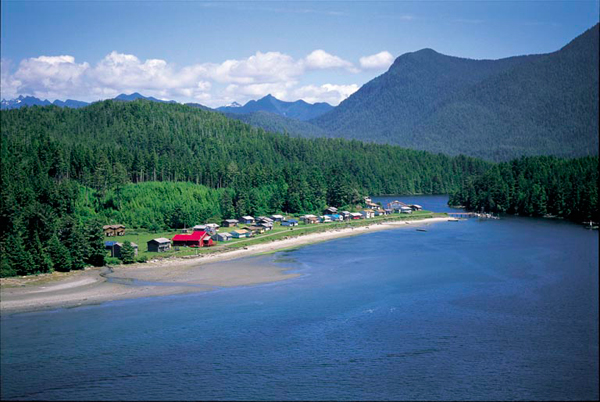
When I questioned native teens about their language and culture, it didn't matter whether they hailed from the remote villages or the small towns or the big city. Their tone was, with few exceptions, the same: wistful.
"At potlatches they speak in our language," says Alanda Atleo, 20, of Tofino. "I'd like to know what they're saying. I don't understand, though. I've no idea what's going on."
Alanda says she"s happy that she at least knows a few words. "I've tried to learn, asked around. But I don't get much."
According to 2006 Census data, only 18 per cent of Aboriginal children who live in B.C. and attend elementary or high school had an Aboriginal teacher or teacher's aide. And only seven per cent of the children had a teacher or aide who actually taught in an Aboriginal language.
But a formal school environment is not the best way to learn a second language anyway. Becky Martin, 18, of Opitsaht was one of the few I spoke to who received language instruction at school, yet it didn't help her. "I was in the First Nations language class at Alberni District Secondary School, but I didn't understand it." She shrugs. "I know basically none."
Like Alanda (and indeed most coastal native people under the age of 50), Becky is unable to understand the speeches at potlatches. She is fortunate at least to be able to attend with her grandmother, who helps to explain. "She doesn't know how to speak our language"” Becky says, "but at least she understands it."
Little exposure to native language and culture
For native language and culture to exist in any meaningful way at all, they must be alive -- part of day-to-day life in both home and community. However, with a rapidly shrinking minority of speakers of most of western Canada's native tongues -- coupled with myriad modern distractions including television and Internet -- young native people have less and less exposure to their traditional language and culture.
According to the McCreary Centre 2003 Adolescent Health Survey, more B.C. First Nations youth learned about their Aboriginal culture and heritage at school (74 per cent) than from either their families (70 per cent) or their communities (52 per cent).
When the figures are broken down according to youth who live on reserve, compared to those who live off reserve, the influence of community is even more marked. Out of on-reserve youth, 97 per cent report learning about their culture from their families and 93 per cent also from their communities. For those who have never lived on a reserve, 63 per cent learn from their families and only 43 per cent from their communities.
Belinda, growing up in urban Port Alberni, is one teen who feels a strong and deep connection to both her language and culture. Yet she still faces numerous stumbling blocks in her quest to learn more about it.
"It's more important to me than a computer or video or a cell phone. My grampa wanted to buy me some of those things, but I said no. Instead, I'm busy with basketball, and learning dance, and doing a workshop on traditional teachings." If she were forced to choose between them, she says, it would be an easy pick: dance practice would trounce basketball.
'If I knew the prayers, I would say them'
"I want to learn more prayers. When we go to workshops, I want to hear the prayers from beginning to end. If I knew the prayers, I would say them. I told my grampa that, so he's been teaching me, taking me out on the road, and now I'm learning about medicinal plants and foods."
Belinda recognizes that there are teachings associated with her people's songs and dances. "I want to understand what they mean, so I go and ask my grampa. I don't want to sing without knowing what it means."
She tells me that there are not many kids her age who share her interest in their traditional culture. But, she says, there are some -- including a friend who even offered to pay her to help her learn the language.
"And," Belinda adds, "I know one girl who doesn't go to school at all. She goes to visit her gramma every day. Instead of just learning the English way of doing everything, she wants to learn the Nuu-chah-nulth way. She's really fluent in our language."
Vanessa is one of Belinda's schoolmates, but she doesn't feel the same connections to her heritage that Belinda does. Vanessa is Ahousaht, but she lives outside her people's traditional territory, in Port Alberni. "Sometimes I don't feel cultural very much, or I don't think I do. I feel that I lost my culture. But," she adds, "it's not my fault. It's society's fault."
Thinking about the residential schools
Vanessa is referring to the effects of the residential school system. She had been learning about this in school the week that I interviewed her, and she was visibly angry. "I just found out the last residential school closed in 1996, and they're still acting like it's okay. My Uncle John [one of her teachers] just told me that last night."
Vanessa's understanding of the effects of both the abuse, and the loss of culture and self-esteem, is only beginning to sink in. Her eyes flash with bitterness toward the damage she says the residential schools did to some of her relatives, and to her people. "And people wonder why we're alcoholics, why we're getting knocked up, wonder why we're so retarded."
Patrick, who struggles with his own addictions, explains to me the run-down effects the booze and the drugs have had on his remote community up at Hot Springs.
"It stops us from getting together on culture nights, and stops us from playing basketball. People would rather go out drinking than go out, rather drink than gather together just to have fun."
Now, that residential school story is one more part of their own people's history that these kids learn about in school. It was also on the mind of the Squamish teens who spoke with me.
"So many people forgot about our culture," says LanLan. "That's why now we have Squamish language classes and First Nations Studies classes at school. We've learned so much about our culture and our past there; we just spent a month learning about residential school."
Wonka and Ralphie both add that they know that their fathers went to residential school, but that they are reluctant to ask them about it because of the obvious pain that their questions bring up. So they figure it out in school.
"The way I heard it, in the book in social studies, they were teaching them to speak English," says Wonka about his elders. "They smacked them for not speaking English. And, the way I heard it, the people there raped them, too."
As I listen to the teens talk about what they have heard, it is apparent to me how new some of this knowledge is to them; they are still processing what happened and its continuing effects. "I'm just thinking," says Bud, "if it was still happening today, how would we be? And if that didn't happen, we'd still be speaking our own language today."
"We probably wouldn't even know English!" SarSar exclaims, and I can practically see the wheels turning.
'Only one family who sings'
Some of the young people I spoke to feel little connection to their traditional culture. Patrick, who splits his time between Hot Springs Village and Port Alberni, feels that his native traditions are long gone. "Our community has already lost the language and the culture. People used to talk about what dancers and singers the Hesquiaht are. But now, we're not all as one, as we used to be. We hardly ever go to potlatches any more, and even if we do there is only one family who sings."
By his comments, though, Patrick demonstrates that he does understand the depth and meaning that both culture and language had to his people's identity -- even if he feels they are no longer relevant. This contrasts with some of the other teens' comments: teens who value their traditional culture and language more than Pat, but in what seems to be a much more superficial or esthetic way.
Becky, in Opitsaht, says, "I don't know why, I just enjoy Indian songs. I like going to potlatches, watching the dances, and singing the songs." She doesn't know the teachings behind them -- "I just like listening to them," she explains -- but she is committed to making sure her young son learns to sing and dance as he grows up.
The Squamish teens, too, show an appreciation of their culture. It may not be to the same level or depth as their elders, but it may help to ensure that it lives on, even if in a different form. They have all heard their traditional language spoken at story-tellings, and at gatherings and funerals. Even though they don't understand it, they enjoy hearing it. "It sounds better," says Ralphie, "it's a lot more pretty than English."
These teens, growing up in urban North Vancouver, appear to have had less exposure to cultural events such as potlatches than the kids I spoke to in the smaller communities. LanLan tells the group about an event she heard about. "My auntie and uncle actually went to a traditional native wedding. My auntie said it was really beautiful." She explains that the traditional weddings used to last for four days, with the bride being carried up in a canoe, but that now people complain about them lasting too long.
"Oh, I would love that!" says Ralphie, clasping her hands together. "And I would make it the full four days."
I can't help but notice that these kids' appreciation of their culture really is centred around the beauty of it -- which is one of the fundamental attributes of "western" art. But this contrasts with the traditional intentions of First Nations art, which was concerned less about aesthetics or individual expression, and more about teachings and history. I mention this to Squamish youth worker Latashkinem Roberts.
"And that's okay," he replies. "It's just another chapter in our history: re-establishing ourselves and our history, readapting. It's nothing new to us. We have stories and songs from times long ago, around the ice ages, when we faced famines. Once, we were down to just two people, a man and a woman, and we came back from it. Our culture regenerates, then we have another fall. And then we come back again."
Cultural programs at schools are a poor substitute for a living culture within family and community. But for many youth, it is all they have. In the final article of this series, we will look at some of the programs that are working to help B.C.'s native youth make their way in this world.
On Monday: Looking to the future. ![[Tyee]](/design-article.thetyee.ca/ui/img/yellowblob.png)
Read more: Indigenous, Education






Tyee Commenting Guidelines
Comments that violate guidelines risk being deleted, and violations may result in a temporary or permanent user ban. Maintain the spirit of good conversation to stay in the discussion.
*Please note The Tyee is not a forum for spreading misinformation about COVID-19, denying its existence or minimizing its risk to public health.
Do:
Do not: