- Ms Kaye is a Tyee Builder. You can be, too.
- Mary Carlisle is a Tyee Builder. You can be, too.
- Prem Gill is a Tyee Builder. You can be, too.
- Nancy Flight is a Tyee Builder. You can be, too.
- Justin Everett is a Tyee Builder. You can be, too.
- John Westover is a Tyee Builder. You can be, too.
- Nora Etches is a Tyee Builder. You can be, too.
- Edward Henderson is a Tyee Builder. You can be, too.
- Bharadwaj Chandramouli is a Tyee Builder. You can be, too.
- Dean Chatterson is a Tyee Builder. You can be, too.
- Marius Scurtescu is a Tyee Builder. You can be, too.
- Robert Parkes is a Tyee Builder. You can be, too.
- James Murton is a Tyee Builder. You can be, too.
- Susan Doyle is a Tyee Builder. You can be, too.
- Vincent Strgar is a Tyee Builder. You can be, too.
- Helen Spiegelman is a Tyee Builder. You can be, too.
- Subir Guin is a Tyee Builder. You can be, too.
- Kimball Finigan is a Tyee Builder. You can be, too.
- Joanne Manley is a Tyee Builder. You can be, too.
- David Leach is a Tyee Builder. You can be, too.
Native Youth, In Their Own Voices
Today begins a series in which B.C. First Nations youth speak about school, alcohol and drugs, family, culture and language.
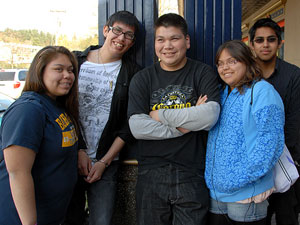
Squamish Nation teens: Tired of hearing dire statistics. Photo: J. Windh.
[Editor's note: This is the first in a six-part series on native youth speaking out about their challenges and dreams. This project was made possible by generous readers who gave to the Tyee Reporting Fellowship Funds.]
The statistics about native youth -- and we've all heard them -- are alarming.
They've been in the news for years: nameless and faceless "aboriginal youth," and the myriad problems that confront them both on and off reserve: They are less likely to complete high school than non-native Canadians. They are more likely to have been physically or sexually abused than non-native youth.
In B.C., more than one-fifth of aboriginal children have been in some sort of government care. Aboriginal youth are nearly eight times more likely to be incarcerated than non-native youth.
Their death rate, from all causes, is three times higher for native youth, according to the 1999 Annual Report from the BC Children's Commission. Their suicide rate is pegged, in a study by the UBC Early Human Learning Partnership, at between five and 20 times higher than that of the general population.
But to native youth, these numbers are boring. According to a 2005 report by the McCreary Centre Society, B.C.'s aboriginal youth "are tired of hearing dire statistics about themselves, and want to see more positive news reflecting their progress into adulthood."
This article is the first of six in a series, funded by a Tyee Investigative Fellowship, that looks at issues in the lives of native teens. In their own words, they will talk about:
Attitudes towards school: Is it important? What keeps kids from graduating?
Alcohol and drugs: How does usage in family and community affect them? Why do they themselves choose to use or not use?
Family: What positive or negative influences do parents and immediate family members have on them? How has being put into care affected them?
Culture and language: What does their traditional First Nations culture mean to them? Do they feel that it is even still alive? Is it worth working to preserve?
According to the 2006 census, 196,075 British Columbians identify themselves as aboriginal -- nearly 5 per cent of our population. Two-thirds of these are First Nations. Most of the remainder are Métis, with a small per centage identifying as Inuit or "other." Youth (defined as those aged 24 or under) comprise more than 38 per cent of the aboriginal population.
The people behind the statistics
The aim of this series, however, is to move beyond the statistics to the people. In this introductory article, you will meet 14 First Nations young people, from B.C. communities that range from urban to remote, whom I interviewed in the course of a year.
In North Vancouver, I met with a group of eight close friends who were either in school or had recently graduated from high school, and who live on the Mission Indian Reserve. Six of them --
Alana "LanLan" Paul (17),
William "Wonka" Joseph (16),
Danielle "Ralphie" Joseph (16),
Kerry "Bud" Nahanee (17),
Nathan Humchitt (16), and
Dylan "Didi" Bruno (15)
-- were enrolled at Carson Graham Secondary School in North Vancouver.
About 10 per cent of Carson Graham's students are First Nations. The school offers a unique First Nations Integrated Studies Program stream, which has smaller class sizes and uses culturally relevant materials, to ensure kids are caught up in basic skills in their core subjects, as well as provides classes in First Nations studies.
Two more already finished school. Sarah "Sarsar" Harry, 18, finished high school at Carson Graham, and was working part-time at the Capilano Youth Centre as well as volunteering two days a week at a nursery school, planning to further her schooling in Early Childhood Education. Joan Daniels, 17, attended Sutherland Secondary School, a North Van public school with very few First Nations students.
In Port Alberni, I spoke with three young Nuu-chah-nulth women: Vanessa George and Monica Sam, both 16, and Belinda Lucas, 17. While I did not purposely seek out youth who had spent time in government care, all three of them had. Monica lived with relatives, Vanessa lived with a foster family, and Belinda had spent times between the ages of five and eight in foster care. All three were attending Vast Learning Opportunities Centre, an alternative high school that pays special attention to individual needs in order to create a supportive learning environment.
In the smaller town of Tofino, I met with Alanda Atleo, a 20-year-old Nuu-chah-nulth woman who finished high school at Ucluelet Secondary School in 2007. She worked part-time through high school and worked full-time as a cleaner while taking a college-level math course by correspondence through North Island College.
On the more remote reserves, I talked to two young Nuu-chah-nulth people who lived in very different circumstances. Becky Martin, 18, grew up mainly in Port Alberni and Nanaimo. She lived with her boyfriend and infant son, the young family splitting their time between her mother's home in the village of Opitsaht (population about 150, a short boat trip from Tofino) and his parents' home in Ahousaht (population about 400, and 20 kilometres by boat north of Tofino). Becky finished Grade 10, and hoped to finish up her schooling when her son was older.
Patrick Lucas, 17, was living with his father in remote Hot Springs Village (population about 90, 50 km north of Tofino by boat) when I interviewed him, but father and son have since moved to Port Alberni; Pat dropped out of school in Grade 11.
Distinct voices, speaking for themselves
These 14 young people come from communities that represent a cross-section that ranges geographically from urban Vancouver, to smaller towns, and right through to remote reserves without road access.
Of course, this small group can't speak for all of the roughly 75,000 aboriginal youth in our province. But they give at least a first insight into what matters to them: their dreams, their obstacles and their issues. Some of those issues are common to both urban and on-reserve youth; others are more localized.
In the second article of this series, we will look at these young people's view about school: Do they believe it is important? Why do so many kids drop out? What, if anything, helps them to be able to stay in?
Tomorrow: Thinking about school. ![]()


10
Login or register to post comments
charlie no song
1 year ago
This is absolutely great!!!
This is absolutely great!!! Giving Native youth the opportunity to speak about their needs will help schools, gov't and other forms of institutions to effectively create programs that will improve healthy lifestyles amongst Aboriginal people. As an First Nations person, I think it's so important to provide young people the space to talk about their current realities and challenges. Thanks so much for this series.
The following blog post is regarding Aboriginal youth and statistics in Canada:
http://karleneharvey.blogspot.com/2010/04/writing-generations-and-generations.html
dorothy
1 year ago
But certainly -
This must be a new opportunity for the broader public (if we can count Tyee's readership as such), to hear from this group of youth, but it cannot be, certainly it CANNOT be the first time ANYONE has asked them what they think of it all. I hope not. So I am very impressed with not only the Tyee's gusto in taking this up, but also, and even more, of their willingness to speak to the rest of us, who have, for years, done little else than tallying up those boring numbers and wringing our hands. They have finally understood that we can only be held to account for those numbers if we are made to see what is behind them. Big step, very postive, congratualtions!
the real ODB
1 year ago
what about N.E?
It is a nice change that someone is allowing native youth speak their minds as opposed to speaking to them as to what should be on their minds. However, the failure in this group of youth is indicative of most conversations of B.C.. Their geography. They are all from the lower mainland and Vancouver Island. What about the N.E.? The Peace River country? Fort Nelson area? Dease Lake? Etc.. The area of B.C. east of the continental divide. Where native communities are totally isolated and abject poverty is the order of the day. Where the enviromental destruction wrought by the oil, gas, coal and forestry industries has a profoundly adverse affect on these native communities. As they do on a lot of other communities, especially farmers. And don't get me going on Site C! Or the Enbridge pipeline!
I'm sure these young people will give us all a good insight into their lives and I commend Ms. Windh on her work.
It is unfortunate tho that this large and mostly forgotten area of B.C. (with the exception of Govt. and Corp. bean counters) will not be heard from.
Luck
1 year ago
First Nation peoples
Another great article by the Tyee.ca. Much appreciated.
The whiteman have not understood these peoples until they rioted in the streets like our coloured folk.
The whiteman has had our day and now the colored are having their day minus the whiteman.
I have worked with first nation on 4 occasions and believe me they are not backwards.
They can build a house on the res for 130,000.00 for their people.
The whiteman will charge as much as he can take.
FN municipalities look after the people, houses and land.
Sure they have their issues but band council prevails and helps out.
They are creating their own workforces and only hire non-status when they need help in that area.
I am ashamed to say that the whiteman has created so much distrust in the world that our society may never recover.
When FN have elections every one gets out and votes. We don't. Why is that???
Maybe more white folk should work with aboriginals and learn from them.
The Governments of canada sure have learned a lot from them thru treaty agreements.
But Gov. have not shared it with the rest of the canadian population.
I think the next political party at all levels of Gov. should be named the Peoples Party of Canada.
Sounds fitting don't you think.
Jerry Munro
1 year ago
The headkess horsemen are coming...
Get ready. The subject of our Native peoples has been mentioned on tyee again. The wingnuts are coming. Let me predict who they will be.... :-)
Looking forward to the series.
paisley
1 year ago
pick me pick me
Yes, those that disagree with or have an opinion differing from the coyoteman will once again be called wingnuts or his favorite fall back comment "racist". Yes, we know the coyoteman has no tolerance for any opinion other than his own on the subject of aboriginals. Despite coyoteman's obvious talent as a thinking person it's to bad he can't lose the chip on his shoulder. Lose the the name calling it renders one voiceless and wins nothing.
Chatterbox
1 year ago
Storytelling
The best stories are told by people you know and respect. Jacqueline begins well by telling us first about those who she expects will tell us their stories. It is a magnificent start, and now we await an unfolding that I hope can do justice to the perspectives and words of the first true people of the Salish Sea and opitsaht, a people that treated this land far better than later settlers.
reallife
1 year ago
What about N. E.?
The northeast First Nation communities are not totally isolated and in abject poverty. Fort Nelson, Halfway, Blueberry, Doig, Prophet River are all connected to the cities and towns in the area by paved roads. Because of preferential hiring in the resource industries, every employable resident of these reserves can have a job. Additionally, the oil industry funnels huge amounts of cash into the communities, either directly through voluntary donations, through government resource revenue sharing or through payments from the Oil and Gas Commission. With this said, there are still drug and alcohol and social problems on the reserves that will take some time to address. Hopefully, continuing strong leadership in the First Nation councils will get the job done.
nukshya
1 year ago
more and more hope
There's a saying. The seventh generation youth will makes changes. Changes these youth make are going to have long lasting effects. I'm finding out more and more everyday that this prophecy is coming or it's already happening now. Yes, it's time to change the stereotype and show all of the people of our land that we are more than the words being spoken about us. We can speak for ourselves. I commend these youth for stepping forward.
the real ODB
1 year ago
N.E. revisited
Thanks reallife for the update. I admit it's been many years since I've been to the Blueberry or Doig reserves. It was all bad gravel roads then. The reason they're paved now has nothing to do with improving the lot of natives tho. Before the '05 election, Gordo "I've never met a wealthy person or martini I didn't like" Campbell told the residents of the N.E. that the Lieberals really do love them and would be (if reelected) spending millions on improvements to their secondary road network. All of this money was spent on roads leading to oil and gas rights. If you're lucky (or arguably unlucky) enough to live along these roads, you now have pavement to drive on.
I do take exception to some of your comments tho. Oil industry funnels huge amounts of money into these communities? Only via the cost of doing business and thereby making a profit. Directly thru voluntary donations? Not a chance. Resource revenue sharing? Sure, but this is, thanks to the Lieberals, absolutely minimal.
And don't forget the subsidies they get from the province and the feds. And the fact that "external" costs (which society will eventually pay for) are never factored in.