


It would be easy to mistake a "Swap-O-Rama-Rama" for a craft fair or a flea market, or, at first glance, the tragic implosion of grandma's sewing circle. Hordes of anti-fashionistas swarm dozens of tables, picking through the wreckage of each others' wardrobes, salvaging one person's forgotten attire to be reborn as another's showy new find.
The rules are simple: bring all the clean, usable clothing you want to evacuate from your closet. Pay somewhere between six and 10 bucks to the organizers and hand over your cache for sorting. Then start your treasure hunt. Rama-goers can take home all the clothing they can carry, and at most events, stations with volunteer sewers, silk-screeners, iron-oners, button-attachers, and otherwise crafty folk will help you turn your special discoveries into one-of-a-kind originals.
"My hope is that society at large can reengage with the process of creativity, and walk away from consumerism," says Wendy Tremayne, who held the first SORR in 2002 in a friend's New York City apartment. Since turning it into a public event in 2005, SORR has expanded to dozens of North American cities. Vancouver's version launched in 2006, and is looking for a new organizer this year.
Escalating thrift-store ideology into a fun, community-based event, SORR is one of several institutions that have sprung up over the past few years with the mission to, in Tremayne's words, "create something where we could not consume any raw materials... learn how to stop shopping and be given a really good alternative, and a much more satisfying alternative. So here we're using the surplus that would make its way to landfills, and we're working with that as a creative tool."
In terms of visibility, automobile choices get the most attention when sizing up someone's environmental commitment. It's easy to nod in approval or shake your head in disgust when seeing a Prius and a Humvee sitting next to each other at a stoplight. But how much do we notice -- for that matter, how can we tell -- what attention those drivers paid to their clothing choices?
'Natural' but devastating
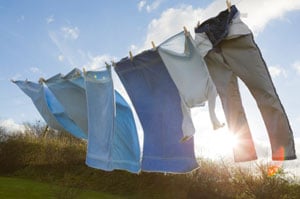
Although the clothing industry has managed to maintain a low profile in the carbon-footprint shell game, our relationship with our wearables bears as much scrutiny as our transportation and housing choices. The ubiquitous cotton, for instance, seems harmless enough -- it is a natural fiber, lacking the petroleum base of rayon and polyester, and not dependent on methane-producing ruminants required for wool and leather (methane creates 72 times the warming potential as an equal amount of carbon dioxide), according to Scientific American.
But our dependence on mass-produced clothing has turned this natural material into one of the world's most devastating crops. Cotton is a $300 billion-per-year industry that accounts for two thirds of the world's clothing. Its decidedly unnatural harvesting process has made it the most toxic crop on the planet, using 25 per cent of the world's insecticides, 12 per cent of the world's pesticides, and seven times the weight of those chemicals in fertilizer. The manufacture of a single cotton T-shirt involves one-third pound of chemicals and more than 2,800 liters of water just to grow the material, followed by a slew of toxins released into the air and water during bleaching, dying, and mercerization.
The environmental effects of the clothing industry have spurred a number of more eco-friendly options, with Paris runways suddenly vogue-ing with all manner of kinder choices, from organic and sustainable cottons to soy to bamboo to an increasingly softer line of hemp. But it's impossible to manufacture for the larger market without incurring the cost of some chemicals, and even fibers grown close to home are routinely shipped overseas for processing, adding the cost of transportation to the environmental bill.
"We could substitute materials with less harmful ones," says Lynda Grose, a sustainable-fashion designer at San Francisco's California College of the Arts. "But as long as the consumption of conventional fibers is increasing per capita worldwide (which it is), and as long as population is growing and increasing in wealth (both of which lead to greater consumption), the ecological gains we achieve through fabric substitution are lost."
The fact is, our efforts to reduce the environmental impact of our clothing choices has lagged far behind our housing and transportation concerns. The average North American throws out 27 kilograms of clothing per year, most of which ends up in landfills regardless of how much life they have left in them. And when we buy new clothes, at least 90 per cent of our purchases originate overseas.
Winning the clothing battle
The solution -- buy used -- is obvious, but we are far more reluctant to purchase pre-owned clothing than we are pre-owned houses and cars, perhaps a clean-freak revulsion to donning attire that spent years brushing a stranger's skin. But it is in thrift stores and vintage shops that the battle for sustainable clothing choices is being won, and at shared-resources events like Swap-O-Rama-Rama and the dozens of Freecycle networks around British Columbia (think Craigslist, except everything is free) that bring a community focus to environmental sustainability.
Taken as a whole, the clothing industry is one of the most environmentally destructive forces on the planet. But when you buy used or trade with friends, not only can you score finds you would never come across in retail stores, but the sunk environmental cost of those purchases reduces your closet's footprint to zero.
As with most of our environmental attitude shifts, adaptation requires a mental adjustment that removes us from the momentum of our destructive choices. Escaping the clutches of plastic grocery store bags requires that first trip to the Safeway with our own cloth carriers.
The same is true with a move toward sustainable clothing options. The next time you go on a shopping spree, make it a point to visit stores that offer recycled wearables.
If every Canadian bought their next cotton shirt used instead of new, it would save five million kilograms of agricultural chemicals and 95 billion litres of water.
We can imagine a whole suit, or a whole closet, but it's the initial thrifty buy that we all need to make. Take that first step and see where it leads you.
Tomorrow: What happens when a bunch of people decide to share a house in one of Canada's toniest neighbourhoods? ![[Tyee]](/design-article.thetyee.ca/ui/img/yellowblob.png)
Read more: Environment









Tyee Commenting Guidelines
Comments that violate guidelines risk being deleted, and violations may result in a temporary or permanent user ban. Maintain the spirit of good conversation to stay in the discussion.
*Please note The Tyee is not a forum for spreading misinformation about COVID-19, denying its existence or minimizing its risk to public health.
Do:
Do not: