- Ms Kaye is a Tyee Builder. You can be, too.
- Mary Carlisle is a Tyee Builder. You can be, too.
- Prem Gill is a Tyee Builder. You can be, too.
- Nancy Flight is a Tyee Builder. You can be, too.
- Justin Everett is a Tyee Builder. You can be, too.
- John Westover is a Tyee Builder. You can be, too.
- Nora Etches is a Tyee Builder. You can be, too.
- Edward Henderson is a Tyee Builder. You can be, too.
- Bharadwaj Chandramouli is a Tyee Builder. You can be, too.
- Dean Chatterson is a Tyee Builder. You can be, too.
- Marius Scurtescu is a Tyee Builder. You can be, too.
- Robert Parkes is a Tyee Builder. You can be, too.
- James Murton is a Tyee Builder. You can be, too.
- Susan Doyle is a Tyee Builder. You can be, too.
- Vincent Strgar is a Tyee Builder. You can be, too.
- Helen Spiegelman is a Tyee Builder. You can be, too.
- Subir Guin is a Tyee Builder. You can be, too.
- Kimball Finigan is a Tyee Builder. You can be, too.
- Joanne Manley is a Tyee Builder. You can be, too.
- David Leach is a Tyee Builder. You can be, too.
Woodward's Designer Reveals Secrets
Architect Gregory Henriquez gives a tour of his creation's quirky nooks and crannies, and replies to his critics.
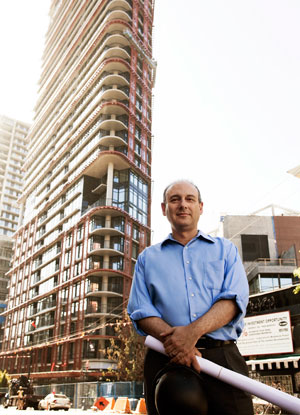
Henriquez in front of Woodward's complex. Photo by Marina Dodis.
In 2003, Vancouver's city council was in opposition to the 2010 Olympic bid. They gave their support for it, however, contingent on a trade. They would endorse the bid if the province would sell them the land on which to build what has become the largest, and one of the most controversial developments in Vancouver's history: the Woodward’s complex.
Now, seven years later, the Downtown Eastside city block that once held an empty, dilapidated department store has a density over three times that of Vancouver's West End -- already one of the most dense neighborhoods in North America. Woodward's houses 200 units of singles and family non-market housing including a dentist and doctor's office, a tower of 1,400 units of market housing, a floor of wheelchair accessible units, a grocery store, a drug store, a bank, an indoor public atrium, an outdoor public square, City of Vancouver offices, office space for non-profit organizations, a coffee shop, a school for contemporary arts, an art gallery, a performing arts theatre, a daycare facility, a massive, controversial mural depicting the 1971 Gastown Riot, and a community basketball hoop.
It is the climax of a vision that the City of Vancouver had for the revitalization of the Downtown Eastside. In order for it to be a success, however, it had to be a work of perfectly balanced art; both a symbolic and tangible expression of the quest for justice and equality in Vancouver's troubled Downtown Eastside.
The man who packaged it all together, architect Gregory Henriquez, has spent his entire career seeking to blend architecture with activism. In the few decades since Henriquez graduated from his architectural training at Carleton University, he has barely touched market-priced housing, aside from the design of his own home. Instead, he has built community centres, arts facilities, and schools on First Nations reserves. He has designed award-winning housing co-ops and social housing developments that seek to empower the residents by involving them in the decisions that shape their living spaces.
At Woodward's, Henriquez sought to do this by challenging himself to become the citizen architect -- by participating socially, politically, and environmentally in the community through the architecture he designed. The goal was not only to design housing, but to mould a sense of belonging, interaction, and inclusivity in the Woodward's community and Downtown Eastside.
As the pinnacle of Henriquez's career nears completion, The Tyee caught up with him in the centre of the action to see the final product through the visionary's eyes, and to hear firsthand what Woodward's means to him.
A guided tour
If you ever get a tour of Woodward's from Gregory Henriquez, I dare you to contain him to one section of the complex. When I met him in the atrium, his time was short. I assumed this is typical, given how I immediately found myself trailing breathlessly behind him as he barked out details to the left and right, pointing with his long, wood-handled umbrella. But what was meant to be a quick, truncated glimpse of only one part of the complex quickly became a two-hour long master tour. Maybe he's just a grandstander, I thought at first, who can't help but show-off the minutia of the masterpiece of his career. But the deeper we went, the more I began to see his rigor as a subtle expression of a much deeper notion: that no single part of Woodward's means as much without the context that surrounds it.
A tower of market-priced housing, for instance, is nothing special in Vancouver. And despite a communal penthouse space, fitness studio, climbing wall, and W-shaped hot tub on the roof, the condo tower in Woodward's -- known as the W Tower -- is no different than most (though most condo developers don't specially design the men's urinals to overlook the north shore mountains). Small apartments with big price tags, high-end appliances, and floor-to-ceiling windows overlooking the ocean make up much of Vancouver's skyline.
But as we walked from Hastings Street into the lobby of the single-room social housing units adjacent to the condos, the W Tower suddenly meant something completely different. Residents of the social housing units, run by the Portland Hotel Society, waited in the lobby for the elevator when Henriquez and I galloped in. Some had transferred here from SRO hotel rooms on the Downtown Eastside. Some had moved right off the street. And a select number of new residents were even part of the original squat group of protestors that demanded the city build social housing on the site. Henriquez, in a slick black trenchcoat and suit pants, immediately struck up conversation with one of the tenants -- who he already knew by name -- and made plans with him to go for a drink.
The elevator spat us out on the communal floor, where residents have access to laundry, health services, television, couches, and an enormous outdoor patio with a viewing pond overlooking the city. The extra cost for such public spaces in the non-market housing, Henriquez explained, was absorbed entirely by developer Ian Gillespie.
"I took him on a tour of my social housing project just around the corner called Laurie Krill Co-op, which won a Governor Generals award and is considered by many to be one of the nicest social housing projects in the entire country. I'm very proud of it," Henriquez said. "And Ian said, 'This is just not good enough. We have to do better than this, right?'"
"I explained that it was done at the end of the NDP's last reign and the funding you're getting now from BC Housing doesn't translate into a building like that anymore. And he said, 'Okay, whatever you need to make up the difference we'll do.' And he did."
'Treated with same dignity'
HENRIQUEZ'S FAVOURITE TOUCHES TO WOODWARD'S
The mews: Instead of one main entrance, many little alleyways lead into the centre of Woodward's from midblock Cordova, Abbot, and Hastings Streets. Henriquez fractured the site like this to allow room for as much public space and density to be packed into the same small area, resulting in what he calls "Tokyo meets London in Vancouver."
The view from the top: It may be lonely, but if you can sweet-talk Jim Green -- or one of the W Tower's other residents -- into giving you a private tour, you may use other words to describe the view from the outdoor patio 40-plus stories above Vancouver: like "breathtaking," "spectacular," or something far less cliché in the same vein.
Old-growth benches: A colleague from Henriquez's office discovered some fallen old growth logs one day in Stanley Park. When they learned that the Parks Board was getting rid of the logs, the firm enlisted an artist to carve them up into furniture for the inner atrium.
The "french fry columns": Like four criss-crossing fries, these huge semi-vertical cement slabs in the outdoor courtyard support the W Tower that looms above. Stand at just the right angle however, and watch them form yet another W. As if two on the roof weren't enough...
The spiral staircase to nowhere: A very important piece to Henriquez, the staircase in the middle atrium is the one soft object in an otherwise hard, urban environment. Like a giant umbilical cord rising from a pool of water, it stands a symbolic statement of re-birth.
"Parking" relic: For a blast from the past, take the umbilical cord to the second floor, and walk back towards the parkade into the glass walkway, where the traffic rushes beneath you. Try to spot the turquoise "Parking" sign, an exact replica of a sign from part of the original Woodward's building, meant to induce nostalgic childhood memories.
First-rate rays: Though they're imported from Scandinavia, the romantic strings of glowing orbs illuminating the courtyard at night are not the cheap IKEA model. Henriquez splurged on these special, top of the line European lamps to lend intimate warmth to the outdoor public space.
The 350 square foot units have real maple cabinets, a full three-piece acrylic bathroom, and woodworked shelving aside the Murphy bed that folds into the wall. Towels, blankets, and a gift basket with cleaning supplies all sit on the shelves, awaiting the room's new tenant. The windows and heating system in the building are identical to those in the market housing, despite the fact that the government does not require that quality of materials for social housing.
"They are treated with the same dignity, the same windows, same quality of finishes as everyone else," Henriquez said.
He guided me to a large ballroom off of the communal space that can be used by residents for weddings and special events, and crosses the room to look through the window over to the family housing. Smiling, he pointed to an elevated outdoor playground where children from the family social housing units can play, a mere 20 metres away from the gleaming balconies of the market condos.
"The architecture of this site is really fundamentally about programming. It's about a mixed-use program trying to posit an inclusive form of community," he said. "I think the fact that market housing can live with singles non-market housing, with families non-market housing, with institutional uses, with all these things, really posits hope for our society."
"It's pretty amazing that the world let us do this."
Beauty, ethics and Woodward's
The first page of Henriquez's book Towards an Ethical Architecture boasts an ambitious manifesto.
It reads: "Architecture must be a poetic expression of social justice."
"The Greeks did not make a distinction between ethics and beauty being two separate disciplines of endeavors of human existence," Henriquez told me, looking through the steam of a skim-milk chai latte at the massive feature mural dominating the outdoor plaza. "It's only modernity that's done that... So what we've done with modernity is we've separated everything into distinct endeavors. Social justice issues are now very separate from what most architecture is about. That's a very unfortunate reality in our profession."
"I knew that if you were going to do Woodward's, you had to not only do the right thing, it had to be beautiful. It had to be both. The ethics had to be dealt with and it had to be beautiful. If it wasn't both, it would just end up being a disaster."
"So the things that make it beautiful are the acknowledgement of the realities of what it is, and the conflict, the tension, and the love of this building that we have to somehow reflect in what we build here. That's what this is trying to do in some way."
'We displaced nobody'
But what about that fear lingering in the back of everyone's mind on the Downtown Eastside: that the glitzy Woodward's condos will lead the tip not towards a diverse, inclusive neighborhood, but rather a trendier, pricier locale?
"I think that gentrification is a real fear that people have. I think that it's coming with or without Woodward's. There's going to be a change in this neighborhood. The developers came long before Woodward's; they were building loft projects just down the way here. I would argue that the loft projects that people love -- all the arts community thinks they're fabulous, and everyone thinks are this great historical integration into the neighborhood -- are more of a gentrifying force than Woodward's. There's no social agenda to them, there's no inclusivity. They're just pure market condominiums.
"I think if you look at Woodward's as a model... if every project had to have 40 per cent non-market housing in it like Woodward's does, then it doesn't displace. This project on this site -- we displaced nobody."
"If every little project that occurs when gentrification does come, if each one was as thoughtful and tried to do something of worth and value to society and this community, I think you could do it in a sensitive way. It's possible."
"I think you have to accept that this neighborhood was once much different than it is... This neighborhood wasn't what it is today. It was a much more diverse neighborhood... To think that somehow the fix is to leave it the way it is and only build social housing is a little naïve, as well. The reality is that it has to change, and if we make that change, something that is healthy for the neighborhood and provides a diversity of housing types and doesn't displace people -- the essence is not whether it's gentrification or not, the essence is displacement, and to this day Woodward's has not displaced one person. It's actually added housing to the neighborhood and that's the thing we need to focus on: zero displacement and the creation of more affordable housing. That's what it should be about."
'We can have inclusive communities'
"I hope that Woodward's is seen as a symbolic step in the right direction. That people use it as a model, not as a literal model of the scale of the development, but as a model of inclusivity where we try and include non-market housing, market housing, affordable ownership and all these types of things in a broad mix that doesn't displace anyone, that is inclusive. That's the real message, right?" Henriquez says as we leave, adjusting his umbrella to shield me from the cold Vancouver drizzle.
"We're all just people, and all the sort of departmentalization that happens in most cities doesn't have to happen in Vancouver. We don't have to have gated communities. We can have inclusive communities and create healthier cities and happier cities." ![]()


18
Login or register to post comments
Bobby Peru
2 years ago
Woodwards - An Homage to Naivete
Woodwards is a metaphor for Vancouver's brand of the politics of political correctness. The poverty pimps' monument to their astounding power to build a trendy ghetto that will never be moved. And its political power to force the govt to create the most expensive social housing in the country. It may be euphemistically called 'non-market' housing, but the opportunity cost of providing such housing in an expensive downtown area is very real and market. It may be idealistic to imagine that yuppies or whatever label we use for the 'rich' will actually pay hundreds of thousands of hard earned dollars to live and risk their lives in a complex along with welfare people. Or on the same street with druggies and dealers and pimps. It's a fact, I guess, that the apartments have really been sold. But, the let's see if it lasts and what really happens because its success will depend on a radical change in human nature. And we can see the real side of human nature outside on Hastings.
Is Woodwards just a prize for Jim Green, who finally made 'the man' cough up for the poor? Or is this simply a naive hope that by making yuppies pay for the privilege of living next to junkies and criminals we can all hold hands and sing, "We are the world...?" Aside from sheer, unjustified hope is there any logic that shows that goodness and mercy shall certainly follow and poverty, drugs and homelessness will vanish from Downtown Eastside because Woodwards will be a shining example of how society can work together? Can you really live in that area without being robbed blind by the druggies looking to set up their next fix?
Obviously, Woodwards would be a great location for drug dealers and pimps- it's their prime office location. I love the selective and optimistic examples used in this article. Where are the dealers, pimps, thieves and other assorted subversives? Have any of you asked existing Yuppie residents in the area how it's like to live there? They'll tell you about the high risk of burglary, damage to your car (not Porsche, but Honda) from vandalism and people urinating in the entrance. So all of a sudden you think everyone will behave like they live on Sesame Street if you install some trendy architecture? Why don't we just name this as Jim Green's pyramid.
High minded social activists conveniently forget that human nature can't be changed. Common sense says Woodwards will be a neighbourood more suitable for Travis Bickle (Taxi Driver) or maybe Dirty Harry- because that's who we'll need to clean it up.
alive
2 years ago
best of intentions!
Unfortunately in our very democratic society it is standard practice to give priority to anyone who already live in the area, whenever a new social housing project opens up.
A bit of screening would solve the problems outlined by Bobby Peru, but hey, we are Canadians.
Anyone with a sob-story must be considered, even if they have shown no attempt at bettering their own situation.
I understand that it is depressing to have to fight for everything when you are poor, but giving up is not an option!
About the criminal element, perhaps the police should begin to enforce our laws?
G West
2 years ago
Bobby
I'd say your posts here at Tyee are better proof "that human nature can't be changed" than anything in the built environment of the Woodward's complex.
If you actually knew anything about the role of the street in creating positive social and public spaces you wouldn't make such a foolish claim.
The point being, of course, isn't that human nature can't be changed - that's simply a truism.
What needs to be recognized is that even the 'creatures' you dismiss with little more than an idle and hateful epithet share a place in the same human family with the rest of us.
The problem isn't that we can't build better cities and more humane places for people to live - the problem is creating an atmosphere where a community can exist in some kind of harmony and that problem conflicts with the same kind of prehensile thinking that gave us ghettoes, slavery and indentured labour – the inhumanity of those with power toward those who have no power.
You may think the social atmosphere in a gated development in West Van or Pt Grey constitutes a community - I assure you, it does not. And that perception doesn't require even 'common sense' to recognize.
The role of the appropriate built environment in establishing and promoting community development, stability and freedom from fear has been very thoroughly studied. The results are well-known to anyone who takes the time to educate themselves. And it has nothing to do with big guns of any kind.
Your final allusion to Dirty Harry says a good deal - but not at all what you meant it to say.
John Greg
2 years ago
Bobby Peru
Are you by any chance actually Rush Limbaugh or perhaps Anne Coulter in disguise?
o-b-s-e-r-v-e
2 years ago
Complaints
There are drug couriers in the lobby around the clock in the W Tower: to service the condo owners. What a joke. The rich addicts are seen as being at the frontier of revitalization but the token poor are stuffed into little boxes. A model for us all.
o-b-s-e-r-v-e
2 years ago
"Affordable Housing"
And the "affordable" family housing is a joke too. It starts at $1300 a month. Guess who is moving in? Young professionals. So they're getting the subsidy instead of low income people. Just like what happened at Laurie Krill where no poor people were accepted but they still pretend it's social housing.
zalm
2 years ago
I'll have to take a look
...and see this Henriquez project up close. I've heard both about him - visionary (positive) and impractical (negative) but I've never seen it for myself.
Much as this project, tries, it simply can't stand on its own. It needs a lot of support in the local neighbourhood to make it a go - viable restaurants, night schools, community centres, libraries, the like... but what has it got? And will what's around it cater to one population at the expense of another? Or will the gentrifying population continue to flee their home turf for other areas to shop, play, read, school themselves?
One small rant:
"...has a density over three times that of Vancouver's West End -- already one of the densest neighborhoods in North America."
We keep hearing this nonsense. Depending on how you draw the boundaries, the West End neighbourhood is either 22,000 or 35,000 people per square km. It's nothing close to San Francisco's North Beach district at 55,000, Boston's South district at 65,000 or Manhattan at 75,000. And let's not even talk about some other cities in the world that routinely exceed 100,000 by large amounts.
Anyway, an interesting article, if only for a peek into the mind of one trying to bring a human touch to gentrification.
zalm
2 years ago
Gawd, Bobby...
"Common sense says Woodwards will be a neighbourood more suitable for Travis Bickle (Taxi Driver) or maybe Dirty Harry- because that's who we'll need to clean it up."
I'm speechless. Nothing more need be said - I think every contribution you've ever made can be summed up in this one phrase - it's your acme.
Urbanismo
2 years ago
"quirky nooks and crannies" Huh!
Of course, time was, an architect with a scintilla of integrity would refuse such a commission: but we live in desperate times!
This over built mixed-up contraption, for starters, is 320 feet of sunless, looming ugliness over built in a zone restricted to seventy feet height: more evidence of a desperate civic process only too willing to keel over to any developer snake oil salesman's distraction that will keep it from facing the anthem of slow decay: social housing, social responsibility at those rents . . . BALDERDASH.
The give always comes when an, only to gullible, public, desperate to believe, can be fed comforting delusion . . . in this case "THE GAS TOWN RIOT" art piece.
In fact, at the time, this harmless mele was recognized as a "POLICE RIOT".
But of course forty years later, with minds and imaginations, totally co-opted by polite consumerism, we can no longer handle the truth, can we?
In fact the mural is quite misleading because, on that August day (well before dark) of 1971, Maple Tree Square was a throng of happy, well behaved people, until quite mounted police goons came charging in wielding batons. So much for truth in art . . . ?????????
Woodwardsmouse
2 years ago
My Home Sweet Home
I am one of the fortune people who was chosen to live in the new social housing area run by Portland Hotel Society and I would like to thank Gregory and all the people who put this great place together. I use to live in a box in the downtown east side known as an SRO or single room occupancy unit I now live in a place I'm proud to call my home for the first time in 12 years. THANK-YOU GREGORY!!!!!
ohhh and for some reason everyone keeps avoiding the fact that most of residents here are disabled. Whats up with that?
ASKBiblitz.com
2 years ago
Deference to the Woodwards Mo'feshnuls and Property Crime
Why do Vancouver reporters typically pay such deference to real estate mo'feshnuls here, one wonders? Why prose so purple in full embarrassing view of a decades-old leaky condo epidemic that has infected highrises, low-rises, condos, co-ops and even brand-new single-family homes?
Surely the real story here is how, if at all, this guy's construction will be any better than the fifth-rate kinderklatche currently under tarps every five years or so throughout the Lower Mainland.
Once that one has been answered, ask what kind of police protection condo owners can expect when the junkies start start stealing their required annual $50k-worth of liquidable assets from their wealthier neighbors! How are the police doing these days recovering property stolen during B/Es? Do they even investigate anymore?
alive
2 years ago
just playing along
"How are the police doing these days recovering property stolen during B/Es? Do they even investigate anymore?"
No they quit pursuing leads several years ago!
Maybe because that would screw up the insurance firms pay-outs? too much paperwork in case the stolen item was recovered.
realisticman
2 years ago
Woodwardsmouse
It is good to see you commenting here on the subject that you know more about than anyone else. Please continue and come back soon.
There are many discussion here regarding what is, or is not being done as regards socially funded housing in Vancouver and in BC in general.
The Tyee readers,as well as some of the writers, can benefit from your thoughts. Is Woodward's helping the neighbourhood? Has Woodward's just moved the problems further east? Are the 'dealers' everywhere? Have locals found work because of the development? Is the social mix mixing, or avoiding each other? Do the day-workers that come to the offices, shops, cafés and SFU fit in okay, or do they seem as though they are just visiting?
These are important issues for the city and The Tyee regularly runs stories on this subject; your impressions or ideas over time, as Woodward's and its effect mature, can contribute valuable first-hand knowledge.
We can read plenty of opinions from writers that suggest moving everyone out of town and others that say nowhere near enough is being done.
Keep a diary of how this project evolves and share it. People want to read your stories.
alive
2 years ago
yeah but
realisticman:
I think the issue here is how it will work out to have such a mixed bag of residents all in one place.
It is idealistic to think that yuppies will enjoy mingling with what they consider scumbags.
I think it is great that places are provided for the less fortunate, but all the hoopla about this specific place seem to be more about making a statement, than solving a problem.
I fail to see why we need to provide subsidized space in high rent areas.
A lot of average citizens have had to move elsewhere for that reason, so what makes the real poor so different?
Maybe getting away from the old hangouts, might inspire a few to change their lifestyle?
realisticman
2 years ago
alive
I agree with just about all you say as well as your suggestion and those issues are where opinions diverge. Let's hear from someone who's in there and perhaps the debate will become less theoretical and more practical.
realisticman
2 years ago
alive
Further; getting them away from their old hangouts to inspire them to change their lifestyle is exactly what all the successful recovered junkies say is necessary. If Woodwardsmouse does come back and report that the place is overflowing with crack and meth it will confirm that there is something very wrong with letting this continue. If he or she comes back reporting that people have found work and that there is a general feeling of well-being, then that too will steer the debate.
G West
2 years ago
Yeh, Thanks and good luck woodwardsmouse
Notice how even the putative well-wishers provide no comment about what's likely the most significant point you made.
I’d guess it’s because it doesn’t fit their ‘view’ about what the ‘real’ problem in the DTES actually is.
They much prefer to continue to blame the victims
Good luck to you.
Snowrunner
2 years ago
Woodwards and the DTSE
While I have to agree with him that Woodwards isn't the reason for the gentrification in the DTSE that rotating and glowing W will be seen as the sign of it.
I like the building / complex actually as far as architecture goes it is one of the more interesting buildings in this town (much more interesting in my opinion than the Shangri-La), but it won't solve the DTSE's problem nor the problems of the people having existed there for the last 30 years.
What seems to continue to be happening is that an "out of sight, out of mind" attitude drives the development / people in this town, instead of trying to break up the DTSE and put the people into different neighbourhoods all over the lower mainland in decent places with access to detox etc.
We'll see what happens, but I doubt that Woodwards will usher in a new era of prosperity for the people currently in the DTSE.