


News

What's Driving Olympics Homeless Protesters

As housing prices soared, social housing went unbuilt for years. As a result, shelter is hot politics in Vancouver.

By Monte Paulsen and Geoff Dembicki, 16 Feb 2010, TheTyee.ca

Red Tent Campaign Pivot Legal

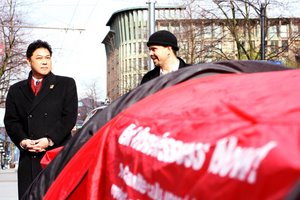
Vancouver city councillor Kerry Jang and Pivot Legal director John Richardson with homeless campaign's red tent. Photo by Justin Langille.

Related

Bruce Laking has lived on Vancouver's Downtown Eastside for 56 years, off and on. Early Monday afternoon, he gestured to a bright red tent on the sidewalk. "Hey, how d'you like my new home?" Laking shouted to a friend.

Hundreds gathered today at Pigeon Park, a triangular slice of concrete in the city's most troubled neighbourhood. They rallied for solutions to homelessness and erected an "Olympics tent city" just down the road.

"We're not here for any violence -- we're here for love and peace," the Power of Women's Elaine Durocher told reporters, activists, homeless residents and city councillors. "We're here for the poor and poverty-stricken."

Native elders led a short march throughout the neighbourhood, beating solemnly on handheld drums. Someone pushed a stroller with the crowd. The baby calmly munched handfuls of popcorn from a small plastic bag. Yellow-jacketed police rode bikes alongside, joking with each other.

The walk ended at an empty, fence-fringed lot between Abbott and Carrall streets. Tents sprouted like mushrooms from the red clay and concrete amongst old sneakers and syringes.

Many of the shelters were bright red, the result of a Pivot Legal Society campaign to house Vancouver's homeless and draw attention to the issue. In coming weeks, organizers will distribute up to 500 tents.

"There's not enough shelters and there's not enough hotels," Laking said. "The hotels that are here are dirty and they're full of bedbugs. I believe the tents will be popular."

Nobody's sure how long the tent city will last. Or where new ones will grow. For now, police keep a watchful eye.

As the Tyee's Monte Paulsen explains below, today's protest is merely the latest incarnation of a decades-old problem.

More homeless than athletes

The provincial government bills British Columbia as the "Best Place on Earth" but rarely mentions that Vancouver is also among the least affordable places in the world to find a home.

Metro Vancouver, in particular, is plagued by market failure across the housing spectrum. Its poorest residents are becoming homeless, working-class parents cannot afford to rent appropriate apartments, and middle-income families cannot afford to buy ordinary homes. Between 10,000 and 15,000 people are currently homeless in British Columbia. That works out to two or three homeless Canadians for each of the roughly 5,000 athletes competing in this month's Olympic Winter Games.

Homeless Canadians are living (and dying) in British Columbia's cities, suburbs and small towns.

The growth of homelessness in B.C. has been driven by a variety of factors.

Gentrification has been a leading cause. In Vancouver, for example, hundreds of residential hotel rooms have been lost to redevelopment. The low-end accommodations that remain have doubled in price, and now cost much more than the province pays welfare recipients. As a result, many of B.C.'s most vulnerable -- those suffering from mental illness, addiction or other disabilities -- have been driven into the streets.

Cities in the United Kingdom and the United States have successfully reduced homelessness through a "housing first" approach, where homeless individuals are moved from the streets into low-barrier supportive housing. The advantages of this proven approach are two-fold: First, people who live indoors seek treatment sooner and achieve better long-term outcomes than those who shuffle in and bounce out of inpatient treatment centres; second, people who live indoors use far less police, ambulance and health services than the homeless do, meaning that it costs taxpayers less to house them than to keep them homeless.

But unlike federal governments in the U.K., U.S. and Europe, the Canadian federal government led by Prime Minister Stephen Harper has steadfastly refused to fund housing first solutions, in much the same way it has repeatedly tried to shut down Vancouver's safe-injection site.

Indeed, Canada remains the only G8 nation with no national housing plan. If there is an overarching theme to the diverse housing protests scheduled throughout the next two weeks, it is an attempt to call international attention to this fact.

Single parents sleep on the sofa

Those 10,000 to 15,000 homeless people are just the visible tip of the province's housing iceberg. More than 600,000 British Columbians are living in housing that is inadequate, unsuitable or unaffordable.

That figure comes from Statistics Canada's 2006 estimation of "core housing needs." This term includes housing that is too run down or too crowded -- or, as is most often the case in B.C. --- consumes too large a share of the median household income.

StatsCan found 14.6 percent of all British Columbia households were in core housing need in 2006. That's 233,704 households, or about 619,561 people living in housing that costs more than they can reasonably afford.

Renters were almost twice as likely as homeowners to face affordability problems. In 2006, 43.7 percent of B.C. renters spent more than 30 percent of their household income on shelter.

The stats were even worse for the roughly 15 percent of Vancouver-area families headed by single parents. The median after-tax income for a single parent family headed by a woman was $34,350 a year in Metro Vancovuer. Using federal affordability guidelines, that works out to $859 a month for rent. But in Metro Vancouver, $859 doesn't even pay for the average one-bedroom apartment -- and it is about half what median two-bedroom units cost.

As a result, single parents sleep on the sofa every night in Vancouver.

And with less money left over to pay for food and other necessities, one in five British Columbia children live below the poverty line. In fact, the "Best Place on Earth" is home to Canada's highest rate of child poverty for the sixth year in a row.

Ordinary families can't afford ordinary homes

Nor does housing market failure end with the working class.

Vancouver is the least affordable place to buy a house in the world, according to a recent report by the Winnipeg-Based Frontier Centre for Public Policy. Abbotsford, Kelowna and Victoria are also among the 40 least affordable housing markets.

Ordinary, two-income families earn $64,332 a year in Metro Vancouver, according to Statistics Canada. A typical bank will loan that family enough money to buy a $258,142 home.

But ordinary Metro Vancouver homes cost $562,463.

That's the 2009 residential benchmark price as calculated by the MLSLink Housing Price Index. That figure averages condos, attached homes and detached homes throughout the region. Apartment properties averaged $382,573, while detached homes averaged $766,816. Half a home is all that ordinary Vancouver families can afford.

Many remain trapped in high-priced apartments for decades longer than they would in any other Canadian city. Business leaders warn that the high cost of housing has become a golden egg that threatens Vancouver's economic goose.

Political fallout on parade

The peaceful activists organizing this week's tent city believe that the 2010 Winter Games have exacerbated Vancouver's already fragile affordable housing market.

"The upcoming 2010 Winter Olympics have escalated the homelessness crisis in Vancouver's Downtown Eastside and the Greater Vancouver area. Since the Olympic bid, homelessness has nearly tripled in the Greater Vancouver Regional Distrct, while real estate and condominium development in the Downtown Eastside is outpacing social housing by a rate of three-to-one," they claim.

Whether or not these Olympics worsened the region's housing problems, it's clear that organizers have done next to nothing to help matters. The city and province officially declares as "non-binding" a promise to build social housing as part of the Olympic effort -- and investments by the Olympic organizing committee, VANOC, have been described as "chump change."

Since the election of Mayor Gregor Robertson in late 2008, the City of Vancouver has created hundreds of emergency shelter beds over the past two winters, but the city's own estimates show the effort to be insufficient -- and many of these are scheduled to be closed on April 30th after the Winter Games are through.

The province has purchased dozens of old residential hotels, as well as promised more than a dozen new buildings to house the homeless, but even these efforts are nowhere near what's needed to bring 10,000 British Columbians indoors.

The federal government has contributed little toward British Columbia's efforts to end homelessness, earning universal scorn from housing advocates. The hundreds of red tents given to the homeless this week are the start of a year-long effort to call attention to Ottawa's lack of a housing plan.

As the 2010 Winter Games unfold, politicians from all three levels of government navigate among middle-income and working-class voters who share an uncommon bond with the homeless -- they all feel insecure about their housing tenures.

It is amidst this curious gumbo of public compassion and private self-interest that this week's homeless protests are being launched.  [Tyee]

29  Comments:

Login or register to post comments

  • TommyBoy

    1 year ago

    Homelessness andhousing

    Good analysis Monte and Geoff. We're coming to a critical 'mess' as far as housing and housing affordability in Metro Vancouver is concerned.
    Now I hope the masked hoodies out there don't groan and denounce me in cyber space for say this: but at least Vancouver is trying.
    Perhaps, Monte, you and Geoff should look at other Metro Vancouver municipalities are doing about housing and homeless. Vancouver has about 28% of the population of Metro Vancouver, but approx. 75% of the shelter beds.
    Burnaby, with one third of Vancouver's population has one part time shelter. Hasn't done a significant social housing project for years, and sits while much of its existing rental stock deteriorates and won't even legalize basement apartments - which probably make up about 40% of our rental stock province wide. And it has an NDP dominated council.
    Perhaps the Tyee could look at the contribution to affordable housing issues and homelessness the other 22 Metro Vancouver municipalities are making.
    I think your readers would be surprised.

  • verso

    1 year ago

    minimum wage

    "...Vancouver is also among the least affordable places in the world to find a home."

    I think another piece of this puzzle is the minimum wage – the lowest in Canada! Try living in this city on 8 bucks an hour.

    Shameful.

  • realisticman

    1 year ago

    "Canada remains the only G8

    "Canada remains the only G8 nation with no national housing plan. ", Monte Paulsen & Geoff Dembicki

    Er, excuse me, that's wrong for a kick off!

    The United States federal government no longer pays to build housing projects. Since the early 1990s, it has given money under HOPE VI to tear down distressed projects, to be replaced by mixed communities built with private partners.

    Also, Canada is a decentralized federation. Do you writers seriously imagine that the federal government is going to take back the responsibility for social housing from the provinces? What on earth are you talking about?

    This article is riddled with holes.

    "The provincial government bills British Columbia as the "Best Place on Earth" but rarely mentions that Vancouver is also among the least affordable places in the world to find a home."

    What did you expect? The best place in world to be, ... cheap? You know very well that density and height is opposed by many Vancouverites, even and often by those that want cheaper digs. Vancouver's high property taxes and development costs also contribute substantially to the high cost of residential properties.

  • Monte Paulsen

    1 year ago

    US leads on 'Housing First' funding

    While it's true that the U.S. has moved away from the development of large social housing projects toward smaller mixed-income projects, the anonymous commenter known as "realisticman" is simply wrong about the U.S. not funding social housing. Indeed, U.S. expenditures on redevelopment of social housing have increased.

    With regard to the homeless, the U.S. has been funding Housing First since the early 1990s. The U.S. Congress in 1999 directed that Housing and Urban Development (HUD) spend 30 per cent of its funding on the method. The most recent of many authorizations came as part of the “Helping Families Save Their Homes Act of 2009."

    Housing First is endorsed by the United States Interagency Council on Homelessness as a best practice, and is similarly endorsed by government agencies that deal with the homeless in the United Kingdom. In 2007, HUD credited Housing First as a prime cause for an overall reduction in the number of chronically homeless individuals living on the streets or in shelters.

  • gnam

    1 year ago

    What did you expect? The best place in world to be, ... cheap?

    Not necessarily 'cheap.' But one would expect that cost of living would be included in any qualitative assessment of regional living space. While you are right that many Vancouverites don't appear to have a very clear understanding of the relationship between density, height, and affordable housing, Paulsen & Dembicki draw attention, quite rightly, to the ideological contradiction inherent in billing a city as the 'best' while ignoring a major factor that should be taken into account in any reckoning of 'quality of life;' namely, affordability. Again, r-man, your steadfast insistence that the rest of the world really is/should be organized according to the same circumstances and principles that govern your subjective situation belies the extent to which your apprehension of social reality is merely ideological... in the end you lean on your arguments like a drunk on a lamp-post... more for support than illumination--which is what gives them their ideological character.

  • natan

    1 year ago

    excellent article.

    Thank you for an excellent analysis that so many in the public could learn much from. Many are simply are lacking the information of what drives protesters and activists, and are looking to hear about solutions to the housing crisis in a constructive manner.

  • ASKBiblitz.com

    1 year ago

    Best Place in the World for 'leaky condo syndrome' housing

    Once again the reporters miss the story, which is the B.C. government's de facto creation not just of homelessness but of our new and most lucrative industry, the one many of us refer to as the failed housing industry.

    This is the legacy of a decades-old 'leaky condo' epidemic that has infected highrises, low-rises, condos, co-ops and even brand new single-family dwellings! There's no mystery here. Real estate developers, of whom our Premier is one, and building design mo'fessionals know perfectly well that the fifth-rate garbage so often concealed (or not!) under green and blue tarps will only keep the rain out for about five years, when yet another set of major repairs/restoration/redevelopment will be expensively required. It's worthy of an Olympic sport, surely!

    With the help of the media, local architects and homebuilders have successfully perpetrated the fraud that construction this brazenly flawed is somehow the new normal, and worse, that equity in a toxic, leaky mess is somehow preferable to the substantial protections provided to tenants under residential tenancy legislation.

    Taxpayers subsidized the failed housing industry for years in the form of those HPO repair loans but happily that tap has been shut off.

    The good news: When enough suckers lose their shirts in B.C.'s failed housing economy, those grifters at the NRC may be forced to admit that all those energy-saving provisions from the '70s are the ultimate cause of this disaster. The question is, will they do it in time to prevent the Green people worldwide from importing Canada's embarrassing standard?

  • freebear

    1 year ago

    ?!?!?

    "What's Driving Olympics Homeless Protesters"

    A limo?

    Do the homeless have cars?

    Stupid Headline!

    How about:

    Why a homelessness activist?

  • gnam

    1 year ago

    @freebear

    You might not like the headline... but don't be obtuse; look up the definition of the verb 'to drive.'

    http://dictionary.reference.com/browse/drive

    You'll see that the very first definition indicates that the headline of this article is perfectly intelligible.

  • realisticman

    1 year ago

    Monte Paulsen

    The Housing First Program you cite operates in 9 States and the District of Columbia - hardly a national program. "Housing First moves the homeless individual or household immediately from the streets or homeless shelters into their own apartments." Just like the programmes in BC.

    I was writing quickly and forgot the quote you say is wrong. It came from Wiki, perhaps you would like to go there and correct it.

    You can find it here:
    http://en.wikipedia.org/wiki/Public_housing_in_the_United_States

    Or, read more here:

    http://www.nytimes.com/2008/03/21/us/21housing.html?_r=1

    "The federal government no longer pays to build housing projects, which in Washington, Chicago and other cities became symbols of concentrated poverty.

    Since the early 1990s, it has given money under a program called Hope VI to tear down distressed projects, to be replaced by mixed communities built with private partners. In a pattern that critics disparage as “demolish and disperse,” some former tenants return but most scatter with rental vouchers, destroying community ties. District officials say they have learned from past mistakes. ..."

    In 2006, The Village Voice called HUD "New York City's worst landlord" and "the #1 worst in the United States." The criticism is based upon decrepit conditions of buildings and questionable eviction practices.

    As for your "Helping Families Save Their Homes Act of 2009". This was due to the foreclosures in the USA and irrelevant to Canada.

    "In the wake of the bursting of the United States housing bubble and the collapse of the American subprime mortgage industry, this bill was introduced by Rep. John Conyers (D-Michigan) on February 23, 2009."

    Unless, of course, you have some inside information on foreclosures that we don't know about.

    The other point is that since the Federal Government in Canada withdrew from MURBs in Canada the responsibility has shifted to the provinces, as I mentioned. Any attempt to take back this responsibility would be opposed by Québec, for one. Just yesterday when Ignatieff was questioned on this he said consultation was needed but he would not say anything concrete would be done under a new Liberal government.

  • Monte Paulsen

    1 year ago

    Realistic? Man?

    I'm delighted to read that the anonymous woman or man who cower behind the misnomer "realisticman" has discovered Wikipedia. How wonderful for you!

    Please continue reading. For in the very same source,
    you may discover that the U.S. government funds Housing First not directly but by making payments to local organizations. Or you may learn that the aforementioned housing bill included components aimed at funding homeless reduction. (Specifically, Public Law 111-22.)

    I have no idea who you are or what your agenda is, but I find your misleading citations far from realistic.

  • realisticman

    1 year ago

    Monte Paulsen

    The vast majority of this, and indeed, all Web 2.0 and later web sites use nicknames. I doubt it is going to change and I don't detect any problem with it. No need to be disparaging.

    The Public Law you cite, 111-22 is, as I said before, specifically for cases where foreclosure is occurring, which is not applicable to Canada and is not a new initiative for creating more housing.

    As I said, "Just like the programmes in BC."

    http://en.wikipedia.org/wiki/Public_housing_in_Canada

    "Public housing in Canada is a federal, provincial, or local program designed to provide subsidized assistance for low-income and poor people. Increasingly provided in a variety of settings, public housing used to be one or more blocks of low-rise and/or high-rise housing operated by a government agency."

    Canada does have a policy and this is delivered by the provinces.

    http://www.cmhc-schl.gc.ca/en/co/prfinas/index.cfm

    "Programs and Financial Assistance

    Financial assistance takes the form of forgivable loans or non-repayable contributions, and can be used to fund repairs, renovations, accessibility modifications, the creation of low-income rental units, and home adaptations.

    In September 2008, the Government of Canada announced $1.9 billion, over five years, for housing and homelessness programs for low-income Canadians. As part of this investment, the renovations programs were extended for two years, until March 31, 2011.

    These programs are available for low-income households, seniors, and persons with disabilities and are cost-shared and delivered by Provinces and Territories in most jurisdictions."

  • Monte Paulsen

    1 year ago

    On defamation and other topics

    Thank you for reminding me why I generally don't respond to this forum. A few quick points and I'll return to my habit of ignoring you.

    1.) You disparage (sometimes defame) those of us who write for The Tyee on an hourly basis, and yet you have the gall to suggest that we not disparage you? I think you have it backward. I'm real. We're using my real name here. If you defame me, you are legally liable. But we are not using your real name, are we? I could defame you all day long at no legal risk whatsoever. I simply choose not to.

    2.) Unlike so many Tyee commenters -- who have been gracious enough to contact Tyee writers and pursue meaningful conversations -- you persist on engaging in these red herring disputes anonymously. In my personal opinion, that makes you a coward. The evolution of "web 2.0" does not negate your responsibilities as a citizen. Just because The Tyee's generous moderator, like a good bartender, is gracious enough to allow you to be an ignorant bully doesn't make it right for you to do so.

    3.) The news report above states that the US and the UK fund Housing First housing. I've clarified how that funding was delivered and pointed you to precisely the bill through which the latest funding was delivered. I stand by our report.

    4.) The news report above states that one of the key demands of this week's housing protests is for the federal government to reengage in the funding of housing, specifically housing for the homeless. I stand by our report.

    I can't see how continuing a nonsensical debate with an unrealistic coward will accomplish anything.

    Say 'hi' to your mom for me,

    Monte

  • realisticman

    1 year ago

    gnam

    "Again, r-man, your steadfast insistence that the rest of the world really is/should be organized according to the same circumstances and principles that govern your subjective situation belies the extent to which your apprehension of social reality is merely ideological..."

    Can't imagine how you assumed any of that. My point is that the federal government, criticized in the article, has no sway over the density and heights of buildings in Vancouver and this is absolutely a cause of the high cost of living spaces, as well as the local property taxes. I wouldn't mind, in fact I'd like to see more height and density. There are vast stretches of Vancouver, even main streets, that are only one or two storeys high. Whenever the subject is raised people come down on developers wanting to keep them out and keep the city small. In fact, were my wish for the above put into practice and more units were available then the cost of housing might come down. Supply and demand worked well over the past couple of years when the markets all stopped or crashed. Housing in Vancouver became cheaper.

    This is not a selfish wish on my part since the value of my property would decline too. Small retailers would also be more viable, as would transit expansion.

  • realisticman

    1 year ago

    Monte Paulsen

    Sorry I upset you so much. I do apologize to you regarding the US Bill. I'd looked for it and the first thing that came up was an abstract that only deals with foreclosures (www.nlihc.org/doc/701-704-Public-Law-111-22.pdf ). I blame Google but that's no excuse for my sloppy research. So, I went back and scanned the entire Bill on the US government's web site.

    http://www.govtrack.us/congress/billtext.xpd?bill=s111-896

    It is interesting and hopefully good will come of it.

    Nom de Plume's have been around for thousands of years and they are probably here for a while yet. Do you remember the citizen's radio handles, "good buddy", etc. I wouldn't get to excited about people using them. Do you know Lady Gaga's real name?

    Perhaps we will have an enthusiastic journalist here in BC that will ask of a federal politician here, or perhaps somewhere else in Canada, as to the practicality of a similar initiative in Canada and whether the provinces would acquiesce to such. Could be a good question for Norman Spector since he has experience at the Ottawa level. There are many social housing facilities in the Vancouver area that do benefit from federal funds, whether a new national policy could open the national-unity and federal-powers debate should be explored.

    Mom says 'hi' to you too. She also mentioned decaf.

  • OilbertaRedTory

    1 year ago

    realistically, noms de plume

    can't disguise character.

    Look! Who's this ?
    http://www.youtube.com/watch?v=qNkvM1BSwy0

  • A Guenther

    1 year ago

    Low income rentals in the future?

    And on the plus side, they might have a problem selling units at the athletes village for $1.6 mil or even a $mil:

    Athletes and coaches slam Olympic Village accommodation

    http://www.bild.de/BILD/news/bild-english/sport-news/vancouver-olympics-2010/02/12/olympic-village-accommodation/coaches-athletes-slam-walls-as-thin-as-curtains.html

  • gnam

    1 year ago

    Guenther... wishful thinking

    Hi Guenther,

    I read this article earlier and got all excited that the village might be put to some use other than hi-end condos for part-time residents (tourists) but if you re-read the article the athletes in question appear to be Whistler event athletes. So I think the criticisms are directed at the Whistler accommodations. I'm not too sure about that though as the article isn't explicit. Anyway, if you find out more about this it would be great to hear about it.

    cheers

  • Bill Bargeman

    1 year ago

    Brilliant and thorough analysis

    Thank you Monte and Geoff! This is the clear case why there MUST be non-market, that is, state intervention in the real estate market. Without a comprehensive national, provincial and local housing strategy that uses tax dollars to alianate real estate from the market, that is, build subsidized and public housing, Vancouver will become the urban resort of the developers' wet dreams. The market demands housing for profit. We must intervene to provide housing for people.
    So how to get there? This article is a fabulous basis for an immediate political program. Any federal, provincial and civic party with a whit of sense and ambition to overturn Harper, Campbell and permanently terminate the NPA would gain tremendous public support in this city by moving forward with this analysis.
    Meanwhile the activist community and those like myself who believe the broader forces of the market will eventually limit any strictly electoral political program, the question of tactics is paramount. There must be a public and consistent policy of non-violence and increased action with wide participation and serious discipline.

  • A Guenther

    1 year ago

  • vancurber

    1 year ago

    housing

    There is lots of cheap housing in the province for welfare recipients in places like Kitimat, Ft. St. John, Salmon arms, etc. If people are not working, they clearly don't have to live in Vancouver. Also, as a student, I have often rented shared accomodation for around $300 per month, sharing a 2 or three bedroom in the suburbs. People are often homeless by choice, not for lack of affordable accomodations. People should watch this documentary about the East side to see how much resources the homeless have in Vancouver (to the tune of $70,000 per individual per year) that they do not take full advantage of. http://www.youtube.com/watch?v=I6-1oo-b3Ds

  • jimgde

    1 year ago

    interesting...but somewhat lacking

    found the article somewhat informative, but it unfortunately neglects to consider the point of view of any of the people that may be in a position to address the problem (policy makers at the municipal, provincial, federal levels)....could no one be contacted for an opinion or position?

    also, Monte, you are a journalist here - you might benefit from having a slightly thicker skin when it comes to comments section. all i can see from this thread is that you were the first to go ad hominem

  • A Guenther

    1 year ago

    gnam

    We have a rather incongruous reference to acoustics in an article by AP. Rogge: Feb 9 "He said the acoustics of the rooms are also crucial. "Sometimes after a victory an athlete can make some noise," he said. "You need to make sure the other athletes are not woken up."

    http://www.google.com/hostednews/ap/article/ALeqM5jVJwhsKpiCXBS3e1Tdh9pOmmSxyQD9DOVTP80

    And some semblance of clarity in a Canadian Press article. Rogge: Feb 9 "He said he's already heard that the rooms are quiet - an important feature for athletes. "Sometimes after a victory an athlete can make some noise,'' he said. "So you must be sure the other athletes are not woken up.''

    http://origin.ctvolympics.ca/about-vancouver/news/newsid=36755.html

    I found this article in which the author did a translation from the German die zeit article.

    http://dailygumboot.ca/2010/02/german-athletes-complain-about-olympic-village/

    So I decided to do the same, and sure enough Whistler olympic village is mentioned more than once.. odd that the english version of bild does not mention whistler and in fact, puts a link right in the article to olympic village in false creek.. go figure... the wordpress article mentioned previously, basically just copies that.

    Half of the athletes are in Whistler are they not? Any idea how much these units are being sold for after the games?

    Still looking.

  • mary jane

    1 year ago

    canadas shame is known to the world wide

    the whole world now knows how shabby the politican have treated the residence of bc. If there is no safety for the athletes is it any surprise there is no safety for the citizens of bc. This has also put a light on how BAD the games are for the people of the country they are held.

  • barney

    1 year ago

    Support for Monte

    Put aside the fact that Monte Paulsen has dedicated much of his Tyee writings to issues of homelessness and social housing (great stuff, by the way, Monte), I like the fact that a journalist, from time to time, enters the nom de plume lions den to defend his integrity and credibility. This shows Paulsen has passion for the issues he writes about.

    I completely share Paulsen's frustrations regarding Web 2.0 citizen journalism. You've got hard working journalists who work tirelessly to uncover facts and data to back their stories, and then in walks some alias to throw Wikipedia monkey wrenches and red herrings into the story, without any accountability. I agree with Paulsen, it is cowardly. Paulsen et al stand behind their words, are responsible and accountable for them. The rest of us who hide behind anonymity are, essentially, not. And yes, I've thrown my own share of barbed wrenches into the mix.

    Anyway, one little gem from Paulsen is easily the best quip I've read on the Tyee comments section:

    A few quick points and I'll return to my habit of ignoring you.

    This one's a keeper!!

  • jimgde

    1 year ago

    @ barney

    I don't mean to knock the value of Paulsen's contributions in general, but only to suggest that any fanning of the personal-attack flames that often characterizes Tyee article commentary sections -- especially when it comes from someone professionally associated with the website -- detracts from the overall quality of the discussion.

  • david hadaway

    1 year ago

    Realist

    If you are reading this please refer to the previous article on which we were discussing your situation and contact me. If others see him on other topics please alert him to this.

  • Takuan

    1 year ago

    fear not!

    the provincial government has saved the day yet again and just announced the restoration of Riverview Hospital to full function with several improved amenities. All those mentally ill tipped out into the streets years ago are now entitled to return to newly refurbished, clean, bright rooms. Far from the crack dealers into whose clutches they fell, they will be lovingly cared for as human beings. They will especially appreciate the spacious shower rooms provided by our Dear Leader along with the energy efficient co-generation plant, the furnaces of which are conveniently located alongside. Truly BC has become a workers paradise at last!

  • realisticman

    1 year ago

    On calling cowards

    I have contacted and engaged personally with Tyee writers, actually. We even did lunch and coffees too - the full-caff kind.

    • The discussion for this story is closed. No more comments can be added.