


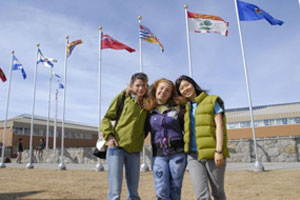
It seems an unlikely place for a college, serving a territory the size of Sweden and with a population of only 35,000. But Yukon College has made an advantage out of its smallness and remoteness. And on Wednesday of this week, it became the home of the Yukon Research Centre of Excellence, dedicated largely to studying the impact of climate change on the north.
Terry Weninger oversaw its start as a trade school in the 1970s, when he was territorial deputy minister of education. After years in post-secondary education elsewhere, he returned as Yukon College's president in 2006. In an interview with The Tyee, Weninger talked about the challenges and opportunities his school now faces.
While trades programs and developmental education are key parts of the college, Weninger said, Yukon is a comprehensive college offering academic and career programs as well -- and doing so in 11 communities across the territory. It does so in the face of a major constraint: the small student population. Yukon has about 1,400 full-time and part-time students, plus another 5,000 who take continuing education courses.
"The needs go right across the spectrum," he said, "but it's hard to respond with economic efficiency because of our low enrolments." As the college begins to offer degree programs, it will still have to stay comprehensive.
Competing with southern schools
It will also have to stay competitive. Southern schools' distance education courses are just a mouse-click away. Yukon offers distance-ed as well, running courses by videoconference that link students across the territory. The college's business management courses go out from five instructors at the Watson Lake campus.
Meanwhile Yukon art history students take videoconference courses from the University of Toronto. Yukon's program in Early Childhood Education also serves students in the Northwest Territories, and its program in visual arts articulates with Emily Carr University of Art and Design.
Yukon College is one of four contributors to the Northern Collaborative Information Technology program, along with the College of New Caledonia, Northern Lights College, and Northwest Community College. Via BCcampus, the program offers an identical course in applied information technology for business purposes.
Videoconferencing and online courses help create what Weninger calls "critical mass" -- enough students to sustain support for courses and programs. Even so, classes tend to be far smaller than most in southern schools. Christina Thomas, president of the Yukon College Employees' Association, told The Tyee that typical enrolment in trades and academic classes courses is 12 to 15, though a new program in office administration admitted 40 students this fall.
Like most post-secondaries, Yukon is working hard to market itself and to attract more students. According to Thomas, enrolments are up this year by about 15 per cent, from 1,228 last year to 1,412. The college even has about 20 international students.
One selling point has been remarkably low tuition fees, though Weninger says they just went up by 50 per cent, all the way to $225 for a 3-credit course -- $825 for international students. (By contrast, Capilano University charges $327, and $1,275 for international students.) On-campus residences, a legacy of the 2007 Winter Games, are also cheap; a single room costs as little as $100 a week.
Thomas said tuition fees were hard to raise when the minister of education set them, but the college's board can impose fees now. She felt higher fees wouldn't automatically drive students away; many consider high fees an indicator of high quality.
Finding answers to local questions
As a kind of curtain-raiser for the new Yukon Research Centre of Excellence, the college in early October hosted the first "north of 60" conference for students and young researchers sponsored by the Association of Canadian Universities for Northern Studies. Attracting 200 delegates from as far away as New Zealand and Poland, the conference was a venue for discussion of issues affecting both polar regions.
Such conferences may become more common when the YRCE's new facility is built in 2010. Its purpose will be to supply on-the-ground studies of issues affecting northern Canada -- especially technologies that can help northerners deal with the impact of climate change. The YRCE will be an umbrella organization, including both college faculty and programs like the Yukon Geological Survey's Mining and Petroleum Energy Research Group.
One program, for example, will provide research and development to help manage roads and runways built on permafrost. Another will develop improved fibre fuels from Yukon sources -- wood pellets providing more efficient heat. A thermal exchange R&D program will explore ways to improve and extend storage of locally grown food for remote communities.
Yukonners are famous for multi-tasking: running gold mines and tourism operations, or B&B's and security companies. Yukon College, too small to survive with a single specialty, is doing the same thing. In the process, it may teach survival skills to colleges in southern Canada as well. ![[Tyee]](/design-article.thetyee.ca/ui/img/yellowblob.png)
Read more: Education









Tyee Commenting Guidelines
Comments that violate guidelines risk being deleted, and violations may result in a temporary or permanent user ban. Maintain the spirit of good conversation to stay in the discussion.
*Please note The Tyee is not a forum for spreading misinformation about COVID-19, denying its existence or minimizing its risk to public health.
Do:
Do not: