

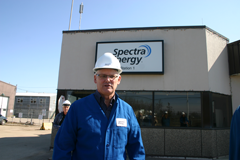
Two weeks ago, as Premier Gordon Campbell visited a sour gas drilling rig near Tomslake in Peace River, he extolled the big money such operations produce for the province. B.C. earned over $3.6 billion from oil and gas in 2008, counting land-rights sales and royalty revenue.
At the same time, a different set of oil and gas numbers where being crunched at the northern end of the Peace River region.
"There are at least a dozen documented cancers within three miles of Upper Pine Elementary," said Rose Prairie resident June Volz. The farming community about 30 kilometres north of Fort St. John is permeated by oil and sour gas wells, including one directionally drilled beneath the school.
The former elementary school teacher mapped out the incidences of cancer in the Rose Prairie area in 2006, and said she was alarmed by the trend she saw.
"I think there's more research that needs to be done about this," she said. "Nothing will happen with regard to the health situation until someone draws attention to it."
It's a call for action directors with the Peace River Regional District (PRRD) have become familiar with. In December 2007, they were presented with a report from former Northern Health medical health officer Dr. Lorna Medd. Her study recommended a review of setback regulations, better public consultation and more health funding to address the impacts associated with the industry.
Sixteen months later, those recommendations have yet to be set in motion. A working group led by Northern Health medical health officer Dr. Charl Badenhorst has been set up to implement the recommendations, but the group remains in its teething stages and in need of funding.
Asked about the report on his April visit to the Peace, the premier said he'd never heard of it.
Sources of concern: setbacks and flaring
While Peace country residents are generally supportive of the oil and gas industry that has flourished in the area in the past five years, two areas of concern have arisen amongst those who live near to gas wells: setbacks and flaring.
Setbacks are the minimum required distances between gas wells and nearby buildings. They're regulated by B.C.'s Oil and Gas Commission (OGC), and now dictate sour gas well must be set back 100 metres from buildings and installations. (The majority of wells in the Peace are considered sour under the OGC's definition -- those that emit more than 0.01 cubic metres of hydrogen sulphide per second. Straight natural gas wells require only an 80 metre setback.)
"Back in 2003, we said 'we want these bloody things set back from our properties,'" explained Rick Koechl, a Fort St. John secondary school science teacher and longtime advocate for increased setbacks. Then energy minister Richard Neufeld promised to review the setbacks in 2004 and each year thereafter, but no changes were made.
Many are concerned about the long-term effects of hydrogen sulphide, a toxic gas that can be lethal at 800 parts per million, and harmful to the nervous system at much lower concentrations. While health trends relating to sour gas exposure are anecdotal at best, WorkSafeBC numbers have shown about two incidences of injury due to hydrogen sulphide exposure in the oil and gas industry each year. In the first 10 months of 2008, the number of reported hydrogen sulphide injuries jumped to 10.
In recent years, the OGC has heard "a common call for a 1.5 kilometre setback," said an OGC spokesperson. The commission also regulates flaring, the process of burning off impurities like sand, water, and carbon dioxide in order to stimulate gas to flow from wells. The process also releases volatile organic compounds (VOCs), which can be carcinogens.
Under the 2006 B.C. Energy Plan, the Ministry of Energy, Mines, and Petroleum Resources (MEMPR) is calling for flaring to be reduced by 50 per cent by 2011, and eliminated by 2016. Energy Minister and incumbent Peace River South MLA Blair Lekstrom publicly advocates technologies such as vapour technology, incineration, and in-line flow testing as ways to ease that transition for industry.
The industry is still picking up speed in northeast B.C. The Montney shale that underlies the Peace contains an estimated 50 trillion cubic feet of natural gas, only a fraction of which has been tapped thus far. Which means the minister can expect setbacks and flaring to become bigger issues in years ahead.
But for now, the local voices clamouring for change are background noise at the provincial level. Being regional issues in two safe BC Liberal seats, they're unlikely to garner any significant attention in the two weeks remaining before the May 12 election.
Silent on health and safety
Medd explained her report is "a preliminary assessment of the population health impacts of oil and gas activities in the Northeast," which was only intended "to shine a light into areas where further work might be required." Nine recommendations came out of the report. Northern Health, the provincial health services authority covering the top two thirds of B.C, has committed to working on three of those recommendations, plus one of their own.
"People had really high hopes for this report," said Medd, who received more than 50 anecdotal reports of health issues arising from sour gas exposure. The PRRD board "recognized the report came from the people," recalled director Arthur Hadland, who represents a rural area near Fort St. John. "Dr. Medd captured that and brought it forward."
While Medd's report points out the B.C. Energy Plan "is a strong initial response to the need to address climate change," the plan "is silent on the health and safety requirements of communities being impacted by resource exploration and extraction."
Much of the spotlight has focused on the report's call for a legislation review to ensure setbacks respect health considerations, but the report also looks at social health issues affecting the Peace during the oil and gas boom.
"These are large social determinant kinds of issues, oil patch workers who literally descend on communities in the winter," said Medd. The phenomenon is not new to the Peace, which saw an influx of migrant workers brought in to construct the Alaska Highway in the 1940s. But the current "rigger culture" spurred Medd to recommend an epidemiological analysis of changes in health status in the region between 2000 and now.
Previous study shed 'unremarkable' results
The Medd report may be the first to examine the gaps that likely exist in the regulatory regime that governs B.C.'s oil and gas industry, but previous studies have looked into the long-term health effects of exposure to gas wells.
One such attempt was the Western Interprovincial Scientific Studies Association (WISSA) study on the effects of sour gas on the health of cattle and starling. Governments in B.C., Alberta, Saskatchewan and Manitoba collaborated in the late 1990s to produce the six-year, $17-million study.
The results, released in May 2005, showed a one to two per cent increase in calf mortality in areas near sour gas wells. The results are "pretty unremarkable" and the methodology behind them is "tough to criticize," said Medd. The study focused on animals instead of people because of significantly higher levels of exposure faced by animals living outdoors.
"We really lacked confidence there was any ability to look at exposure for humans," said Dr. Ray Copes, the B.C. Centre for Disease Control's director of environmental health and a consultant to the WISSA study. "I'm not sure the real issue is chronic, low-level exposure."
"What we're breathing in an indoor environment has a far more direct effect on our exposures," he said. But "getting a closer look at the trends is always a good thing," he added.
Funding proving elusive
The Medd report surfaces almost monthly at Peace River Regional District (PRRD) meetings. Northern Health sought $30,000 from the PRRD in February to get the ball rolling on the working group, which is composed of about 20 stakeholders (landowners, local and provincial government and industry) and meets sporadically. The regional district declined, wary of shouldering a load they feel is a provincial responsibility.
"It's a time-honoured tradition that when you have an uncomfortable situation, as an overreaching governing body like Northern Health or the OGC, the best thing you can do to make the problem go away is send it to committee and let them work away at it for God only knows how long," said Fort St. John Mayor Bruce Lantz at a March PRRD meeting.
The working group's plea for external funding "just means that Northern Health would like to have another entity off to the side taking the heat off them and delaying the process," he said. Both the working group and PRRD have sent letters to Lekstrom seeking funding to implement the recommendations.
Lekstrom said he's looking to field-based trials initiated by Alberta's Energy Resources Conservation Board (the equivalent to B.C.'s OGC) that will lead to new models predicting how sour gas is dispersed under different environmental conditions. The study will be made available to B.C. later in the year, and will "inform our review of setback requirements," he wrote in an April letter to the PRRD.
Meanwhile, the province's 2009 budget includes $1.5 billion in provincial government subsidies to the oil and gas industry over the next three years, an increase of 57 per cent over the previous year's subsidies.
Koechl and West Coast Environmental Law staff lawyer Greg Gowe have sought to solve the setback issue by encouraging the province to offer a tax credit to oil and gas companies who abide by larger setbacks.
"We've had this offer on the table for four or five years," said Koechl. "It should be sitting on ministers' tables throughout the legislature. There's enough evidence that low-level issues are not being addressed."
The waiting continues
Though two PRRD staff sit on the working group, little information is emerging from the group's closed meetings, and neither Northern Health nor the province appear any closer to funding the group.
"It just seems they're at a stagnant position. No one seems to want to take the bull by the horns," said PRRD director Tim Caton. Oil and gas companies sitting on the working group have not seen any funding requests directed their way. An EnCana spokesperson declined to comment on the situation, stating "we would prefer to let that discussion take place between members of this group."
Asked whether oil and gas issues have any meaning beyond the Peace, Caton said "I believe (they) will, because it depends on whether the present government gets back in with a majority or a minority, and whether one of our two MLAs ends up being (energy minister.)"
"If that occurs, our present minister (Lekstrom) has been very receptive to working on setbacks, flaring, and these sorts of things."
While no chronic health impacts relating to oil and gas exposure are jumping out at health professionals, it's too early to declare the industry safe, said Medd, now a medical health officer with the Vancouver Island Health Authority.
"Absence of proof is not proof of absence," she said. In Rose Prairie, Volz said she'll continue to press for setbacks.
"Farmers are just too busy farming, and don't want to get in politics at all," she said. But we don't want to look back in 20 years and say 'if only we'd known.'"
Related Tyee stories:
- Sour Gas: The Smell of Money
B.C.'s oil and gas boom emits a deadly poison. As government trims its watchdogs, labour and health activists cry alarm. A Tyee special report. - BC's Oil and Gas Boom: Three-part series
- Premier pumps oil patch; fields questions on landowner concerns
PremierPumpsOilPatch/
![[Tyee]](/design-article.thetyee.ca/ui/img/yellowblob.png)
Read more: Health, Politics, BC Votes '09: Your Issues, Labour + Industry







Tyee Commenting Guidelines
Comments that violate guidelines risk being deleted, and violations may result in a temporary or permanent user ban. Maintain the spirit of good conversation to stay in the discussion.
*Please note The Tyee is not a forum for spreading misinformation about COVID-19, denying its existence or minimizing its risk to public health.
Do:
Do not: