News

Factory Grabs by Workers Coming?

If bailouts fail to save jobs, unions may crank up militant tactics.

By Tom Sandborn, 31 Dec 2008, TheTyee.ca

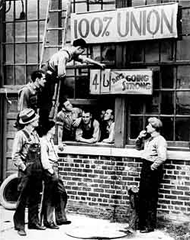
Auto Plant Takeover, Flint, Michigan, 1937

Auto plant takeover, Flint, Michigan, 1937.

Earlier this month, in a scene reminiscent of militant labour struggles of the 1930s, Chicago members of the United Electrical Workers Local 1110 sat down in their worksite at Republic Windows and Doors and occupied it for five days.

By the time factory occupation had ended, the workers had won major concessions from their employer and from management's key financial backer, the Bank of America.

"We have achieved victory," Local 1110 president Armando Robles told his membership. "We said we would not go back until we got justice, and we got it."

Some observers are asking whether the current economic crisis will generate more factory occupations here in Canada. At least one prominent union organizer here in B.C. says he predicts more occupations if hard times stretch on and deepen.

"Ultimately, if the system doesn't produce results," John Weir, director of organizing for the B.C. Federation of Labour told The Tyee, "we may see more occupations -- not in the short term, but certainly if this goes on for years like the Great Depression."

Angela Schirra, the federation's secretary-treasurer, agrees. She said she expected to see more use of the factory occupation tactic as workers reached a "breaking point."

For a template for action, labour in Canada need not look back all the way to the Great Depression era. Within the past several decades, on a number of occasions, union members have taken over facilities where they worked in order to wrest a better deal, or the very survival of their jobs, from employers.

'You get bailed out, we get sold out'

The Republic occupation was organized by the United Electrical, Radio and Machine Workers of America, a fiercely independent union with its own militant roots in America's Dirty '30s. The union was expelled from the Congress of Industrial Organizations for alleged communist links during the Red Scare of the Cold War 1950s.

The Chicago action this month made headlines around the world and garnered support from president-elect Obama. Illinois governor Rod Blagojevich, just before he became enveloped in scandal, backed the workers as well.

When over 200 workers marched triumphantly out of the Republic building supplies factory late on Dec. 10, chanting "We did it!" they set aside picket signs that read "You get bailed out, we get sold out."

The signs had targeted Bank of America, their employer's main financial backer. BofA, together with its newly acquired subsidiary Merrill Lynch, has received over $25 billion U.S. in bail-out money this fall, much of it used to purchase an enlarged share in a Chinese bank.

Despite the infusion of billions, BofA reportedly had refused to advance Republic's management a line of credit that would have allowed for proper severance pay for the company's workers.

"We're just shocked that Bank of America, after receiving $25 billion in bailout money, not only do they refuse to extend credit to companies but, to add insult to injury, they don't allow these companies to fulfil their legal obligations to their workers," union spokeswoman Leah Fried said on Dec. 7.

The post-occupation settlement at Republic, funded by lines of credit from Bank of America and JP Morgan, provided workers with eight weeks of severance pay, two months of extended health care coverage and all accrued and unused vacation pay. The union announced the creation of the Windows to Opportunity Fund, designed to find a way to reopen the plant.

Does seizing workplaces work?

Mark Thompson, professor emeritus at UBC's Sauder School of Business, has long observed Canadian labour relations. He told The Tyee that while it seemed possible to him that Canada would see the factory occupation tactic re-enacted in the future, he was skeptical about its utility.

"The tactic is essentially a political gesture, I think. My problem is how you define victory," he said. "How do you know when you've won? The United Electrical Workers were astute. Getting legally owed severance pay is an achievable victory, but re-opening a plant is harder."

This is not the first time workers have taken over a workplace to advance their demands. During the 1930s, French workers staged frequent factory occupations that won them favourable changes in national labour legislation. In America, the United Auto Workers brought industrial giant General Motors to its knees and won first contracts with the auto company by occupying plants in Flint, Michigan and in Detroit in 1936 and 1937.

And Canada has seen instances of this militant tactic too.

The occupations of 1981

British Columbians of a certain age will remember when members of the Telecommunications Workers Union occupied phone company offices across the province in 1981.

More recently, smelter workers took over an Alcan operation in Quebec in 2004, while Ontario saw several plants taken over by workers in 2007.

In Argentina, where the global economic crisis arrived earlier than it did in Canada, hitting in 2001 and creating unemployment figures over 20 per cent, desperate workers responded by occupying hundreds of factories. Even now, seven years later, more than 200 worker-controlled factories are still operating, providing employment to over 15,000 workers, although many are facing legal actions to evict the occupiers.

Bailout 'madness'?

What would it take for Canadian workers to revive such tactics? A key catalyst could be perceived unfairness as government defines whose needs to address in shoring up the economy.

The Canadian government has opted to mirror U.S. bailouts by providing $4 billion to the auto industry and a $3.5 billion loan guarantee for financial speculators. Now many other industries are lining up for their bailouts, at levels called "madness" in one Financial Post headline.

David Rice, now a regional director for the Canadian Labour Congress in Vancouver, was in the exultant crowd that greeted the union occupiers as they left B.C. Tel buildings in 1981. The Tyee asked Rice of he expected that workplace occupations might recur during the current crisis.

"I could see that," he said. "These are desperate times and workers are increasingly pissed off at management, especially as they see their jobs shipped away overseas."

Sid Shniad, a researcher for the Telecommunications Workers Union, sees his group's occupation of company property in the 1980s as a useful lesson for today's workers.

"They just want workers to play by their rules -- rules designed to kick the shit out of us. But if we are good little boys and girls, we lose. Workers have to break out of the straight jackets of the last few decades."

Related Tyee stories:

 [Tyee]

30  Comments:

Login or register to post comments

  • Van Isle

    3 years ago

    It'll never happen here.

    It'll never happen here. Canadians are too complacent. I've heard a lot of bitching about the Campbell government and the stuff that they have pulled off in the last 8 odd years but the idea of shutting this province down just does not wash. Oh, don't get me wrong, there are some people who would love to take action, but they are too few and too spread out.

  • sunshine coast girl

    3 years ago

    It's been done before...

    And it will happen again if it's warranted.

    I love union workers. They have balls when they need them.

  • sunshine coast girl

    3 years ago

    last time was 1983..

    http://bctf.ca/publications/NewsmagArticle.aspx?id=12834

    and it nearly happened again in 2004. I remember them both fondly. Gibsons was a real union town in 1983 and most everyone participated with enthusiasm.

  • DPL

    3 years ago

    "Don't let the bastards

    "Don't let the bastards grind you down", was the title of a book that highlighted how management tries to cut pay and benefits for their workers. Canadians can be militant. The occupation of public buildings have happened. Some died after being shot by private police. Many rode the rails heading to Ottawa to try to force the government of the day to back down on their handling of events harmful to workers and their family. I saw a tombstone a few years ago. It said. "Don't morn for me, Organize".

    Don't call a General Strike if nobody shows up is a real issue. Solidarity Coalition had many thousands on the street. Our union was federal and we were due to walk in the next two days. We paraded in the stadium along with provicnal workers and the general public. Our managers let us go there in uniform and none of us got suspended for taking the time out of a working day to go there. We were prepared to go, and were told since our collective was current we could and would be fired. Jack Munroe was sent to talk to Bennett to keep thousands of workers from being fired. People still argue that he caved in. I'm not so sure he caved. Bennet won the next election as people don't want anarchy which was quite possible. To say we are complacent fits some of the time, but not all of the time.
    To get rid of the present government do as the tombstone read. Organize and beat him at the polling booths.

  • Wilfred Laurier

    3 years ago

    Not the best example

    "French workers staged frequent factory occupations that won them favourable changes in national labour legislation"

    These actions were ordered by the Comintern to destabilise the Popular Front government of Leon Blum. This also crippled France's rearmament effort and was a major factor in France's defeat at the hands of the Nazis.

    This makes interesting copy but the last time unions tied this in BC, "Operation Solidarity," it resulted in a landslide for Bill Bennett. Hardly the desired effect.

    "Organize and beat him at the polling booths."

    This is a much more effective tactic. A mob may be fun, but it has no legitimacy other than that it bestows upon itself.

    Finally, we don't have a lot of factories in BC.

  • southdeltawalker

    3 years ago

    whatya doin for New Years Eve?

    Naoimi Klein and Avi Lewis made a film a few years back about a factory occupation in Buenos Aires-"The Take".
    Here is link:
    http://www.thetake.org/index.cfm?page_name=watch_the_trailer

    Might make good watching for New Years Eve and a great way to start the New Year.

    Happy New Years Eve everyone!

  • anarcho

    3 years ago

    A good idea.

    But as someone pointed out we don't have many factories to occupy - thanks to years of neo-liberal policies. But I suppose workers could occupy Starbucks, Walmart and MacDonalds. Wait till this idea catches on in China where the factories are now!

  • anarcho

    3 years ago

    The French Factory Occupations

    "These actions were ordered by the Comintern to destabilise the Popular Front government of Leon Blum."

    Nonsense. The CP was PART of the Popular Front Govt. The take-overs were largely spontaneous, as workers saw the chance to improve their working situation. The CP, as ever, was a MODERATING force in the strike, trying to halt its revolutionary potential. Furthermore, the many of the militants who led thee take-overs were of the non-Communist left - anarcho-syndicalists and Trotskyists, the former of which were a significant force in the France of 1936.

    Suggestion - read some history before you spout! For a non-CP viewpoint see:
    ”http://pubs.socialistreviewindex.org.uk/sr193/france-5.htm

  • BC Mary

    3 years ago

    A rare book

    This might be a good time to mention an unusual book I just heard about, concerning a communist living in the USA.

    Here's what one of the co-authors said:

    Here is news of a new book on the Scales Family! The Web site is truly excellent.

    In March 1971, Mickey Friedman, a young writer started to interview my mother and my father and myself for a book about the impact of the McCarthyist spirit on our family.

    Harvard was interested but thought Mickey’s introduction was too sympathetic on us. Then for various reasons my parents asked him to withdraw the book. He did with a heavy heart. Shortly after my father died, over 30 years later, Mickey was still interested and I agreed that it would be OK.

    University of Illinois Press grabbed it instantly and hired historian Gail O’Brien to write an historical chapter and asked me to write an Afterword..

    Those interviews (edited in a rather intelligent way) and Mickey’s introduction, Gail’s essay and my afterward will appear as "A Red Family" at the end of January. You can find more information about "A Red Family" on

    www.Aredfamily.com

    And a Happy New Year to all !!

  • snert

    3 years ago

    The next wave

    I have posted the Snopes article just to save everyone from having to check it out.

    The letter to General Motors by Gregory J. Knox

    http://www.snopes.com/politics/soapbox/knox.asp

  • anarcho

    3 years ago

    When in doubt - blame the unions!

    The Snopes article is just more of that "blame the workers - blame unions" rubbish promoted by the far-right. Don't these dopes realize that the auto workers in Japan and S.Korea are also unionized, indeed the latter could teach the UAW a lot about militance?

  • alive

    3 years ago

    There are two sides to this.

    People who have not worked inside large plants fail to understand that there is constant friction between management and the hourly paid workers.
    The general attitude is that workers are paid well, and that should solve any problems.
    If you were to put yourself into this picture, think how you would feel about investing your only asset, the best years of your life, in a situation where you were reduced to being a mere number?
    where you have no possibility of having your opinion heard and you were likely to be replaced by a robot.

    Working people are mostly quite intelligent and it is an insult to treat them as if they have no brains!

    There often is a chilly atmosphere in such workingplaces, Many now average more staff than actual workers, and unfortunately it seem obvious from the "floor" that many staffers are hired because of their affiliation with golf and country clubs and the like, rather than because of their skills.

    The people who actually produce things, have a better understanding of what the problems are, but find time and again that someone just out of university is the one who has the decision making job.

    I see it as no wonder if workers are prepared to take a chance at running the plant they work in; They have lived for years watching stupidity rule, and naturally feel that even if it is bad times, they could do no worse.

    This applies to all larger facilities, we have had forest oriented plants going co-op quite succesfully.

    Where they may run afoul is when the competiton is prepared to spend money to underbid them long enough to cripple them!

    Workers who buy out their plant do not have enough extra capital to fight crooked competiton.

    Another thing people ought to consider is: why be envious that a forklift operator makes a good living? is it a scandal that he and his family can afford a summerhome and a boat?
    The emphasis should be on having everyone earn enough that they too could get above starvation salary!
    We produce all these toys, why is it that only a select few should earn enough to enjoy a toy or two?
    In other words, think about how to improve the income of the poor, even if it means you pay a buck extra for that coffee.

  • G West

    3 years ago

    Amen alive

    Thank you!

    Couldn't have put it better myself...take a look at the recent history of United Airlines for another example of just how the cooperation between finance and management works against the best interests of workers, retirees and the public...http://www.pbs.org/wgbh/pages/frontline/retirement/view/

  • dorothy

    3 years ago

    that wasn't the reason.

    "the last time unions tied this in BC, "Operation Solidarity," it resulted in a landslide for Bill Bennett. Hardly the desired effect."

    The reason Bill Bennett won was not Solidarity. It was, incredibly, the fact that he was completely non-committal about what he would do when elected. I remember my sense of what he did being completely predictable, as well as the impossibility of calling him on it, since he had made no commitments.

    Let us hope that, in the time between now and then, people have learned to understand, that the fact politicians say nothing does not mean they'll do nothing. I think the electorate of today do not buy cageyness the way they were gullible enough to do then.

  • morechatter

    3 years ago

    Why not a cooperative?

    I mean for the workers as clearly they are the driving force.
    If they united there is little need for unions, little need for big management and little need for a bailout as you get back to the day to day operations but only it doesn't take and arm and a leg and a foot(just kidding about the foot) to get things going it just takes vested interest and a co operative attitude. Its different times as its a world wide time and its global competition as the INTERNET opens a widow of opportunity to merchants around the globe. Its seams ideal for the lumber industry as its problems only intensify. Workers could map out a living while leaving BC the beauty she is and the unions well maybe they could pick up a Axe.

  • dorothy

    3 years ago

    Think about it.

    “We produce all these toys, why is it that only a select few should earn enough to enjoy a toy or two?”

    You pose this as one of the classical questions ‘with no answer’. Yet it may be worth trying to answer it.

    Can a country, or the economy of one, be run in such a way, that there are nobody who falls out of the bottom? Can there truly be enough to go around?

    Probably, but it would require (you guessed it!) a cultural shift of fundamental proportions. It would require, that people who ‘run things’ are not just clever, ‘financial whiz kids’ to their own advantage, but can see far ahead and wide around, as well as think in communal terms.

    We have all heard the story, that two men on an island with an equal number of coconuts to start, would in pretty short order result in one of them owning all the nuts and dictating terms for everything to the other one.

    Perhaps, but then the next question is: What do we want? The total laissez-faire has been bankrupted. So has the communist idea. So has the push-pull-manipulate-and-scheme ‘mixed economy’, with its ranks of registered and non-registered ‘lobbyists’.

    Truth is, we need a new model. Or maybe an old model. We have had people in these columns scoff at the potlatch institution as ‘romanticising the tribal stuff’. But think about the basic idea: The man with all the coconuts throwing them all over again, so there can be sport out of a communal revival, just like shuffling the deck in a card game. What is wrong with that, when we talk glibly about ‘the game of life? The people who have no stomach for economic blood sport would be guaranteed a regularly returning shower of plenty, with some to stick aside to tide them over till next time, and those who are bent on – and good at - piling coconuts at the expense on others, would never get the opportunity to get fat and lazy and rest on their laurels, as sooner or later, they would be right back at square one.

  • dorothy

    3 years ago

    The rest of the less than 300 characters on Word at least..

    I think, that deep down, Jimmy and all his cohorts like the idea, as it gives them not just fortune, but also fame with a much wider circle than just their equals in the little gated community. But where they balk is when they cannot do these things with a flourish, but it gets institutionalized, bureaucratized and invaded by boring, procedure-ridden nitpickers with their filing cabinets. Social democratism, as it is known in my old country.

    I know it is an extremely foreign idea here on the West Coast, but maybe we could have a little fun living with each other, a little colourfulness in our daily exchanges, a little spectacular ceremony now and then. It works, also in the long term. Ask any Haida. They did not have the need to travel to foreign lands to find the means to prop up their own ailing social order. They must have been doing something right. Maybe the potlatch. It must have been pretty central in maintaining social stability, since it was one of the things most viciously attacked by those who wished to see them weakened and de-stabilised.

  • dorothy

    3 years ago

    OOOPs

    That should have been 3000 characters. Why is it that Word counts less than 300, and we are told that the comment is too long?

  • dorothy

    3 years ago

    I give up. Not a day for numbers..

    Happy new year! It IS 2009, right?

  • ME2

    3 years ago

    Dorothy

    Long before the banning of the Potlatch, there was no need "to see them weakened and de-stabilised." The Haida suffered the most of all the Coastal tribes from the white man's diseases, and by 1900 had been reduced from perhaps 20,000 people to well below 1,000.

    The fact that today their numbers now stand at approx 5,000 (which includes those living elsewhere) speaks well for the efforts of the medical missionaries and the monies spent by the Federal gov't on social welfare items and grants for local enterprises.

  • dorothy

    3 years ago

    And then there's Maud...

    "..The fact that today their numbers now stand at approx 5,000 (which includes those living elsewhere) speaks well for the efforts of the medical missionaries and the monies spent by the Federal gov't on social welfare items and grants for local enterprises."

    Perhaps we ought to give a wee bit of credit to some great leaders of that people and their ability to inspire their flock to find themselves and re-discover some important elements of their culture. Maybe you take that for granted, but I thought it should be said, lest somebody thinks we can grow people like bugs in a test-tube, just add the right nutrients...

  • realisticman

    3 years ago

    Would you like the keys?

    Accompanying this story is a photo of workers occupying an auto plant in Flint, Michigan. If this were to happen today the company could well offer the workers the keys to the building because this time it's a different paradigm. The product is not selling. All over the world there is an oversupply of vehicles and it's the same for many other manufactured goods. Workers may decide to take over factories but if the market for the products has evaporated the owners may just walk away.

    If, as 'alive' writes, "Another thing people ought to consider is: why be envious that a forklift operator makes a good living? is it a scandal that he and his family can afford a summerhome and a boat?
    The emphasis should be on having everyone earn enough that they too could get above starvation salary!
    We produce all these toys, why is it that only a select few should earn enough to enjoy a toy or two?" No; nothing wrong with that. Maybe the worker should have a big truck to haul the boat too, but that means expanding the market and finding new customers for ever more high-priced stuff. (Kinda goes against the grain of that other Tyee story, "Idea #10: Biophysical Economics"). Nevertheless, if that's what's wanted then a flush middle-class market with disposable income needs to be cultivated both here and abroad.

  • ME2

    3 years ago

    Dorothy

    Dorothy, I did not correct you in order to start an argument / discussion, or to hint at some inferiority of FNs. I commented only because I bridled - as usual - at the totally unfair and untruthful practice of socially progressive people to characterise absolutely EVERY "White"/ FN interaction as yet "another" instance of deliberate destruction of aboriginal culture. That's straight, inexcusable BS, and incompatible with the respect for truth I know you strive for.

  • alive

    3 years ago

    who is earning what?

    NO realisticman, it means we need to have a more fair distribution of wealth!
    There is no reason why some salaried workers should haul in three times as much money as a forklift operator!
    We have seen beyond any doubt that, having a diploma on the wall is not equivalent to having a brain or contributing anything to society!
    It would be reasonable to pay anyone working enough that they have monies to spend, That is the recipe a for growing economy

  • RickW

    3 years ago

    CEO's

    Last year, it took the average CEO in Canada a day and a half to "earn" the average Canuck worker's yearly salary. This year, it is evidently hovering around a day and a quarter.........

  • realisticman

    3 years ago

    alive

    I don't know why you say NO, since I agreed with you, "No; nothing wrong with that."

    I was on a pretty big boat last year that's owned by a guy that works as a mechanic at BC Transit. Do you say he should earn less?

  • G West

    3 years ago

    High earnings

    I think there are two ways to look at this. Either limit maximum upper earnings to some multiple (say 10) of the average industrial wage - certainly THAT would be appropriate in areas of the economy which make their livings by shuffling financial paper.

    If, on the other hand, one still believes what seems to me to be a fairy story about the necessity for sky high remuneration as a goad to performance, productivity and hard work, then so be it.

    But for God's sake don't pretend that such earnings should NOT be taxed at higher and rising marginal rates. What we have now is the worst of both worlds.

  • realisticman

    3 years ago

    Non sequitur

    GWest
    "But for God's sake don't pretend that such earnings should NOT be taxed at higher and rising marginal rates. ..."

    Who's pretending? Rising rates is exactly what we have now!

    http://www.cra-arc.gc.ca/tx/ndvdls/fq/txrts-eng.html

  • G West

    3 years ago

    Not just rates R/Man

    So you're now in favour of removing the special rates for some 'kinds' of income?

    Something I've been promoting here for ages.

    What a marvellous resolution that would make for you for 2009.

    Besides, you're dissembling, you know exactly what I was writing about....

    I take it you're also in favour of this then:

    Quote:
    Either limit maximum upper earnings to some multiple (say 10) of the average industrial wage - certainly THAT would be appropriate in areas of the economy which make their livings by shuffling financial paper.

  • ME2

    3 years ago

    GWest

    Only the pampered NA CEO would see a 10 to 1 ratio as a hardship, Garth. It would also be nice if these bozos EARNED their bonuses too.

    RMan might find a review of W Edwards Deming instructive.

    • The discussion for this story is closed. No more comments can be added.