Homeless by Choice?
A Victoria court challenge depends on what's voluntary and what's not.
'Right to fall asleep' at issue.
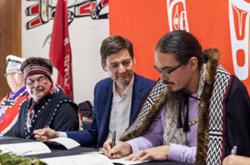
The provincial government this week lost its bid in the British Columbia Supreme Court to quash a constitutional challenge to Victoria's anti-camping bylaws, but not before it became clear much of the case will revolve around whether the choices homeless people make are voluntary or involuntary.
A loss in the case, which is scheduled for five days of trial in June, would set a precedent that could see homeless people free to set up tents across B.C. and the rest of Canada.
"We're very, very pleased," said Catherine Boies Parker, a lawyer representing the campers. Justice Victoria Gray made the right decision, she said. "We think the court made it clear we have a serious constitutional issue."
The case stems from an October 2005 City of Victoria injunction against people who were camping in Cridge Park, a city-owned property a block away from the provincial legislature. Lawyers for the campers challenged the injunction, arguing people had no choice but to camp when there were only 170 shelter beds for a homeless population of 1,200 or more.
It's unconstitutional, they argued, to prosecute people for failing to follow laws they cannot comply with.
Since the case involves constitutional questions, both the federal and provincial governments were given the opportunity to intervene. The federal government declined, but the province got involved in September 2007. The province will remain involved as the case goes to trial, confirmed Veronica Jackson, a lawyer representing the provincial Attorney General's Ministry.
Choice of shelter
During Jackson's closing remarks on the second day of the hearing, she spoke about the difference between voluntary and involuntary actions. "It's acknowledged at some point a body falls asleep," said Jackson. "It's involuntary. You are not making a choice."
Since sleeping is involuntary, it is protected by Canada's Charter of Rights and Freedoms, she said, and people have a right to sleep outside. It would therefore be allowed under the city's bylaws, and in fact the city did change its bylaws last year to allow sleeping in public.
"While it may be the case for sleeping," Jackson continued, "That's not the same for having shelter."
Having shelter is something people can control, she said. "I'm suggesting it's not on the same footing as 'involuntary' because involuntary is something you can't control." They are making a choice to erect tents, she said, and that should not be protected under the charter.
"There is no, in this case, government legislated, and certainly not a constitutional, right to shelter," she said.
Right to wake
"It has to be the right to fall asleep and wake up," said Boies Parker outside court. If people have the right to sleep outside, she said, surely they also have the right to protect themselves from the elements while they do it. "Taking care to make sure after you go to sleep, you wake up, don't freeze to death, that's voluntary?"
The city's current policy is that people are allowed a waterproof sleeping bag or a tarpaulin, but not a tent. It is unclear, however, whether police are following the policy. "We're not really sure what's allowed and what isn't allowed," said Boies Parker. The policy needs to be spelled out in the city's bylaws, she added, not left up to the police.
And if setting up a tent is a choice, would the province not argue that people are also choosing to be in the park? Or even to be homeless?
Asked on March 5 about the government's position, Attorney General Wally Oppal said, "I don't know enough about the case." He needed time to review it, he said. "Call me." But the following day he was unavailable.
The minister responsible for housing, Rich Coleman, was also unfamiliar with the case. "I really don't have an opinion," he said. "I'd have to read it."
So, in his view, is being homeless voluntary? "A person can decide where they live," he said. "It's a free country." He added, "We don't force people into shelters." A community court might tell someone where to sleep, but in general the government does not. "We don't say you have to go anywhere."
'Where you lay your head is home'
Asked if homelessness is a choice, a man who goes by Ancient and who has been in court observing the case, said, "For some." It is for him, he said, but for many it is not. He also pointed out, "Technically it should be called houselessness, not homelessness, because wherever you lay your head is your home."
"No, no one's homeless by choice," said David Arthur Johnston, a man who has been in and out of court and jail the last few years as he's tested the city's bylaws by sleeping on public property. (There will be a screening of a film about his fight and discussion of the charter challenge at 12 noon on March 14 at the Our Place drop-in centre at 713 Johnson Street in Victoria.)
A Victoria activist who has at times been homeless in the past two years, Rose Henry said, "No. For over 50 per cent of the people, it's not by choice."
There are many factors that affect homelessness that are outside an individual's control, she said, such as housing programs being cut, landowners hiking rents or banks increasing mortgages. People who are aboriginal are overrepresented on the streets, she said. "We're not by choice," she said. "They're forcing us out into a world that's not friendly."
That echoes comments Boies Parker made in court. People are homeless at least in part because of membership in groups protected under the charter, she said. "There is a really disproportionate impact on homeless people from this bylaw," she said. That group includes many people with disabilities and mental illness, and Aboriginals, who are explicitly protected by the charter. "This isn't a happenstance.... There's a linkage among these groups."
Positive obligations
In her ruling that the case may proceed, Justice Gray noted the Charter of Rights and Freedoms may soon be used to require governments to provide for citizens' basic needs.
Summarizing government lawyer Jackson's arguments, Gray said, "She argued there's no obligation on a state to provide anything to anyone."
However, Section 7 of the charter says, "Everyone has the right to life, liberty and security of the person, and the right not to be deprived thereof except in accordance with the principles of fundamental justice."
"The full extent of Section 7 has not yet been determined," said Gray. She referred to a ruling by Canadian Supreme Court Chief Justice Beverley McLachlin that said one day the section may be interpreted to include "positive obligations."
Related Tyee stories:
- Homeless, Housing Stats Disputed
Minister Coleman's figures are 'bogus' says NDP critic. - Unspent Millions in Housing Fund
Most of small payout from $250 million goes to burn facility. - No New Homes in Premier's Homelessness Plan
Coleman challenges cities to "step up."


Stump
07-03-2008
Our laws, our shame
How hateful must our society be towards the poor that we would allow a person a tarpaulin to wrap themselves in, but not a tent?
As usual, a story we need to know about but aren't seeing in media outlets.
kudos to you both, Andrew and The Big Fish
alive
08-03-2008
interesting comment
"She argued there's no obligation on a state to provide anything to anyone."
Remember the saying: "I'm allright Jack!"
The state seem to feel obliged to provide for banks and large contributors, One could wonder why they deserve help?
Revolutions start when the poor are mistreated, long enough!
There comes a day when they have nothing to loose, and then I suppose the police and army will be faced with the dilemma of: who is the enemy?
reality_check
08-03-2008
If you work hard, you will be rich ...
Many wealthy and powerful people (if you look at their life) were born in favorable conditions. Gordon Campbell and many members of his party should understand this. Except! They worked hard to get where they are now. What they don't get it, is that most of the rest of us worked hard TOO and did not get (and will probably never) get where they are, unless we prostitute ourselves or lie our way to the top, a path that some use. This government is totlally out of toouch with reality.
It is appalling --for instance-- that the minimum wage has not changed in 8 years, considering rising cost of living. It is appalling that a province that can find the cash to pay for the Olympic Games cannot find some money for a tent for the homeless. What the hell! They cannot find some money for learning disabled people. They cannot find money for decent retirement homes. They cannot find decent facilities for people who have mental issues. Are those people for real?
Campbell and company are heartless and callous people. Sure! There are people who abuse the system, but NONE of those who stay outside when it is -2 degrees outside!
realisticman
08-03-2008
No wonder...
...there aren't many posts on this story. One cannot but help interpreting the sad sentiment of entitlement that permeates the stories. The admission that up to half of the homeless may be such voluntarily confirms the reticence by many to entertain them. Were all in dire circumstances then compassion would be more forthcoming - they tell us that this is not the case. This, up to 50% is detracting from those that are truly in need and thereby diluting the case of whom we should assist.
The supposition that, "banks increasing mortgages." is one cause of some of their plight is simply specious, since mortgage rates are at most no higher than around 1.5% greater than the historical low levels that they are, and have been for a few years now, in the last 40 years.
dorothy
09-03-2008
There are so many different kinds...
Part of the problem with discussing this meaningfully lies in the lumping together of all categories of homeless people, as if we could offer one set of remedies that would fit all. We are looking at a very diverse group of people, from young ones who left miserable homes, before they had anything of their own to fly with, to elderly, mentally ill people, who were simply turfed out of Riverview to fend for themselves. Everybody who inputs has mainly anecdotal knowledge, and some go completely overboard and think we should 'take care' of everybody who is out in the cold, now and completely. The problem is, there are a few millions of those on the continent, and there will soon be more, when the bubble crashes. What will we do then?
In the long run, inclusion rather than 'remedy' would be best, but these things take time. And the cost of living will soon go through the roof. I do not think we can avert social tragedies, we have been headed that way for decades, and we have all thought 'they' would take care of it. Well go lift the visor; that suit of armor has nobody inside of it. I think the sad truth is, that each one of us must approach this as our resources and conscience dictates, as there is zero leadership to be had. And the village is long gone...
Sorry if this sounds defeatist. It is how I see it. I would be happy to hear something more upbeat, but won't hold my breath.
ME2
10-03-2008
RMan
You write:
"This, up to 50% is detracting from those that are truly in need and thereby diluting the case of whom we should assist."
To you, this demonstrates the foolishness of universal social programs.
Tell us then, What do you think the response would be if, after announcing a tax break or other incentive for business, a government rep told a businessman "Sorry fella, no dice. I know you meet all the visible criteria for this, but we know for sure at least 50% of you guys don't really need or deserve any help, and I think you're one of them".
And since we know the gov't favours the greedy as much as the needy amongst their business friends, should this be a reason for the discontinuing of "investor attractive" programs and the like?
G West
10-03-2008
Did anyone watch the documentary on Newsworld last night?
The one called 'Devil Plays Hardball’.
The suggesting that there is a 'proper' and appropriate recipient of compassion and empathy is so beyond the pale that it would not be out of place in 1930s Germany.
We are truly approaching the bottom of the barrel.
When a system supposedly designed to help people help themselves involves waits of 10 days or two weeks to see a caseworker (as the show last night revealed in the 4 cases it highlighted) it shouldn't come as a surprise to anyone why some folks seem to have 'chosen' homelessness.
The studied indifference of the so-called moral majority on this file is evident in everything they say and do. Even when a few naïve individuals take it upon themselves to ‘help,’ the system is stacked against them – from a hot-shot lawyer to a West Van fundraiser, they can’t find a way to make the system work for the people they tried to mentor.
So much easier to just write the homeless off as flawed failures who don’t even deserve our compassion….
realisticman
10-03-2008
Stump
A park is an area of open space provided for recreational use, usually owned and maintained by a local government.
Do you want to change the definition or should we just eliminate recreational spaces from our cities?
A city street is where one finds vehicles. I don't know of any restriction on the time limit an owner of a vehicle is permitted to spend inside their own vehicle.
dorothy
10-03-2008
We are all in that boat, but only some are rowing...
“…waits of 10 days or two weeks to see a caseworker…”
Forgive me if I am wrong, but is there any service provided by public agencies, which are available on a drop-in basis? It seems to me, that most or all of the ‘things” I have ever needed (in the course of one very instructional trip up and down the ladder of socio-economic misery), came with quite a waiting time. Such is life, after the village, where you could go and talk to the priest and the schoolteacher and the women in the kitchen of the big house, is gone. We opted for the paved streets in place of the muddy country roads; the clean, well-lit rooms in place of the grungy abodes in wattle-and-daub, and a multitude of “things” to placate our sorrow over having written ourselves out of real community, for which we are constructed. We cannot go back, but we can call a spade a spade. The down-and-outers simply haven’t made the adjustment to the cold,hard “thingie”-driven place we live in now. They don’t know just how cheap commodities they have been turned into, while they weren’t looking. Therefore, they are in need of guidance and protection, but it would be the blind leading the blind: We all live in some degree of fear of falling into that same abyss, via the slippery and multiple slopes that leads to its edge, and which are called ‘opportunity’ for those holding the other end of the stick.
Until we can divorce our existence from the ‘thing’-based living (including paper things to get other things), we will not avoid some people coming under collateral damage, fallout, etc., from the acquisition stampedes of the rest of us. There are always blood on the sand in the arena, when the games are over.
Back to the ten days: Some of the people out there have problems with the waiting time, because they never mastered the delayed gratification trick, and that’s what landed them in the fix to begin with. The rest of us are trained enough to deal with it, but that doesn’t mean it’s healthy for anyone. It does emphasise the value of fragile people as an ‘indicator species’. Be warned, brothers and sisters, your gaskets will also be under attack!
G West
10-03-2008
dorothy
Did you see the documentary?
One of the subjects, after the show was put in the can, had his feet run over by a car while he was 'living' on the street.
I think the stories in the documentary take 'waiting' to a whole new level.
I'm sure it will be re-broadcast on Newsworld if not elsewhere...
"Best Place in the World" takes on a somewhat different colouration...
Stump
10-03-2008
City streets
You managed to miss the point R/man.
Let's try again. What's the difference between someone seeking shelter on the grassy verge between street and sidewalk, and someone sleeping in their van or car right beside them in a parking spot on the street? Why does one get to stay and the other gets the bum's rush?
realisticman
10-03-2008
Stump
I guess it's Rocket Science.
Grassy verges between a roadway and a pathway are considered to be public spaces and they are zoned as such. Municipalities create and maintain these public spaces for the passage of citizens not for their dwelling. They are not zoned as dwelling spaces. A privately owned vehicle is considered to be just as it's described, 'private'.
Stump
10-03-2008
Same space, different shelters
Yet, the privately owned vehicle can occupy that space for as long as the driver wants (there's spaces in Southeast False Creek with no time limits that are regularly used for this purpose).
The vehicle sits on public space as well. You are trying to differentiate between two public spaces and the only difference is one has a car on it and one has a tent. Clearly, there is discrimination going on there. There's no difference between the two situations except the type of shelter... both of which are portable.
C'mon dude, it's not rocket surgery.
realisticman
10-03-2008
Stump
I'm not, as you say, trying to differentiate anything here. I'm explaining definitions that exist legally worldwide.
There's no discrimination. If you want to live on the sidewalk perhaps you should get a vehicle, license and insure it and keep it on the roadways which are designed for that purpose. The sidewalks are designed for passage of citizens not living on. Cities are perfectly allowed to write by-laws to define how their property is to be utilized and define the boundaries of usage.
If you want to live by the roadside find a back-road out in the woods and you'll probably get away with it - for a while.
Stump
10-03-2008
Not the sidewalk
I didn't say the sidewalk. I expressly said the grass between sidewalk and road. In my neighbourhood it's mostly used as a dog toilet.
The roadways are for transportation purposes, not for people to use as their personal squat. You're simply confirming what I've said, there's a discrimination concerning public space going on that hinges on economic status.
I could stand in that spot as long as I want. I could sit there as long as I can stay awake. I could even wrap myself in a blanket. But the minute I shelter myself from the elements in a tent, it becomes transgressive? Doesn't compute in a free society, esp. when an individual could be less than ten feet away doing the exact same thing (simply in a vehicle) and not be breaking any laws. It's clearly discriminatory based upon what one does or doesn't possess in terms of material goods.
gordon
10-03-2008
what a park is..
realisticman,
A park is common lands, lands that are for the common people, free from private ownership, for the use of all, protected in the light of such a right by having the government own/control manage said land. That doesnt really mean that government can say who can and cant use these lands, tho we have strayed in that direction. Unfortunatly the well off have their sense insulted when beggarly types gravitate towards these lands. ie do you see anybody kicking the poor who pass out at pigeon park? No but you do see the indignant rich with their private security kicking them out of places like the fountains park at the BC courts. These lands are the last bastion to congregate freely for those on the fringes of society for whatever reason. A park isnt just a place to enjoy nature, but the very fact that it is undisturbed/undeveloped is that it is left pristine for those to enjoy who have no land.
Anyway, thats how I believe parks should be, and the mercy towards the less fortunate.
As far as not many people commenting on this story, well I must say THETYEE probably has written more stories on homelessness than there are homeless, and after a while it sadly becomes something I tend not to want to face day in and day out. No doubt others are drained for the typing that ends up not on the desks of those that really could make a difference.
The frustration level is numbing, even with a billion dollar federal government homelessness minister. A pitiful office with a pitiful record on a pitiful population, with a governments puffery and prideful indifference.
Stump
10-03-2008
Southeast False Creek
In Vancouver, there are a number of vehicles used as homes to be found in the blocks bounded by Cambie to the West, Main to the east, 1st Ave to the North, and Broadway to the South. The reason they can do this is because there are no parking restrictions on some of the streets. You would not however, be able to pitch a tent in the same spot and not expect to attract the attention of the police and be 'moved along'. It's very clearly discrimination based upon the goods one owns. One does not need a permit from the state to be on the road.
I can keep spelling it out for you if you like, but I think you 'get it' just fine.
realisticman
10-03-2008
gordon & Stump
Free usage yes but not to set up a dwelling and inhabit it - an important difference.
Your permit for the road is paid for and obtained through your license to drive and the registration of your vehicle.
If you wish to allow people to set-up and live in structures on the public sidewalks, grass verges and/or parks then you should run for office in a municipality proposing that, or suggest that that becomes an issue for a municipal candidate to raise. Good luck!
You're contemplating other places or other times.
Stump
10-03-2008
what I wish
is irrelevant. There simply can't be two sets of laws determining the public places you can occupy and for how long -- that depend on the amount of property you own.
I could park my bike in the same spot for as long as I liked. No registration required. The road is a public space and the licence and registration is to ensure you have the neceessary insurance coverage to operate a motorized vehicle on it, not for the right to occupy it.