
News

Ministry Fish Farm Biologists Won't Be Penned

None joined expert body Libs created for 'public interest.'

By Andrew MacLeod, 17 Jan 2008, TheTyee.ca

Fish Farm

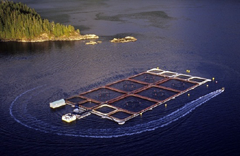
BC salmon farm.

The provincial government has required many of its biologists to register as members of the College of Applied Biology, but not the ones in the Agriculture and Lands Ministry who work on aquaculture and oversee the province's contentious salmon farming industry.

The college monitors members for scientific rigour and reasoned conduct. Some critics of B.C.'s aquaculture policies wonder why most government biologists focused on fish farming aren't subject to the college's scrutiny. Broughton Archipelago salmon researcher Alexandra Morton would go further, suggesting all biologists swear a professional oath to protect "crucial life systems."

A November 2006 organization chart for the Aquaculture Development Branch identifies eight staff members as biologists. They are Bill Heath, Clint Collins, Scott Pilcher, Gary Caine, Terry Nielsen, Shelee Hamilton, Marco Peemoeller and Sean Cheesman. All except for Collins are still listed with the branch in the government's telephone directory.

But none of their names appear in the membership list for the College of Applied Biologists.

"It was news to me that they weren't [members]," says George Butcher, a chair of a B.C. Government and Service Employees' Union local and a member of the union's environment committee. "It's surprising because there's been a move all across government to get all its biologists registered so the government can be sure they're following a code of ethics."

Membership not required

The B.C. Liberal government passed the legislation setting up the college in 2002. When introducing the bill for second reading, the Hansard says, then forestry minister Mike de Jong said the college was "charged with upholding and protecting the public interest." The college would ensure "the integrity, objectivity and expertise of its members," and would uphold "the highest principles of stewardship."

The college, according to its website, sets conduct and performance standards, holds members accountable and ensures competence. It has the power to conduct investigations and discipline members.

A senior biologist in the Aquaculture Development Branch, Gary Caine, says whether or not to become a member of the college is up to individuals. "There's no mandatory requirement to do so," he says. "It's voluntary and there's no requirement in our ministry." Caine was a founder of the Association of Professional Biologists of B.C., which existed before the college, but says he let his membership drop in 1998 and hasn't paid attention to the organization since.

'It surprised me'

While membership isn't mandatory for biologists in the Agriculture Ministry, the Environment Ministry, where Butcher works, went through an extensive process in 2005 and 2006 that looked at the job descriptions for some 450 people. Its December 2006 report found nearly 250 people in the ministry should register with the college.

The Ministry of Agriculture and Lands, which includes people focused on fish and shellfish farms, should go through a similar process, Butcher says. "It surprised me that didn't occur in the Ministry of Agriculture."

A spokesperson for the ministry took questions, but did not provide any answers by deadline.

'Outside the rules'

Linda Michaluk is the executive director of both the College of Applied Biologists and the Association of Professional Biologists. Speaking on behalf of the association, she says that anytime a person's work includes applied biology, "We'd encourage membership in the college."

Michaluk was a member of the panel that assessed jobs in the Environment Ministry, but says she is not familiar enough with what the aquaculture staff do to offer an opinion on whether or not they should be members.

Researcher Alexandra Morton, director of the Salmon Coast Field Station in the Broughton Archipelago, is a member of the college. "For people who don't have a PhD, it's the next level of certification that you know what you're talking about," she says. "It really does monitor behaviour. I know they're monitoring mine all the time."

The college requires members to act in a professional way, she says. That means being polite, basing what you say on demonstrable facts and trying to keep emotion out of the discussion. For someone who is passionate about what they are doing, that can be hard. "In the heat of the moment a person can forget," she says. "You have to be careful you don't get carried away."

Asked what she thinks about the government not requiring its aquaculture specialists to join, she says, "The first thing that comes to mind is that's very odd, if they are biologists.... It's worrisome because it does put them outside the rules that most of us play by."

'We're done for'

"The qualifications are irrelevant if the quality of the work is good," says University of Victoria ecologist and salmon researcher John Volpe. Volpe is not a member of the college, but does have a PhD. "We all know the world is full of people with impressive qualifications on paper who choose not to pursue the best information."

The government's approach to salmon farming has long ignored the best science, he says. "The whole aquaculture issue is not one of science," he says. "It will be played out in the grocery aisles. As long as consumers demand fresh salmon year round at three bucks a pound, we're done for on the coast. To provide that product under those constraints requires the death of wild salmon."

There is consensus among scientists that salmon farming is a threat to wild salmon and the marine ecosystem, he says, but you'd never know it from how the industry is governed. "That consensus voice stands in clear contrast to the voice we hear coming from politicians and bureaucrats."

Despite promises, decisions would be based on sound science, that can prove inconvenient in practice, he adds. "It's difficult to push forward a political agenda if you are constrained by robust science. In fact, the conclusions often times are quite clear. The policy recommendations are self-evident." If, on the other hand, the science is "loosey goosey," he says, decision makers are left with more options.

Many of the industry's pitfalls were predicted long ago, Volpe says. Sea lice, algae blooms, escapees and the accumulation of toxins in the flesh of farmed fish were all expected. "It wasn't from experienced evidence," he says. "It was from basic, first-year ecology. We know if you do A and B you're going to get C. We've seen it in Europe and we're seeing it here."

Oath urged

Science is often abused in discussions of salmon farming, says Morton. For example, she says, someone will say a certain farm has "reduced" the number of sea lice on its fish. But reducing the number of lice doesn't eliminate the problem. "Instead of dying from nine lice [wild salmon] are dying because of one louse. Dead is dead," she says. "They know exactly what they are doing. They are confusing people."

Morton says she would like to see professional standards taken a step further, with professional biologists required to swear an oath, the same way engineers or doctors do. The oath, she says, would say that a biologist who sees a life system being dismantled will communicate it openly to the public. "Crucial life systems are in decay. The environment is not a luxury item."

Morton added, "The Canadian public is going to be so appalled when this is over."

When the B.C. Liberal government lifted the moratorium on new fish farms in 2002, then agriculture, food and fisheries minister John van Dongen said the decision was based on "the best available science."

In December, the journal Science published a paper by Canadian researchers finding that sea lice from fish farms are destroying runs of pink salmon along the B.C. coast, but earlier this month Agriculture and Lands Minister Pat Bell declared "the industry is safe" and complies with "the toughest standards in the world." The same day, media reported that farmed fish from Tofino had failed testing at the American border for traces of a potential carcinogen at times used to control disease on fish farms.

To avert the sea lice threat, a legislative committee dominated by opposition NDP MLAs eight months ago recommended open-net fish farming be replaced by closed pens. The government has yet to respond to the recommendation.

Related Tyee stories:

 [Tyee]

35  Comments:

Login or register to post comments

  • The brain

    4 years ago

    These are the times!

    We are witnessing the strong possibility that just one premier will be responsible for the death of pink salmon and it has to do with greed, and a complete utter lack of morality.

    What are wild salmon in the way of? Profit from farmed salmon that is, by the way, what we eat when we go to restaurants and its by no means healthy compared to wild salmon.

    We are living in trying times, folks. Government is clearly pro corporate and self interested. I've heard all the excuses in the book to keep voting for Campbell, namely there is no one better to replace him. I don't much care for Carol James, but if she would give me just one promise, the promise to protect wild pink salmon from fish farms, its enough for me to go NDP in the up and comin'. And why? Think about it. How important are wild salmon to the food chain?

    You all think about this seriously now. Its predicted that wild salmon could be extinct in just 4 spawns. Folks, thats just 8 years. Do you, the voter, want to live knowing you did absolutely nothing to prevent this?

    Oh, we have all the issues in the world. Global warming, overpopulation, over consumption, rapid deforestation, unsustainable environments, social meltdowns, a possible recession, devalued homes and shrunken equity, war in Afghanistan, a possible 3rd world war hovering around Iran and all the rest, but if we de-evolve and go back to huts due to our lust for money and fleeting prestige, do we want to take our wild fish with it?

    Everyone likes to go on about the doom and gloom of wild salmon with shrinking glacers, ocean dragging and all the rest... folks... its time to take some kind of stand, here. Pick 'em. We've got no shortage of causes. Organize. The time has come to rattle the cages.

    Lorne Mccuaig
    Revelstoke, BC

  • Grumpy

    4 years ago

    So what else is new?

    The provincial marine biologists don't want public scrutiny, EDITED FOR LEGAL CONCERNS. TYEE EDITOR

    A hint to Rafe and to the rest, can't you guys get these people in front of their professional boards and have them charged with professional misconduct?

    It's an interesting avenue I have been looking at with ministry transit planners.

    Certainly if professionals ignore scientific fact to pursue their careers, etc., to the detriment of the environment, there may be a good case for professional misconduct.

  • zalm

    4 years ago

    Volpe sez: Quote:"The whole

    Volpe sez:

    Quote:
    "The whole aquaculture issue is not one of science," he says. "It will be played out in the grocery aisles. As long as consumers demand fresh salmon year round at three bucks a pound, we're done for on the coast.

    Who demands this? When I grew up, salmon was expensive unless you caught your own, when it was unbelievably expensive. No demand. Yet when my father grew up on the west coast of Vancovuer Island, it was cheap - poor families' food. No demand. It took him decades to like it after that beginning.

    I appreciate being able to buy salmon at $3 a pound for tasteless, mushy fish, but I certainly don't demand it, nor does anybody else in my circle of thousands.

    This bumph peddled by big business that "consumers demand" something is an astounding mauling of economic fact. When one has disposable income and has the ability to choose what to spend it on, people will spend first on things that give them comfort, then status.

    If salmon falls into either of those categories, heaven help us. Yet that is what the Real Canadian Superstores would have us believe. And it simply isn't true. Any economist - even a two-time Econ 100 wash-out like me - can tell you that.

  • Fiat lux

    4 years ago

    This is another example, not

    This is another example, not only of the total moral corruption of this government, but that the scientific letters and titles behind names mean absolutely nothing for the benefit of humanity.

    After all it was scientists who developed some of the biggest crimes, like mass murdering weaponry, DU ammo, the cancers, pollution and destruction causing products, etc. etc. all over the world and when it comes to their defence in the courts, or public opinion, are the first ones to "prove" their "benefits".

    Give them the money and most of them will sell their souls. Luckily, I still have good many of my friends who haven't and never will, regardless of the bribes, but how do we, the public, distinguish between the good guys and the frauds?

    Ed Deak.

  • Jeffrey J.

    4 years ago

    News Not Reported Elsewhere

    In times of yore, the Vancouver Sun would have covered this story from both sides. Citizens of BC would be quite informed on the issue. And the conclusion would be obvious to all. Open net pen fish farms are wiping out wild salmon. Full stop. Even WAC Bennet would have pulled the plug on this. That was then. This is now.

    Today, our media infotainment newspapers from CanWestGlobal (except for one or two columnists like Stephen Hume) pumps out irrelevancies every day.

    As media owners learned long ago, it's what you DON'T print that really determines the agenda. And this issue will remain firmly off the front page.

    This coverage by the Tyee confirms the age old axiom: the more you dig into an issue, the more you find. Who would have suspected that Gordon Campbell's aquaculture biologists have avoided having to comply with the College's requirements! Keep digging!

  • cariboost@gmail.com

    4 years ago

    Title/Header

    A more direct - less "clever" - title would be more likely to draw attention to this important article. e.g. Ministry Fish Farm Biologists Avoid Accountability.

  • oeanda

    4 years ago

    economics?

    zalm, that you're an "Econ 100 wash-out" is plainly in evidence.

    by "demand," an economist doesn't mean townspeople pounding down doors with pitchforks and torches. it's the subtle pressure of price- and quality-preference that accumulates to create a powerful force against the supply.

    i buy salmon from the indians for great prices, but it's not poverty food by any means. i love the stuff. anywhere other than the west coast, it's highly sought-after. but most people, in most places, see "west coast salmon" and, without knowing any better, make their choices based on price. given two apparently similar products - who can tell the difference between farmed and wild salmon, for example? - consumers will usually buy the cheaper product.

    while working in LA, i stopped in at a KooKooRoo restaurant (a cheapo american chain) and on the menu found "fresh pacific northwest salmon" for $9.99. i ordered it, only to find a single, lonely ounce of flaccid, pale flesh on my plate. we take it for granted out here, but your personal experience says nothing about the worldwide market's perception of salmon. growing a fish in a pen on the wild west coast gives it a cachet that it wouldn't have were it raised in a pen in, say, new jersey.

  • G West

    4 years ago

    Economics...not 'cheap' at any price

    Fish farming certainly isn't good for the fish ( as Rafe Mair is constantly telling Tyee readers) - despite the three-monkeys stance of provincial fisheries biologists – for which, Andrew, many thanks!
    Farmed fish ain't very good food for the folks either - I'd say at pretty much any price. But that's obviously one reason why the stuff is sold more cheaply than the real thing at Safeway.

    Perhaps people haven't seen (or they've tried to forget) this study:

    http://www.ewg.org/reports/farmedPCBs/

    Which showed that 70% of samples tested were so high in PCBs as to be a threat to cause cancer.

    Money quote:
    The levels found in these tests track previous studies of farmed salmon contamination by scientists from Canada, Ireland, and the U.K. In total, these studies support the conclusion that American consumers nationwide are exposed to elevated PCB levels by eating farmed salmon.

    Here’s a couple of MSM stories about the same ‘problem’ for the skeptics:
    http://query.nytimes.com/gst/fullpage.html?res=9B07E3D6123EF936A25751C0A9609C8B63&scp=1&sq=Farmed+salmon+heavily+contaminated

    http://query.nytimes.com/gst/fullpage.html?res=9F0DE1DA163EF933A05754C0A9659C8B63&scp=2&sq=+tests+samples+of+farmed+and+wild+salmon

    So WHO is it good for? And why is your provincial government promoting it, expanding it and ignoring its consequences?

    Eat up folks!

  • NicS

    4 years ago

    The Brain-Check out NDP's "Sustainable BC"

    I just read this new NDP vision of what they believe will work for us in the future. It sounds somewhat naive at first. It has the "Precautionary Principle" as one of its guiding principles which is the same as the "do no harm" oath doctors take. http://kootenayactivist.ca/action.htm Will it work? Well it could work if committed people like you and I decide to take action and get involved.

    The new NDP is still a bit like an empty house. They have 33 seats and 41% of the vote, but were so devastated by their last leaders actions and the spin that the liberals put on them that they are still treading water carefully until the election in 2009.

    The NDP is our next gov't if we want to take the reins from the poor excuse we now have for a premier.

  • snert

    4 years ago

    Here's one reason

    From the NY Times

    why we should make sure that fish farms are managed properly.

    Wild stocks are just not in danger of being killed off by fouled habitat but they are also being depleted by over fishing.

    Fish farming can be used as a major source of protein but only if managed properly. No open pens and all water leaving said pens must be filtered. Sea lice should be far easier to control in a closed system.

    Although I don't think the profits would be as tidy I think they would still be there be there.

  • Skywalker

    4 years ago

    Then it would not be a civil "service"

    How could a government obsessed with free enterprise at all cost allow itself to be served by a civil service that is "charged with upholding and protecting the public interest"? It just can't be risked. Any code of ethics for professionals is dangerous to this government's agenda. Professionals are expected to show professional integrity and they might have to say something about government policy that is not based on sound science. Campbell can't have that! Ministry Fish Farm won't be governed by a code that might carry some disciplinary provisions because they want to keep their jobs. They are there to serve their masters.

    The fish farm issue is just not a big vote determiner for most of BC. NicS says the NDP is still "so devastated by their last leaders actions and the spin that the liberals put on them that they are still treading water carefully until the election in 2009." Imagine being SO devastated by things the Liberals spin. That is political cowardice or incompetence. Why not create some positions that resonate with the people, no they get sucked into participating in an NDP dominated committee making a report that any politically aware person will know is going to be ignored by the government.

    Maybe James should say something worth listening to for a change

  • chevy

    4 years ago

    A rant.

    In all of this, there is one truth. The wild salmon species is being killed off. This is a bit of irony because this resource is renewable. For a government that is trying to shore up support from green enthusiasts, this doesn't seem like an idea they want to take in. Why? I have no idea. But
    I have concerns and issues about this.
    I am not against aquaculture, and I think neither of us here are opposed to it either. I think with the appropriate infrastructure, these aquaculturalists can actual benefit more than what they already are. I think that this industry is reflective of this current government in using very short-term thinking, a run it till it breaks style of thinking.
    Similar thinking is creeping up in the City of Vancouver under our current mayor. Spend as little as possible on infrastructre, run it till it breaks, run to the Prime Minister looking for money to pay for new stuff only to run that into the ground again and so on. The forestry industry got it, now they re-plant trees and in about 10 years, they'll be re-harvesting those same lands and we'll have a continuous supply of wood. What I don't understand is why First Nations groups are yelling louder? They are the first ones to fish on a river, even when the run is closed. If it is their way of life, why aren't they yelling? I am writing to everyone I can about this idea. And it is for some selfish reasons. Being on the river is one of the few good things that I look forward to. I get to spend time with my aging dad. Its not about catching fish, its just about being there. We release mostly everything we catch, except for one or two sockeye and pinks here there during their respective seasons. I want to take my kids fishing. I want them to know what its like to be away from TV, video games, the mall and a consumer reality. I don't go out at night, I spend time with my family and my partner knows where I go and I have never once been hassled for it. In fact, she actually comes with me sometimes. When the fish all die, well, so does this honest, thrilling, cheap, accessible, wholesome and natural activity. When it comes to taste, I can taste the difference between wild and farmed, I can even look at the dammed fish and see it. The taste is different, the texture is different and, I dare you all to try, the farmed fish takes longer to cook, even when its supposedly fresh from the market. I think it takes longer to cook due to all the preservatives and 'nutrition' the fish farmers give these fish. The overall picture of this is simple. We have allowed an industry to literally take liberties with the health of our economy and resources. Aren't governments supposed to protect us against this? But
    I beg you all to not give up. This fight isn't over. Like I said before, the forestry industry got it. With some help, we'll make these fish farmers get it too!
    Thanks for letting me rant.
    Eugene

  • Right to Bear

    4 years ago

    chevy...

    chevy said:

    Quote:
    What I don't understand is why First Nations groups are yelling louder? They are the first ones to fish on a river, even when the run is closed.

    chevy I appreciate your rant, some good points, but allow me to explain something. These FN people you are referring to, are not all FN people, and it is a mute point you made when you consider the damage non-native people are doing to the wild salmon. The FN people often live in a subsistence way and in this, there should be no problem with them doing just that...Right?

    One more point... The affected people by the loss of wild salmon are "The People of the Salmon"....

    Cheers,

    Bear

  • Peter Dimitrov

    4 years ago

    Reply to Biologist Andrea Morton

    Thank you for the January 17, 2008 Tyee (thetyee.ca) expose on the fate of wild salmon. Sometime ago I received a letter from biologist Andrea Morton, a letter conveyed to me by a friend. She asked in that letter- what is to be done?

    Let me add my voice to her question - by posing other questions that beg to be answered: who will speak out and act, not just for the salmon, but also for other species that rely on salmon as part of their food chain (eagles, whales, sea lions, bears, seagulls, some 100 plus species,); who will act to defend the rights of 'future generations' of Canadians to share in the sustainable harvest of wild salmon; who will speak out and act for the countless fishers and their communities up and down the BC coast, who may be devastated like their brothers and sisters on the east coast when the cod fishery collapsed? Where are organized labor, student activists and church congregations on this issue? Why are they not more active and focused? If this were France ( and it clearly is not) there would be hundreds of thousands in the streets on a persistent basis demanding the repeal of the laws that allow ocean based fish farming. But the streets are empty, the voices are silent, people are not present. Yes, they show up to the tune of 300,000 to see the Santa Claus parade, in the tens of thousands to hockey games to sing the national anthem, but where are they when their presence, their voice, their mindfulness is required on such an issue - nowhere? Where is the leadership of the NDP on this issue? The legislature is out, why don't they use their time to organize meetings and connect with the base of people who are concerned about this issue, who need a 'political instrument', such as a political party, to create a public space for conversation and then for action. If they could learn to better connect with the base of people and be better leaders in action outside the legislature, they just might, together with other changes direly needed by the party, see their support rise from 35%, to a higher level. And where or where is Stephen Harper and the federal conservatives on this issue? The protection of salmon and their habitat is ultimately a federal constitutional responsibility - why is not the Federal Minister exercising his legal jurisdiction to protect this fishery in a duly diligent manner?

  • Peter Dimitrov

    4 years ago

    part 3-Reply to Biologist Andrea Morton

    I am not sure what is more tragic: the imminent extinction of wild salmon of the west coast of British Columbia; the ill-advised legislation authorizing ocean based fish farming when other countries have turned away from that policy direction, or the failure and/or refusal of massive numbers of citizens (and civil society groups) to rise to the challenge to create a 'space' to diligently confront, via legal action and civil disobedience if deemed necessary, the arrogance and ignorance of a 'provincially-minded' government whose legislative agenda on this, and other issues, is considerably beholded to the corporate sector.

    Soon May 12, 2009 - BC election day will be upon us, the way things are going now, I foresee the re-election of the BC Liberals. Maybe we are a people that no longer deserve to have wild salmon amongst us. If that be so, what kind of humans living within what kind of society have we become?

    This is a non-partisan issue. This is an issue, where we, individually and as a society, could rise to express more compassionate respect and mindfulness for the needs of wild salmon (and the species that depend upon them), and the intergenerational cries for justice from generations of Canadians not yet born, rather then yielding to our greed, our materialism, our consumer distractions, our apathy, indifference, our political divisiveness, and other vices and foibles that from time to time challenge our identities as 'modern, civilized' citizens.

    If there ever was a time for you and I, and we, to rise to the occassion in defence of wild salmon, in defence of the equality rights of your children not yet born to see wild salmon, to taste it, to joyfully witness the journey of wild salmon from stream to ocean and back again - this is the moment. Either we will tragically succumb to history whose script is written by major corporations and elitist politicians who dance to a corporate tune, politicians who believe less in democracy and more in authoritarianism, or we shall rise, as citizens, and make a new history, a more just future, where we all live with a much smaller ecological footprint upon Mother Nature - who nurtures us all, albiet due to the intercession of unjust laws, not equally.

  • Peter Dimitrov

    4 years ago

    the real Part Two- Editor pls erase prior Part 2 post

    In my mind, the publication of hard scientific evidence in the peer reviewed Science magazine far supercedes the less believeable evidence from government biologists, and the way credible, independent scientists see it, unless drastic action is taken 'pronto' by the BC public, we may well see the extinction of serval species of wild salmon on the BC coast within a very short time period- I believe the Science magazine article, mentions four years. Whether it is four years, three, five or six is unknown, great uncertainty exists about the resilency of wild salmon to 'bounce back' once their population falls below a certain level. Therefore, the precautionary principle should be implemented, and that means that legislation, on the basis of persuasive science and probable risk of irreparable harm needs to immediately require that fish farm pens be pulled from the ocean as soon as possible. Indeed, if I may suggest, given the intransigence of the government, some parties (perhaps First Nations and others) need to rely on the evidence published in Science magazine (and elsewhere) to boldly apply for legal remedies, including an application to the Supreme Court for an injunction. That seems to me to be the forum for resolution of such a dispute - let the government trot out their 'experts' and their evidence, and let the other side do the same, allow vigourous cross examination, provide fair press coverage to keep the public informed, and let justice fall will it may- and may First Nations rise to legally protect their rights.

    In my mind it is a gross abuse of power for a Minister of the Crown (whether Federal or Provincial) to sanction economic activity by private corporate parties when persuasive scientific evidence is available showing the actual existence of damages to 'Crown property' namely the wild salmon, risk of probable damage to First Nations culture and economy, and, the probable (not just possible) risk of extinction faced by wild salmon from that economic activity. The Crown has a duty to protect wild salmon from third party damage, not just because it owes a fiduciary duty and a duty of honor to First Nations, who historically have been dependent on salmon as one pillar of their economy, but because 'intergenerational equity' - requires justice for future generations, and more importantly, because ecosytem integrity and the high reliance of other wild species on wild salmon require that the Crown step up to the plate.

  • The brain

    4 years ago

    Thanks for that, Peter

    Your truth says it all.

  • Nereo

    4 years ago

    So Take Action!

    There are many groups out there taking action ... writing letters, protests, meetings, getting informed... we have to step it up more than ever before. Keep talking.. louder... and check out www.savebcsalmon.ca Sign the petition. Most of these guys are at the heart of the Broughton Archipelago where the pinks are in grave peril.

    The public needs a hero to guide them. People want to do something they just need someone to show them a way.

  • Right to Bear

    4 years ago

    You said it all Peter D.

    The Truth has been spoken...

    I have nothing more on my mind to say. Thank you a thousand times Peter.

    Right on Nereo... www.savebcsalmon.ca They are a good group to back on this urgent issue. They believe in inland "closed containment" farms, which will protect the wild salmon...

    Peace,

    Bear

  • RickW

    4 years ago

    But......

    ....true to the comment expressed in Michael Moore's Farenheit 911 by some CEO or other, where he says that everything should be privatized or owned, this government as well as the one in Ottawa is encouraging this direction by doing nothing but obfuscate. When Salmon become functionally extinct (along with gosh knows how many other species in the food chain), control will be that much more complete.

  • Peter Dimitrov

    4 years ago

    Peter Dimitrov

    This is to advise that next wednesday, from 7:00 - 8:00 pm on co-op radio vancouver, CFRO-102.7 FM (also on cable) - on the show called Discussion the program will focus on "wild salmon and fish farms.

    The confirmed guests are: Alexandra Morton, scientist,

    Chief Bill Cranmer, Naamgis people

    Catherine Stewart, Living Oceans Society

    Peter Dimitrov

    Charles Boylan-host of the show Discussion

    You are all invited to tune in. Thank you

  • Nereo

    4 years ago

    See www.callingfromthecoast.com

    There is also some great coverage on this issue by Twyla Roscovich. Visit www.callingfromthecoast.com There will be a presentation of her documentaries and discussion on what we can do to help the wild salmon this Jan 24th from 7 to 10 pm at the Filberg Centre in Comox.

    Note to Bear...
    I am fairly certain www.savebcsalmon.ca isn't suggesting closed containment as a solution. They are focused on a Biological DEADLINE for the out migration of Pink Salmon Smolts. One Sea Louse will kill these little guys. The migration routes need to be cleared for the best chance of survival. It's a really scary situation for one of the most beautiful places on this planet.

  • Right to Bear

    4 years ago

    Hey Nereo ;-)

    Not my information Nereo...but no worries, as I know that saving the wild salmon is their primary concern :-)

    I've signed... as there is no choice but to keep up the fight bro. Thanx

    Cheers,

    Bear

  • lynn

    4 years ago

    Inspiring and powerful. Thanks Peter....

    Quote:
    I am not sure what is more tragic: the imminent extinction of wild salmon of the west coast of British Columbia; the ill-advised legislation authorizing ocean based fish farming when other countries have turned away from that policy direction, or the failure and/or refusal of massive numbers of citizens (and civil society groups) to rise to the challenge to create a 'space' to diligently confront, via legal action and civil disobedience if deemed necessary, the arrogance and ignorance of a 'provincially-minded' government whose legislative agenda on this, and other issues, is considerably beholded to the corporate sector...

    Quote:
    If there ever was a time for you and I, and we, to rise to the occassion in defence of wild salmon, in defence of the equality rights of your children not yet born to see wild salmon, to taste it, to joyfully witness the journey of wild salmon from stream to ocean and back again - this is the moment.

  • Bailey

    4 years ago

    Intent

    Some people seem to be suggesting that this destruction is intentional. That the extinction of the salmon is intended, and the policy regarding these fish farms is in aid of that intention.

    It leads me to a question. Granted that genocide was not even a word in the 19th century, let alone a crime; now it is both under international law. So...

    When the American government in the 1800s decided to wipe out the buffalo which had for five hundred generations sustained the rightful owners of the land they coveted , was that an act of genocide?

  • bigred

    4 years ago

    beyond science

    I agree with John Volpe's comment about this no longer being about science. There is a glaring absence of debate in the scientific journals --only paper after paper illustrating the problems of open cage salmon farming and the ever-developing details of exactly how it is a threat to wild stocks. Industry and supporters like to cast doubt on all this, but where are their papers? In Science? --nope. In any credible journal? --nope. In any peer-reviewed journal at all? --nope.

    (Reminds me of the global warming pseudo-debate.)

    While it is easy to cast doubt and aspersions, the real issue is about wishful thinking. I don't know exactly how it goes, but maybe something like: "If we are making money, it must be okay... Those detractors are just not getting it; they just want to hurt us because they are, uh, mis-informed." Whatever is being thought (if anything at all), it is not about science.

    But then again, it rarely is.

  • The brain

    4 years ago

    We've known since 2001

    For Bailey

    http://thetyee.ca/Views/2005/07/31/SeaLice/

    This article by Rafe Mair best spells out that yes, the dots could be connected to say that it is intentional. Gordon Campbell's beloved fish farms want more market share (of which they are monetarily nice to the Campbell government) and to to that, think about it. Wild salmon must go.

  • Peter Dimitrov

    4 years ago

    connect the dots

    the way I see it, when the wild salmon populations off the coast are gone, so much it easier will it be to commence oil and gas exploration. ...is that intentional???..

  • lynn

    4 years ago

    In the Way

    I agree, Peter...policy based on whatever it takes to smooth the course for their sacred God of Development... and his next sacred project.

    They are very busy removing "the stuff" that's in the way.

    Good-bye fish, good-bye trees... good-bye, you and me.

  • SharingIsGood

    4 years ago

    Bailey asks

    of Americans 19th century destruction of bison, and the peoples sustained by those bison, "was that an act of genocide?"

    Nothing less!

    This Liberal government is guilty of nothing less with the destruction of the salmon. Given the advances that science has made and the Liberals' army of media monitors that is paid to report upon such as we write - right here, Campbell can claim callousness, but he cannot claim ignorance!

    Thank you for your well-chosen words, Peter. I will be listening on Wednesday - and I will be telling everyone I know to tune in. I especially hope that all yellow-bellied media monitors are going to be listening. (Can you hear me?) Perhaps some of them will become disgusted with themselves enough to quit the Liberals.

  • Right to Bear

    4 years ago

    ..."takes care" of a lot of "pressing" issues...

    2010 Olympics, hummm, with the exception of the Marmot mascot, all the other animals used in the makeup of the mascots, DEPEND ON SALMON ... lynn brought up the Olympic angle on the "Gordo" thread and I think it is a good one. It would be a good lobby for school kids. Once you get them on an issue, look out...

    Thanks for your thought provoking post Bailey... It appears that the death of the wild salmon would "take care" of a lot of "important", "pressing" issues, and pave the way for others. The truth is the carnage to this land would be unimaginable...

    Peace,

    Bear

  • Moat

    4 years ago

    Which organization?

    Which organization is the most active and effective in its campaign to protect wild BC salmon?

    If do a google search, you will find several organizations. However, you begin to wonder which ones have substance behind the webpage.

    Which organization puts the best science forward and stays away from weak arguments and myths?

    If we are going against salmon farming, we better back those who make the strongest arguments. Most people are not paid scientists, so the key is getting out research that people can trust - and understand.

  • HawkEyes

    4 years ago

    I have to wonder

    ...how the chemically permissive USA would ban Canadian farmed salmon for a substance that the salmon allegedly did not come into contact with.
    While I am reluctant when putting anything American into my mouth and while our aquaculture relationship with the USA merits much more criticism than given...this contradiction bears more scrutiny here.
    How do you treat a pen of fish in the ocean? If a liquid application, you’d either have to accept inconsistent results or you would have to exceed and repeat the dose beyond recommendation. Malachite Green, to some measure, is banned from use with fish destined for human consumption. If this “Canadian” farm never used Malachite Green, why would they repeatedly test for the substance on their own? It makes no sense
    This is a serious breach of trust…
    In my mind; it should be enough to shut the farm down.
    Abuse of chemicals in the food chain on top of our permitted excesses should not be ignored and tolerated.
    With no regard for human life, why would one believe this farm would ever care about wild salmon? Why would one imagine this is an isolated incident?
    The provincial government is a deliberate shambles. Where is the DFO?
    While mismanagement is their specialty, I believe they are still getting paid? With the waters warming up, they should finally step up for the species they haven’t lost already...

  • bob the cat

    4 years ago

    Calling from the coast

    Filmmaker focused on wild salmon
    January 16, 2008 | | | |

    Earlier this year Twyla Roscovich moved to the remote Broughton Archipelago, home of the highest concentrations of fish farms on the coast, where she spent the spring documenting the impacts of the farms and following the researchers studying them. PHOTO submitted

    Want to learn about wild salmon and view informative short films on salmon and salmon farming by local filmmaker Twyla Roscovich?

    If so, drop by the Filberg Centre Jan. 24 at 7 p.m.

    Wild salmon are considered one of the world’s healthiest foods. Our coast is one of the last places left in the world where five species of wild salmon return each year in abundance. Imagine that. One of the cleanest protein and Omega-3 sources in the world returns each year to our streams and rivers without us having to do anything.

    In an effort to bring awareness to local communities about the impacts the farms are having on the coastal ecosystem and food source, Roscovich has produced a series of compelling short films on the issue.

    Earlier this year she moved to the remote Broughton Archipelago, home of the highest concentrations of fish farms on the coast, where she spent the spring documenting the impacts of the farms and following the researchers studying them.

    Surprisingly, Roscovich started out as a proponent of fish farms. Her father was one of the early fish farmers back when the industry was still a mom and pop industry in the late 1980s. Her first films were about salmon farming — a music video with a song written by her father, and later she was hired to produce corporate films for the companies.

    As her career progressed she began doing wildlife documentaries about British Columbia’s coastal wildlife — an ecosystem that depends almost entirely upon wild salmon stocks.

    As the sea lice epidemics from the salmon farms began to take a heavy toll on the wild salmon stocks in 2001, it became clear that if she wanted to continue producing wildlife films on the coast, this was an issue that could not be ignored.

    The evening will also be a celebration of wild salmon where there will be a discussion on the importance of protecting this resource and how as individuals, the community can make a difference through informed decisions. For informatin call 337-5971.

    Roscovich’s website is www.callingfromthecoast.com.

    Terrific site!

  • Nereo

    4 years ago

    The DFO ???

    I'm quite certain the DFO is being investigated by the Auditor General of Canada presently but the report won't be ready until 2009. What sucks is that there are some really great people working for DFO who believe they are screwed because their opinions are dictated to them... and I think they take a oath of sorts not to talk about it even if they get totally disgusted and quit.

    Well.. enough enough I say!

    Grab your balls boys and girls... guardians of the "real" fisheries... and trust that it will be o.k. , life will go on and it can be even greater when you are true to what you know and care about ... SO SPEAK SPEAK SPEAK... ... lots of you love this coast ... hold onto that! Oh CANADA.. we really hope that more than a few people will stand on guard for THEE !

    • The discussion for this story is closed. No more comments can be added.