

A Vancouver physics instructor believes he may have identified design flaws that led to the deaths of four people at the Sullivan Mine in Kimberley last spring, but his efforts to alert the chief inspector of mines and present his theories to an upcoming coroner's inquest have so far been met with silence, he says.
The government called for the inquest after an Oct. 30 accident report from the province's then-chief inspector of mines Fred Hermann drew criticism from surviving family members and other members of the public, including politicians and union officials.
Critics said the report should have looked more closely at possible flaws in the design of the below-ground sump under the structure in which the workers died, and at whether management's failure to enforce safety regulations was part of the lethal equation. A copy of the Hermann report can be found here.
A coroner's inquest is precluded from making any findings of fault or blame, but family members of victims told The Tyee they hope the inquest will provide answers to questions still hanging.
The Hermann report described the fatal events stretching out over two days in May as "unprecedented," saying no such loss of life due to oxygen depleted air had occurred anywhere else in the world. It goes on to say that the lethal air's entry into the shed was unexpected.
The implication, say critics, is that the events were so unique that no reasonable steps could have been taken to reduce the risks at the Sullivan Mine.
"I have to hand it to the government," said NDP labour critic Chuck Puchmayr in a recent phone interview. "They have done a brilliant job of spinning this issue. This was not a freak accident, and not unavoidable."
'E-mails went unanswered'
Vernon Moen is a physics instructor at the Lower Mainland's Capilano College, and is involved in a company that designs and markets navigation systems for aircraft. He also has extensive practical experience in house construction and auto mechanics. Moen told The Tyee that he suspects design flaws in the below-ground sump covered by the water sampling shed may have led to a build up of de-oxygenated air in the confined space that killed the workers and rescue team. (A diagram of the shed, from the Hermann report, is here.)
Moen says he tried to raise his concerns in e-mails (see sidebar) to the chief inspector of mines, but has received no reply, and is now worried that design flaw concerns may not be properly addressed by the upcoming coroner's inquest.
Despite the debate, some of facts are clear. On May 15, 2006, Doug Erickson, working for Pryzm Environmental, a company with a contract from Teck Cominco to monitor environmental impacts associated with water flowing underground over waste rock on the former mine site, went into a shed (the #1 Shaft Waste Rock Dump monitoring building) to take water samples from the below-ground-level sump accessible from that structure.
The shed was full of severely oxygen-depleted air and Erickson succumbed almost immediately. (At oxygen levels tested within the sump after the deaths, an exposed individual would be unconscious within the time it takes to breath in twice, the chief mine inspector's report says.)
The Mines Act requires an isolated worker to be checked for safety each two and a half hours, and that workers entering and leaving a mine site must be formally logged on and off the site. However, no one in authority at the Sullivan Mine site seems to have realized Erickson had gone missing for two days. The first reported search for Erickson began on the morning of May 17, after his wife contacted Teck Cominco offices and said he was missing.
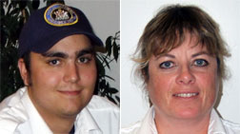
Searching for Erickson on the morning of May 17, Bob Newcombe, a Teck Cominco employee, found the contractor's truck outside the water sampling shed. Newcombe entered the shed and fell unconscious in the lethal atmosphere. Two more victims were claimed in the following hours, as B.C. Ambulance attendants Kim Weitzel and Shawn Currier, responding to a 911 call, entered the shed to try to rescue the fallen workers and were overcome.
Chief inspector: 'No evident design flaws'
Moen has tried for months (see sidebar) to interest authorities in his theory that the design of the weir and sump beneath the fatal shed was faulty and may have been responsible for filling the sampling shed with lethal oxygen-depleted air. (A sump is a pit or hole in which superfluous liquid collects in a basement, mine or machine. A weir is a dam-like structure built to regulate the flow of liquid. Beneath the water sampling shed at the Sullivan Mine, a ladder led down into the sump where a notched weir had been built between the inflow pipe and the outflow pipe for purposes of flow measurement.)
Fred Hermann was chief inspector of mines at the time of the deaths, and retired from public service soon after completing the report on the Sullivan Mine events to take a position in the private sector. Reached at his new offices at Breakwater Resources, an Ontario mining firm, Hermann declined to comment on his report or on Moen's critique of sump design for this story. He suggested The Tyee contact Ricci Berdusco, who had worked closely with him on the Sullivan report and who is B.C.'s new chief inspector of mines.
Berdusco responded to The Tyee in an e-mail, saying: "There are no evident design flaws in the sump and the weir. These structures were meant to collect water and afford a means of sampling the flow and chemical characteristics of the water."
Berdusco also confirmed that check-in/check-out procedures required by law were not being observed at the Sullivan Mine last May. He denied, however, that this company's failure to observe the law caused any of the Sullivan Mine deaths.
'Have to examine sump design'
Repeated calls to Teck Cominco spokespeople with requests for comment on the sump design question or on failures to enforce Mine Act safety requirements were not returned as this story went to press.
Professor John Meech teaches mine engineering at the University of British Columbia. A researcher into mine safety issues with more than a quarter century's experience, Dr. Meech is currently serving as an independent academic advisor on a committee formed by Teck Cominco that is looking into the Sullivan Mine tragedy. He expressed some skepticism about Moen's critique of the sump and weir design, but did indicate that changes made to the waste rock dump surface (changes which covered the drainage ditch conveying water to the sampling shed with glacial till rich in clay, thus sealing it off from the air above) shortly before the lethal incidents may have been factors in allowing de-oxygenated air to accumulate.
"The risk potential was zero before the ditch was covered," Meech told The Tyee by phone. "After the fall of 2005 when the ditch was covered, there was a higher risk. We do have to examine sump design to prevent a recurrence."
This assessment by Dr. Meech confirms suspicions previously expressed by George Weitzel, who lost his wife Kim in the Sullivan Mine disaster. In an interview with The Tyee in late 2006, Weitzel said his suspicion was that the 2005 decision by Teck Cominco to cover the waste rock dump and its drainage ditch with clay-rich glacial till had created an air-tight seal that allowed the formation of lethally oxygen-depleted air which was then conveyed into the sampling shed.
"Teck Cominco, in our opinion, designed and built the shed and the seal. They didn't do their due diligence on either the shed or the seal," Weitzel said.
Dr. Meech amplified his views in an email, arguing that before the drainage ditch was covered, thus creating the conditions in that allowed de-oxygenated air to flow down the covered ditch and into the sump, there was no danger. No covered ditch, no problem with de-oxygenated air. And thus, presumably, no need for the re-design of the sump piping he refers to as a “water trap.” ( A “water trap” arrangement is , in effect, the structure Vernon Moen advocates in his communications with the Inspector of Mines.) Besides, the quantities of air released into the sump varies widely with the temperature and air pressure, and even if Teck Cominco had been testing for air quality prior to the accident, they might not have picked up on de-oxygenated air. Sometimes, he pointed out in a later phone interview, depending on temperature and pressure, the dump would be in effect “inhaling” air and sometimes “exhaling.” A problem only exists when the dump gives off de-oxygenated air and the air is contained, as it was beneath the cover over the ditch and within the sampling shed.
"Unfortunately, hindsight, although accurate, is not particularly useful except to understand the situation in question and to prevent such a problem from occurring in the future," wrote Dr. Meech.
Questions for inquest
It is unclear at this point whether the debate on sump and weir design at the Sullivan Mine will be addressed by the upcoming coroner's inquest, although Moen told The Tyee in early January that he had volunteered to testify about his concerns.
Other questions remain:
Who was responsible for keeping daily records of workers coming into and out of the mine site? The Teck Cominco report available at the government website blames Pryzm Environmental for the fact no such check-in/check out procedures were being enforced when Doug Erickson went onto the Sullivan property on May 15. Repeated attempts to obtain comment on these charges from Pryzm Environmental's CEO, John Przeczek, were unsuccessful by the time this story was filed.
Also vexing is the question of why there was a two-day lag between Erickson's death and the first attempts by Teck Cominco staff to find out what had happened to him.
The inquest may pursue whether Fred Hermann's report was accurate when it called the circumstances surrounding the four deaths "unprecedented."
It also remains to be seen whether the coroner's inquest will recommend changes in training for B.C. Ambulance workers who may be called upon to perform rescues in confined spaces.
In the meantime, the survivors of those who died at the Sullivan Mine and their neighbours in the close-knit Kootenays communities where the victims lived before the tragedy are left with their grief and questions, and their hopes the results of the inquest can go some distance toward resolving both.
"The inspector's report looked like a rush job," George Weitzel, whose wife Kim was one of the B.C. Ambulance paramedics who died at the mine site told The Tyee. "I hope the coroner's inquest can help guarantee that this never happens again. We are confident the truth will come out eventually. We can live with the truth, but we don't believe we've heard it yet."
Related Tyee stories:
![[Tyee]](/design-article.thetyee.ca/ui/img/yellowblob.png)






Tyee Commenting Guidelines
Comments that violate guidelines risk being deleted, and violations may result in a temporary or permanent user ban. Maintain the spirit of good conversation to stay in the discussion.
*Please note The Tyee is not a forum for spreading misinformation about COVID-19, denying its existence or minimizing its risk to public health.
Do:
Do not: