News

A Nest of Disagreement

Does the Sea to Sky Highway Improvement Project threaten eaglets?

By Carrie-May Siggins, 29 Jun 2005, TheTyee.ca

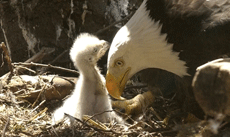
Eaglet

An eagle's nest is bringing conservationists and the Sea to Sky Highway Improvement Project into disagreement once again as construction continues along the controversial highway

The Nest Environmental Stewards Team (NEST) is claiming that construction surrounding an active eagle's nest by Horseshoe Bay is breaking Ministry of Environment regulations and is potentially disruptive to the raptors. The Sea to Sky Expansion Project claims they're well within guidelines.

This morning, the Ministry of Environment gave the green light for the company in charge of construction, Kiewit, to drive a manlift with a mechanical arm close the nest to observe the eagles. NEST is concerned that the close proximity of the manlift to the nest will disrupt the eagle's nesting activity. Jim Cuthbert, a biologist and member of NEST, claims someone from the company could climb a near-by tree and still effectively see the birds without the disruption.

It is only the latest example of the growing tension between the citizen's action group and the Sea to Sky Improvement project.

Before construction began, the Ministry of Environment created two zones around eagle nests to protect them from disruptive noise. Clearing isn't permitted 500m from the nest, and rock blasting must be 1000m away.

But some permitted construction activities such as vegetation removal, roadside construction, movement of boulders and others are threatening the nesting patterns of the birds, says Cuthbert. "We feel that there is a serious encroachment on the protection that was offered by the zone."

But Peter Milburn, executive project director of the Sea to Sky Expansion Project, claims that the only activity that is not allowed within the exclusion zone is tree clearing. Other than rock blasting and drilling, any other activity is allowed. So no matter how far into the zone the company treads, it's within the guidelines.

"We're 100 per cent committed to abiding by what was set out, and we have been so far," says Milburn. Milburn says that Kiewit is adhering to the Ministry of Environment's regulations.

An independent environmental manager hired by Kiewit is on site most days observing any activity that might have an impact on the surrounding environment, says Milburn. And any recommendations made by the manager are closely abided by.

But an e-mail from the contractor's environmental manager, Andrew Allan, to NEST member Susan Cameron, shows that Allan instructed the contractor to stop all grubbing (the process of clearing the soil for construction,) when they discovered the nest was active "Once the eagle was observed in the tree by [Ministry of Transport] personnel," writes Allan in the March 1, 2005 email, "I instructed Kiewit to halt all blasting and clearing and grubbing within the required limits."

A separate e-mail to Cameron, written by Doug Kelly, the environmental coordinator of the Sunset Beach to Lions Bay section of the Sea-to-Sky Highway Project, reinforced that "no clearing or grubbing" is permitted within 500 meters of the nest.

But "grubbing is occurring," says Cuthbert, "and they've indicated in writing several times that that's not allowed."

Some grubbing is allowed within the exclusion zone surrounding the eagles, says Brian Clark, the Ministry of Environment's regional manager for the Lower Mainland. "If it's slow, low scale, low noise, low activity," says Clark, the activity is allowed. "We're basically making a judgment call here."

The eagles are "used to a certain amount of human activity. So if activities within that zone aren't going above the normal noise level too much, that's probably good enough."

But Jim Cuthbert doesn't believe it is good enough. He claims that the noise caused by the machinery is loud enough that residents in the surrounding area have expressed concern.

"It's clearly in contravention with the intent of the regulation. It follows from anyone's point of view that large, loud heavy equipment working close to an eagles nest is not considered acceptable," says Cuthbert. The mechanical arm being used this morning is only the latest example of that heavy machinery.

NEST is asking that construction be moved to another part of the seven-kilometer stretch until August 15, when nesting season is over, and the eaglet found in the nest is better able to take care of itself.

One of the potential consequences of disruption during the nesting season is abandonment of the nest. Studies have found that if a tree is disrupted, parents will leave the home base and the eaglet to defend for itself, which it almost always can't. It's also possible that the parents will not return to the nest the following year.

Campbell's Liberals have been widely accused of sacrificing environmental protection for the sake of economic development. Some worry that the new Ministry of Environment (the ministry was formerly known as Water, Land and Air Protection) may not effectively enforce its own rules.

But Clark says that the Ministry is trying to balance the concerns of all parties. He says that although the project is taking environmental protection very seriously, there is a road that needs to be built. "It's not that we're bending to development, we're just saying what development can we allow and still meet everyone's intent in protecting the eagles?"

But Cuthbert is skeptical. "Unless the community had spoken up, there is a thought that the protection that we've been able to facilitate may not have been applied and therefore there's a risk of the eagle family being disrupted."

Carrie-May Siggins is on staff at The Tyee.  [Tyee]

10  Comments:

Login or register to post comments

  • loblollyboy

    6 years ago

    Comments on "A Nest of Disagreement"

    Quote:
    One of the potential consequences of disruption during the nesting season is abandonment of the nest. Studies have found that if a tree is disrupted, parents will leave the home base and the eaglet to defend for itself, which it almost always can't. It's also possible that the parents will not return to the nest the following year.

    Oh, it hurts my fingers to type this, but this time the Forces of Darkness might have a point. The above assertion may be true for eagles which have no experience with, nor tolerance for, human activity, but Vancouver seems to be producing an urbanised eagle which is much more highly tolerant of such activities and is human-habituated to the point of nonchalance. Over the last decade, several pairs have established eyries (eagle nests) in very human high-traffic areas and at least one pair successfully reared young in a cottonwood at the south end of the Arthur Laing Bridge in spite of noisy heavy-industrial activity (dump-trucks, industrial pipe, barge-loading) sustained all spring and summer---the breeding season for this pair---directly below the nest. The company who owned the site had the grace to wait for the young birds to leave the nest and fly on their own before knocking the tree down; obviously, it saw the presence of an active eyrie as a potential constraint to its activities. Other pairs have eyries at Jericho (heavy car and pedestrian traffic), Vanier (heavy pedestrian, boat and vehicular traffic on close-by Burrard Street Bridge ), Stanley (very heavy traffic from low-flying seaplanes) and Strathcona Parks (this last site is above a busy baseball diamond and skateboard park but on the nearby streets, there's many adjacent warehouses with high 24/7 heavy truck traffic and a railway track busy with container traffic to and from the Port of Vancouver. These urbanised eagles teach their young to take advantage of the city's resources in the urban environment---based on feather surveys below the various eyries, the citified parents are feeding their eaglets mostly gulls, crows and pigeons---and are passing on their easygoing acceptance of human proximity and activity. Urbanised eagles seem to be something new in Canada, and may make it hard to generalise about their sensitivities, or lack of them, around the nest.

  • KWD

    6 years ago

    Urbanized wildlife, a dream come true for MOE. Thanks loblollyboy.

    I read that several hundred Pilot whales recently made an unsuccessful attempt at city life and terrestrial existence on the east coast. I gather it’s something they’ve tried doing, on a regular basis, ever since Columbus. Perhaps their marine environment is suffering from too much human encroachment and disturbance.

    In the case of the Vancouver urbanized eagles, perhaps the environmental levels of mercury, dioxins, NOX, and other endocrine disruptors have successfully created a new subspecies.

    Sounds like some DNA work is in order. Should keep some MOE people out of trouble for a while.

  • zen

    6 years ago

    Quote:
    The company who owned the site had the grace to wait for the young birds to leave the nest and fly on their own before knocking the tree down;

    Nevermind if the young have fledged - it's illegal to take down a tree with an eagle nest (Section 34(b) of the BC Wildlife Act) other protected nests include those of ospreys, herons, burrowing owls, gyrfalcons, and peregrine falcons.
    I hope the company was fined at least...

  • jesterjogger

    6 years ago

    Who cares about some f***in bird when gordo and the boys are droolin over exploiting all that land along the new highway. Yep when they bought that south korean guy the fix was in for the biggest real estate scam in Canadian history. Just in Squamish alone they've rubber stamped 8000 overpriced yuppie units in the next 3 years for the new elite. Let's see thats 8000 times 500000$/unit = 4 billion!!!
    And you guys are griping about some freekin bird!!
    As for the highway expansion how else are all the new yuppies along the corridor and in Squamish gonna commute in their single occupant SUV's the 150 km round trip to and from their jobs in vancouver? Now thats smart growth!

  • skeptikool

    6 years ago

    Just as the plains were once filled with buffaloes, so was the Lower Mainland home to abundant and varied wildlife and aquatic species.

    The environment encompasses air quality and all plant and animal matter. To serve all of these better is to facilitate the movement of all traffic with as economical routes as possible. To do that means inevitable displacement. That, of course, should occur with as much care as is humanly possible.

  • dangrice.com

    6 years ago

    Of course, what most people don't realize it the "Eagle's Nest" is a 8 million dollar West Van estate over looking the bluffs, that threatens to have its view impaired, and to have its snow bird owners cocktail parties disturbed by the blasting..

  • Steve P

    6 years ago

    Jester Jogger:

    If new housing isn't built, then housing prices will continue to skyrocket & hurt lower income households. Squamish has actually been delaying approval of some new master-planned developments in order to have them in accord with their SmartGrowth-inspired Growth Management Plan -- which is already over six months past due. If we don't build more, higher-density units near the downtown and nearby neighbourhoods, then nobody will be able to live in Squamish.

    Are you griping about the Sea to Sky University development? I thought this project had the hope of offering some good jobs and expanding the economic base of the community. Not all housing developments are created equal, so I'd be interested in hearing which one has earned your contempt.

    I want to see environmental values protected, too, but nasty vague griping about new homes & casting stereotypical aspersions upon those who buy them isn't helping. We need high-quality, pedestrian-oriented, master-planned neighbourhoods to form the physical basis of community.

    And besides, my understanding is that commuters in Squamish tend to go north to work in Whistler, rather than south to Vancouver. Perhaps a broader economic base in Squamish plus affordable housing in Whistler could address this issue.

  • Backpacker2

    6 years ago

    Oh, who cares about some stupid birds? Build the highway, the birds will move somewhere else, and all will be well with the world.

    Seems to me that some cash-poor charity will just rush in anyways to save the eaglets, so why worry? It's BRITISH COLUMBIA! As long as you don't wear socks with your flip-flops, who cares!

    On with the steamroller!

  • dangrice.com

    6 years ago

    If only we could plow some of those damn seagull nests at the same time, I've never been attacked by an eagle before..

  • Eddy Haskel

    6 years ago

    I suppose that if the eagles COULD relocate, the raptors and similar wildlife would not require protection by legislation.

    • No best comments selected by an editor for this story yet. To see all comments, click the All Comments tab, above.
    • The discussion for this story is closed. No more comments can be added.