- Ms Kaye is a Tyee Builder. You can be, too.
- Mary Carlisle is a Tyee Builder. You can be, too.
- Prem Gill is a Tyee Builder. You can be, too.
- Nancy Flight is a Tyee Builder. You can be, too.
- Justin Everett is a Tyee Builder. You can be, too.
- John Westover is a Tyee Builder. You can be, too.
- Nora Etches is a Tyee Builder. You can be, too.
- Edward Henderson is a Tyee Builder. You can be, too.
- Bharadwaj Chandramouli is a Tyee Builder. You can be, too.
- Dean Chatterson is a Tyee Builder. You can be, too.
- Marius Scurtescu is a Tyee Builder. You can be, too.
- Robert Parkes is a Tyee Builder. You can be, too.
- James Murton is a Tyee Builder. You can be, too.
- Susan Doyle is a Tyee Builder. You can be, too.
- Vincent Strgar is a Tyee Builder. You can be, too.
- Helen Spiegelman is a Tyee Builder. You can be, too.
- Subir Guin is a Tyee Builder. You can be, too.
- Kimball Finigan is a Tyee Builder. You can be, too.
- Joanne Manley is a Tyee Builder. You can be, too.
- David Leach is a Tyee Builder. You can be, too.
Offshoring the Aquaculture Industry
Get ready for giant fish feedlots 200 miles out at sea.
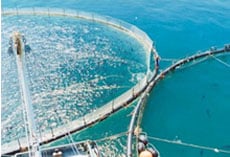
Fish farming has long been viewed as a way to help fill dinner bowls worldwide while easing the pressure on declining populations of wild ocean fish. Now the U.S. aquaculture industry is poised to shed its coastal cloak to farm deeper waters. Last week, the Bush administration has sent a bill to Capitol Hill that would open 3.4 million square miles of ocean -- roughly the land area of the lower 48 states -- to fish farms.
The bill would allow the U.S. secretary of Commerce to issue permits for fish farms in federal waters, up to 200 miles offshore.
The proposed legislation represents the latest effort to implement recommendations from the U.S. Commission on Ocean Policy, which last fall sent the White House its blueprint for overhauling the approach the country takes to managing its vast offshore resources. It also represents the start of a process that will give various "stakeholders" -- including the aquaculture industry, environmental groups, state and local officials -- an opportunity to help shape the rules, federal officials say. "Our goal is to develop a sustainable aquaculture program that balances the needs of fishermen, coastal residents and visitors, seafood consumers, the environment, and the aquaculture industry," said Conrad Lautenbacher Jr., administrator of the National Oceanic and Atmospheric Administration (NOAA), in a prepared statement.
Nutrition meets scarcity
The measure comes at a time of rising global demand for fish as a source of dietary protein, declining fisheries, and rising aquaculture efforts overseas. By 2030, less than half of the fish humans consume will come from wild stocks, according to United Nations estimates. Aquaculture will dominate. Global consumption is expected to reach 110 million metric tons of fish within the next five years.
In the US, "nutritionists are asking us to eat twice as much seafood as we do," says Michael Rubino, manager of NOAA's aquaculture program. "At the moment we import 70 percent of our seafood, and wild fisheries won't be able to meet future market demand. So any increase in supplies is coming from aquaculture. The question is, do we keep importing it, or do we produce some domestically?"
Currently, the U.S. consumes 6 million metric tons of fish a year. By 2025, US consumption is expected to grow by another 2 million metric tons.
"If we could produce that here, that would create 500,000 direct jobs, and 100,000 or more indirect jobs, and contribute about $5 billion in revenue," Dr. Rubino says.
The bill would allow NOAA to issue two permits -- a site permit and an operating permit -- for 10 years. Operators could renew their permits in five-year increments. To receive the permits, fish farmers would have to meet a number of requirements that deal with issues such as environmental monitoring and quality, and business practices. "Those details would be worked out in the regulatory-design process," Rubino says.
And it's designed to push the state of the art in technologies that allow for more environmentally sustainable aquaculture in the open ocean. Indeed, he says, it contains strong language regarding environmental stewardship and public input.
The move to open oceans to fish farming is attractive for several reasons, some analysts say. It moves fish farms away from the coast, where plumes of pollution from urban runoff can endanger the "herd." And it can make siting a farm somewhat easier, since it would draw less opposition from local residents uneasy about the potential for aquaculture pollution -- in the form of waste from the fish -- to foul beaches.
Voracious carnivores
Some environmentalists and marine researchers view open-ocean fish farming with a wary eye. They are concerned that because open-ocean farming is out of sight, it may slowly fall out of mind. Many of the species to be kept down on the aquafarm are top-of-the-food-chain meat eaters, which have the highest market value. But they also are voracious, requiring anywhere from three to 25 pounds of feed -- read smaller fish or fish meal -- for every pound of meat in the farmed species. Concerns also have been growing over the spread of parasites, such as sea lice, from farmed fish to wild schools that pass by, as well as over the results of genetic mixing between wild fish and their escaped farmed cousins.
Sustainable aquaculture is possible if the right species and techniques are used, says William Mott, outgoing president of SeaWeb, a nongovernmental organization that supports sustainable aquaculture. If the motive truly is to meet demand for food, he says, more can be done with fresh-water species grown in urban areas close to their markets, rather than developing large marine feedlots offshore.
Citing unease at what he sees as a bill crafted with input dominated by the aquaculture industry, Mr. Mott adds that it's important to get the measure right. "This legislation will set precedents for generations."
Peter N. Spotts is a staff writer for the Christian Science Monitor. © 2005 Independent Media Institute. All rights reserved. ![]()


36
Login or register to post comments
skeptikool
6 years ago
Comments on "Offshoring the Aquaculture Industry"
As a non-expert, I believe one problem said to plague many fish farms would be resolved, that of excrement build-up under the containment nets. Deeper water and greater water movement should provide more dilution and spread of the matter
As a gardener, I'm surprised that innovators in the fish farming industry have not been able to exploit the agricultural potential of this under-pen growth of fish manure, and in so doing, kill two birds with one stone.
I hope they can learn to raise vegetarian fish. Feeding 25 pound of protein to yield one pound of fish seems crazy economics and may be one of the reasons I can't buy a fresh herring in any of my local supermarkets.
ammonra
6 years ago
I'm glad to see someone else thinks the feces of fish could be used for fertilizer, "spawning" a new industry, perhaps. Let's not confine ouselves to fish feces, though. Animal wastes are not used very much in any part of the country. The result is that nutrients are taken out of the soil, and chemicals are added. Composting and recycling could be done far mor, including that of humanities muck. I used to buy bags of human composted manure prepared by at least one place in Oregon, years ago. No good for food, obviously, but fine for flowers. I've talked about it for forests for a long time. It's a wasted resource, as far as I am concerned.
Fresh water vegetarian fish have been farmed for centuries, if not millenia. Goldfish and Koi were originally bred for that purpose. All over Europe carp ponds were a standard feature of nearly every monastery and community. The problem is that we don't eat carp much anymore. Perception is all, so maybe we need some renaming and marketing like that for dogfish - sold as "rock salmon" in English fish and chip shops.
Name
6 years ago
How does investing 25 pounds of protein to create one pound of fish protein help feed the world? Sorry, I don't for a moment buy that the continent of 16-ounce hamburgers, whose biggest health problem is obesity, is in any risk of starving if it doesn't expand fish farms. This "business case" was dreamed up by the industry's PR folks.
It's just a way to justify new opportunities to make money while putting more of the remaining ocean resources at risk from transmitted diseases, parasites, ecosystem and food chain imbalances, algae blooms, etc. and offering inferior consumer products contaminated with dangerous levels of toxins.
And the world's poor who do need affordable sources of protein will never benefit.
yarrow
6 years ago
Funny the writer of this article seems to have no knowledge of the human health risks of farmed Atlantic salmon, and how these might be a concern in other species raised in aquatic feed lots. The argument this is about feeding the world recalls the argument you should eat your GM soy sludge and shut up about studying the longterm risks.
Adnuces
6 years ago
Given that the only problem with close-to- shore proximity fish farms was the disposal of fish waste then yes finding a market to capitalize on this would be beneficial all round. The major issue is that this is not the only problem with the fish farms we now have. Large concentrations of fish (read salmon)are generating equally large concentrations of parasites which are decimating the local wild stocks. I have long been a staunch supporter of land based fish farms or at the very least farms put out in the open oceans where the parasitic populations wouldn't be so concentrated and our local wild stocks wouldn't have to migrate through a gauntlet of hungry sea lice. I imagine that something akin to an ocean platform would be needed to support the employee population of these open farms. I wonder what plans there are in the works to address this issue......
Bailey
6 years ago
Mr Spotts seems somewhat delusional about the source of 'opposition'. I must say the one objection I've never heard anyone raise is fish poop on beaches. I think he just made that one up himself.
If so, it would seem to show a bias, an attempt to trivialize major biological difficulties involved in the concentration of huge numbers of predators into a small space already occupied by natural populations, and the proliferation of pesticides into the sea, such as the treatment for sea lice which also kills crabs and shrimp.
He makes one good point about the vital importance of choosing the right species and using intelligent techniques, but by and large, skeptikool and ammonra have written better pieces here than Mr. Spotts.
lynn
6 years ago
The real problem with all this is linking farming with nature. eg. the "raising" of fish rather than the "catching" of fish. Nature, in this case, fish, are only seen in human terms now, as just a means of facilitating food for our never-ending consumption. At the same time we have decimated its habitat so "catching" a fish has become less and less a possibility. We have seriously strayed from the wildness of nature... and the cruelty of its domestication and the part we play in it in must now be faced.
As we moved away from being hunter-gatherers, to gardening and farming for the needs of our own families and perhaps a small extended community, with still some hunting and gathering, balance still remained. This has finally progressed to the massive industrialization, the mega-store caging of animals, cattle, cows, chickens and fish for our own benefit. When animals must live in over-crowded pens, mired in their own feces then it is not surprising that Mad Cow disease turns up as their avenger... like sea lice and toxicity in fish.
My husband and I had an oyster lease for many years. Oyster growers are notoriously snobby towards fish farming and growers are largely environmentalists because oysters depend on pristine waters to grow and their habitat is largely undisturbed in the case of beach oysters though long lines are used in deeper waters to grow oysters faster and to increase production.
That's where a precarious line must be drawn, however...and oyster growers themselves must not get too self-righteous... when oyster leases remain relatively small, the natural still holds sway, but when over-production and greed come into play, even oyster leases themselves can grow too large, dominating bays and inlets.
There is a wonderful book by Paul Shepard that has been on our bookshelf for close to twenty-five years now...it is called "The Tender Carnivore and the Sacred Game"...another good one by him is called Nature and Madness".
Shepard writes, "In the ideology of farming, wild things are enemies of the tame; the wild Other is not the context but the opponent of 'my' domain."
His over-riding view is of the importance of the non-human in the lives of humanity. Our philosophy, religion, science and technology are approached in human terms but the diversity of the land "is not made by humans, only discovered and celebrated, or ignored and diminished by them"... "To ignore the natural world, to think of only what humans can do and make...to think only of the greatness of "human" civilization, is to diminish and to destroy both the natural environment and human civilization itself."
skeptikool
6 years ago
Bailey, Praise indeed. Appeciated. I'm sure the author left a few things unsaid to stimulate discussion.
ammonra, You raise an extremmely important issue of what we do, or don't do, with human waste (sewage). As our sensibilities around the topic encourage the flushing and forgetting of it, billions of dollars are spent, or are miss-spent, on mega projects to handle the flow.
I recall many years ago, in Ontario, using Milwaukee sewage - admitted to quite unashamedly on the bag. It was used on my vegetables and I recall no warning to not do so.
On reading your post I Googled for confirmation and was reminded that the product's brand name was Milorganite. I remember wondering at the time, Why am I buying this stuff from the USA?
edited:
The recommended rate of application is about 5 pounds per 100 square feet. Reapply it every two to four weeks. One of the best things about this kind of deer repellent is that it is a bonus for the plants. Milorganite is a high-quality, slow-release fertilizer. It has the highest EPA safety rating, even on vegetables. Milorganite is made from partially composted sewage from the city of Milwaukee that has been dried at intense heat. It may yet become known as the brew that made Milwaukee even more famous. If only it worked on slugs, too!
ammonra
6 years ago
The composted human feces I used to buy (in Prince George) was from a city in Oregon, and it did contain a caution about using it on food for humans. However, I think that is largely overcaution, based on the minute possibility that a salmonella or pathogenic e.coli could survive the composting and processing of the stuff, and the possibility of heavy metal contamination. Personally, I would have no hesitation using it on food and I have done so.
I think a larger view of the subject is required, though, because the vast amount of human waste produced far exceeds the amount that could be absorbed by gardens. If we are to make an impact in reducing the amount of this material dumped in the sea or just left in piles on the ground, as is often done on the prairies, then we must find an industrial level use for it and one that contributes positively to the economy. That is, we must redefine it from being a "waste" material to being a valuable resource material, the processing and use of which generates employment and profit. The heavy metals could be removed and reused, and the composted sludge could be used in horticulture, farming forestry and anywhere else where plant nutrients are needed.
freebear
6 years ago
The Chinese have been making use of human waste for years.
Ocean ranching is not sustainable-dependent on fossil fuels which will only rise in price and scarcity-making the product less and less affordable. Besides how long can the 4-10 pounds of fish to create one pound of fish last?!!
freebear
6 years ago
The Chinese have been making use of human waste for years.
Ocean ranching is not sustainable-dependent on fossil fuels which will only rise in price and scarcity-making the product less and less affordable. Besides how long can the 4-10 pounds of fish to create one pound of fish last?!!
crh
6 years ago
I'm not sue I would want to use farmed fish waste in my garden. To many pesticide residues in the stuff.
skeptikool
6 years ago
We heard you the first time, freebear ;-)
True - and the Chinese refer to it as nightsoil.
I don't doubt that the oil industry has conspired against the wider use of domestic sewage as fertilizer. It could be used to great advantage on clearcuts - particularly, I should think, if the clearcut was converted to hemp production. None of this is rocket science.
I get sick and tired of government just sitting on its hands as it gives lip-service to the environment. What the heck are we paying it beaucoup bucks for as we struggle to put bread on the table?
philster
6 years ago
Interesting story. Perhaps I could share some first hand experience on the matter of aquaculture feed and fish waste. With respect to the fish used in feed, there are primarily two sources of fish meal used in feed, fish waste (heads and guts) and "commercial" fish such as Peruvian anchovies. Most people would agree that the use of herring heads and guts in feed is preferable to dumping them in the ocean to rot, and using them as food for humans is not a practical alternative. When you open a can of "Brunswick" sardines, this is where the heads of the "sardines" went (actually herring in this case).
Peruvian anchovies live rather short lives, after which they die and sink to the bottom of the ocean, where they rot. The demand for anchovies for human consumption – think canned anchovies on pizza, is far smaller than the supply, so harvesting the surplus for use in animal feed is a good use of these fish, which would otherwise go to waste. These small oily fish will spoil rapidly which is why transport to markets for human consumption is not practical, and processing is the best alternative. Until recently, most fish meal went into animal feeds like poultry feed. Birds are far less efficient converters of feed to body mass than fish, making fish feed a more ecologically sound choice than poultry feed.
As Freebear points out there is a limit to the commercial feed fish resource and as a result research is being done to develop alternative protein sources for fish feed, such as soybeans.
Having participated in numerous studies to capture and utilize fish waste from rainbow trout and salmon, I would like to point out several facts. First, fish waste is largely liquid which quickly dissolves into the water, so it is very difficult to capture to start with. Secondly, solid fish waste makes excellent, high nitrogen content fertilizer, as we learned during several studies. Left in the ocean environment, waste material from fish farms has been demonstrated to increase growth of shellfish (mussels) and kelp, both of which have significant food value. Dr. Thierry Chopin, a Canadian researcher, has found this in his research studies. Practical experience from farmers engaged in "polyculture" of mussels and salmonids confirms higher meat yields from mussels when grown in conjunction with fish. This is a win-win solution in reducing the environmental impact of fish farming operations and increasing food yields.
As the author pointed out, aquaculture is growing in importance globally for valid reasons, notably, a growing demand for seafood from a burgeoning world population and declining stocks of wild fish. Peter Drucker has predicted a Blue Revolution in aquaculture that will be every bit as transformative as the Green Revolution in agriculture.
If you are interested in resolving the pros and cons of current aquaculture issues, check out this Fisheries and Oceans Canada web site.
http://www.dfo-o.gc.ca/media/backgrou/2005/salmon_e.htm
lynn
6 years ago
The words "declining stocks of wild fish" are rolled out so flippantly as just another argument for farmed fish. This is a bizarre world indeed - wild fish already had the best enclosure to roam in - our oceans. Instead man steps in, destroys natures simple effciency, and then wants to re-create it in a complicated, inefficient, and ultimately even more destructive way.
Admit it, nature does it way better and that these present steps at trying to stem the result of our own failures and control fish through farming are just going to make the situation even worse.
As a kid who grew up on the ocean I know one thing about kelp and kelp is a response by the ocean to cleanse itself. You often find it in areas becoming subject to pollution. You can tell where there is septic system leakage on beaches because there you will find a proliferation of seaweed and kelp.
There is a big difference between the waste material from salmon being naturally deposited over a wide open range of the ocean as salmon travel their long distance runs... and a big ball of penned fish depositing their waste all in one place, even if some of it filters out...those are not comparable experiments.
KWD
6 years ago
Marine researchers and environmentalists have pretty much hit the offshore aquaculture nail on the head. This is simply a case of ‘out of sight of mind’; it will do nothing to protect and enhance wild fish, the environment or prevent pollution. Nor will it develop a sustainable aquaculture industry or balance the needs of fishermen, coastal residents, visitors and seafood consumers: This all about increasing aquaculture industry profits by reducing costs. The rest is political and industry doublespeak.
Producing 110 million metric tons of aquaculture products annually, using a biomass conversion rate of 25:1, will require 2755 million metric tons of ‘head and guts’ and ‘Peruvian anchovies’. How can we possibly be concerned about satisfying the growing global demand for seafood if we are already producing that much ‘waste’ from existing seafood sources??? Sounds like someone’s been eating too much pizza!
Chris H
6 years ago
I wouldn't want to even speculate what fish will cost at the supermarket if fish farms, 200 miles out to sea, would be viable. I love eating a good, grilled piece of wild BC salmon, but I guess I could live without it. I doubt very much that the US is interested in the fish farming business to "feed" the hungry world.
Te Aro Arahina
6 years ago
I absolutely agree. All mass-production techniques from the abattoires deplored in Fast-Food Nation to chicken-boxes originated with the intent of feeding "starving masses" of people. The results, along with free-trade practices that punish developing nations, are that these nations cannot feed their own populations, while developed nations are overfed on subsidized food, heavy in fat, overly-refined carbohydrates and low on nutrients. Soylent green vs. soy-sludge.
I think mercury poisoning from the current freshwater fish-crops in the US, said to affect huge numbers of the population, goes a long way towards explaining Bush's re-election.
Bobb999
6 years ago
I've gone from being a nearly daily consumer of fish, especially salmon and herring (as my only "meat"), to maybe eating tiny amounts once or twice a week.
I've cut back so much 'cause I no longer trust fish,farmed or wild,as a food source. It's not just mercury pollution. Every fish you eat contains cancer causing PCBs and other toxins. These accumulate in the body, becoming time bombs that eventually may "explode" as cancers.
Here I wanted the health benefits of omega 3 fatty acids from fish oils, and now I'm too sceptical! Living and breathing in the modern world has become a mine field where 1 of every 2 males will step on a "cancer mine". Women are more fortunate with both longer life expectancies and lower likelihoods of developing cancers.
I'm wanting to eat flax seed regularly as a fish alternative. It needs to be ground and should be left uncooked, but I've yet to find a tasty way to eat 2 - 3 tablespoons a day.
(Does anyone have any good flax recipes??)
Te Aro: I recall enjoying that Soylent Green movie with Charlton Heston. I'm guessing it was a novel first. A very clever premise for a plot.
No wonder Bush is stalling on cleaning up those coal burning power plants,if all that mercury is turning Americans into Republican voting zombies!
SMitchell
6 years ago
No one can say that I am a rabid right-winger by any means: nor can I be called an anti-environmentalist. But I believe aquaculture is something that MUST happen.
Take, for example, the history of man on this continent. For thousands of years, we were hunter-gatherers. We didn't plant or raise our food, we simply took it where we got it.
This was great when our population was only a few hundred thousand, but the problem is, thanks to our larger than normal brains, we got too good at it, and we got civilized. Eventually, as our populations grew and civilization multiplied our needs, we depleted our food supply faster than nature could resupply it. The mammoth, sabretooth tiger, great auroch, all paid the ultimate price for our success. Up north, the Native Americans learned to regulate their food consumption - developing methods to efficiently process their kills and thereby retain a nomadic existence. Down south, the Aztecs developed agriculture, enabling them to produce their own food without stressing the native environment, while providing the resources they needed to develop a highly advanced civilization. Today, nobody thinks that our civlization could exist without agriculture.
The problem is, where the sea is concerned, we're still hunter/gatherers. And the sea's paid the price. 90% of the oceans big fishes, like tuna, are gone. We came within a hair's breadth of wiping out the whales, and our salmon fishery is in crisis every other year.
Quite simply, the same situation that we faced in North America is happening again. We are trying to maintain a hunter/gatherer existence which the sea simply cannot sustain. Just as our ancestors developed agriculture to get us away from the land-based version of hunting/gathering, we have to develop aquaculture or we are going to decimate the oceans in a very short while.
Now, I'm not saying we need to turn a blind eye to the costs of aquaculture. But I am saying that long-term, the costs are going to be far greater, environmental and otherwise, if we don't develop this technology.
redgreen
6 years ago
We have yet to truly experience the irreparable damage to the planet that the "green" revolution will cause. The world's population will face an inevitable crash as we run out of good top soil caused by the intensive farming practices developed mostly since the second world war. The oceans will be unable to withstand a "blue" revolution. Carnivorous fish simply require too much biomass in the form of other fish for aquaculture to be a viable long-term solution for the protein needs of the planet. Long-range sustainability for human populations will require us to harness natural flows of renewable resources such as the pacific salmon. Through extreme mismanagement of our river systems here in the Pacific Northwest (largely due to improper forestry practices and Hydro-electric dams) we have virtually destroyed this once abundant fishery. Thanks to the BC government, the aquaculture industry will provide the final nails in the coffin for the once abundant pink salmon runs in the once pristine Broughton Archipelago. This incredible wild paradise is now home to the largest concentration of fish farms on the BC coast. This region is also home to the magnificent Northern resident Orca. Numbering just under 200 animals, they are quite vulnerable to sudden massive changes to their habitat. The loss of this massive run of fish could be disastrous to this beautiful mammal. The sad irony is that the fishermen and loggers put out of work by the mismanagement of their respective industries are now turning to the eco-tourism industry. The whales (not to mention the scenic beauty) are a major draw. The Southern resident Orcas are already extremely endangered due to a lack of fish and the bioaccumulation of toxins such as PCBs. I suppose the above author is ok with a world that is bare of any wild animals and instead the only non-human life will live in massive factory farms both terrestrial and aquatic. This is not the future I want to give my (yet to be born) children. The aquaculture industry is not born out of a genuine need to feed the starving millions. It is based on short-term greed and supported by a government dedicated to these pursuers of profit by any means. I strongly recommend reading up on the causes of civilization collapse. Numerous authors suggest that civilization collapses when the carrying capacity of the environment is exceeded. Artificially increasing the carrying capacity of the biosphere through large scale fish farming will only temporarily slow the inevitable decline of our civilization. I believe that it will also increase the likelihood of sudden massive ecological collapse. That being said, I still believe that if we get our acts together, get rid of the neo-cons governing the globe, and take back the planet there will still be hope.
philster
6 years ago
Comments above on the condition of the pink salmon runs in the Broughton Archipelago do not reflect the most recent facts. Just released information from DFO surveys indicate that the pink salmon runs in 2004 in the Broughton Archipelago were the largest in the last 50 years.
Details on the surveys and further information is provided on the DFO website.
We should expect our governments to make decisions on matters like aquaculture based on scientific facts rather than myths that become unquestioned dogma.
lynn
6 years ago
The pink salmon runs did flourish in 2004 but a lot of scientists and environmentalists are attributing their return to a process called fallowing, which is the removal of farm salmon from the migration route of the juvenile pink salmon before they go out to sea as babies. This reduces sea lice and increases the survival of wild salmon. This was done in the spring of 2003.
Stupidly, this spring the salmon farms were re-stocked, placing more farm salmon than ever on the path of the migrating juvenile salmon once again. Alexandra Morton has said that because of this she does not expect to see many pink salmon return from this run in 2005, due to the increased risk once again of parasites, sea lice.
philster
6 years ago
Lynn, I don't think your dates work out. Pink salmon spend two years at sea, so fish returning in 2004 would have gone to sea as smolts in 2002, the year before the fallowing of the sites began.
My point is this, based on the 2004 record high returns of pink salmon to the Broughton Archipelago, one cannot make a sound case for any correlation or causation between salmon farming and pink salmon numbers.
In fact, there are more pink salmon now (2004)than there were before salmon farming began in this area, according to DFO stats. Applying the same logic as critics of salmon farming, the conclusion would be that salmon farm numbers went up and so did pink salmon populations so therefore salmon farms increase the number of wild pink salmon, which is ridiculous of course.
What it suggests to me is that there is no direct link in terms of correlation or causation and that pink salmon numbers are fluctuating for other reasons.
A recent study by DFO (Dr. Don Noakes et al)into the decline of Pacific salmon stocks attributed the overrall decline to three factors: overfishing, destruction of spawning habitat, and changes in ocean conditions (warming). This study is available on line from DFO.
Salmon farming is not the problem.
Michelle Y
6 years ago
philster, you are incorrect, and Lynn's dates work out just fine. The good return in the fall of 2004 was a result of the salmon farms along the migratory route being fallowed in the spring of 2003. The pinks migrate out to sea the spring after they are spawned. The smolts from the fall run of 2002 migrated out to sea in the spring of 2003, when the farms were fallowed, and returned in the fall of 2004 with good runs. There is an obvious correlation, as there have been sea lice infestations on smolts every year they had to migrate through the fish farms, and a poor return a year and a half later. The only year the farms were fallowed, the returns were good a year and a half later.
Sea lice are only one of many reasons to shut down all open net cage salmon farms. There is the potential for the transfer of other diseases, the destruction of the ocean floor below the pens due to fish waste, the biomass issue, PCB's, dye fed to the fish to make them pink, the mushiness of their fat, lazy flesh, etc.
As for relying on a DFO study, they have consistently denied any sea lice problem, yet mysteriously Health Canada recently increased the acceptable level of Slice, a drug used to control sea lice in fish farms, in Canadian food.
I have studied this issue very closely over the years and find it interesting that every scientist that supports fish farming is associated with the government or industry ...hmmm....which one applies to you?
capndan@shaw.ca
6 years ago
Hey Philster, you tell us to look for backup information on the DFO site. May I remind you that the numbers there are from the same folks that said the Gun Registry was only going to cost us a couple million..........The information purported to be scientific is crap, period....
Name
6 years ago
Sorry folks, the potential benefits of waste as fertilizer do not justify the risks of growing vast quantities of anything in confined spaces without a clear understanding of how to manage all the risks and implications.
Disposing of the enormous amounts of waste generated by feedlots and industrialized animal farming is already a major challenge that causes tremendous damage to natural environments. For example, excess manure and fertilizer runoff into streams from industrial farming affects marine ecosystems. (And it's not just the poop--figuring out how to dispose of the mountains of cow parts left over each year is a major industry in itself.)
It's not so much the specific wastes or materials involved, it's the quantities involved in large-scale industrial farming or aquaculture, which overwhelm natural environments and ecosystems. (It's as simple as that amazing MiracleGro that gives you such fabulous flowers, and that will kill them all if you apply too much.)
That's not to deny that we can't find ways to manage these wastes and turn them to good use in the future (methane gas to fuel cars, for example), but we're nowhere near managing the wastes that we're already producing. And we turn up the risk of irreversible damage to vital ecosystems if we keep adding new pressures before we get the current problems under control. Once such systems get out of whack, it's often not a simple matter to restore them (stopping fishing when Atlantic cod collapsed has done nothing to bring it back--the ecosystem has changed permanently and there's no going back.)
Further, the argument that no one else would want to eat the fish parts used to feed farmed fish illustrates why we keep screwing up -- we're not the only ones who have to eat if we are to preserve the natural systems that support us! Those sardines or whatever are currently feeding something else in the ocean that ultimately lands on our plates. If they currently can't sustain enough wild fish to feed the world, what makes anyone think they will sustain enough farmed fish to do so--the math is simple!
The problem is not so much fish farming or whatever, but our habit of jumping into these things before we know what we're doing and can manage the consequences, It's the breezy attitude that we should seize the moment, forge ahead and handle the problems as they arise on the fly.
That attitude has prevailed for centuries, but the consequences weren't overwhelming until the industrial revolution allowed us to do everything on a massive scale. As we start to feel the ominous repercussions, we realize that our science and technology for managing change is way behind the science and technology that drives that change.
Fish farms will be reality some day. But if we repeat the mistakes that we made on land and jump in before we truly understand and are ready to manage the implications, we will have learned nothing from the past 150 years.
Name
6 years ago
...and Philster, you are correct that there is at present no conclusive scientific proof of a direct causal link between sea lice on farmed fish and risks to Pacific pink salmon.
On the other hand, there is NO proof that farmed salmon do NOT pose a risk to wild fish and lots of evidence to suggest that they MIGHT pose a risk. The precautionary principle suggests the need for caution until these questions are answered more definitively.
As you seem to be suggesting in citing the Noakes study, other factors certainly play a role in pink salmon productivity, including ocean conditions, habitat damage and climate factors. These do not preclude or discount an additional impact from fish farms. While we can't do anything to control a hot summer or ocean productivity, we can control habitat destruction and fish farming. Common sense would dictate that if a species is already under pressure from other factors, that you don't pile on additional risks that are avoidable.
And re historical numbers, DFO did not do the baseline studies needed to allow comparison with the situation in the Broughton before fish farms. Further, cuts in recent years have vastly eroded their ability to count fish with acceptable accuracy, so a lot of the data are questionable.
We're going to be debating this for a long time--it took over a decade in Europe to establish the links and they're still arguing!
anne cameron
6 years ago
To suggest the anchovies which die are "lost" and simply rot on the bottom and pollute the water is bullshit of the worst order. It absolutely ignores the presence of any number of creepies and crawlies who EAT the dead fish.
Nothing is added to an informed consideration of the pro's and con's of fish feedlots by promulgating such simplistic and self serving propoganda.
The absolutely last to benefit from commercial fish feedlots are the starving of the world. The species being raised are the most expensive, and are destined for the plates of the already grossly over-fed. There has been some suggestion this will mean the over-fed will not eat OTHER food which will then become available to the starving.
Oh, right, legislate the idea they can have the crumbs which fall from our tables. We'll eat salmon and ling cod and they can have our squash and bulgar wheat.
Enlarging the size of fish feedlots will mean cramming more numbers of fish into them. And that will mean catching more and more and more of a rapidly diminishing wild population in order to turn them into pellets to feed the ones being raised for the greedy and already overfed. Can none of the proponents of this expansion see the inevitable crash when there isn't enough "trash fish" left to feed the feedlot slaves?
As for Milorganite: I used it some thirty years ago, it worked wonderfully; then I got notification it was only to be used on non food areas because of dangerous concentrations of heavy metals. It is now used on golf courses and has been used on experimental patches of forest. Powell River has experimented with sludge from their sewage treatment plant and spread it on a clearcut near Gibson's Beach. The stench was beyond belief!
We should leave the ocean alone. If people want to raise fish commercially it should be done in landbased tanks with proper sewage treatment and should be done with non carnivorous species. There has been some sucess raising a type of carp which feeds on algae and water weeds and which can grow to three and four feet in a very short period of time.
Of course carp isn't salmon, the spoiled brats won't want it and that would mean the market for it would have to be those starving millions we've heard so much about..and they don't have the finances to pay ridiculous prices for it so........let'em eat turnips?
Michelle Y
6 years ago
There IS conclusive evidence that sea lice from fish farms in the Broughton Archipelago have caused the collapse of pink salmon there. Every spring that there have been sea lice infestations in the fish farms, the returning runs a year and a half later have been very low. The little smolts leave the rivers all healthy and ready to venture out. But as soon as they pass by the infested farms they are covered in sea lice. This has been witnessed and documented by scientists and fishermen. These levels of sea lice are never seen on wild smolts away from fish farms. Why? Because in the wild, baby and adult salmon are never in the same place. Europe has experienced the same collapse in wild salmon caused by sea lice infestations from fish farms. Their scientists warned our government of the problems they had, yet that information was ignored. What more evidence do you want?
The information from the industry and government is denial, rhetoric and propoganda. Don't believe their BS. It's just business as usual regardless of the impact on our health and the environment.
clubofrome
6 years ago
redgreen has hit the nail on the head. Collapse has already started, we have been living on borrowed capitol, writing cheques that this planet has no intention of cashing. This planet can no more support 6+ billion than Mars... and we're not going anywhere. Your choices will become more limited until they are taken away, so start choosing wisely now. Replace consummer values soon while you still can. You won't see an ad for that on TV, so turn off, go out and tune in to nature. It's only going to give us a few more generations to play with, then..... bring on the next intelligent species. This planet will do just fine without us, so I don't buy the argument that we must save the planet. We have a limited time to save our own asses. If you think that they are worth saving... you may want to take a closer look at what you find important in this fragile web of life. If you measure success of a species by longevity, then we haven't been around anywhere near the length of time reptiles ruled the earth. Check out the big brain on T-Rex!
allan
6 years ago
Our brains may be too large for our heads, but we are far, far away from being too civilized as someone suggested yesterday as one of the reasons we are such good comsumers.
I find it quite ironic that anyone would use that (civilized) term, which has been the justification for so much of the rape, plunder and general ruination of the world.
It's my belief that we might begin to approach something that could be described as civilized if we ever catch up with our penchant for new forms of technology long enough to stop the development of truly bad science simply because someone tells us it's good and, of course, someone else makes a tidy profit.
We're now scraping away at the bottom of the food chain and we think we are an advancing society?
clubofrome
6 years ago
Civilized? Not even domesticated.... I'm glad to hear that fish farms will stop the decimation of the oceans. I was getting a bit concerned there for a while! No offense SM, we all need to keep our eyes and ears open, then share what we found in places like this. Any solution short of a miracle is going to take a pretty big team effort. I wonder if the average person in North America, say, ever thinks that empty shelves in our stores will even be remotely possible?
RickW
6 years ago
Mr. Smith (The Matrix) referred to humans as viruses. He is right. We will kill our host (earth)and in so doing, will kill ourselves. Question is: should there be any humans left, will they be "seed stock" for another viral infection, or will they have "learned" from their forbearers "mistake"?
PS Why take 3-25 pounds of protein to create 1 pound of protein when, using existing technology, we can turn this 25 lbs. directly into -- food!
"Soylent Green" anyone?
http://www.imdb.com/title/tt0070723/
RickW
6 years ago
PS
If anyone needs "proof" that we are "doomed" (a la the previous post), it seems the more of us there are, the stupider we get:
http://harpers.org/WeeklyReview2005-06-21.html
Name
6 years ago
Clubofrome is right -- we're not actually talking about "saving the planet", which will do fine without us. When we speak of these things we're really discussing ways to save what we think will be needed to support a decent existence for our children and grandchildren.