Haida Blockaders Vow ‘As Long as It Takes’
The standoff is over who controls and benefits from logging on Haida Gwaii.
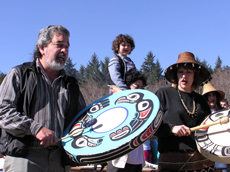
Haida leader Guujaaw drums at yesterday’s protest. Photo: H. Ramsay
“I think they waited too long for this,” said a Roberta Aiken, a Haida woman from Skidegate who was snapping photos as a caravan of 15 cars, representing the Haida families of Old Massett, pulled up at the blockade in Queen Charlotte City.
“Look around. Everyone is hungry, our land is hungry and it’s being taken away,” said Aiken. The smell of the campfire drifted from makeshift concession stand where salmon sandwiches were rapidly disappearing.
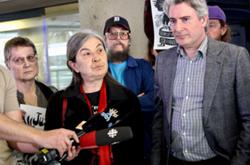
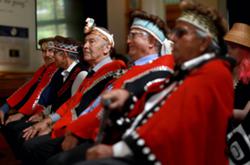
Now in its second day, the protests on Haida Gwaii continue to grow. The sun shone as elders wrapped in button blankets, babies in kerchiefs, men in lumber jack shirts and women in cedar hats continued their vigil after a long, cold March night.
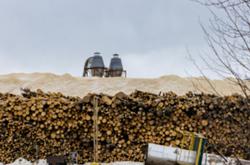
Haida and non-Haida have come together to form two round the clock lines blocking access to Weyerhaeuser’s log sorting facilities, one near Juskatla and one near Queen Charlotte City, where hundreds of cedars wait to be loaded onto massive barges and shipped to mills farther south.
Juskatla is half way between Masset and Queen Charlotte City and the caravan stopped to have a look before continuing to a huge rally held at 1 pm Wednesday at the blockade in Queen Charlotte.
Chief Alan Wilson of Old Massett held his hand above his six foot frame and told 200 onlookers there were cedars bigger than that ready to be shipped away.
“The amount they log in one year would last us ten and all communities would be prosperous on Haida Gwaii,” he told the crowd.
Already the protests have dissuaded the Weyerhaeuser log barge from navigating the waters of Masset Inlet and Weyerhaeuser staff and crews are at home with a wait and see attitude about coming back to work.
Those on the frontline recognize a company logging truck or a Ministry of Forests employee at 100 metres and both are being turned away. In these small communities those on either side of the line know each other by name, and for now, there is a jovial atmosphere to the standoff.
But as Aiken said, “We need to survive too,” and she worries about small logging contractors and others who haven’t been able to work in the face of this standoff between islanders, the government and Weyerhaeuser.
Appeal to Governor General
The reasons for the blockade are long and complicated, yet utterly simple — the Haida want control over their traditional lands and resources.
Diane Brown, who at 56 is the youngest fluent speaker of Haida, held her granddaughter aloft and said she wants her to be able to harvest food from the beach, take cedar bark from the trees and collect pure medicine from the forest floor.
“The people have entrusted their leaders to resolve conflict through negotiations and the court. When court decisions are ignored by this government to accommodate industry, I think it is proper the people stand up,” said Guujaaw, the president of the Council of the Haida Nation.
Although the Council of the Haida Nation do not officially sanction the protests, Guujaaw stood beside a red Haida flag on the road Tuesday morning, along with everyone else.
At a Monday night meeting in Skidegate when times and locations of the blockades were discussed by audience members, Guujaaw joked that it seemed rumours were being substantiated. But he was careful to also say all who join blockades or actions do so under their own conscience.
The Haida have taken their ongoing dispute with the province over land-use decisions on their territory to the streets, but they have also taken it to the highest authority in the land.
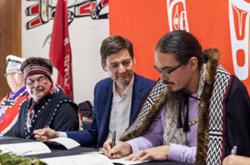
A day before the blockades went up the CHN sent a letter to Governor General Adrienne Clarkson asking her to intervene in a matter of honour — what the Haida call the province’s contempt for the Supreme Court decision on the case referred to as TFL 39 handed down in November 2004.
The Supreme Court of Canada ruled in favour of the Haida on a case in which the Haida asserted the Crown had failed in its duty to consult over the transfer of tenure when McMillian Bloedel was sold to Weyerhaeuser.
The decision included a unique legal concept known as “the honour of the Crown.”
“…the Crown, acting honourably, cannot cavalierly run roughshod over Aboriginal interests where claims affecting these interests are being seriously pursued in the process of treaty negotiation and proof,” said Justice Beverley McLachlin in her decision.
Duty to consult ?
Now the Haida are facing a new transfer of tenure — as Weyerhaeuser plans to sell its Tree Farm License to Toronto-based asset management company Brascan — and once again they were not consulted.
There is another letter involved in the story. The same day a letter went out to the Queen’s representative, a letter from the Ministry of Forests was received by the Haida.
The letter said the Crown has no authority over the transfer of tenure and therefore no reason to consult with the Haida. Strangely enough, it was during the time the Haida and Province were in the Supreme Court, that laws were changed ensuring the Minister did not have to approve these transfers.
The Haida point out another contentious issue. The November Supreme Court decision said the honour of the Crown may require consultation and accommodation to avoid harming Aboriginal interests while negotiations take place.
While the Haida sought remedy through the courts, the province has enacted legislation to divest itself of the legal authority and public duty to regulate the forests, says Guujaaw.
He also cites the 18 months of negotiations for a Land Use Plan for the islands in which representatives of all interested groups tried to come to consensus on land and resource management issues.
“The provincial government has continued to compromise the outcome of the planning process by approving cutblocks within the area.”
Although the province’s duty to consult was made clear in the Supreme Court decision, businesses breathed a sigh of relief in the aftermath, as the court relieved them of any duty to consult with First Nations.
Privatization challenged
But some who are following this dispute carefully, don’t think businesses like Weyerhauser and Brascan are out of the proverbial woods yet.
Will Horter runs the Dogwood Initiative, a non-profit organization concerned with sustainable land reform. He has been watching closely as the Weyerhaeuser deal moves through the paces.
The deal will likely not be complete until June, and Horter says the companies face significant legal hurdles, which could end up scuttling the sale.
“Foremost is the law suit filed by the Hupacasath First Nation in Port Alberni. They are challenging the privatization of 70,000 acres of Weyerhaeuser’s Tree Farm Licence lands, which are included in the proposed Brascan deal,” says Horter.
The case which was launched earlier this year involves a quarter of the private lands proposed for transfer to Brascan. Although the BC Supreme Court refused their injunction, the judge said there is a serious issue to be tried regarding the Crown's failure to consult first nations.
What really galls Horter, the Hupacasath and the Haida is that the Liberals took 90,000 hectares out of Tree Farm Licenses in the province and turned them back into private holdings, once again without consulting first nations. This was done quietly over the summer, Horter says, even though 97 per cent of people were opposed to taking private lands out of the TFLs when a public process took place in 1997.
Horter explains the history.
“In exchange for agreeing to manage their private land under provincial forestry laws, and for operating local mills that would build regional economies and employ workers, logging companies were granted [rights] to log vast tracts of public lands. And they made millions doing so,” says Horter.
With this aspect of the social contract taken away, Weyerhauser and other companies like Timber West, West Fraser and Western Canada Forest Products who have taken private land out of TFLs stand to make a windfall when they sell their licenses, Horter says.
What’s left for islanders?
And while corporations can now happily buy and sell their rights to Crown land with no public comment or judicial review, those who live and work on the islands feel like their hopes for control over the island economy continue to slip away.
One retired logger who stood at the blockade Tuesday morning, lamented the loss of jobs on the islands.
There are 11,000 spin off jobs in the south, thanks to our wood, he told others who stamped their feet in the chilly March air.
When asked how long they were willing to stand at the blockade, elders and others agreed.
“As long as it takes.”
At the Monday night meeting Guujaaw declared: “We still have an opportunity to create a sustainable economy, but that opportunity is fading away. If we let this transfer go through it will fade away completely.”
Heather Ramsay lives in Queen Charlotte City and is a frequent contributor to The Tyee. ![]()


24
Login or register to post comments
Stuart
6 years ago
Comments on "Haida Blockaders Vow ‘As Long as It Take
I support the natives all the way, they can teach us left wing intellectuals a thing
Or two. We can wine to the cows come home but unless you'll willing to organize and act the
Corporations with government in pocket will run over us without a second thought. The shareholders do not live in the area nor do they care about how they poison or rape the land. The only thing they care about is shareholder value, once their done they just walk away and leave the mess. They want it both ways, first they want no interference in their operations etc, they want a total no holds barred free market yet they want the public to socialize or pay the other costs. The public pays in lost habitat, clean up costs, lost resource costs etc, hospital cost for a poisoned environment. The natives have figured out before the rest of us that these companies are only in place to service themselves and no one else, the natives are showing us the way, in short they still have some fight left in them, how about you folks.
Birch
6 years ago
One of the strongest arguments conservative economists make for private control of property, resources, etc. is that personal ownership makes for more careful stewardship. As can be readily seen from corporate practices, however, careful stewardship is often abandoned for short term shareholder return, etc. In the case of the Haida, ownership by those closest to home, the Haida themselves (as well as the other citizens of Haida Gwaii) would lead to the fullfilment of that goal. Good luck to the Haida in this protest, and shame to the government of Canada if it does not support them.
anarcho
6 years ago
I support the Haida completely. They certainly can teach the rest of us a thing or too. The Haida ought to have control of the forests and all other natural resources in their area. So should all communities. De-provincialize resources and development. Leave it up to the local people to decide democratically. The only cure for government and corporate authoritarianism is direct democracy at the local level.
dunngy
6 years ago
the best benefit for the globe is also the best benefit for the local community.native or not, keep a significant portion of the wealth generated locally in the local area.share the wealth!what happened to EVERYONE getting their fair share of the pie.
Christopherk
6 years ago
I am not as familiar with Canadian treatment of First Nations people as I am with America's treatment of Native Americans. That's because I am an American who has spent many years working with the indegenous people and studying their history. I am an adopted member of the Tlingit Nation, neighbors to the Haida. I have seen how our governments have consistently violated the treaties we made with the original inhabitants of this continent. And I have watched in horror as our governments have consistently placed economic gain over the rights of those who hold the land to be sacred.
Few dare say the word, but I will. Our treatment of the indigenous people amounts to nothing less than a North American Holocaust.
But, of course, we're not Nazis, are we?
Frankindustries
6 years ago
North American Holocaust, That is a rather dim view of things, I for some reason think that living almost tax free, having the Governments lining up (it seems) to pour money into anything that has Aboriginal in the name makes me think otherwise, I wish I was a "non white" so then I could have my college degree paid for, if that is your definition of a holocaust then sign me up.
Christopherk
6 years ago
OK Frank, you're signed up. All you have to do is give up your culture, your land, your language, and your hope.
bevinbc
6 years ago
Well....there is an election coming soon (maybe even federally too) and somehow we need to get get big business out of our political parties and somehow make them acccountable to citizens. If (I do say if) the NDP manage to get control or even if they only get to be the 'opposition' we must convey to them (all parties)that citizens and community are the most important issue in their platforms. Of couse this means advocating big time to make outselves heard. Accountability needs to be the new mantra.
satyricon
6 years ago
I think Frank is also forgetting an important point. The whole reason for treaty settlement is so that aboriginals can forgo "special" attention such as tax exemption and eventually provide for themselves economically. Unfortunately it is difficult for them to become sustainable when most of their land is owned by the Provincial Government who allows multinational corperations to expropriate profits abroad. The profits from the land should stay with the people of the land. I fully support the Haida position.
shakinglikemilk
6 years ago
It's been my experience that people who say things like Frank has said, lack any real knowledge of the history of Canada's treatment of Native people and the complete absence of justification for "Crown sovereignty".
One of the flaws of a democratic culture is that people feel entitled to hold and to express opinions on subjects about which they have bothered to learn nothing. Even worse, they expect other people to listen to and be influenced by those opinions.
Frank, why don't you try reading a book or two on the subject before you open your ignorant yap again?
BC Mary
6 years ago
I love it, that the Haida are showing the way again. Also the Telegraph Creek group.
About that election. It's May 17 ... and we can all make a difference for the better.
Oligarchy OUT ... People IN ...
BC Mary
6 years ago
I love it, that the Haida are showing the way again. Also the Telegraph Creek group.
About that election. It's May 17 ... and we can all make a difference for the better.
Oligarchy OUT ... People IN ... Corporations OUT ... People IN ...
spud
6 years ago
Great article!
The Haida Spirit is rising, about time!
re: the holocaust issue, if Frank likes movies, perhaps by viewing 'Rabbit Proof Fence' he could form a clear picture of how horrible indiginous people were treated by white settlers (and the gov't they erected). It is an Australian movie, but there are common themes (for Namerica)...residential school being the main one.
People IN!
KWD
6 years ago
Great article. Although I wish folks would question their use of the term "sustainability". Like the term "certainty", it has become reified to the point of being meaningless when used in relation natural resources.
spud
6 years ago
Excellent website up for facts, pictures, maps...
http://www.haidanation.ca/islands/islands.html
http://www.haidanation.ca/
Frankindustries
6 years ago
I find it interesting that no one has learned to let go of the past, what is the point of it all? Your land ,my land it is our land now. I think it would do all of us some good to look into the future and realize all of this will not make any differance.
Percy
6 years ago
The Haida have applied for an injunction. The courts refused it, presumably because the threshhold legal test of irreparable harm was not made out. So...shouldn't they deal with the matter in court in the due course of things, the rule that applies to everyone else? Whatever political views we may have, surely we agree upon the rule of law.
chuckstraight
6 years ago
From the last 3+ years, it is fairly easy to see how the law is fair for all. It didn`t count when ripping up collective agreements,for example, so many of us do not have faith in the law being applied evenly with the BC Liberals in charge. Add to that the 2million or so raw logs that were exported last yea from BC, and we can say that this land is not our land. It belongs to Weyerhauser and other BC Liberal donors. Go Haida Go!!
spud
6 years ago
Frankindustry, I wonder what your motivation is to comment on this article as you do? To combat an existential crisis? Perhaps to demonstrate to us what a city-boy opinion might be (I assume)?
You really challenge me. I wonder if trying to answer your questions would help your understanding at all.
What is the point of it all? Very philosophical really. It is difficult to let go of the past, this is true. Partly because it repeats itself. If a Nation of people that were reduced to 500 from a flourishing 10-70 thousand (I know, that's a big leap, but us white book writers never counted them before they got disease and died) wants to strengthen the amount of culture it still has, POWER TO THEM.
If I feel jealous because I am white and the dominant culture related to my ethnicity revolves around pop and TV, then who am I to put them down?
Rather, I choose to support diversity in this world. If history has a chance to repeat itself, the Haida, their people, songs, dances, architecture, artwork, stories, will disappear. The cedar tree is fundamental to the Haida as people, that is why they are causing a stink right now, enough is enough.
They are incredibly noble and friendly as a Nation as well, this is why the Island's people are unified and supportive. It is not just the Haida standing the blockade.
Tell me more Frank...
haida
6 years ago
What is most remarkable about the situation and what is almost lost in the headlines is that the Blockade is not simply an Indigneous Peoples issue. The check points are operated by settlers and Haidas alike. The issue has grown beyond a neat and tidy package .
Aboriginal Title is becoming a vehicle for complex communities. No longer an exclusive haven for mono culture. Aboriginal Title provides an opportunity for the marginalized to challenge the status quo.
Aboriginal Title is not "Land Claims".
Should the news that Island communities have enjoyed some very substantial benefits from a decade long alliance with the Haida Nation spill out into other rural areas of BC, we may soon see other Municipalities extend a hand where once a fist would do.
New ways of thinking and working with Indigenous Peoples such as in the Municipal governments of Terrace, Masset, Port Clements
are examples of a progressive change that has few supporters in Victoria.
That is because they might understand that the most effective tool for social and political and legal shifts in Canada lies in two words.... Aboriginal Title.
paulabbott
6 years ago
Frank. How long after I steal your wallet does it become historical (i.e. my wallet)? For me, I'd say about 3 seconds.
Coyote
6 years ago
"Whatever political views we may have, surely we agree upon the rule of law.," says Frank.
There's also the little matter of course, of whose law? My law, "our" law or the "oppressors" law? Hitler's law was the law of Germany, should all the nations it conquerored, declaring the new Hitler Law have bowed down and surrendere themselves to it? The Jews had been absent, by and large, from what was Israel for over two thousand years, when suddenly they show up in what had become Palestine, with European and other Western assistance, and declare Hebrew Law the law of the land, drive out the Palestinians and declare them "terrorists" for resisting. What is the obligation of the Palestinians here, to merely submit and resist?
You are too naive by half, or there are other "issues" you have in being "objective" about the interests of other peoples and groups. Or is it only an issue when it comes to Natives and White folks?
Nope, we don't all agree on the rule of law. The Law, like everything else, is a relative thing, and very much influenced by Power, who has it and who does not.
Coyote
6 years ago
The check points are operated by settlers and Haidas alike. The issue has grown beyond a neat and tidy package.
An accurate and well written piece, Haida. Land, Resources and Title for Aboriginal Nations. Indeed.
RickW
6 years ago
Birch states:
Thing is, neither Weyerhauser nor Brascan, nor the company(s) that opbtained the orginal logging rights, actually OWN the land. It was given them by the provincial government some time ago, under the (now functionally defunct) forest tenure agreement.
http://www.kcfa.bc.ca/tenure2.html
The companies that originally obtained tenure, began selling or trading this privilege, which eventually morphed into a "right". While companies are free to buy and sell in the marketplace, the tree forest licences should never have been.
Consequently, all these companies have access to lands they never paid for, and so don't own. Had they paid "fair market value" (and not some subsidized token fee), doubtless they WOULD exercise "more careful stewardship", as it would take them at least 20-40 years to realize a profit.
But these companies practice a modified "slash and burn" piracy that we admonish such "banana republics" as Brazil, Phillipines, Indonesia, Thailand, Cambodia, et al. for practicing.
And all at the behest of our provincial governments, of which the present one is simply the most recent practitioner.