

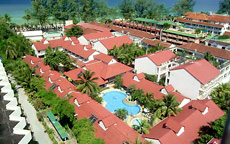
As Southeast Asia struggles to recover from the tsunami’s devastation, the power of tourism -- for ill or good -- is being weighed closely by officials faced with restoring the coastal economies of their hard hit nations.
Yes, tourism creates jobs and pulls in foreign currency. But its infrastructure can also harm the environment, and beyond its gleaming compounds can spring up shanty towns and shadowy sex and drug economies that exploit the vulnerable, including children. The result can be a tourism financial bonanza traded for the soul of a culture.
In the grim aftermath of the tsunami, however, some experts in the field of culturally sensitive tourism see difficult choices ahead. In places like Sri Lanka and the Maldives, reconstruction efforts are expected to receive enormous foreign aid and investment by the World Bank. Will the rebuilding be done in ways that attract visitors without huge sacrifices of nature, traditions, and local autonomy?
“Community involvement is essential in tourism development,” says Geoffrey Bird, co-ordinator of the tourism management co-op program at Capilano College in North Vancouver. Bird is working with a village in the lush Vietnamese countryside. The Sapa region is popular with backpackers and trekkers who often arrange homestays with villagers through tour companies based in Hanoi.
‘Old world charm’ on steroids
Along with his students, Bird is working with the Vietnamese government, Hanoi Open University and the Sapa village community to train villagers to exert some control over tourism in their area. Villagers will still be making the standard price of $2 Cdn per homestay, but will be receiving important training, Bird says.
“Our concern is to provide training to the village so they can work with tour operators. And it just so happens that first aid, sanitation, food safety are the skills needed that are also useful to the villagers,” he says. By the end of the five-year project, Bird hopes that his program will have trained 200 villagers.
The training also helps locals learn to negotiate with tour operators and government officials to control the pace of change. In the particular village Bird is working with, local residents decided to only allow ten tourists to visit each day. Guides must maintain that quota.
Ultimately, Bird is hoping for the development of mutually beneficial relationship between the village and tourists.
This go-very-slow approach to tourism development offers a sharp contrast to the mega-resort approach fast tracked by governments in many developing tropical countries. In Hua Hin, Thailand, a nearly century old summer palace for royalty has gotten an extreme make-over due to a multitude of visitors. The historic destination is popular among foreigners and Thais alike, and is advertised for its "old world charm." But, much to the dismay of older generations from the area, the formerly quaint fishing village destination has been replaced with high-rise condominiums, a luxury hotel, beer gardens and an airport.
“Tourism is a big force and it’s rolling through the world. People have to be prepared to deal with it,” Bird says.
The Zapatista tour
In Mexico, where by government decree many large resort areas have sprung from rustic settings over the past few decades, some are benefiting from real estate windfalls while others are pushed further to the margins.
Take, for example, the tourism hotspot on the northernmost tip of the Bay of Banderas near Puerto Vallarta, Mexico. Since 1993, Mexico’s government has granted more lenient land acquisition rights for foreigners and a four-lane highway was constructed connecting communities in the Bay of Banderas. Since then, the area has become a lucrative location for hotel and resort developers.
In a small town called Punta de Mita, a Four Seasons Hotel and a million-dollar housing community were recently built. The development—with a Jack Nicklaus golf course and plans for a marina and equestrian centre—has sliced a gated strip of land directly through the area. At the time of its construction, local residents of a land collective were displaced to cement block houses. Now, many of the displaced residents have opted to build wooden shacks to live more comfortably in. A colourful assortment of these wooden homes stands next to the neat rows of houses provided.
Not to say that every visitor to Mexico, where tourism accounts for 8.3 per cent of GDP, goes to loll in sun-and-sand adult theme parks. The more politically adventurous can join one of the tours now offered to the Zapatista rebel stronghold in Chiapas.
A little further south, Costa Rica is famous for its “ecotourism” industry—one that often supplements local farmers’ incomes who moonlight as tour guides.
Thailand’s government, too, has made an effort to encourage eco-tourism. An organization based in Bangkok, Econet, offers tours to catch glimpses of Thai wildlife. The goal is to educate travellers about the country and its flora and fauna, as well as provide income in the communities visited. All profits from tours are given to the parent organization, the Wildlife Animal Rescue Foundation of Thailand.
‘Deciding their own demise’
Thailand’s losses in earnings from tourism (currently projected to be around US$763 million over the next three months) will be offset by government reconstruction spending, according to Thailand’s tourism minister Sonyata Kunplome.
But other nations in the region don’t have nearly the resources, and had banked heavily on a growing tourism sector. Before the tsunami struck, tourism accounted for 6 per cent of the GDP in Thailand, 5 percent in India, 12 per cent in Malaysia and 10 per cent in Indonesia. In the Maldives, tourism made up a vital 75 percent of the economy.
Tourism was on the increase in Sri Lanka, with intrepid travellers taking advantage of a tentative ceasefire to the civil war. According to Global Insight, an economic research and analysis company based in London, this change supported the country’s base of payments after a period of trade deficit.
Done right, tourism can not only improve the material well being of people in developing countries, but forge global connections with very positive results, points out Bird. “Why is there this great outflowing of cash [to Southeast Asia],” he says. “A lot of people are giving because they have been there.”
But Bird warns North American romantics, who might wish to keep “simple” places just as they are, should beware. Try and impose such restrictions on faraway, poor communities, and you’ll be labelled imperialist.
“If communities decided that they want the resort because they want the jobs, there may be a community who decides their own demise in a way,” said Bird. “We have to be careful about putting our own beliefs on communities, you know, sort of preserving the noble savage, and not recognizing that they are just as connected as we are.”
Caroline Dobuzinskis is on staff of The Tyee. ![[Tyee]](/design-article.thetyee.ca/ui/img/yellowblob.png)












Tyee Commenting Guidelines
Comments that violate guidelines risk being deleted, and violations may result in a temporary or permanent user ban. Maintain the spirit of good conversation to stay in the discussion.
*Please note The Tyee is not a forum for spreading misinformation about COVID-19, denying its existence or minimizing its risk to public health.
Do:
Do not: