- Ms Kaye is a Tyee Builder. You can be, too.
- Mary Carlisle is a Tyee Builder. You can be, too.
- Prem Gill is a Tyee Builder. You can be, too.
- Nancy Flight is a Tyee Builder. You can be, too.
- Justin Everett is a Tyee Builder. You can be, too.
- John Westover is a Tyee Builder. You can be, too.
- Nora Etches is a Tyee Builder. You can be, too.
- Edward Henderson is a Tyee Builder. You can be, too.
- Bharadwaj Chandramouli is a Tyee Builder. You can be, too.
- Dean Chatterson is a Tyee Builder. You can be, too.
- Marius Scurtescu is a Tyee Builder. You can be, too.
- Robert Parkes is a Tyee Builder. You can be, too.
- James Murton is a Tyee Builder. You can be, too.
- Susan Doyle is a Tyee Builder. You can be, too.
- Vincent Strgar is a Tyee Builder. You can be, too.
- Helen Spiegelman is a Tyee Builder. You can be, too.
- Subir Guin is a Tyee Builder. You can be, too.
- Kimball Finigan is a Tyee Builder. You can be, too.
- Joanne Manley is a Tyee Builder. You can be, too.
- David Leach is a Tyee Builder. You can be, too.
Vancouver's Drug Experiment Winning Converts
Kamloops, Victoria and other cities are getting serious about safe injection sites. Top salesmen: Vancouver mayors Owen and Campbell.
[First of a two part series]
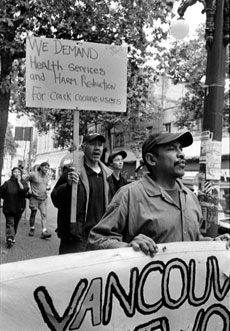
Fighting drug addiction, it seems, is addictive. A year after opening North America’s first safe injection site for heroin users, Vancouver is expanding hours, arranging prescription heroin trials, and hoping to add a safe inhalation room for crack users. Not only are Montreal and Toronto looking at opening their own safe injection sites, but so are smaller cities, most notably Kamloops and even tourist-quaint Victoria.
“People see Victoria as paradise,” says mayor Alan Lowe in an interview with The Tyee. “But in the last 20 months we’ve seen a lot more IV drug users shooting up in parkades.” Business owners and citizens are asking for a fix, and Lowe wants to find one.
Victoria is no stranger to confronting the idea of addicts, as 10 years ago it founded the first needle exchange in B.C. Lowe says they have developed their own “four-pillar” approach—prevention, harm reduction, treatment and enforcement—and are ready to move forward. The chief of police, a key ally, is on side.
Small cities, hard core problems
In the spring, a Vancouver delegation visited Victoria to talk about the safe injection site, which receives 600 visits a day. Recent Canadian Medical Association and Vancouver Coastal Health Authority reports show that it gets addicts off the street, improves public order, prevents the transmission of AIDS, hepatitis and other diseases, and saves people from overdose deaths.
Lowe says the city is considering smaller but multiple sites, and they recently applied to Health Canada for $50,000 to do a thorough consultation. “We don’t know when we will hear back, but we are lobbying them to make sure they’ve heard our cry and see our need,” says Lowe.
The smaller cities are just beginning to recognize their need. “We do have an active drug-use problem. It’s grown so that it’s much more visible. People are finding needles in back alleys and parks,” says Kamloops mayor Mel Rothenburger. “However, this problem isn’t any more acute in Kamloops than any other interior city.” (See the Tyee article ‘B.C. North a Hot Zone for HIV’ on Prince George’s heroin woes.)
“We know what we’re doing now isn’t working, so a safe injection site is something the city should discuss.” However, he says that there are no specific plans for consultations, though he is willing to take cues from the Kamloops Community Action Team, which includes street nurses, the RCMP, and the AIDS society. Rothenburger says that he believes Vancouver’s safe injection site is reducing harm to drug users, but that doesn’t mean Vancouver’s version will work for the people of Kamloops. “In fact, I don’t know if they will want something this controversial,” he says. “It wouldn’t advance very far without the community buying in.”
Harm reduction evangelist
If British Columbia towns are considering safe injection sites at all, that may be in large part due to the efforts of former Vancouver mayor Philip Owen, who in the last two years has toured the province from top to bottom (as well as visiting the rest of the country) with documentary filmmaker Nettie Wild, promoting Fix, her chronicling of Vancouver’s drug problems and “harm reduction” activism.
On the road, Owen speaks to every mayor, and tries to ensure local politicians make the screening. He has seen many transformations along the way.
“When we went from Prince Rupert to Prince George, Terrace did not want anything to do with Fix. Six months later, they phoned and asked us to come,” says Owen, on the phone from his second home in the Okanagan. “It was the same with Merritt and Kelowna. At first, they were in denial. But six months later Kelowna’s mayor phones up and says he wants to talk about the four pillars. He set up a mayor’s forum and 250 people showed up!” Other victories were surprisingly easy. “Penticton is a retirement town—but the theatre sold out, and we had to arrange a second showing,” he says.
Not every town is coming around. “Though Nanaimo has a huge [heroin] problem, no politicians came,” Owen says. “There is no political will there right now to deal with it.”
Campbell pushing for more
In Vancouver, there is no shortage of political will—two years ago, mayor Larry Campbell rose to power on a wave of outrage about the apocalypse of the Downtown Eastside. Sitting at the conference table of his large, wood-paneled office in Vancouver’s City Hall, Campbell says he will not rest on his laurels. There is more that could be done. “We just started expanding the hours of the safe site on Welfare Wednesday,” he says. (The site is usually open from 10 a.m. to 4 a.m.) There are no plans to open any additional sites but, Campbell says, “I would put one in Kerrisdale if it was needed.”
Campbell says he is most excited about the upcoming clinical heroin trials, which will be overseen by the Canadian Institutes of Health Research in Vancouver, Montreal and Toronto. The study will target hardcore addicts who have failed two or more times to get off heroin through methadone. Also, Campbell is pushing for a “safe inhalation” room, where crack users could get clean equipment, in the existing heroin site—and in fact the room exists, but is presently used as an office.
The glitch: since doing crack is illegal, the site needs an exemption under the Controlled Drugs and Substances Act from the federal government. Viviana Zanocco, a spokeswoman for the Vancouver Coastal Health Authority, says they have drafted a preliminary request letter that they plan to send to Ottawa shortly. “But I honestly don’t think they will grant us that until the three-year trial period for the safe injection site is over, which will be two years from now,” she says.
Face off with U.S.
Even if some of these radical treatment ideas are located safely in the future, enough has gone on to get the United States in a tizzy over the Vancouver experiment. When the safe injection site first appeared on the horizon two years ago, U.S. “drug czar” John Walters came to Vancouver to express his outrage and make his threats. In a private meeting with then-mayor Philip Owen, he said crossing the border would be a nightmare for Canadians if the city went ahead with its plans, as they ran counter to U.S. drug policy (which is arrest, arrest and arrest).
“It was the most unsatisfactory meeting of my life,” Owen recalls. “The pressure was intense. John Walters had about 30 officers with him, special agents. At the door there was a guy with the bulge of a gun under his clothes.” Larry Campbell was also present at this meeting, and he hasn’t forgotten about it. At an international harm reduction conference in Melbourne, Australia, this spring, Campbell countered to the effect of “Let’s see how they like it if we shut down our border—they’ll be thirsty in the dark in L.A.” The applause was deafening.
Meanwhile, John Walters stands firm. “The only way to reduce the suffering of addiction is to treat it, not encourage it—which is what the safe injection sites do,” says Jennifer Devallance, a spokeswoman for his office in Washington, D.C. “Canada’s drug policy is Canada’s business,” she allows. “Until the impact flows over into the U.S.”
Them’s fighting words. “It has broken down to the U.S. against the rest of the world,” Campbell says. He insists that the American crackdown causes more drugs to be brought into Canada than vice versa. “Anyway, they can’t do anything to me,” he says. “Or Canada.” He smiles. “We’re tough, and we have 4,000 miles [of border] to retreat to …. It’s a brave city that accepts what we’re trying to do. It demonstrates the compassion and caring of its citizens.”
Part 2: What’s the U.S. Drug Enforcement Agency doing in Vancouver?
Vancouver based Alisa Smith has written for the Globe and Mail, National Post, Ottawa Citizen and Vancouver Sun. ![]()


29
Login or register to post comments
Bailey (not verified)
7 years ago
Very telling article. The attitude of John Walters represents the true cause of the ballooning drug problem in the western democracies. Drug enforcement has only one successful attribute; competition control. It guarantees high prices and virtual monopoly markets for the established drug cartels,and continued power for law enforcement bureaucrats.
It gives excitement and a certain screw-you defiance to users that is very attractive to them, but no deterrence at all. It prevents rescue or treatment of people at risk, or already damaged by drugs. It prevents quality control, risk management or any other sane approach to the problem.
I have to ask why? The strategy is insane, will never achieive it's nominal goal, couldn't be designed better to assure it's own failure. So, why? Are the authorities really so blind or stupid that they would fail to notice utter failure for seventy years? They don't seem blind or stupid.
I applaud the belated beginnings these sites represent. I hope our governments can resist the opposition they will get from Mr. Walters and his ilk and carry on with their efforts.
brutal bobby T (not verified)
7 years ago
Safe injection sites as 'harm reduction'? Bull! If anything, it's 'harm promotion'--Saving dope fiends from the negative consequences of addiction does them no favours whatsoever. And yes, unfortunately DEATH is one of the possible consequences. Let's take the money put into the black hole of SIS and put it toward abstention-based treatment.
allan (not verified)
7 years ago
Good thing we have these brutal bobbies to keep us on track. "Saving dope fiends from the negative consequences of addiction does them no favours whatsoever," he waxes ever so wisely. Like 'keeping the poor out of poor houses doesn't teach those malcontents anything about debt', or 'keeping prostitutes away from brutal johns doesn't teach these women they too don't count in some people's eyes. Thank you Larry Campbell for not hiding your head in the sand because some voters may think harm reduction is "controversial". Of course it is and so is pretending it doesn't exist just because you might lose a vote or two. But rather than focussing on the "controversial", I just wish my mayor in Kamloops would understand his job is to lead rather than follow by focussing on the "harm", which, once you accept it as a reality, should naturally lead to an effort to reduce it. We need real leaders rather than politicians who are afraid to pull back the curtain.
The Grim Reaper (not verified)
7 years ago
Hooray for brutal bobby T! I'm all for his approach, speaking in my professional capacity as The Personification of Death Itself, I say we arm bobby with deadly weapons and let him wreak his own visionary version of harm reduction on everyone! The victims aren't worthwhile at all, hardly human, so what's the loss?
Besides, people like the idea of having the power to dispose of those who can't defend themselves as much as they like sucking up to those with the power to dispose of themselves.
deeby (not verified)
7 years ago
Hey brutal bobby, are you involved in the Surrey School Board's proposed abstention-based sex education proposal as well? "Just say no" was certainly a brilliant success south of the border; just look at their stats regarding addiction. I suggest that you're not only a troll, you're a fool....
As for the 'negative consequences of addiction', harm reduction also refers to reducing the amount of harm to society as a whole, not just the addict.
Safe injection sites and free clinical heroin will not only save addicts' lives, they will help prevent the spread of HIV and Hepatitus, they will help control the cost of our ICBC premiums, and save us tax $$ by not having to scour the alleys cleaning up used needles.
Tha Geek (not verified)
7 years ago
Anyone can plainly see that the situation requires drastic measures. Whether or not you agree with the morality of a safe injection site is a moot point, it's time for us to try anything to help these poor people.
trew (not verified)
7 years ago
addicton I THoUGHT WAS A MEDICAL PROBLEM. THERE IS A VENIPUNTURIST INJECTION DEVICE THAT WITH OUT A NEEDLE INJECTION UNDERHIGH PRESSURe BLOWS DRUG,ETC. UNDERSKIN. It's cost is not prohibitive since it can used over and over, why not get trained peole to inject this addicted to minimize harm from hiv/aids hepc,etc. Drugs could be procured by m.d.'s, and persriptions could be filled at clinics free by the gov't. Thereby eliminating the profit motive , turf wars, snitching on one another to police etc. the whole gamut needs new vision. WHY OH WHY DOES THE GOV'T. GIVE MONEY TO ADDICTS? MONEY THAT ONLY GOES TO THE DEALERS ARE THE BUREAUCRATS THIS STUPID? or what. Bust up the myth that addicts are not sick but made achoice to do it.
brutal bobby T (not verified)
7 years ago
Nobody (at least not me) said addiction wasn't a sickness. X-mayor Owen is a fool who came under the thrall of VANDU deadbeats---Mayor Larry is no better--he parrots the opinions of the last person he spoke to....BTW, in case you didn't guess, I'm also against needle exchanges--ask the people of the DES if the drug plague has been eased in the slightest degree by these misguided dupes. Why do you people so under-rate what other people are capable of? I want to see dope fiends clean up & become useful citizens, not remain walking zombies. Recovery is a simple process, but it ain't easy.
Sue Clark (not verified)
7 years ago
And, bobby, while the addicts are making efforts to detox and kick the habbit, they have a safe place to inject for the times when they do have relapses. They will have relapses since they are addicted for life just like for alcohol or tabacco.
IQ 86 (not verified)
7 years ago
I think brutal bobby is right. Let's round up the drug users and sit them in jail without access to their drugs until they get clean. When they sober up, ship them out of town to work camps where they'll learn the value of a hard day's work. Nothing gives a man a sense of pride and accomplishment like a full day's work (on a chain gang). At every meal there will be strictly enforced religious re-education. After six months of unpaid labour a worker can apply to leave the camp. He is given $250 and told to find work within the month. If he fails, it's back to jail--one strike and you're out. Back to the work camp until you shape up.
Ken from Kamloops (not verified)
7 years ago
Harm Reduction methods not only reduce harm to the community,they save thousands of dollars in health care by reducing overdoses as well as absesses and other ailments that result from unsafe injections. Perscription Heroin would take the profits away from the gangs that currently make millions on the black market, not to mention it would reduse the murders and beatings that result from turf wars. Property crimes will drop as the addicts won't have to steal in order to feed their addiction. Harm Reduction will do exactly that, REDUCE HARM, for the whole community, not just the addicts
Ted (not verified)
7 years ago
The senior level of government makes it illegal to use or possess these nasty drugs. The junior level of government enables these poor souls to continue their addiction and wretched existence. Is the good mayor Campbell breaking the law by helping these addicts break the federal law? Where is that disgusting little fellow Randy White while all this is going on? Mr White should wear his white stetson and help enforce the federal laws he claims to respect so much. After our leaders vote themselves another raise, they should look at this mess and revise their archaic laws, or start enforcing them.
David (not verified)
7 years ago
Many sensible comments have been made to justify "harm reduction"-- but I'm always surprised that it needs justification. Surely if all harm from drugs were removed, the problem would be solved, wouldn't it. Seems obvious, but then it mustn't be: brutal bobby writes "Saving dope fiends from the negative consequences of addiction does them no favours whatsoever" -- what are the laws trying to achieve? The fact the special interest groups and their spokesmen such as John Walters see a crisis in solving the problem rather than expanding inforcement is, on the other hand, quite unsurprising. Remember taxes for you and me == wages for John and his fellow feeders on the misery of drug users.
allan (not verified)
7 years ago
David, interesting how this all gets back to your taxes. Put away your investment statements, turn off the calculator and pay attention. Despite the good news about harm reduction, after decades of bad press about Vancouver as the mean, bleak end-of-the-road for so many, people like you and John Walters still don't get it.
Sue Clark (not verified)
7 years ago
A doctor friend of mine who works in addictions research told me that "for every dollar spent on harm reduction, $4 less is spent on hospitalizations" Anyone out there who can verify these numbers?
brutal bobby T (not verified)
7 years ago
Some excellent points, IQ86!! I think a year would be minimum for the necessary re-programming, not six months. We could dispense with the chain gang, although there would be a requirement to earn one's keep. I would steer away from the 'religious' aspect somewhat as well, and have daily speakers and intensive group therapy as well. Don't forget the weekly urinalysis!
Stuart (not verified)
7 years ago
PS--ANYONE WHO KNOWS ANYONE IN SURREY PANORAMA RIDGE SHOULD MAKE SURE THEY GET THEM TO THE POLLS FOR THE BYELECTION TOMORROW, THIS IS IMPORTANT, WITH THE BC FIBERALS WITH ALL THE MEDIA IN HAND WE NEED ALL THE SUPPORT WE CAN GET....MAKE SURE THEY NOTE NDP..
David (not verified)
7 years ago
Alan...In what sense does it all get back to taxes? I mention taxes for a good reason, I think. Many of those who seem reflexively dubious about the efficacy of government interventions and uniformly treat statements from policy advocates (e.g. environmentalists) as covert efforts to raise funds for themselves, somehow manage to listen to advocates of more drug law enforcement intervention with a straight face, and worse to support endless additional funding despite the enormous failure of present practices. Why? Surely the "war on drugs" is as large and costly failure as any other government program you can name, including Fast Ferries. I think reminding reluctant supporters of reforms of this inconsistency is perhaps part of the solution. All I desire is that they ask to see evidence to support positions, and I think harm reduction will win on the merits. Anyway I'm not sure what I don't get. Re-read my post, which could have been clearer no doubt. I await reply from someone willing to provide reasons why reducing harm would somehow paradoxically make users worse off; I've heard this stated before, but really don't see the logic. Hence my question. Then I added, off topic, a warning about listening to self-interested advocates seeking your tax dollars. I notice the very next poster mentions the potential savings from shifting focus -- so maybe Alan you have some higher motive (there are plenty), but why dismiss a sensible argument just because it is not the whole story? Why not remind readers that John Walters and his ilk are promoting a failed program to their own benefit, and that this explains their hostility to experiments open to disprove their dire warnings. Why does this logic require a calculator?
allan (not verified)
7 years ago
David, it doesn't require a calculator and I apologize (I'm doing lots of that these days) for misreading your thoughts. My initial reaction to your post was the thought that you were too deeply inbedded in your own day-to-day finances to get beyond what this was going to cost you personally. That obviously isn't what you meant to say as is evident in your last posting here. I guess it's time to get on my bike and burn off some of this fog and then try a little harm reduction myself by putting my glasses back on. David, you are right. John Walters and his ilk are a bad drain on our taxes.
Ron Yamauchi (not verified)
7 years ago
I think that the debate about safe injection could be improved by a reiteration of the goal, which is harm reduction, not harm elimination. A sterile needle merely reduces the chance of secondary infection. I'm sure we all agree that the contents are still very dangerous for the user.
Bailey (not verified)
7 years ago
Just before the second war, prohibition was repealed, removing a huge income from Sicilian-American criminal 'families' who had established a monopoly position supplying booze to the entire US.
During the war the American Military Intelligence community recruited many Sicilian Mafiosi such as Joe Bonanno to prepare a welcome for American troops who would 'invade' Sicily to open a second front in Europe. This 'invasion' went so well that in at least one case it was reported that the troops were met by the mayor and town band, showing respect to the Mafia's request. The Intelligence community was very impressed and rewarded the Mafiosi in question by releasing them from jail and returning them to their homes in Italy after the war. They maintained those relationships and continued to be so closely allied to the underworld that it has become difficult to tell them apart. And underworld interests now require that nobody ever repeal the prohibition against drugs, which have replaced booze as the cornerstone of the enormous fortunes made at the cost of millions of lives ruined.
This is the only theory I have ever been able to see that could begin to explain the American insistance on maintaining this disastrous seventy year failure of a policy of theirs.
David (not verified)
7 years ago
Bailey -- I agree that "prohibition" funded the crucial organizational stages of US organised crime, an organization that outlived the law itself. Once founded, it used its structure (and in particular violent gang tactics)to pursue illegal gambling, tax fraud etc. I am certain we are making the same mistake now in Canada, handing billions of dollars to a group of people who I can only view as violent, low-life scumbags. Seems an odd policy choice, given the historical evidence. To what extent there is or was a "deal" with old line mafiosi I can't testify. No doubt the Hell's Angels are not advocates of legalization. Earlier I asserted that the law enforcement agencies have motives for continuing the failed approach also. But I do think there is another explanation for the "keep digging" metality following 70 years of ever worsening results: social control of "undesirables". Some police are (perhaps inadvertently) quite open about these motives: e.g. the new "safe streets" laws were greeted by at least one police spokesperson *not* as "at long last we can stop these attacks on innocent passersby" (we have assault laws to cover that), but as "another tool" to deal with recalcitrant street people. I live in Victoria, and am always surprised by the fantasies of danger on our streets I've heard from otherwise reasonable people, based solely, as far as I can tell, from the shabby appearance of a few young adults. So this is popular. Race is another factor, perhaps the most important in the US, where the focus on stopping African Americans from "harming themselves with drugs" was certainly intensified if not wholly initiated after the demise of Jim Crow. Sceptical? Go search for "Janey Cannuck", importer of racist drug policy, and try to realise that some people still think that way. And alas, the majority react in instinctive fear, even if they can convince themselves they are not racist. (Since the drug laws are supposed to be colour blind.) This only works because of selective enforcement, anathma to any true believers in the rule of law. Examples and evidence abounds, but prison populations are perhaps the best measure. Anyone who thinks that the multibillion dollar drug trade is funded by the worn down heroin addicts milling around downtown is arithmetically as well as morally and logically challenged.
Bailey (not verified)
7 years ago
David, all that is undoubtedly true, but I would argue it falls into the secondary category of mechanics. The policy is not explained by the abuses it allows. The fact that bigots and abusive officials love to have 'tools'is anciliary, not causal. There are always bigots, and thay will always find a way to abuse somebody.
Most of the arguments we will be hearing here will be basically Darwinian. Death will cure their addictions, they weren't fit to survive anyway, there is such a thing as free will, etc, etc,. The victimizer's laments to justify the condition of the victims.
The ultimate expression of Darwinian thought as social policy was of course the Eugenics Movement of the twenties and thirties which began with forced sterilisation of 'defectives' and ended in the gas chambers of the third Reich. A thoroughly discredited and dangerous way of thinking.
Of course, the goal now is no longer racial purity, but something else, political purity, or financial purity or some combination of the two. The crime of the victims is compound, and has two parts:
First, they are defiant of authority, they think for themselves that the state has no right to dictate, and they will decide what uses to put their own brains and bodies to. And so they are caught up and addicted.
Second, and more heinous, they then become poor and powerless, and that more and more is the crime for which they are condemned. In BC lately, to be poor is unforgivable. The poor have no civil rights, no right to live, to be in the public places, to be fed, or sheltered from the cold and rain, to medical care, psychiatric care, clothing, or protection from those who ache to find somebody to abuse. From the 'tools' of the BC government.
There's an old saying "To know what a thing is, watch what it eats". A good way to judge a government or any force really, is by how it behaves toward those who are in it's power. Those with no means of defending themselves. The BC government thinks of nothing but money. It's their faith, their weapon. their love and their truth. No other need apply. So they oppose these treatment strategies unless financial agruments are brought to bear. But the BC government represents only a small minority of wealthy like minded people, and the rest have other priorities they can't understand, and those people are not entirely penniless or powerless, so we see these programs start up and struggle without official support as long as they can. I find hope in the idea that these ideas are spreading despite the obstruction placed in their way by 'tools'.
American (not verified)
7 years ago
The world needs to know that not all Americans support the political insanity of our country. People like Johns Walter & Ashcroft do not represent what the average American thinks. Our politicians are a danger to the world and the demon bin Laden has given them carte blanche. So look out world! Telling you how to deal with your drug users is only the beginning.
trew (not verified)
7 years ago
thanks Bailey for truely riveting reading.esp.on oct27 I had not pointed out as you stated the effects of addictive culture ,loss of full life,mea culpa. Additional it should be realised that house insurance rates esclate into the stratosphere eventually [this is a Manhattan experience].Legal action on a class action scale was required to effect some relief to home owners when the NYC after 1990 had a drop in crime rate. Will a repeat performance grant windfall profits to insurers in Vancouver/victoria ? Yet to be noted in the press. Wholesale purchase of heroin/cocaine will reduce crime no doubt about it. Medical perscripted / injected drugs will reduce harm. A close acquaintance says he can get by on a maintenance level of heroin,and needs very little to "float along"[ not feeling desperate i think he means]. I donot advocate work camps /indoctrination camps, i actually think the writers of that slant must be playing the devil's advocate stance.Very few visitors to "insite" injection establishment have opted for cessation treatment[72 perons i understand] We must get over the idea that these addicted folk are the author of their own misfortune many dealers need the addicts for income plain as that.
Bailey (not verified)
7 years ago
Rereading David's post above here I begin to wonder. This idea of 'social control of undesirable recalcitrant street people' Let me offer some historical connections and see if I can make a point. It may be a bit of a stretch, so please bear with me.
When the Kennedy brothers and Dr. King were murdered, it was widely believed by certain segments of society that it amounted to a coup d'etat by certain reactionary, largely southwestern interests, known collectively as the "military industrial complex", or "the man". The war in Viet Nam had been exposed as corrupt and morally bankrupt, and these same segments of society were convinced that these honorable leaders were killed because they wouldn't go along with it; the war, the status quo which provided huge profits and power to the military establishment and war industries. They, the dissenters, resented it.
While most Americans went baa-ing along the path they were being led down, a growing number insisted on thinking. Seeing and deciding things for themselves. Disenfranchised blacks, who contributed disproportionately to fill the thousands of coffins streaming back from Asia. Students, alive in the world of ideas and information, with resources for seeking truth. Young working class whites who believed in the principles of Democracy and freedom, and were willing to insist on them and fight for them even against their own government, who they felt were in fact criminals and usurpers.
Things deteriorated. Demonstrations were held all over; campuses, the Pentagon. American troops fired on American students in Ohio. The slums in several cities were burnt by their own residents, who rioted in protest among the burning neighbourhoods. A corrupt president fell and the dishonourable war was ended.
I point out that those neighbourhoods that burnt are the same ones where drugs are now rampant. That these same groups are the ones who are most highly addicted. That the drug policies under discussion originated or at least were organised in those places at about that time.
And that nobody has burnt a slum or successfully opposed authority since, although the actions of authority are still at least as morally bankrupt and corrupt as they ever were then.
Mordred (not verified)
7 years ago
Get a clue on drug use! I have friends who have been on drugs for 15 years and they have never commited any crime for their partying. It's paying bills first, then after all is taken of they will go out once or twice a month and party for the evening. Not all people who use drugs are criminals.
American (not verified)
7 years ago
Mordred must not have any hard core heroin addicts, the drug is 1st. I applaud Canada for trying a new approach, the U S does not understand that they are not stopping the flow of heroin, etc. and only making the dealers richer, and the vulnerable public more at risk. When their children succumb to the dark depths of heroin addiction maybe they will open their eyes.
Cranbrool Guy (not verified)
7 years ago
is there anyone against these houses of crime?