- Ms Kaye is a Tyee Builder. You can be, too.
- Mary Carlisle is a Tyee Builder. You can be, too.
- Prem Gill is a Tyee Builder. You can be, too.
- Nancy Flight is a Tyee Builder. You can be, too.
- Justin Everett is a Tyee Builder. You can be, too.
- John Westover is a Tyee Builder. You can be, too.
- Nora Etches is a Tyee Builder. You can be, too.
- Edward Henderson is a Tyee Builder. You can be, too.
- Bharadwaj Chandramouli is a Tyee Builder. You can be, too.
- Dean Chatterson is a Tyee Builder. You can be, too.
- Marius Scurtescu is a Tyee Builder. You can be, too.
- Robert Parkes is a Tyee Builder. You can be, too.
- James Murton is a Tyee Builder. You can be, too.
- Susan Doyle is a Tyee Builder. You can be, too.
- Vincent Strgar is a Tyee Builder. You can be, too.
- Helen Spiegelman is a Tyee Builder. You can be, too.
- Subir Guin is a Tyee Builder. You can be, too.
- Kimball Finigan is a Tyee Builder. You can be, too.
- Joanne Manley is a Tyee Builder. You can be, too.
- David Leach is a Tyee Builder. You can be, too.
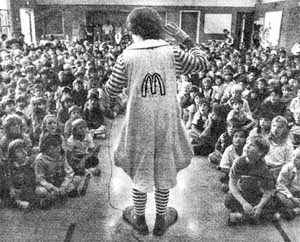
Do Corporations in Classrooms Hurt Kids?
Psychologists say alliances with companies might fill schools’ coffers, but jeopardize students’ well-being.
Corporations are heading back to school, armed with sponsorship deals and merchandising opportunities. In Surrey, there’s the Bell Performing Arts Centre, the auditorium for Sullivan Heights’ Secondary, with its BMO/Bank of Montreal Balcony, and RBC sound system. Over in Coquitlam, Burger King, Pizza Hut and Subway serve up kids’ lunches in the cafeteria. And in schools throughout the province, Scholastic Book fairs are held to fatten up shrinking accounts.
A growing chorus of researchers, however, caution that the corporate presence in schools is associated with long-term damage of children’s educational, psychological and physical well-being.
These critics contend that corporate money is a quid pro quo, intended to capture the allegiance of thousands of potential customers, most of them too young to own a credit card, but not too young to be branded for life.
‘Everything is for sale’
Corporations portray their presence in the schools as benevolent. In the words of the BMO/Bank of Montreal, corporate largesse is given “to ensure that Canada's regions, towns and communities remain strong and vibrant.” School board policies around the province characterize education-business partnerships as a carefully monitored “win-win” situation, that does not allow commerce to exploit students. A typical example is the one adopted three years ago by Surrey: “The Board encourages corporate and community sponsorship as a means of enhancing learning opportunities for children and building citizenship in our communities.”
Doors that remained closed to corporations are being cracked open by tight budgets. Some districts now raise as much as 16 percent of their budgets through “local fee-generation,” the euphemism for money raised through business arrangements of various sorts rather than taxes. Cheryl Quinton, spokeswoman for the Coquitlam School Board observes that commercial relationships are “a help,” because “obviously there are some parts of education that are not being funded as liberally as they were some years ago.” Turning to the private sector to keep schools afloat has been tried by chronically under-funded American public schools. Susan Linn, who teaches psychiatry at Harvard Medical School, has studied how these public-private relationships affect children’s well-being. She says relentless exposure to all kinds of marketing messages—from the Coke logo on a gymnasium scoreboard to the promotional literature for Scholastic books—inculcates materialistic values in children. “What children are learning is that everything is for sale,” she says. “They’re immersed in a culture of materialism and adopt the value that things can make them happy. And what researchers are finding is that that’s not true.”
Learning about happiness
Tim Kasser, a psychology professor at Knox College in Illinois, is one of these researchers. Kasser and others have surveyed hundreds of American students, most of them 12 years old and up, with a set of questions aimed at establishing the student’s primary values. Students are asked to agree or disagree with statements such as: "I'd be happier if I could afford to buy more things" and are asked to choose, for example, whether the purpose of life is to be rich or to contribute to the world. The same students are given a battery of questions aimed at measuring their level of happiness and satisfaction with life, and researchers draw associations from the findings.
“We know from scientific research,” says Kasser, “that when kids are presented with the kinds of messages that you typically see in marketing, they come to believe that money and products will provide them with happiness.” Children who adopt materialistic values tend to believe advertising’s underlying themes: that possessions, image, and status will make them happy, likeable, and successful. “The problem is that there are lots of costs associated with that value system,” Kasser says.
Happiness, for example. A person whose values are based on the pursuit of money report less happiness and fewer experiences of pleasant emotions, Kasser says. “They report that they are less satisfied with their life. They report less happiness with their life, fewer experiences of pleasant emotions. And then they report more things like depression, anxiety, being angry and upset more often—and on and on.”
He also says these people are disproportionately afflicted with symptoms of physical distress, such as sore throats, headaches, and sore muscles.
Critical thinking suffers
High school students who bank their happiness on material goods are likelier to have sex, smoke cigarettes, use drugs, chew tobacco, and drink alcohol than peers with an orientation to non-materialistic values, Kasser has found. Other researchers have found that serious psychological problems, from separation anxiety to conduct disorder are associated with the belief that the road to happiness is paved with gold.
Schools that open the doors to advertising-driven business may also jeopardize children’s education, Linn says. “Schools are supposed help children to think, and to think critically, to prepare them for life in a democratic society.” Instead, marketing depends on seducing consumers with invitations to heed emotional, not rational responses. She says the clamour of slogans like “obey your thirst,” legitimize self-indulgence, she says. That marketing seeks to manipulate youth to want a specific product is not news to the advertising industry. The guru of youth marketing, Martin Lindstrom, says success in the marketplace depends on framing products in the context of primal emotions like love and fear. He explains just how to do this in his recent book, BRANDchild, which comes with “action lists” explaining how to capitalize on the “emotional jet fuel,” of consuming kids.
Young ones ‘need branding’
It is an axiom of marketing that the earlier kids are exposed to a brand, the better chance it has of getting a toe-hold in the $2.6 trillion youth market around the world. Building brand loyalty while kids are at school has been known to be an effective long-term strategy since the 1960s, when psychologist Lester Guest showed that one quarter of consumers brand preferences were established in childhood. An advertisement by a youth marketing company in AdAge, a prominent marketing magazine, showed a cow being branded with a red-hot iron. The caption read: “younguns need branding.”
Linn observes that companies like Scholastic—the largest children’s book publisher in the world--value a relationship with schools “because they’ve got the kids trapped--and also because the school’s sanction gives it extra weight.” In BRANDchild, Lindstrom points out that school and other “cause-based” marketing “is not a charitable donation. It is a strategically-planned marketing effort designed to increase a company’s sales or improve its position in the marketplace.”
Most companies, however, cite different motives when explaining their presence in schools. Jill Briers, the director of book fairs for Scholastic, says her company’s book sales in schools are as “a literary event.” The 11,000 book fairs her company stages in 7,000 schools across the country bring “the joy of reading to students,” she says. “Because we all know, the more you read, and the more you enjoy reading, the better chance you have at success later in life.” The relationship is benevolent, not entrepreneurial, she says. “We see ourselves as partnering with the schools, as partnering with the teachers and the librarians, to bring a broad selection of books to students and at a minimum of 50 per cent that goes back to the school. It’s not commercial--like selling chocolate bars.”
Elementary schools are prime locations for marketers to build brand loyalty, especially if students are recruited to work for free for the company. Although teachers and parents organize Scholastic’s book fairs, children also play a prominent role, according to their promotional literature. “Students were responsible for setting up and running the Bookstore,” reads one information pamphlet, which goes on to say, “They were great at making recommendations to parents on books to buy their child.” Relationships like these, Linn notes, convey an implicit message that “helping your school means helping the company.”
Fast food teaches ‘choice’
Even organizations with a strong reputation for civic involvement, such as VanCity, are stepping into the school-based market. At Coquitlam’s Glen Elementary, VanCity tellers train and supervise grade five students who operate a “junior credit union” at the school, an arrangement Quinton described as “mutually beneficial.” The grade fives learn about banking; every child opening a new account gets a $10 grant from VanCity; and the school also receives a matching grant based on the number of new customers at the school. As for VanCity, it might get a client for life.
Some corporations have made inroads in schools that do not derive financial benefits from their presence. Coquitlam schools house Subway, Burger King and Pizza Hut in their cafeterias, but Quinton says the fast food is provided “more as a service,” not as a money-maker. Education, she said, “is all about choices and making informed choices. And food choices are all part of that. We have a full range of food choices in our cafeterias and these others are options. It’s like anything else in life, it’s consumer-driven. There’s a consumer factor in there that some of these choices are preferred by young people.”
Experts like Linn, however, challenge the wisdom of viewing education as a commodity and children as consumers. “I don't agree that everything else in life is consumer driven--what about love, friendship, spirituality, the natural world, or democracy? Children’s experience in school should certainly not be consumer driven.” Besides, she says, schools routinely make choices for children that are in their best interests, not because they are popular.
Linn also contests the idea that fast food in the cafeteria educates kids about decision-making. “How is having junk food available in school contributing to informed choice? Are the calories posted right next to the food? Are there charts prominently displayed showing how much exercise it will take to work off those calories? Are the food contents displayed prominently as well? Is the amount of money food companies spend advertising those particular products to kids visible? What about the health risks associated with obesity?”
Diabetes warning
Last week the B.C. Auditor General, Wayne Strelioff, sounded an alarm in a report on the staggering growth of diabetes II, an entirely preventable disease that costs the provincial health budget $750 million annually. That’s about the same amount that Burger King spends annually on advertising.
“As a society, we today enjoy the benefits of societal choices such as cheap and convenience automobile travel and easy availability of calorie-rich food—choices whose side-effects will lead to increasing diabetes in the future,” Strelioff wrote. Although he floated the idea of imposing a fat tax on junk food, Strelioff did not consider whether the financial value of junk food to schools’ budgets offsets the expense of diabetes to the health budget.
Linn is optimistic that the public has begun to grasp that multi-billion dollar food conglomerates in the schools are harmful to children’s physical health, and points to the move afoot in the States to get pop out of schools. But the invisible damage done by all kinds of marketing and consumerism to students is being overlooked, she says. What’s at stake is not just children’s “happiness, their capacity to function in a democracy, their problem-solving ability,” she says, but childhood itself. “There needs to be some place in a child’s life that’s not market driven.”
Judith Ince is on staff at The Tyee and writes frequently about education and health issues. ![]()


50
Login or register to post comments
Patti Bacchus (not verified)
7 years ago
Thank you Tyee and Ms. Ince for another well-researched, thought-provoking story. This is an issue about which I am deeply concerned. My kids have been bringing home Scholastic catalogues on a seemingly monthly basis ever since kindergarten. What do they beg for? Not the books - they want the glow pen, the charm bracelet, the pop-star booklet and other junk. When I say “no,†they whine, 'but mom, it's for school! You have to help the school!†At last year's Scholastic “Book†Fair, I watched as the students crowded around the trinkets table - overpriced book marks, shiny pencils, erasers and other stuff. They were not interested in the books. In fact, those buying books were mainly parents who were shopping from the classroom “wish lists†posted on the wall. Once again, here we go subsidizing under-funded public schools. And sorry to be boring, but doesn't this just lead to more inequities when families in some schools have significantly more disposable income than others? Should school library funding come from partnerships with massive corporations who use slave - I mean student - labour to avoid the costs of retailing (not to mention access to free, taxpayer funded retail floorspace, which at my school meant canceling strings classes for a week to make room for the fair)? And what about the appalling business of having the students “preview†the sales during school time so they can go home and beg their parents for money? Captive audience indeed! In my neighbourhood we are lucky to have an independently owned children's bookstore with staff that are happy to spend time with each customer to find reading material that will make their kids fall in love with reading. It worked for mine. The stuff they've bought from Scholastic - with their own money - seldom has met their needs. Keep up the great work Ms. Ince. We need more of your stuff.
KS (not verified)
7 years ago
I hate Scholastic! The primary items my kids look at are the trinkets, the stickers, and the software -- the books are secondary -- which obviously misses the whole point! My little 7-year old went to school with her saved-up allowance money to buy trinkets at her school's annual Scholastic fair. I am appalled that my childrens' school administration supports running a store in the school. Our family frequents the local library and bookstore at times chosen that are good for our family -- I would like to be able to have power over those kinds of decisions, and not be at the mercy of salespeople at my childrens' school. Thank you, Judith Ince, for capturing the information in this story.
Burgess (not verified)
7 years ago
Walt Kelley's 'Pogo' said something like this "I have seen the enemy and he is us." In the past two decades the taxpayers 'us' have let 'them' the governments slash school budgets to the point of collapse. 'Us' keep electing anti-education/children governments who are in bed with corporations so what can we expect. Just look at the campaign funds the Liberals have received from corporations. The money has to come from somewhere for political parties and schools. The first two posts above sort of prove the point. Complain about the corporations and not a word about the political agenda that they have allowed to ruin our system of education. Perhaps both of the above posters could spend some volunteer time at their schools supervising book sales rather than complaining about the trinkets. The easiest way to solve their trinket problem is to put them up out of sight and out of mind. A few hours of their time explaining to children the lasting joy of a good book rather than a cheap trinket would really help their school's children. But it is easier to complain than be involved I guess. Scholastic would soon do away with the 'trinket' component if they didn't sell. As for the fast food in schools there again 'we' have allowed it happen by electing the very politicians who endorse what is happening. Look in a mirror ladies 'we are the enemy.'
Patti Bacchus (not verified)
7 years ago
Thanks for the advice, Burgess. Instead of volunteering my time for a corporation, I've directed my considerable energies and almost non-existent free time at lobbying my provincial politicians for adequate and fair funding to meet the needs of all students. I also give my time and efforts and (I like to think) skills to advocacy groups like Save our Schools (Vancouversos.ca) and Families for School Seismic Safety (fsssbc.org). Both are wonderful, volunteer-run, non-partisan organizations. In addition to that, I represent a parent group on a school board special needs advisory committee. For awhile, I also gave my time to chair a Public Education Advocacy PAC subcommittee at my children's school, until it was axed by parents who wanted the politics out of the PAC (see Ince's story on the Fundraising King). Oh, and there's the school literacy program, the crossing guard duty, the field-trip driving and all that other stuff. Then there's teaching my children to ask the tough questions and be critical thinkers. My daughter and I even have our own mother-daughter book club - she choses the books, we both read, then go out for dinner and discuss. In between I fire off lots of letters to editors, MLAs and at times, trustees and MPs. I would consider myself pretty involved and speaking out on public issues means more to me than complaining - I call it advocating. And by the way, I did not vote for these guys and my kids could explain why. Now I have to go help with homework…
Ragamuffing ... (not verified)
7 years ago
I also hate Scholastic, not just because of the overpriced shiny crap, but because their books are moronic. The picture books are garish and aggressive with ugly stories and uglier characters. The books for youths are mostly serials with banal characters and overworked shtick, as bad as any movie sequel.
Lenore (not verified)
7 years ago
Yes, thank-you Tyee and Judith Ince once again. That remind that on top of everything else I do as a parent, I have to send a note to the school board voicing my disapproval of these hand-outs. That especially includes an application for insurance that came home a few weeks ago with the acknowledgement that it came approved by the VSB.
I also want to know how much money the school boards receive for distributing and sponsoring these businesses.
GM (not verified)
7 years ago
I'm a shop teacher in the lower mainland. I have seen my budget drop to almost one half of the operating budget I started with over 9 years ago. I have seen the increase in the price of lumber double and triple. I have seen drafting software programs somewhere near $2000 per license (BTW I have 30 students in that class feel free to do the math) My equipment is over 35 years old, it is still in good condition BUT if they did falter and I need new machines.. there is "no dough joe". If a major lumber supplier or a machine /tool company wanted to sponser me...I'D have a real hard time saying no; imagine what my employer would say. I'm not defending the school boards here, I'm just saying that they take the path of least resistance.
Patti Bacchus (not verified)
7 years ago
I'm not blaming the boards — I'm blaming the provincial government. Teachers like you should have the resources you need to do your jobs without having to worry about materials and equipment. Far too many teachers subsidize education out of their own pockets and by giving their time for fundraising. It's time for the education minister to stop playing games with numbers and provide adequate funds so boards aren't placed in the awful position they are in terms of having to make deals with corporations to keep schools running. Who voted for that?
Julianne Doctor (not verified)
7 years ago
As much as I think the recent offerings from organizations like Scholastic are in large part glossy posters, shiny baubles, and some of the books have no literary merit, it outlines again the inequities schools face.With very few dollars directed at our libraries, Inner City schools may rely on scholastic to get some new books for the library. In some cases, programs for at risk youth are partially funded by corporate grants and donations. These are programs which should have sustainable government funding. It's a no-brainer. I will continue to lobby for adequate tax dollars to replace the resources children across the province deserve. We also have to watch out for the vulnerable children, and offer them hope where we can.
shirin (not verified)
7 years ago
"A person whose values are based on the pursuit of money...." - isn't that the basis of our capitalist society? It starts in the home - parents pay their kids for good grades and chores, kids watch commercials wear brand name clothes - and are accepted in "herd school" mentality. The olympic athletes with their branded tatoos - the race car drivers and our firworks - you can't escape from branding inside our outside of our schools because that is the basis and foundation of this consumer/market-driven society - even "no-name" is a brand name. However, before we spout our ideological perversions against such a distasteful influence in the lives of our children (and ourselves) - let us consider the words of the impressionable youths we are so scared of influencing the wrong way - a youth wrote into the Courier - as they had also covered the branding of public school topic: http://www.vancourier.com/issues04/102204/opinion/102204le2.html A voice of youthful reason, in my humble opinion. My last question is, who sponsors all this interesting research that is spoken of so enthusiastically in the article?
Chicken Slinger (not verified)
7 years ago
Taxes are supposed to cover what corporate donors so kindly step in to contribute. Businesses trip over oneanother - like parents at an Elmo door crashing sale before Christmas - to get their products and marketing magic into schools. If it isn't Channel One requiring teachers to keep the television volume up above a specified level during friendly Doritos or MacDonalds commercials - a stipulation participating Channel One advertisers demanded - for free audio visual equipment and a few measly bucks it's hot lunch choices being limited to Dominos Pizza or some other big brand junk because it's economical for students on a low budget.
These businesses that are so kind to step in and give kids their money are also the same folks that kick and scream their way out of paying the taxes that fund education.
We are responsible. We're responsible for the fund slashing at our schools because "Simon Says". The papers we read and the majority of the TV stations we watch also have close ties with big corporations and press their corporate perspectives, and will, on sucker parents who think that newspapers and six o'clock TV news are unadulterated sources for news. If teachers complain perhaps your favorite news paper will publish public responses that favor the corporate vision and include an article or two that subtly label teachers as whining trouble makers.
The problems run complicated and the problems run deep. Rather than immersing ourselves in running the show we let others do if for us. After all it's wrong to talk religion and politics. Right? If we are looking for good political perspective that will help us make decisions that are right for ourselves today and for our future we will find it in our trustworthy news papers. Right?
The social and economic gains that have been made in the past were never carried out by the folks running the show. The reason you don't see 9 year olds working in coal mines anymore isn't because the folks running the mines felt compassionate one morning. You don't see 9 year olds in mines anymore because people got together foght with blood sweat and tears to make sure that their grand children would never have to go through what they went through.
Lynette (not verified)
7 years ago
You may not see 9 year olds in mines but they are probably on farms, in store rooms and other hidden places in the British Columbia work force. Having read the Letter to the Editor referred to above, here are some thoughts. Branding is something that happens over a long period of time, not in a one shot deal. When coorporations use their name in a big way while sponsoring an event they are not branding they are advertising their product and their image. "Look how good we are by giving away all this money". That money they give away is most likely tax deductable. Less money going to our important public services. Do not confuse that type of sponsorship to those times that local businesses support teams, special events etc. Supporting your local businesses helps support the local economy and moves money within the system. (that all the economics I know). Lately there is evidence that youth are starting to ignore the overt advertising and so corporatate sector needs to develop new methods. The latest is to infiltrate the curriculum and make it manditory to study business in high school. Unfortunatly the materials provided are extreamly biased and misleading. Think critically and protect yourselves and your children from the hidden (or sometimes not so hidden) agenda of those that believe that money is the bottom line.
rockerbiff (not verified)
7 years ago
As someone who works in the post-secondary environment I can attest to some of the experiments that have gone on over the years in our universities. This university has dabbled with corporate sponsorship over the years with usually poor results. We had this area outside the gym called the "Labatts Court" no ever does anything there, except walk through it, that was a failure. Large corporations do contribute via university advancement, as do individuals and some of these donation are large [over $1million] sometimes there are tags on these funds, ie must be spent in a certain department or school, sometimes there are no restrictions whatsoever.I think it would be too much of a generalisation to say all corporate sponsorship is evil. The issue is the criteria the institution to make a decision on whether the demands of the donor are too much. For example the university has just worked out a corporate deal with Rogers to have exclusive cell phone rights here, in the past Rogers cell phone coverage here has been the worst of the three. So unless Rogers dramatically improve their service, their exclusive deal won't be very succesful. The scary thing about corporate sponsorship at the university level is having the government reduce funds at their end in response to increased funds raised from elsewere. We recently had all the advertising taken out of our bathrooms due to whim of the student society, does it make a difference ?I think the time has come that we do recognise corporate sponsorship for what it is and that is to gain access to markets; otherwise corporations would donate anonymously all the time.
The REAL barking mad fox channel (not verified)
7 years ago
Lynette, I read your response about child labour with some mixed feelings. Yes, children help out on family farms and orchards in BC and other provinces. In most rural areas, you will find children whose chores are done in conjunction with their studies, not at the cost of them.
I don't see the comparison to children working in mines, like those run by William Fernie and Crowsnest Consolidated in the earlier part of the 20th century, where families -- indentured to the company -- were coerced into sending their boys down the shafts. The youngsters worked in unspeakably dangerous conditions; fatalities ran at about one every week; they rarely saw daylight, and their schooling was considered superfluous.
I realize that some farms are pretty sophisticated these days with hazardous equipment, machinery and chemicals galore. But most of the children I've seen working in the rural area where I live are not given onerous work. In fact, I would be hard-pressed to describe a more wholesome and healthy upbringing for these kids with fresh air, fresh food, lots of physical activity and sunshine. It beats computer games anyday.
Patti Bacchus (not verified)
7 years ago
Science World recently struck a 15-year, $9 million sponsorship deal with Telus, and beginning in early 2005 the landmark will be known as 'Telusphere.' This depresses me. -
Burgess (not verified)
7 years ago
Pattie what can I say? Congratulations on your involvement in the schools. Keep working as you are doing and maybe we can make a difference to the liberal and exNDP bean counters in Victoria.
wab (not verified)
7 years ago
As a teacher, I worked through two NDP terms. The schools were subject to cut after cut, to the point of anorexia. Then along comes Christie the clown and dui Gordo - their solution is to put the public school system on a diet. I despise all politicians in BC up to this point. Our science budgetis now back at the level it was in 1994. Good job liberals and NDP. Not.
PRW (not verified)
7 years ago
What message are we sending our kids by "farming them out to the highest bidder"? It is disgusting to think that we are all so quick to mouth the words "Kids are important", or "Kids first"...but that's all this is...lip service. We will sell them out in a heartbeat all for the allure of more cash. " It's a good way to teach children about choices" says one apologist. Are we crazy? We give the "choice" of junk food after teaching them how important a balanced diet is...how hypocritical! Why not just peddle cigarettes? It's bound to be a money-maker! The end result is increased obesity and diabetes and we all wonder why our health care system is strapped. Wake-up call: this is NOT cost effective. The proof is in: commercialization is harmful to our children. As adults, we need to act like adults and protect our kids. Children are not yet capable of making decisions of this magnitude. If you ask a kid, " McDonald's or whole grain pasta?" or, " a classic book or a Ninja Turtle stuff toy?" What do we EXPECT they'll say? We, the adults, have turned our backs on our own future. The cause is obvious. We have allowed governments past and current to hold our children as hostages in the budget wars. They are the ultimate let down as it proves governments are turning their backs on the citizens to cozy up to the corporations. Right on Patti for your hard work to turn this around! To the NDP : If you should form the next government will you fully fund public education and legislate an end to commercialization of schools? To the rest of us: What role do you play in this mess? What can you do to stop it? Boycott it. Parents: go to your schools and demand an end to this or our kids will never forgive us.
KJ (not verified)
7 years ago
"what about love, friendship, spirituality, the natural world, or democracy..." --- "they tore my mother's tongue out me at residential school... they put another voice in my head that told me things my culture never heard before..." - anonymous survivor
John (not verified)
7 years ago
Simple formula cooked up and supported by government..Starve a public system of its resources...buy up the press ( Canwest Global )so you never hear about it except when it reaches its goal ...dependance on ( usually ) a foreign owned business to ( save the day ) where the only motive is profit on the heads of our children.Theyve done the same thing to health care. Dont buy this " long waiting list " garbage....It was CREATED by starving health care budgets..keeping beds closed..so lineups happen....." how do we fix this ? " they say? Oh ..heres some foreign owned companies to save the day!! We are all being had on a day to day basis..
JG (not verified)
7 years ago
I used to promote Scholastic books in my class of grade 3s but I don't anymore. I don't need the hassle and the kids who were ordering whether they were ordering books or not were the same ones most of the time and the others probably felt badly because they couldn't afford to buy anything. When delivery time came I felt badly as well. So, now nobody gets anything. And I'm happier.
anonymous (not verified)
7 years ago
http://www.corpwatch.org/ ~~~ http://www.corporatewatch.org.uk/ ~~~ http://www.corporateering.org/ ~~~ http://www.consumerwatchdog.org/ ~~~ http://www.bchomeschool.org/ ~~~ http://www.consumereducation.org.uk/
allan (not verified)
7 years ago
J.G. I'm happier now that I've read your post as well. Thank you for pointing out the obvious to so many who gripe and complain about this sad state of affairs. As a teacher you are a pathfinder for having the courage to simply put a stop to this consumer branding madness. My advice to the pro-capitalists pushing this consumer agenda in our schools would be to lobby even harder to your right-wing rabble in Victoria. Eventually you will get that dog-eat-dog, back-stabbing, money-grubbing consumer you want. Oh by the way, perhaps you should also lobby for more police and security staff in our schools to help deal with the growth in brash-young free-enterprisers who want to be millionaires before they leave grade school. I wonder, does dealing in trinkets and books lead to drug dealing?
Bob Smith (not verified)
7 years ago
Two things: 1) Judy, some of your credibility is lost to some of us when so many small typos sneak into your stories. The Tyee is a major news source and it should be able to do better at this. if the proofreading matched the research capability all would be better. 2) Type ll Diabetes is not as you say, "an entirely preventable disease.; Many people will develop type ll who never eat at fast food joints as many of their grandparents di who grew up before such "restaurants" were ever devised. While it is clearly true that serious overeating of fats and obesity increase the risk of Type ll Diabetes eliminating fast foods from our society will not will not eliminate the illness. A good article in general. The Capitalists seem to own our schools now so pervasive is their influence and advertising.
RickW (not verified)
7 years ago
Don't keep corporate donors out of the schools, if that is the only viable way to fund programs. But for every yin there is a yang, and required studying should be in something like the book & movie "The Corporation": http://movies.yahoo.com/shop?d=hv&id=1808565671&cf=p arentsguide Kids ARE capable of making decisions, IF they are given more than one side of the equation.
wellherewegoagain (not verified)
7 years ago
The federal governemnt has made a policy decision to match 50% of the research fund that universities raise from the private sector. No money from the private sector no federal funding... Grand? isn't it? Now for Rick W and some of the other brain washed population "if they are given more than one side of the equation..." to think that kids are capable of making decision, you guys are dreaming... 8 chikdren laterr and 7 grandchildren and 32 nieces and nephews, I have not experienced this child you guys are talking about... Children get out of school with so much crap in their heads and such barbaric behaviour and no critical skills... it is pretty screwed up. I permitted my children to go to school after grade 6 and I was appalled at the trasnformation they suffered. Within 2 weeks of my daughter being at Glashan, I heard her on the phone being absolutly obnoxious: I told her: "How do you talk like that with another person?" She replied: "If I treat people the way I like to be treated, I will be stepped all over by others, from the janitor to the principal. In school you have to be though." My 22 year old is back in school after a long hiatus. He said: "School is full of unhappy, unhingered people trotting their misery and distributing it to everyone, if they want it or not. I don't like to be with miserable people no matter what age.They just like shopping. How boring." So I have seeing, heard and witnessed and participated in protesting, complaining and got frustrated with the lack of response from officials. Schools are just a launching pad to corporatization of the citinzenry... And we are all accomplices to the destruction of our children's future in more ways than one.
allan (not verified)
7 years ago
Hey, Bob Smith. Is that a glass house you're living in these days?
beyond hope (not verified)
7 years ago
I had to say i concurr with john from a few posts up the page, that concept is the reality for so many things we used to have in this province, cut cut cut til the service can no longer fulfill even its smallest capacity and the next thing we hear is its not working under government scrutiny we must sell it off to the multi-nationals or to the private sector and our tax dollars must be able to provide help for these pirateers .. i mean privateers look at the latest examples of the health authorities, they are are willing to pay your tax dollars for the private comapny's profit and loss statements in the setting up of new facilities for seniors around the province, is anyone really surprised at the growing corporate influence in our schools, all helped and made easier by the new era gang in Victoria
Sara Smith (not verified)
7 years ago
I'm a high school teacher who is disgusted at the corporate sponsorship evident in British Columbia schools. A public system's needs will never mesh with the interest of the private sectors' dollars and greed. In my school's cafeteria, they sell McDonald's burgers and Pizza Hut pizzas! This is what school boards are offering your children to eat everyday! Who complains? Teachers. Why no parents? Because too few are actively involved in their children's lives and school community. Why? Too busy? Too busy for your kids? Then we wonder and gripe about consumerist values in youth and problems relating to health and obsesity! I urge parents to be informed advocates for your children in your schools and community. For too long we, as British Columbians, have accepted the short end of the stick for adequate and responsible educational funding in this province.
Daphne Neuman (not verified)
7 years ago
Sara, I am a parent who volunteers a lot in both of my chidren's schools. I try and advocate for them often. I would love to raise the issue of corporate involvement in our schools that is mentioned in this article because I truly believe it exists to the detriment of our children; however, in terms of my own family's needs, I also need to raise the issue of (a) the lack of support for my one child who has learning difficulties, (b) what I see as the lack of a proper number of Supervision Aides during recess and lunch, and a whole host of other issues that I find are important. Frankly, if I raised every issue, I would be seen as a "complainer", and thus, I need to pick my battles. So, I do agree that there is definitely a group of parents who choose not to volunteer in their schools, but there are some of us who are either too busy going on field trips, too burnt out, or can only pick the most important issues to deal with. As well, on a related note, I find that many of my "complaints" fall on deaf ears, so on some level I have to question the school's administrators, the School Board, and the government as to whether they even listen to parents at all!
Suzanne (not verified)
7 years ago
Back to Scholastic: Scholastic Canada's fall-back position when questioned on their marketing in our schools is "we bring the excitement of books and are promoting reading to school children -- and that is good." (This is paraphrased from a rep at their Canadian corportate headquarters, whom I spoke to.) So why do they sell toys???? Kids don't want the books, they want the toys. And under the guise of "book seller doing a good deed" we are letting them market cheap trinkets to schools across North America with NO ACCOUNTABILITY. It has bugged me for a long time, but when they started offering game boy video games, (which I noticed last year -- Book seller??? Yeah - right.) I started a local campaign to ban their catalogues from our local schools. The outcome was that Scholastic Canada said they would stop offering video games. I'd say all toys should be eliminated from their catalogues. Call them. Register your complaints with the marketers. They know they stand to lose millions in sales if we don't allow them in the schools. So lets get them to change -- play by our rules. It is just a small piece of this puzzle, but would be an achievable improvement for our children.
Patti Bacchus (not verified)
7 years ago
More on Scholastic: I have complained to my school principal about these catalogues coming home in my children's backpacks and the forced shopping (oops, I mean "previewing") at the annual Scholastic Book Fairs held in the school and coordinated by the taxpayer-funded librarian. It got me nowhere — yet. I even got my first Scholastic catalogue of the school year yesterday and resigned myself to making it a teachable moment with my children. (They're mad, but they're starting to get it.) And yes, I have earned myself a reputation as a complainer from this and my complaints about aggressive fundraising. Who cares — standing up for for what's right is more important than being popular, and sets a better example for our kids.
stephen buckley (not verified)
7 years ago
patti, keep it up. be a whiner. be a complainer. don't stop until all corporate control is out of public education: k-12 and post secondary. ban junk food from your classroom. write a letter to your students' parents telling them why. don't budge. no one can make you support it in your domain. * * * * the idiot teachers that may rag on you for being a zealot or unrealistic or a trouble-maker are essentially affirming that you have a moral stand on life and you believe in it enough to back it with your actions. so are they. their moral stand is to be white bread uncritical conformists and they can't stand when people rock their boat. * * * * you need to rock their boat, overturn it and scream at the top of your lungs that we are selling our students' souls and decision-making capacity to the highest bidder. * * * * as a teacher in coquitlam i've watched our subsidized "revenue losing" cafeterias turn into "revenue neutral" or "revenue generating" food fair divisions of the school profit centres. it's terrible. * * * * as a member of a university community i've seen ad-creep explode on campuses including classrooms sponsored by corporations. * * * * THERE IS NO ROOM FOR CORPORATE SPONSORSHIP IN PUBLIC EDUCATION. if there is, we aren't dealing with public education anymore. nor are we dealing with democracy, equal opportunity for success or universalism in our social values. we're all for sale. * * * * PUSH BACK!
Bonnie Christison (not verified)
7 years ago
I am an elementary teacher. How about the PAC fundraiser called 'Santa`s Little Gift Shop' that sells cheap trinkets for kids to buy as presents for friends and family? In our school, the parents set it up in the math/science storage room--for a 2 week period teachers have no access to the materials in this room. It is seen by PAC as an important fundraiser and a service to the children. They set up a time-schedule for children to make purchases DURING CLASSTIME as well as noon hour and after school. Children leave the classroom, one at a time, during their class' designated shopping period, missing part of a lesson or work time. We are an inner-city school. Our PAC works very hard to raise very little money in return. The teachers don't like this fundraiser, in fact we don't like most fundraisers. We see it as a distraction from learning, an inconvenience to the school and a shift from student as learner to student as consumer. But we have no say. And without fundraisers, there would be no class trips, no subsidized concerts, no science shows, no playground equipment, no team uniforms, no upgraded computer equipment, no school camera (digital, video or manual), etc. We already pay out of pocket for tons of things, from classroom libraries to crafts supplies, from stickers to storage equipment. We would probably be really whining if PAC stopped fundraising through corporate money-making enterprises. What we really need is better funding for schools.
stephen buckley (not verified)
7 years ago
. . . bonnie, what do you think would happen if you refused to allow students to leave class during classtime to go shopping at the PAC store?
Suzanne (not verified)
7 years ago
Bonnie: I think that is a terrible way to fundraise. I wonder if there is some kind of "Ideas for fundraising for PAC's" in existence. Parents at our school sell pizza for lunch one day a week (saves parents making lunch - we buy it from the local grocery store - Thrifty's and bake it and sell it.) It is a great money maker. We do an arts and crafts-oriented winter fest celebration to raise money from the school and local community and other things too. I guess if you teachers or an administrator could hand your PAC a book on other ideas you wouldn't seem ungrateful, but gently point them in a new direction. Again - I agree the bottom line is we need better funding for our schools. But we can change what is already in our court for the better in the meantime.
CF (not verified)
7 years ago
bonnie... been there done that... you name I sold it...meat, gift wrap, candles, pizza, chocolates, desserts, and one year bulbs... I hated every minute of and I was the Fundraiser..for a music PAC... I have also seen manure sales in the spring, poinsettas in the winter... by far the best one I was ever part of as a consumer was buying oranges and grapefruit in the fall for one school and mandarin oranges at another at Christmas, unfortunately I have never been able to duplicate those here. On branding... get used to it.. Send your child to a public post secondary and the book stores are filled with "branded" merchandise with the logo and name of the institution...everything from pens to teddy bears and clothes (and expect to pay big bucks for the clothes.) Many universities and colleges have embraced branded operations such as Subway, Starbucks, Blenz etc. as part of their food service options. Consider the private post secondary.Most private post secondaries are pretty discreet when flashing about their corporate names except one: the Art Institute or AI as it commonly referred to. Unlike most private colleges this one is based out of the US. This is your typical profit driven company rivalling the emphasis on $$$ instead of education. (I consider this the McDonalds of post secondary education) This company brands everything with its corporate logo: from merchandise (caps, pens, umbrellas, etc.)to the name tags that that the instructors are "encouraged" to wear... most don't.. ). Even the syllabus is branded. Don't forget at least one big AI somewhere on campus (usually in the reception area) and those really cheesy adverts. If it were possible to brand the instructors they would as well, but most being the creative type refuse to be pigeon holed into some sort of corporate clone... off my soapbox for now...
Bob (not verified)
7 years ago
You know what I think? I think people need to lay off. Let the corporations do what they want. It's not like the governtment is stopping them. "We're Democratic" right? Let's vote on it. But we're not gonna.
Ron Yamauchi (not verified)
7 years ago
I'm as knee jerk liberal as the next guy (you should hear me on the guitar, I know tons of union shit) but I have to wonder about this branding business. Surely the problem is not the logo on the food but the food itself. If the purchaser was merely to specify that the children should be served food with not more than x grams of fat, or whatever, then the vendor would do it, or not get the contract. I remember eating a shitload (that IS the right word) of university chow served by Beaver Foods. I cannot imagine how it could possibly have been worse if served by Nike, General Motors, or whomever.
allan (not verified)
7 years ago
Hey, I've got a fund raising idea for local PACs. Dart boards. Buy a couple of large trees, (the government's virtually giving them away, especially if you can impersonate a forest executive and promise to help finance a Deceive BC ad for these hucksters. Once you get the trees, slice them up into hundreds of one or two inch circles and then paste your favorite Liberal's mugshot on. My prediction is that they will sell like hotcakes. If nothing else, they might send a message to the premier and his minions that our education system is finally starting to educate taxpayers about politics.
Bailey (not verified)
7 years ago
There was a moment not too many years ago when I was filled with hope by culture jammers. There was an argument about who owns the space between a message and it's intended victims, excuseme audience. So if somebody inserts something, say paint or ink or images or messages between the attempt to brainwash, excuseme brand us, and our brains, then that would be legitimate comment and not illegal vandalism.
Where'd that go, anyway? The worst thing about this pathetic evil that these corps are perpetrating on captive children is the way it makes us take them seriously.
Doesn't anybody have a way to make them look as ridiculous as they are? Schoolchildren are still easy to amuse, and laughter is an effective weapon against overblown nitwittery like this. Hard to be branded by somebody whose embarrassing cheesiness is exposed. Hard to be an effective hardsell artist when the marks, excuseme target audience is laughing mockingly at you.
Ron Yamauchi (not verified)
7 years ago
The hip kids will mock and deface the logos and later on write scathing comments to online free news organs. No one else will notice.
Patti Bacchus (not verified)
7 years ago
"The Clifford The Big Red Dog series is part of a comprehensive brand marketing campaign, including home entertainment, consumer products, publishing extensions, such as television tie-in books, interactive media and consumer promotions, supporting Clifford’s position as a leading pre-school brand. " — Source: United States Securities and Exchange Commission Washington, D.C. 20549 Form 10-K Annual Report pursuant to section 13 or 15(d) of the Securities Exchange Act of 1934 For the fiscal year ended May 31, 2004 | Commission File No. 000-19860 Scholastic Corporation
beyond hope (not verified)
7 years ago
very good friends of ours called us up one night last year to tell us of their little boys first day in grade one.. very exciting for him next question? could we buy something? it goes towards the school we were told, the goodies i thought they were candy bars, were a coupon booklet the cost 35.00! the idea of a kid that young on his first day of shcool having to sell that thing with the veiled threat of your school might close made me sick, as a taxpayer im appalled at the actions of school boards around the province never mind the closures but to make each and every student a seller of merchandise from the very first moment you step into the class room!! perhaps we should be talking tax breaks and reductions here all the free labour being done for various merchants and corporations if you have a couple or three kids in school i think we should be rewarded tax wise for being good corporate shills
ERIC (not verified)
7 years ago
Bonnie, the inner-city elementary teacher several postings above: YOU DO HAVE A CHOICE! As the classroom teacher, you have full autonomy of how you deliver the curriculum to your students, regardless of how your PAC or administrator feels. Hurt their feelings. It's alright. I'm a teacher myself, and there's no way in hell that I'd let any corporate/ fundraising stuff into my classroom, despite the pop and junk food machines littering the halls. There's simply no way you can be forced to take your kids to some in school store. In fact, your science department/ staff could vote to shut the whole thing down. If your staff doesn't like the thing, then get together and do something about it. You have power. On the issue of fundraising, here's a proposition: Cancel all the book fairs, hot dog days, hamburgur days, and all that other crap, and just plain send home an invoice for the parents, asking for a cheque to cover the budget shortfall from the government. They can donate what they can afford or nothing at all, but at least their kids will not be used as pawns and have their bodies polluted. They also won't have the little cherubs bugging them to buy all that STUFF so that they won't feel left out. Parents get the heat through all these fundraising campaigns as well. As for the corporations who still feel in their hearts (like they have any?) that they must donate to a worthy cause, tell them to send a cheque to the Ministry of Finance. Sometimes we have to let the system crumble a bit before significant change occurs.
anonymous (not verified)
7 years ago
http://www.edwatch.org/
Kirsten (not verified)
7 years ago
If you would rather not see Science World - a childrens' educational centre - renamed to the meaningless corporate brand of "TELUSphere" in 2005, please go here and add your name and comments to this petition: http://www.petitiononline.com/telus04/petition.html A lso, please forward this URL to anyone else you think would be interested. Perhaps if there is enough objection, TELUS and Science World will be pressured into coming up with a more appropriate and acceptable title.
stephen buckley (not verified)
7 years ago
"Bob" said:
"You know what I think? I think people need to lay off. Let the corporations do what they want. It's not like the governtment is stopping them. 'We're Democratic' right? Let's vote on it. But we're not gonna."
PEOPLE need to lay off? wow. we're so bad, giving these corporations a hard time. let the corporations do what they want? i'm assuming bob hasn't seen/read "The Corporation." corporations maximize shareholder wealth at the expense of all else. we are their victims. we need to push back.
bu then bob might be right. the government isn't stopping corporations because governments are the agents/advocates of corporations. the fact that each year our municipal, provincial and federal governments charter and license corporations WITHOUT any social, moral, civil or criminal assessement indicates that our governments [that "act" on "our" behalf] are not interested in constraining corporations when they infect our lives and destroy our ecology.
whose fault is this? we can't blame the government. it's our fault for not making our representatives do what we want them to do.
but then bob's right about something. we haven't held our governments accountable for holding corporate psychosis in check. we don't vote for that. and as surely as 3.5 million more americans voted for that terrorist bush than kerry--the lesser of two evils--no time soon are we going to elect governments that will tame corporate greed and disease.
so unless we educate our society [starting perhaps with public school students] so that people like "Bob" see what's really going on in the world, "Bob" will be right: our democracy will continue to condone these pariahs.
Steve Coffin (not verified)
7 years ago
A great piece of writing with local examples too. I love the comments/ reponses. I only wish that I had your email addresses. We've started a new group called School Ads Alet. Please email us about any concerns or comments on this topic at:
. This is an action-oriented group consisting mosty of concerned parents at this time. We need to unite and pressure trustees across the province for tight wording on policy regarding corporations. We need to collectively demand for more funding in education. As a parent of two children at Lynn Valley Elementary School in North Vancouver I'm apalled that the students were just Home Depotized (they even learned a Home Depot song!) at school. We need your support and you could probably use ours too. Let's unite and stand up for our children! Listen to 690 CBC radio on Mon., Nov. 15/04 (6:00- 8:00 AM) for talk-back on this topic. Look for it in The Province newspaper on or around the same day.
anonymous (not verified)
7 years ago
http://www.commercialalert.org/