

 SHARE:
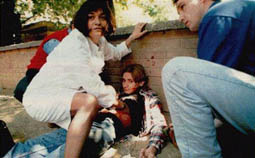
Almost no one in our country remembers the war in Croatia any more.
It was one of those civil wars in one of those far-off Balkan states, where Canadian troops and RCMP officers went as peacekeepers for a few years, and then things got sorted out. A new government was democratically elected, and then life went back to normal, didn't it?
I traveled to Croatia a decade ago, near the height of hostilities, visiting and writing about the work that B.C.-based troops and Mounties were performing in their peacekeeping role. At that point, there was not much peace to be kept. "More like peace-MAKING," I remember a Canadian NCO telling me, trying to maintain a safe distance between the sides that were trying to kill each other and trying to disarm as many of the would-be combatants as possible.
But even then large numbers of Croatians were scarcely affected by the war on a day-to-day basis. They lived in the big cities like Zagreb - block after block of grey concrete high-rise apartment towers - and the war was never carried to their doorsteps. The civil war in Croatia was mainly a war of the countryside, fought in just half of the country's 18 provinces, mostly in the rural areas of rich agricultural plains and vineyards. The towns that were affected were mostly small communities of brick houses, a compact commercial area, a church or two, a school, maybe a health clinic or a hospital.
Memories of devastation
During the war, the Serbs and the Croats chased each other out of those small towns. The marauding forces (sometimes it was the Serbs and sometimes the Croats) would then return to every building in a village to ensure that those who had been forced out could not easily return. Farmers who came back to harvest the crops on their small-holdings often put their lives at risk to do so.
But that was more than 10 years ago, so surely all those areas have been reconstructed now. Haven't they?
I have pictures of Croatia in my mind, pictures so indelibly burned there that I know they can never be erased. Those who should know say that's always true of those who visit war zones.
There is the hulk of a rattletrap old car, parked on the edge of the road near Pakratz, riddled by a total of 37 bullet holes. Its Serbian occupants were ambushed as they tried to return to their village. Canadian medics from the base down the road managed to save the lives of three of the four young men.
There is the hospital that had been the newly built pride of its community, reduced to a burned-out hulk, every window blown out. The enemy wanted to be sure that the other side could not treat their wounded easily.
There is the Romany gypsy family reduced to living in the middle of the town landfill, scavenging for survival among the detritus of a country at war. One of the few things about which the Serbs and Croats agreed was that the Romanies were lower-caste than either of them.
There is the elderly disabled couple whose house has been left standing - the only one in its village - out of pity by the enemy soldiers. The Canadian soldiers take them provisions, but the details must always remain secret for fear that the generals would never allow such compassionate exceptions to the rules.
Lingering terror
But nothing is still like that 10 years after the peace treaty, is it?
That's what I had thought too. I had greeted the ending of hostilities with relief, from thousands of miles away back here in Canada, thinking that the gentle and desperate people I had met could now begin putting their lives back together again. I had assumed it had happened.
Then, last month I met Dr. Aida Mujkic (cct). Dr. Mujkic is a pediatrician and a professor of public health at the University of Zagreb. In the 10 years since peace was declared, she has been studying some of the problems left over from the war - land mines, unexploded ordinance, young people who remain hopelessly traumatized by what they went through during the time of hostilities.
For thousands and thousands of Croatians, the war is still far too close to their daily lives. Every year still, dozens of citizens, many of them children and teens, are injured, maimed or killed when they inadvertently trip over landmines that remain in the fields or occasionally even along the edges of roadsides. The Canadian medics are been concerned that might happen. Many of the anti-personnel mines were no bigger than hockey pucks and painted green to blend in with the vegetation. And because this was a civil war, not much fought under the Geneva Conventions, neither side much bothered with mapping just where they'd laid the land-mines. That makes it just about impossible to ensure that all are found and safely removed when a truce is declared.
Even more injuries and deaths, Dr. Mujkic says, are caused by unexploded ordinance. It's often boys that find the ordinance in fields and alleys and deserted patches of ground, boys ranging in age from elementary-school to their mid-teens. Too often, they don't recognize its danger, and they think it's something to play with - until it explodes.
And the rate of gun injuries and suicides involving guns is also still much higher than it was before the war.
'The people have not come back'
Still, Dr. Mujkic tells me, the number of injuries and deaths are not as bad as they might be.
But that, she says, is because many of those bombed-out villages and deserted agricultural areas - the area where the number of mines and ordinance would be the highest - have never been resettled and repopulated at all.
"The people have not come back," she says. Some went to stay with friends or family in other parts of the country. A relatively small number left Croatia altogether, emigrating to other parts of Europe or even to Canada or the U.S. But the vast majority fled for the big cities like Zagreb, and never returned to their rural roots.
"It sped up the urbanization process more than you can imagine," she says. That, she notes, has caused its own problems because many of the new city-dwellers are having a hard time finding jobs, since all their skills lie in the agricultural sector. It's been hard on the economy because the amount of food produced from those rich agricultural lands has decreased. More people are leaving the country every year, enough to cause an annual net decrease in population.
"What people outside need to realize," Dr. Mujkic says, "is that the suffering goes on and on, long after the ceasing of hostilities."
For thousands of Croatians, the war did not end with the signing of a piece of paper. It lives on. In some ways, it may live on forever. And getting back to "normal" will never be what "normal" was before it was destroyed by a war.
Barbara McLintock is contributing editor to The Tyee. She covered the war in Croatia as a reporter for The Vancouver Province. ![[Tyee]](/design-article.thetyee.ca/ui/img/yellowblob.png)










Tyee Commenting Guidelines
Comments that violate guidelines risk being deleted, and violations may result in a temporary or permanent user ban. Maintain the spirit of good conversation to stay in the discussion.
*Please note The Tyee is not a forum for spreading misinformation about COVID-19, denying its existence or minimizing its risk to public health.
Do:
Do not: