

 SHARE:
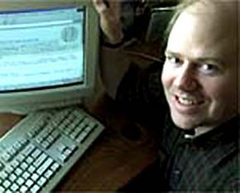
Larry Sanger doesn't trust the wisdom of the crowd, so he's no big fan of Wikipedia. But he's not like the others who get their kicks pooh-poohing the all-powerful (but flawed) wiki: Sanger had a huge hand in creating it. These days, however, he's doing his best to make it something future generations remember only as the troubled little brat of online encyclopedias.
Sanger is staging an electronic coup d'état with a new wiki called Citizendium, to be launched early in the new year. But there's a twist: the site will start out as a mirror image of the English version of Wikipedia through a process called "forking." By making a replica of Wikipedia, Sanger hopes to attract a bevy of experts to the project, who will then refine the wobbly content pulled from Wikipedia's infinite pages to create a resource that is authoritative and reliable. ("We descend upon their content, red pens in hand and start our own new community," he recently wrote.)
"On the day of launch, we have over 1,000 people ready to get to work, and a large portion of them are professors, graduate students, research scientists, legal scholars, technical thinkers and assorted other intellectuals."
Question is, how far will his highfalutin model go in the unruly hurly-burly of cyberspace, where the wisdom of the crowds rules the day?
The Tyee reached Sanger at his home near Santa Cruz, California.
Web 2.0 for highbrows
Both on the phone and in his writings, Sanger comes across as a thinker who doesn't let himself get too hung up on the success or failure of his brainchild, although he is keen to talk about the progress he and the team are making.
"We're going to see an explosion," he says. "I can tell you this because I've done this before."
It's like the early days of Wikipedia all over again, this time without pesky trolls and anonymous vandals. In fact, Sanger and co. have already enlisted a small army of several hundred people who are quietly reworking several hundred Wikipedia articles (and rewriting the worst ones from scratch) in their homes and offices across the continent.
"We're working very hard on it," he says, adding, "There has been zero disruption by anyone."
The latter is intended for his critics, who say that the oversight of experts will drag Citizendium down with bureaucracy and infighting.
Oddly, it's been radio silence in the blogs and chat rooms as to the ethicality of Sanger's heist (which after all is perfectly legal). A Wikipedia press release even went so far as to welcome the expropriation, a reception that left Sanger "very surprised."
"I thought that we were going to be roundly attacked," he says.
Experts versus anarchists
The critics reserve their ire for other things.
The most intense fire has to do with Sanger's insistence that experts -- with real resumes, publications and (gasp!) credentials -- need to be given certain powers to bring law, order and expertise to the Wild West ethos -- "anarchism," as Sanger terms it -- that currently holds sway in the Web 2.0 communities (i.e. websites that bring the power of publishing to the masses). Contrary to the conventional wisdom on the topic, Sanger holds that experts and the hoi polloi don't need to be like oil and water when it comes to hanging out on the Internet.
"It's one thing to be a thorough-going egalitarian, it's another thing to be an old-fashioned academic elitist that doesn't want to mix with the riff-raff. It's a third thing, which most people aren't even thinking about, to combine the two worlds. That's what I'm trying to do."
Gunned down
Sanger, however, refuses to reform Wikipedia from within because to him its "everyone's-an-editor" approach is fatally flawed.
Here it must be borne in mind that Sanger was personally gunned down in Wikipedia's lawless territories by an anonymous contributor named "Cunctator," who went around deleting all of his work in a long, drawn-out edit war. Finding himself a powerless co-founder of Wikipedia with a PhD in philosophy from Ohio State University that didn't give him the upper hand in editing, Sanger became increasingly frustrated, and complained that there was no way to maintain an orderly editorial process or to punish troublemakers like Cunctator. He left the project in 2002.
He says he kept waiting for Wikipedia to "mature," but it never did. The recent Siegenthaler fiasco only confirmed his opinion that the cracks in the great wiki's structure can't be sealed.
"[Wikipedia] is a commitment to amateurism," he says simply.
"I mean if someone can become an expert about, say, Civil War history, just by reading half a dozen books and going to Civil War re-enactments...then basically it's no longer the case that people who should be called experts really can speak with some special authority on a subject."
"I have pretty traditional views about this," he continues. "When someone has studied a subject for many, many years, has gotten their papers past critical reviewers and has rubbed shoulders with people who are equally as well read, researched, experienced in a subject, I hold that those people really do know more about the subject than other people."
Web 2.0 heresy?
While it sounds like common sense in real life, on the Internet Sanger's idea comes across as plain old elitist poppycock, with a dash of authoritarianism thrown in -- especially in the ears of the open-source hacker crowd, and Web 2.0 types. To them, Citizendium is an ivory tower that will never rival Wikipedia's grassroots army of 65,000-plus self-sacrificing volunteers, busy little bees who built Wikipedia into the world's greatest experiment in collaborative knowledge. Citizendium's top-down editing structure and two-tier hierarchy, they say, will strangle the appeal and be a turn-off for mass participation.
The common logic goes that everything is supposed to be flat online, with the eventual aim of ushering in an egalitarian techno-utopia.
Sanger disagrees, and thinks fuzzy countercultural notions circa 1969 have somehow gotten all wrapped up in the ideals of the Internet. He says his detractors are foolishly mixing politics with the nuts and bolts of how online communities must operate if they want to build reliable reference projects.
"It's pretty hard for me to relate to a point of view that makes knowledge subservient to politics. Because that is ultimately what this animus against expertise seems to be doing," he surmises.
"We now live in an age where no one has the right to set themselves up as authorities. Why not? Because that somehow inhibits the freedom or the power and the influence of the people."
"The very concept of an expert as being someone who knows more about a subject than someone else in itself is innocuous. But if you combine that obvious semantic truth with the insight that knowledge is power, then that means that experts actually are in a certain way more powerful than other people."
"It follows pretty logically that the notion of online expertise is anathema."
Turning, turning in a widening viral
If you build it, they will come, goes the chestnut. But that doesn't mean whatever you built will go viral.
Viral online resources create content that on turn attracts more content, like a sort of positive feedback loop. Sanger, of course, hopes Citizendium will gather critical mass just like other content-creating open-source projects did (think MySpace, Wikipedia, YouTube.) Critics jeer, saying that by giving experts the final say-so in the rough-and-tumble disputes that go into creating entries, Citizendium will wither by the wayside. The countercultural bent of Web 2.0, they say, combined with no means of drawing non-experts (i.e. the rest of us) makes Sanger look as if he's throwing a stick he expects cats to fetch.
But Sanger, whose lifelong passion has always been to build "a database that contains everything," says the interest is out there; it's just coming from a different direction. "We don't have to convince anyone who hates the idea of the Citizendium, we just need to convince enough people to get involved."
A recent listserv e-mail makes Citizendium's recruiting strategy pretty clear: "I am after the small but growing minority of academics, and other intellectuals, that are already primed to 'get' radical collaboration, openness, and gradual progress toward perfection. There are, in terms of sheer numbers, more than enough very well-qualified people who are thus primed to staff CZ."
On the other hand, Sanger's also confident that thousands of "ordinary people" will jump at the chance to work under "the loose and gentle guidance" of the pros.
"I think there are a lot of people who are involved in this pilot project who were exposed to the ideas of bottom-up, 'bazaar' content development processes by Wikipedia," says Sanger of current contributors, experts and non-experts alike.
The doctors are in
There are already 130 academics, professionals and scientists "at the PhD level" working merrily away editing articles, he adds. "They get the idea. What they don't like [about Wikipedia] is that they don't have any special rights within the system."
The drive, according to Sanger, is that people get fed up with infighting and get tired of seeing their edits erased. He believes there are many people who, like him, don't mind deferring to luminaries with more experience or knowledge on a given topic.
Whether or not Citizendium will breed this kind of courteous civility, without turning into yet another autocratic hierarchical exercise, remains to be seen. Without Wikipedia's egalitarian openness, how do you keep the overseers honest and non-partisan? Doesn't the thought of blocs of thought controllers worry him?
"You have no idea. That's why we had this proposal in the first place for editors to be self-selecting," meaning that people will go to the wiki, place a link to their CV on their user page, and declare themselves editors. Since the info is public, the community is supposed to spot the phonies, who will then be shown the door by the 'constables' elected by the community.
The devil, as we all know, is in the details, and you can just picture the bitter wars that will inevitably erupt over who is and who isn't an expert. Sanger points out that the self-selecting clause, like most aspects of the wiki work-in-progress, could well be dropped from the charter CZ folk are writing if the community decides to adopt another way of verifying credentials.
But will it be popular? Wikipedia Top 20 most visited sites popular? "Popular with whom is the question," he responds. "A lot of people have shown up."
"They're doing it, and articles are getting better. So what's the big deal?"
Fork you too
It's just a guess, but Citizendium could very well turn into something that makes a big dent in what happens on campuses, while Wikipedia's street smarts and wide-open appeal would entrench it forever as the go-to pop culture favourite. To that end, Sanger already has plans to pitch Citizendium to professors across the English-speaking world, asking them to involve both themselves and their grad students in perfecting the resource, and thus outstripping Wikipedia. But there's a reason why all this competitiveness might not matter too much anyway.
Ironically, if Citizendium does manage to go viral -- or even if it limps forward with only a handful of scholarly articles and a ton of old and unchanged mirrored ones -- Wikipedians will always have the option of taking heaping forkfuls of its 'authoritative' content and re-posting it to Wikipedia, for the same reasons Citizendium can start out life as a little green seedling on the rotting nurse log that is the Wikipedia corpus: free licensing. Which means any notable differences between the two might be erased by an endless series of bizarre information raids, which will be a common thing in the future.
"Some of them have already said that they are going to do that," says Sanger, referring to the competition over at Wikipedia. "That would be great, because if they do that, they'll have to link back to us."
Another little piece of telling irony before signing off: at one point in our conversation, Sanger was at a loss to explain how Citizendium was going to rely on something called "soft security" to enforce stiffer rules. He asks me to hold the line for a sec while he looks it up on Wikipedia, and then proceeds to read off a precise definition of the term.
It's a telling quirk, because it shows where Sanger -- and by extension a lot of other really bright, eager wisdom-seekers -- is coming from: they want to drop the ideology and politics, roll up their sleeves and simply get down to the work of creating a reliable resource the world can use for free. Whether it will come to pass is anybody's guess; we'll find out in the new year.
In the meantime, critics speculate that Citizendium is a way of getting back at Wikipedia's unruly circus, and that the project is Sanger's personal vendetta with former partner and Wikipedia owner Jimmy Wales. Sanger will have none of it.
"This is an attempt to do a project that we started together, better."
Related Tyee stories:
- Wikipedia's Watchdog
- Journalism's Future May Be Wikipedia
- An Internet Idea Army
- A Neo-Techie's Morning
![[Tyee]](/design-article.thetyee.ca/ui/img/yellowblob.png)










Tyee Commenting Guidelines
Comments that violate guidelines risk being deleted, and violations may result in a temporary or permanent user ban. Maintain the spirit of good conversation to stay in the discussion.
*Please note The Tyee is not a forum for spreading misinformation about COVID-19, denying its existence or minimizing its risk to public health.
Do:
Do not: