Mediacheck

Inside Afghanistan's Struggle for a Free Press

Canadians are part of a pricey push to build open media there. Will it pay off?

By Jared Ferrie, 14 Jul 2005, TheTyee.ca

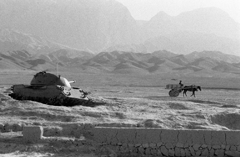
Afganistan Tank

In some countries a desk means a lot, and Faheem Dashty has the biggest desk I’ve ever seen. He’s sitting behind it when I enter, but comes around to shake my hand and plants himself on one of the chairs next to me, lighting the first of several cigarettes. As we talk, we ignore the sound of claws scurrying across the roof of his office in downtown Kabul.

I’ve come to ask Dashty, who is the chief editor of a leading newspaper, about the state of Afghan media. With all the challenges his country faces after emerging from more than two decades of war and five years of the Taliban, why is developing independent media so important? Moreover, after working on a media development project for the past five months with the Vancouver-based Institute for Media Policy and Civil Society (IMPACS), I have begun to wonder whether independent media is even possible in a country so dangerously fractured.

Dashty has that disarming and very Afghan mixture of pride and humility. A soft-spoken man with big ideas, he wants to use Kabul Weekly to help rebuild his shattered country. He sees independent media as a cornerstone of Afghanistan’s nascent democracy, and believes that a free press can help prevent some of the abuses of past governments.

“So far it’s a dream,” says Dashty. “This is our dream, but it’s not easy to reach it, to make it real.”

Dashty’s dream is shared by a growing number of international organizations. Partly as a response to the media’s role in fomenting hatred and inciting violence in Rwanda and the former Yugoslavia, the international community poured close to a billion dollars US between 1992 and 2002 into media development in what are termed “emerging democracies”. The hope is that a free and independent media system will strengthen democratic institutions while helping to resolve the tensions that plague countries with violent pasts.

But many media development workers will tell you that as the big picture collapses into a microcosm of ethnic, religious and political entanglements, those ideals tend to become fleeting and diluted.

In Afghanistan, where 23 years of constant warfare have created an environment of partisanship and suspicion, “independent media” is a loaded term. Afghans now find themselves caught up in a web of alliances and those divisions are reflected in the media landscape. “Every newspaper has a connection to somebody,” says Gawhar, a local journalist who has worked for Kabul Weekly.

Dashty vigorously defends his paper’s independence, but acknowledges the deep seeded suspicion that most Afghans have toward the media. “When you introduce yourself as a journalist of Kabul Weekly the first thing that will come to the mind of the one you want to interview is: ‘To whom this paper is linked?’” he says.

Such suspicions are well grounded according to Ahmed Jan Tanai, a 16-year veteran of Afghan journalism who sees an overt bias in Kabul Weekly’s reporting. “Politically, it goes toward the Northern Alliance,” he says, referring to the loose coalition of former rebels who helped the Americans oust the Taliban. Many Northern Alliance leaders retain political power – some hold government positions, others maintain their own private militias, or both.

Tanai accuses Kabul Weekly, along with other publications, of supporting Northern Alliance members’ political aims by being overly critical of president Hamid Karzai while ignoring crucial issues. “Most of the Kabul press is writing against Karzai,” he says, “but these papers are not writing about the warlords, about human rights. They are not writing about what stands in the way of democracy.”

The myth of Massoud

Dashty’s well-known history with the Northern Alliance does not help his case. Nor does the large painted portrait hanging directly above his desk. The man in the painting is Ahmed Shah Massoud, the lionized Northern Alliance commander who was assassinated two days before the September 11, 2001 attacks on the World Trade Centre. Massoud’s legacy carries great political weight in Afghanistan and has been inherited by his still living allies in the Northern Alliance.

Massoud’s image is ubiquitous in Kabul. A two-story likeness of the rebel military commander – rendered somewhat awkward by the English phrase, “The Great Massoud Your Way Go Forward” – is fixed to the outside wall of the airport. New arrivals to the country drive away on The Great Massoud Road, passing a monument built in his honour. He is the subject of murals, Che Guevera style, and his face is even woven into rugs hawked to foreign soldiers and development workers on Chicken Street. That face, framed by his characteristic pakul hat, passes by in traffic, taped to the front windshield of trucks that are often bristling with machine guns and loaded with somber-looking men.

Despite Massoud’s powerful admirers, he is not a hero to all. Atrocities were committed on all sides of the civil war and many Kabulis recall the role Massoud’s soldiers played in the destruction of the capital. But they mostly keep their opinions to themselves. Tanai believes it would be dangerous for a journalist to write negatively about Massoud because of the intense loyalty of his still-armed and powerful compatriots.

War criminals in government

A Human Rights Watch report released earlier this month details abuses including rape and executions that were carried out by troops under the command of Massoud, who was at the time defence minister in the increasingly enfeebled mujahaddin government. The report warns that many commanders who allegedly perpetrated abuses continue to commit the similar acts today, undermining any chances of stability in the country. Some of those implicated in war crimes plan to run in September’s parliamentary elections.

The report also implicates members of the current government. Among the most high profile of these alleged war criminals are Vice President Khalili, who previously commanded a formidable militia, and Dr. Abdullah, one of Massoud’s most trusted confidants, now Afghanistan’s foreign minister.

Dashty was in the same room as Massoud the day two suspected Al-Qaeda agents posing as journalists detonated a bomb hidden in a TV camera that blew a hole in his commander’s chest. He still carries the memory as well as the physical scars. “I feel myself committed to the ideas of commander Massoud,” says Dashty. “Of course, it’s very hard to convince people that I am independent, that this paper is independent.”

In its first incarnation, Kabul Weekly was the state run newspaper during the mujaheddin government’s turbulent rule between the fall of the Russian-backed government in 1992 and the Taliban’s 1996 takeover. Dashty is aware that many Afghans believe Kabul Weekly is still connected to mujaheddin groups. “I know that many people think that I am one of the members of the former Northern Alliance,” he says. “I am not. I don’t have any relation – I mean any official relation – with the former Northern Alliance leaders like (former defence minister) Marshall Fahim, or Qanuni.”

Yunis Qanuni, the former vice president, was passed over by Karzai and instead ran against him in last year’s landmark presidential election, along with several other Northern Alliance members. One of these presidential hopefuls was Karzai’s one-time defence minister, Rashid Dostum, a northern strongman who human rights groups accuse of war crimes. Dostum’s ferocious reputation presented a challenge to journalists wanting to cover his campaign.

Safe reporting or no reporting?

One month before the election, I am in Balkh, northern Afghanistan. It is the birthplace of the prophet Zoroaster and the final resting place of the famous female poet Rabia. Before Genghis Khan’s soldiers broke through sections of the giant mud walls that stand to this day, Balkh was known as the “Mother of All Cities”. Today, with little trace of its ancient glory remaining, Balkh is a bucolic farming village close to Dostum’s headquarters in Sheberghan.

I ask Mohamad Nabi Hamdard, manager of a community radio station, which is supported by the American organization Internews, if his reporters have done stories critical of the warlord. “If you want to talk about Karzai, I am ready to answer your questions, but not about Dostum,” he replies. Due to fears of violence and intimidation, the station, which was started by the American media development organization Internews, avoids certain topics. “There are so many people with guns,” Hamdard observes.

On the potholed highway back to Mazar-e-Sharif the pungent aroma of marijuana fills the car as we pass fields that will soon be harvested and processed into hashish – part of the drug trade that lines the pockets of warlords and local strongmen. Along another section of the road, Afghanistan’s brutal history is on display. Rusted and dismembered carcasses of tanks and other armoured vehicles sit scattered in former battlefields, serving as grim reminders of the threat of bloodshed that still haunts the country.

Shakiba, a reporter at the IMPACS-supported women’s community radio station in Mazar-e-Sharif, says the staff there also walk a fine line when choosing stories to cover. “We take care about what to say and what not to say,” she says, pointing out that the station is housed in a building owned by Dostum If the station is too critical, she says, “Maybe all these things are possible – kidnapping, being killed, the radio station being closed down.”

Conditions improving

Back in Kabul, Dashty says his reporters have never had any serious threats leveled against them by warlords or politicians.

But that doesn’t mean reporting in Afghanistan is a walk in the park. Earlier this month the Committee to Protect Journalists wrote a letter to Karzai demanding the release of two journalists detained by Afghan intelligence officers. The two were freed after spending more than a week in jail.

Tanai believes that, despite ongoing dangers, conditions are improving for journalists, and that much of the fear stems from Afghanistan’s violent past. “Years ago, the killing of men was as easy as killing a chicken,” says Tanai. “If a war criminal decided to kill a journalist, it was easy for them. Now the situation is getting better.”

As democracy develops, Dashty hopes that Afghans will settle their disputes with words rather than bullets. He believes media can help facilitate political debate, but first, he says, Afghan news media need to regain the trust of the people.

This means dramatically improving journalistic standards. Since the fall of the Taliban, Afghanistan has seen a proliferation of publications, many of them supported by political parties or foreign donors. But quantity does not equal quality, says Dashty. “We cannot see journalism in Afghanistan’s media. It’s not journalism. There’s no professionalism.”

The lack of professionalism leaves the door wide open for opinions, often in the form of attacks against rival political or ethnic groups, which Dashty says dominate other Afghan publications. But he believes the situation will improve by raising journalistic standards: “If we will work professionally, if we will do journalism, then its clear that we cannot attack anyone.”

Development experts appear to agree with Dashty’s assessment. Kabul is awash with international organizations running programs aimed at building an independent media system by funding news outlets and training journalists. The foreigners come bearing aid money and confidence in the positive effects of a free and open media system. But western ideals about journalistic objectivity can be difficult to reconcile with a society where decades of war have driven people into often-murky, but seemingly ever-present, ethnic and political allegiances.

Lane Hartill, an American who at the time of the interview was paid to train journalists by the organization that hosts Kabul Weekly, admits that Dashty’s politics sometimes seep into his stories. “In the West, there are some editors who have hard core political beliefs but are able to keep them out of their papers,” he says. “In the developing world, when one has been ingrained with ethnic beliefs and grown up in a war environment – and in Faheem’s case, covered the war on the front lines for years as a young man – those beliefs, I think, aren't ever completely abandoned.”

But Hartill maintains that, in the incendiary context of Afghanistan, Kabul Weekly is doing a pretty good job. “Even people that don't like Faheem, respect the paper,” he says. “It is one of the few newspapers that isn't loaded with opinion pieces pretending to be news stories.”

Dashty also admits the paper has faults. But like Afghan democracy, he considers Kabul Weekly a work in progress. “At Kabul Weekly we are trying to work professionally, but we cannot claim that it is a professional paper,” he says. “When? God knows. But at least we are trying.”

Jared Ferrie is a freelance journalist who spent six months working in Afghanistan as an editor and journalism trainer for a women’s political newspaper.  [Tyee]

53  Comments:

Login or register to post comments

  • kurt

    6 years ago

    Comments on "Inside Afghanistan's Struggle for a Free Press

    Fascinating story. I look forward to a future updaate.

  • allan

    6 years ago

    It sounds like a place Canwest could adapt to pretty fast if it didn't have such a hate on for anything in the middle east but Israel.

  • jamez

    6 years ago

    That was a hell of an interesting read.

  • Colin

    6 years ago

    I don’t know how many papers are in Afghanistan, but Iraq has approx 170 at last count. Being able to sit in a coffee shop and argue about something in the paper without fear of being punished or killed is something we do every day, for these people it is a new and wonderful experience. They still guard their words and have reason to do so, but is good to see. I am glad that they already have a healthy distrust of what is written in the paper.

  • Yammer

    6 years ago

    Fascinating. The development of a free press is of vital importance to the resolution of the WoT. As long as kids only believe what they hear in the madrassa school and in the mosques of firebrand imams, they will blame the United States for all of their problems. A free press is toxic to fascism.

    What makes it more likely than not is the increasing cheapness and worldwide coverage of wireless media -- cell phones, the Net etc. Not that any one source is perfectly reliable, but if you have mulitiple sources, you can get multiple viewpoints (just as here we can read the Sun and then, say, the Republic of East Vancouver).

    Sometimes I think that the US could have saved itself a lot of trouble by dropping laptops and modems in Iraq instead of bombs....

  • Te Aro Arahina

    6 years ago

    Can't eat laptops or modems, m'dear.

  • Te Aro Arahina

    6 years ago

    Not even barbequed.

  • allan

    6 years ago

    Yammer, please not so heavy on the free press schtick.

    Unless you've been hiding under a rock for the past few years you ought to be embarrassed to run that tired donkey out as meaningful dialogue.

    If or when we get a "free press" as you claim, I'll dance on the rooftops, but last time I looked the press was in the hands of a very few in North America and across much of what is described as the "free-world."

    Next time you have a valid criticism of Gordon Campbell or his government send a letter to the editor of the Vancouver Sun and hold your breath until it gets published.

    The press in Canada is free to do what ever its owners decide.

    You right-wingers who try peddling your 'status-quo is great' junk here get just a bit too shallow sometimes.

    Hey, you're not alone. It appears that Colin has joined in to offer a tagteam of 'if only
    those corrupt and murderous countries could get civilized like us' lectures.

    Your American military heros would have served their country far better had they stayed the hell out of Iraq to begin with.

  • allan

    6 years ago

    I do concede I agree on the "free press is toxic to fascism".

    If America had a free press George W. Bush would not be president and the world would not be in the grip of the terror it faces from a fascist government out to dominate the world from Washington.

  • Colin

    6 years ago

    Allan
    Despite our ideologue differences, I do wholeheartedly agree with you that the compiling of the various medias and news reporting under a small group of people is very unhealthy regardless of the views they represent.

    Although my view point is now centre-right I do enjoy discussing issues with people who don’t agree with me as long as it is done with class and substance. When someone challenges my viewpoint with either fact or well thought out opinion, then it forces me to think about why I formed the opinions that I have. This is why I come here, and other site across the political spectrum (with a few exceptions).

  • jamez

    6 years ago

    "Next time you have a valid criticism of Gordon Campbell or his government send a letter to the editor of the Vancouver Sun and hold your breath until it gets published."

    Sorry Allan, but I see letters slamming the Libs in the Province all the time.

  • Yammer

    6 years ago

    It's tedious to address people who use the anonymous forum to safely launch personal attacks, but since to ignore this would be to have no one to debate with, let's do our duty.

    Allen says: "last time I looked the press was in the hands of a very few in North America"

    Yes, what's your point? The major media spikes stories all the time to fit corporate agendas. Fox News and CNN air plenty of White House propaganda and offer little dissenting viewpoints.

    What else would you expect? So turn to alernative media. Go to the independent press or to the Internet. Your voice of dissent is not a lonely one, Allan.

    "It appears that Colin has joined in to offer a tagteam of 'if only those corrupt and murderous countries could get civilized like us' lectures."

    I'm not unaware of the hypocrisy of the west, but I will, gladly and unrepentently, advocate liberal democracy and capitalism as a flawed but so far peerless method of governance.

    Especially compared to theocracy. Is there anything worse than theocracy? I can't think of one. I'm not even for the Dalai Lama coming back to power (and to be fair, neither is he).

    Radical Islamic scholars of the Qutbist line and their followers, e.g. Baathists, Al-Qaida and wannabe Al-Qaidas, yearn for theocracy. They believe that the Koran is a constitutional document, suitable for ruling countries and the world.

    There is nothing worse than this, as a model for civilized government. That seems so self evident and obvious...perhaps that is why you never acknowledge it, because it is just that trite.

  • Yammer

    6 years ago

    Another thought. It seems callous not to care that CNN and Fox News are not progressive and balanced, and that that contributes to, say, the reelection of Bush.

    I guess I'm an optimist. I look at history and I see very few good ideas going away. It may take a long time to convince people that the earth is round, but they've stayed convinced.

    Women's right to vote, that took a while. But I don't think it's going anywhere.

    I believe in the grassroots. I believe in dissent, as formulated by skillful writers like Chomsky, whose putdown of Skinner's Beyond Freedom and Dignity was as thorough and irrefutable as it was necessary, and who puts out timely memes of forebearance, of restraint, of alarm about Imperial America.

    So, I think peace can come, and that it will come as all ideas come -- from relatively small groups of enlightened and passionate people. Then, if the idea is sound, it will catch fire and never be put out.

    In the meantime, we have to look at Bill O'Reilly or Tucker Carlson and sigh.

  • Te Aro Arahina

    6 years ago

    No, we don't. At least, I don't and won't. There is a wonderful little button on the TV remote called "off", the perfect solution for BO and Co.

  • dangrice.com

    6 years ago

    Allan, as far as I know, none of the Tyee readers have ever been stoned for posting articles speaking out against our current governments. The Georgia Straight has never been raided for posting materials that question the government, and even CNN reports on Rove's leaking of CIA material. Free Press, we do have, even if I do agree it could be freer.

    Short of a lot of brainwashed clerics and their followers, I don't think anyone would seriously suggest returning the taliban to power would increase freedoms in afghanistan. (last bit not aimed at anyone)

  • Te Aro Arahina

    6 years ago

    It's changing. Judith Miller went to jail. People are baying for her blood and Rove's, but she should've gone to jail for being an idiot whose incompetancy contributed to support for the other idiots' war, not for refusing to reveal her sources. So, there's a fresh nail on the coffin.

  • Coyote

    6 years ago

    This site has become total bullshit, refusing to post, unless its of a Neocon digestible length. I'm outta here.

  • jamez

    6 years ago

    "The Georgia Straight has never been raided for posting materials that question the government,"

    True, but remember when they tried to hit the straight with one million in back taxes. I love the way the straight handled that, a huge front page editorial ripping the arse outta the libs.

  • Te Aro Arahina

    6 years ago

    Take it easy, coyote. You aren't the first stung by the word-limit. Copy your comments before you post them, and if the site rejects your comment based on the length, break it up into smaller segments, and paste them separately. You will have to wait a minute before posting the next section, but you still have the right to say it all -- just not all at once.

  • lynn

    6 years ago

    These days we are not such a foreign land in comparison to Afghanistan when it comes to freedom of the press. We just dress up the pressures that bear down on those freedoms a little better, like a clever little cocktail party where underneath all the chatter and nice manners of self-interested news networking (ugh! terrible word) everyone knows exactly what is expected of them to close the deal...what will get them in the door and what will slam that same door in their face....how far to go, how far to push ...and how to behave in a news business that now thrives on superficiality over depth. (As we see here with the neo-con love of the digestible short bite that Coyote refers to).

    So "our western ideals about journalistic objectivity" are not quite as lofty as we would like to believe but are murky and tainted as well...just with a more civil but still oppressive kind of etiquette that in the end is about suppressing whatever truths the-omniscient-powers-that-be have decided need suppressing... and most participants, sadly, play along with that main rule of the game.

    This western quest to bring a free independent media to Afghanistan reminds me a lot of the British attempt to bring their version of so-called civilization to India.

    It is not only the Afghan news media that needs to regain the trust of the people.

  • kurt

    6 years ago

    There is plenty to criticize about India and imperialism but do remember India's the largest functioning democracy in the world — 1 billion people — and the British deserve credit for at least leaving them that. Along with a pretty damn good train system; better than Canada's.

  • skeptikool

    6 years ago

    As far as the world's media is concerned our mainstream media has little reason for sanctimony.

    In the main, it was as gung ho for attacking Iraq as those two thugs, Bush and Blair, and was complicit in adding credence to the contrived reasons for doing so.

    Letters to editors go into the round file for reason other than being smutty, dull, libelous and/or being badly written.

    This very medium I'm now using is also under attack. For good reason it is greatly feared by the Establishment. Why do you think the CBC folded its National message boards just prior to the last federal election? Why do you think the media are pushing blogs? The reason is that a billion bloggers are talking to themselves or small circle of acquaintances.

    We have an awesome medium here. It can and often will be abused, but has incredible potential to improve our world. While many are into building walls it can break down barriers.
    It is my wish that those in Afghanistan and Iraq are able to climb aboard.

  • lynn

    6 years ago

    The foreigners bearing gifts, also bring with them that very western form of enlightenment... homogenization, either intentionally or unintentionally...that is always the danger.

  • lynn

    6 years ago

    And Kurt, yes, India has a wonderful train system, better than Canada's...

    When Gandhi was pushed out of one of those trains for refusing to leave his seat for a white person, a privileged "foreigner", it was right there on yes, one of those wonderful trains that he decided to fight for minorities and freedom...though it was not a wonderful enough train system, apparently, to allow Mr. Gandhi a seat on it... even in his own country...

  • allan

    6 years ago

    Yammer, no one is advocating returning the Taliban to power, at least on the Tyee.

    But whether you like it or fear it, the reality is that it ought to be a decision made by Afghanis, not some western power seeking the same things the Russians sought a decade ago.

    Step back a litle from our own media and tell me we sophisticates here in the west are not being fed nor amply digesting propaganda.

    You don't like the Islamic fundamentalist message. Neither do I, but I equally despise the fundamentalist consumer message so happily wrapped for our ears, eyes and impressionable minds.

    Try knocking down those consumer trappings in MSM and you'll find yourself silenced quickly.

    Yes, we have the alternative media available on the web, but western cultures bright lights are shone through the church of national TV.

    It's great to have a nice backroad like Tyee to drive ideas along, but how many people across the political spectrum motor along here looking for the breaking story?

    Yes fundamentalist religion can destroy cultures or at least change them tremendously.

    Fundamentalist capitalism, which so many here in the west have bought as their doctrine of choice, is also causing real cultural as well as environmental change that certainly appears now to be far beyond just tremendous.

    I'd humbly suggest it's terminal as I watch the ice melt and the waters rise.

  • kurt

    6 years ago

    Lynn: there is nothing homogenous about India, which is what makes their successes and enlightened attitudes unique. The west (and India's neighbours) could learn much from India's example, generally speaking.

  • dangrice.com

    6 years ago

    Quote:
    the reality is that it ought to be a decision made by Afghanis, not some western power seeking the same things the Russians sought a decade ago.

    But the problem is, until we get these BS totalitarian dictatorships out of the way, and ensure a valid democratic system is in place in every country of the world, decisions are not made by the people.

    Its very unfortunate that force must be used, but when you have these regimes in which small minorities can via weapons and suppression stifle the majority, how can you argue that the decision should be made by the locals. National autonomy and self determination is a great concept, but without democracy and freedom of expression it is useless.

    And even if you don't like consumeristic society, you still have the options to minimize your engagement in it under a democracy, you have the option to shape policies and remove governments who fail us. are we perfect, far from it, but give others a genuine choice, and they'll choose western freedoms over cultural tyrannies any day.

  • dangrice.com

    6 years ago

    Doesn't it all go back to the saying, "no two countries with McDonalds have ever gone to war.."

  • Yammer

    6 years ago

    Allan,

    Thank you for the civil response. Debate is fun. Or it should be fun.

    "whether you like it or fear it, the reality is that it ought to be a decision made by Afghanis, not some western power seeking the same things the Russians sought a decade ago."

    As as I know, "the Afghanis" could not have decided anything as a people. They were a warlord-based society ruled by the strongest, the exact opposite of the parliamentary system that the western powers are trying to inculcate.

    Are you advocating civil war, where people who want to trade with the west are pitted against others who want a pure Islamic Afghanistan via jihad?

    Or are you just saying that the way the transition is being done, is not the best. I can agree with the latter. Ideally the Afghanis would have spontaneously embraced democracy, pluralism, secular government, individual human rights, the rule of law, and the other things that we take for granted here. Ideally the USA would not have to lead the reforms while saddled with a deserved reputation for unilateralism, greed, and hypocrisy, with the idiot Bush as its grinning figurehead.

    But. But. I can't support isolationism either just because I have distaste for the intervenor who is, like it or not, rightly motivated or not, leading the country upwards.

    "Step back a litle from our own media and tell me we sophisticates here in the west are not being fed nor amply digesting propaganda."

    I agree, there's no such thing as total objectivity. Of course western thinking is my "default setting."

    That doesn't mean that it's wrong.

    I've looked at a lot of different systems of politics in action today and have come to agree with Churchill that representative democracy is the worst, except for the other ones. I might yearn for anarcho-syndicalism but that's a long ways off; in the meantime, I support the half-measure of getting the rest of the world up to the human rights and natural justice standards of the first world.

    "You don't like the Islamic fundamentalist message. Neither do I, but I equally despise the fundamentalist consumer message so happily wrapped for our ears, eyes and impressionable minds."

    Here's where I depart with you, friend Allan.

    I do not EQUALLY despise them at all.

    Islamic fundamentalism is incalculably worse. If you think that's parrotting Bush then you would have to say that Amnesty and Transparency International and RSF and Human Rights Watch and the International Gay and Lesbian Association are also parrotting Bush.

    "It's great to have a nice backroad like Tyee to drive ideas along, but how many people across the political spectrum motor along here looking for the breaking story?"

    Oh, fewer than read the National Post, of course, or who don't read at all. I'm just pointing out that ideas have a path from radical to mainstream and that the ones which promote good governance and pleasure tend to stick around. Consider yourself an early adopter!

    "Fundamentalist capitalism, which so many here in the west have bought as their doctrine of choice, is also causing real cultural as well as environmental change that certainly appears now to be far beyond just tremendous."

    I agree with the effect concern, but not the thesis of fundamentalist capitalism. There are all kinds of models of business under the general rubric "exchange money for goods and services." Like, I dunno, fair trade programs.

  • skeptikool

    6 years ago

    To repeat a statement in my last post about two or three hours ago:

    "This very medium I'm now using is also under attack."

    Reading of a young man recently in court, charged by the RCMP with using an Internet website to issue threats against its members, I could not help hoping that the RCMP would be as zealous in striving to attempt to apprehend ALL who make criminal use of the Internet.

    I mention this now because the freezing of my computer/monitor leading to improper shutdown requirng scanning and the need reconfirm passwords for three services amounts to harassment that is a criminal denial of a paid-for service.

    I have little doubt this was in response to my previous message.

  • lynn

    6 years ago

    kurt, I don't think anywhere in my post I denied India'a multiplicity, only that it was put at risk by imperialist desires for homogenuity.

    dangrice.com: As for no two countries with McDonalds ever going to war ...probably because they no longer can fit into their uniforms...

  • Bobb999

    6 years ago

    Anyone who believes that US mainstream media, (CNN, New York Times), etc., is fair and balanced, I'd recommend they check out http://mediamatters.org
    The site does an excellent job of critiquing
    mainstream news stories for innaccuracies. You might be amazed as I was at the ommissions, gross distortions, and falsehoods,
    Media Matters' careful research reveals.
    This site, plus Bill Moyers'(sadly gone)PBS show "Now", helped convince me that US TV networks, including CNN, give such an edited (censored), distorted picture of the US and the world, that I'd be better informed by switching them off and finding information elsewhere!
    I feel I'm better informed now with a daily regimen of reading newspaper and other articles from a wide range of internet sources, originating from Canada, the US, the UK, and elsewhere.
    TV news is more infotainment than information. I agree that an irresponsible US media helped elect George Bush, simply by being cursory or silent on issues it should have covered.

  • allan

    6 years ago

    Yammer, You appear to be saying the Americans will determine who they deem to be terrorists and if the people resist they will be killed becaues they used terrorist tactics to defend themselves.

    Yes, I am sure we part company over fundamentalist capitalism. You are an apologist for its excesses but try your damnest to avoid noting the bigger concern isn't excess but degradation of our environment.

    Choice, you add. Who has choice. A few hundred million in western societies while everyone else rtakes wheat there is anything at all.

    Yes, we Canadian fatcats have choice, but do we all have the means. Perhaps that is where the real parting of company is.

    Choice is relative, quite marginal on the large screen and terribly discriminating in its largesse.

    Besides what is so great about your right to choice when others don't have the right to eat
    because of your fundamentalist capitalism which says 'feed yourself sucker.'

  • kurt

    6 years ago

    BTW, just for the sake of historical accuracy, Gandhi was evicted from the first class compartment of a South African train, not an Indian one.

  • lynn

    6 years ago

    You're absolutely correct, kurt, I stand corrected.

  • Yammer

    6 years ago

    allan posted:
    "Yammer, You appear to be saying the Americans will determine who they deem to be terrorists and if the people resist they will be killed becaues they used terrorist tactics to defend themselves."

    How interesting, as I have never said this, apparently or otherwise.

    The general thrust of my posting on this and the previous Iraq-Afghanistan thread is that:

    a) liberals should be supporting the export of western civilization, which includes the idea of trade,

    b) if a fascist theocrat is angry with what you are doing, you are probably doing something right,

    c) it is important to criticize western governments in all respects, but not to whitewash or apologize for deficiencies in non-western governments.

    "Yes, I am sure we part company over fundamentalist capitalism. You are an apologist for its excesses but try your damnest to avoid noting the bigger concern isn't excess but degradation of our environment."

    I have done nothing of the sort. What I said was, capitalism is not fundamentalist. Show me the strict guidebook which says that businesses are obliged to degrade the environment or else they are kicked out of the Capitalism Club. There isn't one. There are good and bad capitalists.

    "Choice, you add. Who has choice. A few hundred million in western societies while everyone else rtakes wheat there is anything at all."

    The rest of your post is, I am afraid, lost on me. Choices? Means?

  • allan

    6 years ago

    Interesting that the Arab regimes have morphed into "fascist" states, yet America is out there "exporting democracy."

    Like in 'give me a big hit of that democracy. Ya, a couple of 500 pounders will clear up all those misguided civilians.'

    Yammer, you don't have to openly state anything about your support of an invasion to prop up a failing capitalist system by the Americans. It is well weaved in the words you write.

    It would seem anything you don't wish to deal with you just don't seem to understand.

    Sorry to upset you, but capitalism is fundamentalism at its finest. The doctrine was defined by Adam Smith and then conveniently distorted by every subsequent generation right up to Milton Friedman and his bizarre take on reality.

    You probably think the arms build up of the past 60 years was a military decision.

    No one said business are forced to degrade the environment. That is a personal choice which all polluters simply opt to follow in the rush to make the profit.

    Where business is likely to get kicked out (or ostracized), is when they criticize another business's practices. Go ahead and try to get company X to challenge company Y's actions even if they are immoral, illegal or unsustainable.

    They face what I call the Chamber of Commerce rule that a business is better to fail rather than to publicly attack another business.

    Competition is the silly side of business that we hear much about, but see little in practice.

    What about those Weapons of Mass Destruction and the so-called ties between bin Ladin and the Iraqi regime?

    Yes those were Muslim terrorists who blew up London's transit lines and those are American terrorists who invaded and continue to terrorize much of Iraq and the middle east.

    Perhaps you think America is exporting democracy, because it certainly appears to be getting rid of much of the so-called democracy that ordinary Americans once enjoyed and it's all in the name of capitalism.

    I must say Yammer, you have slightly better arguments than most of the other right-wingers who come here to try to shape a leftist site.

    But just like the others, you continually try to ignore most of the real issues discussed here.

    It comes through loud and clear in your writing.

  • Bobb999

    6 years ago

    Good and bad capitalists? Perhaps, but the bias is skewed toward amoral positions where profit is elevated to #1 concern, and profit has veto or priority over all other aspects of a business, including social/environmental responsibility.
    It used to be that maximizing that profit for shareholders was #1 concern. Jack Bogle, founder of Vanguard Mutual Funds (And who I'd call a good capitalist), says that "shareholder capitalism" started to morph, after WWII into what he calls "managerial capitalism", where remuneration of executives of a company
    became the priority, with ordinary shareholders' interests taking a back seat.
    Managerial capitalism has worsened over the years, especially in the US, with increasingly obscene salaries, options and bonuses for top dogs. Executive greed got so out of control that criminal fraud became increasingly commonplace . "Edmonton's pride", Bernie Ebbers, just received a 25 year sentence for his US crimes as CEO of Worldcom. And Bernie's just one in a long parade.
    Perhaps even more disturbing is that institutionalized systems of fraud, a kind of racketeering, became standard business practise
    within whole industries. The Mutual Fund industry and late trading (in US and Canada), the Insurance Broker industry with phoney "competing" insurance premium quotes, Stock Brokerages' NYSE "specialists" illegally manipulating stock trading. Fraudulent Brokerage stock research depts., Insurance Companies helping clients cook their books with insurance mirages. With NY A.G. Eliot Spitzer now investigating and prosecuting ingrained fraud rackets in the financial sectors, perhaps a dent can be made in the culture of corruption rife in the capitalist world.Unregulated capitalism resembles organized crime, more and more. Republican politicians are attempting to block and water down legislation to more tightly regulate corporations. Not only is the corporate world corrupt, that corruption spreads into the political sphere, as big money
    and corporate lobbyists have undue influence over politicians. There is truth to the contention of folks such as Ralph Nader and Noam Chomsky who say the Republicans and Democrats are 2 factions of one "business party". One of the few good Chretien did was to ban corporate donations to parties. I'm afraid though there'll be "back doors" and loop holes to be exploited.

  • Yammer

    6 years ago

    Allan,

    You misstate my positions, and evade requests to show where I state that I support right-wing Americanism generally or the bombing of Iraq specifically.

    It's true that I do not join you, Coyote, Sleeps etc in the opportunity to posture drivel of the Amerikkka is the Real Terrorist (tm) variety. While it is obviously a fun and easy game, it reveals an indifference to change.

    Consider how the office of the ombudsman works: entirely by moral suasion, delivered in a civil tone. Nothing is gained by screaming, except a sore throat.

    Progressive people should be the ombudsman of peace and progress, not ranting nihlists. Anger is an energy but it is just pissed away if it cannot engage and address reasonably.

    The "real issues," friend Allan, are not whether Bush rushed to war or whether bombs are killing Iraqi civilians. These are Bad Things. Do you think that is controversial? Are you really going to have to subject us to lengthy speeches about how the environment needs to be saved?

    DUH. We all agree on those things.

    The real issue is, what can be done? What should be done? What are our core beliefs, and how should Canadians apply them in practice?

    Are you ready to be a serious person?

  • allan

    6 years ago

    Quote:
    "The real issue is, what can be done? What should be done? What are out core beliefs, and how should Canadians apply them in practice."

    Hold on to your seats folks, 'cause Yammer is taking this show through a loop or two as he attempts to justify his existance on the Tyee.

    Yammer, You are quite the case. The real issue is Afghani reporting, cowboy. Perhaps we'll even learn if some dumbassed Afghani idealist can run an independant newspaper in Afghanistan and get away with calling for the arrest of war criminals GW Bush and crew.

    But then I hear the economy's really picked up since the "Liberaters" showed up. Poppy fields are now back in vogue and making those newly democratized local warlords wealthy again.

  • dangrice.com

    6 years ago

    Quote:
    I must say Yammer, you have slightly better arguments than most of the other right-wingers who come here to try to shape a leftist site.

    Allan, pure arrogance. Shaping a leftist site??? These forums are a chance to comment on the articles and duke it out on the basis. You're duty as a leftist is to defeat right wing arguments, not to silence them. If only all the major news media had that option for these kinds of forum, it would be great.

  • dangrice.com

    6 years ago

    Quote:
    capitalism is fundamentalism at its finest

    Of course we could move to a statist system of food stamps and predetermined job placements, and still end up with a totally hierarchical society. Ironically, countries like China have been able to grasp capitalism before democracy.

    Basically, fundamentalism is where you try to impose a moral code on society, capitalism on the other hand, at its most extreme, rejects any intervention. The funny thing, is you can be a socialist and a capitalist, a neocon and a capitalist, or a fundamental and a capitalist.

  • Colin

    6 years ago

    Skeptikool

    Making threats on the Internet to harm someone, is no different than making them in person. It is also detrimental to free speech. Would you post here if it felt that it would put you into danger? I like having a free and open internet, but that requires that individuals practice tolerance and respect for others.

    Allan

    Actually the Arab states have been considered fascist for a long time and much literature refers to the Arabs using much of the political inspiration coming out of late 19th / early 20th century Germany to create militaristic nationalism and was the same principles that the Baath party in Iraq and Syria were founded on. Plus Nazi Germany Anti-Semitic policies and promises to endeared them to Nationalistic Arabs that wanted to be rid of the British/French and Italian Colonial masters (funny that they forget Germany was a Colonial master also)

    dangrice.com

    That was an inspired comment. Allan, if you have a website that promotes free speech, don’t be surprised that people do just. Do you really want to be on a website where everyone just agrees with anything that is said, gasp it would be terribly dull.

    Coyote
    I actually enjoyed reading your response to my question about the Arabs, so I hope you continue to post.

  • allan

    6 years ago

    Colin, I've never suggested you or your rightie friends aren't entitled to free speech.

    What I am saying is that none of you are here at Tyee to impart new or even well-proven wisdom, but to try to counter any progressive thought that might show the flaws in the system you have been championing here.

  • skeptikool

    6 years ago

    [B]DISSENT MAY CAUSE YOUR COMPUTER TO ACT UP

    Colin,

    Don't misunderstand, I have neither received nor issued threats on the Internet. My reference was to harassment following particular postings I've made. This was particularly so just prior to and during the early stages of the recent "war" against Iraq.

    As one who tends to shy from the mealymouthed in my expressed opinions I'm also conscious of the many lobbies, groups, institutions and individuals that may be offended. And that may well be the intent. It is noted that the board exists for the offended, also.

    I don't doubt that complaints will frequently go to the board operators and service providers and that the latter may subject the poster to varying degrees of harassment - even though this borders on a criminal denial of a paid-for service,in my opinion.

  • Colin

    6 years ago

    skeptikool
    Sorry I didn't mean to imply that you did make threats, but was responding to the comments that you made about the RCMP charging someone making threats on the internet.

  • lynn

    6 years ago

    An independent media in Afghanistan, hopefully, will not mean that it tows the line of international organizations and agencies now ensconced there, (democracy offered up according to an outside agenda) but will instead be about opening up information and honest debate within the Afghani society itself.

  • Yammer

    6 years ago

    Yes, and hopefully the fundamentalist mullahs will *permit* honest debate within the society.

    Irshad Manji, the Canadian author and activist, has written about the tradition of debate within historical Islam. Her reformist views have brought her a lot of praise from some Muslims, and death threats from others.

    In the long run, Afghanistan will have a free press, at least as free as it is anywhere else, but in the short to medium run...

  • allan

    6 years ago

    Yammer, you are still lost in the American bullshit that they are bringing democracy to Afghanistan.

    A free press in Afghanistan. Sure, just like in Pakistan and of course in Ameristan where the denizens of the fp ride around with the good guys and, if they don't, they get a canon barrel pointed at their hotel room.

    But, I'm just harping here fellow. I have no doubt that once the riches of the poppy trade have cemented the powers of the local warlords, a free press is the first item on their agenda.

    Yammer, I think you ought to see if you can sign up for Gerneral Hillier's outfit for a few months.

    You could always add the pleasentries our profoundly new head of the military appears to have missed in graduate school.

  • Yammer

    6 years ago

    Hi Allan.

    Let's discuss the differences in democracy since the Americans invaded in 2001.

    The Loya Jirga had its problems getting its constitution up, but a lot of that is the mullahs - hence the threatened fatwa for proposing Republic Of Afghanistan instead of Islamic Republic of Afghanistan.

    Amnesty International's recent criticisms have focused on the American treatment of POWs, the need to implement the Beijing protocol, the accidental bombing of a wedding party. These are serious matters, to be sure.

    Let us then look at what AI was writing about when the Taliban was in charge:

    28 March 2001
    AI Index ASA 11/007/2001 - News Service Nr. 56
    Afghanistan: Massacre in Yakaolang

    Amnesty International today issued a report on January's massacre of over 300 unarmed men and a number of civilian women and children by Taleban forces in Yakaolang, in Bamiyan province.

    According to eyewitness accounts, Taleban forces began to arrest and execute Hazara people over several days after recapturing Yakaolang district from Hezb-e Wahdat armed forces on 7 January.

    Eyewitnesses also reported the deliberate killing of dozens of civilians hiding in a mosque. One person said: "Some people in Kata Khana ran to the mosque thinking the Taleban would respect the sanctity of the mosque, but they were wrong." They said they saw Taleban soldiers fire rockets at the mosque where some 73 women, children and elderly men had taken shelter. No one was allowed access to the mosque for three days and only two young children survived.

    Taleban leader Mullah Mohammad Omar has denied the massacres took place and banned journalists from visiting the district.

    ----

    Later that year:

    A fatwa, or religious edict, issued in Kabul in September 2001 reportedly imposes the death penalty for spying. It is believed that this fatwa is being applied by the Taleban against captured opponents. AI Index ASA 11/025/2001 - News Service Nr. 191

    ----

    What is Afghanistan today, paradise? Of course not. By all means, we should criticize the occupation forces and hold them accountable for their prosecution of this war.

    But according to the UNHCR, 940,000 refugees have voluntarily returned to Afghanistan (and 194,000 to Iraq). Numbers, and the observations of human rights reporters like Amnesty International, make it crystal clear that intervention benefitted Afghanistan.

    As for whether I should take up arms myself, no thanks! Bad eyes and probably too old at 38. But I have no problem being on the interventionist side, which is in keeping with what I understand to be human rights, as opposed to the attitude that we should just sit back and not give a shit while totalitarian lunatics are enslaving their own people and, oh yeah, targeting civilians who don't fit their absurd religious ideology.

  • Colin

    6 years ago

    Well a bunch of the guys I trained went overseas, it was the luck of the draw. If I had been born 15 years later, I would be writing this reply from Kabul.

    Mind you if war had broken out where I was, then I would have been a bit of radioactive ash floating around what used to be Germany.

  • allan

    6 years ago

    Yammer, thank you for the Afghan update, but why did it take the US more than a decade to reinvolve itself in that country after it spent so much time and effort working to frustrate Russia's efforts to control it?

    The so-called democratization the US now claims to be instituting runs a bit hollow after it left that nation dangling in the hands of the Taliban, a group it originally funded and supported, just as it did Bin Ladin and most of the other so-called tyrants it now calls evil.

    It would seem that US policy until 9/11 was, as you noted "the atttitude that we should just sit back and not give a shit while totalitarian lunatics are enslaving their own people."

    Apparently, US anti-drug types who, certainly since Nancy Reagen, have had centre stage on much of the country's foriegn policy, were quite happy with the Taliban's success at wiping out the poppy trade.

    Now that the newly democratized Afghanistan is once again the world leader in the popular little drug flower, we seldom hear much of the "war on drugs", unless of course its blaming Canadians for selling pot to more than willing American buyers.

    And, of course, American involvement would have absolutely no ties to its strategic location in the quest to control every drop of oil.

    Can you say Haliburton?

  • Yammer

    6 years ago

    Allan,

    It never escapes my notice that America did, and does, much to arm and support squalid and repulsive behaviour around the world. From destabilizing socialist governments in Chile, Nicaragua, and Greece to turning a blind eye in East Timor, the American legacy is certainly littered with mistakes, and corpses.

    One can make a good argument that America created a number of tyrants whom it now opposes.

    But that argument does not necessarily lead to a conclusion. It just shows that America created a problem.

    America can either ignore the problem, hope someone else fixes it, hope it fixes itself, or take measures.

    I take the view that there are no desirable choices, but the right choice in Serbia is the right choice in Afghanistan and Iraq.

    I'm not sure what better moral choice is available. Do you suggest invasion by the west, but with the caveat that Halliburton be excluded from contracts?

    Or do you suggest that all other nations take a "hands off" policy, risking the results we saw in East Timor, Burma, North Korea, Rwanda, Democratic Republic of Congo, the Sudan, Chechnia, and Kosovo?

    Get beyond the simplistic right/left analysis. Dabble in the grey areas of realpolitik, Allan. Forget about assigning blame, or calling names...what, if anything, would you think is the right thing for to be done?

    • No best comments selected by an editor for this story yet. To see all comments, click the All Comments tab, above.
    • The discussion for this story is closed. No more comments can be added.