

 SHARE:
It was a lovely Roman June. There had even been a rare bit of rain to wash the melted gelato off the sidewalks. For months I had been looking forward to my favourite little routines, especially the morning ritual -- buy an International Herald Tribune at a particular kiosk, then head to one of two particular cafes. I love these opportunities to slip into the illusion of a Roman life. On this visit however, Roman life would be overshadowed by its opposite.
One afternoon I was walking through the Trastavere district, not sure what to do with myself, when a young woman passing by on a bike stopped suddenly. "I know your face," she said. "Caffe Artigiano, Vancouver."
Pays to be a creature of habit, I guess. Her name was Josie, a former Artigiano regular now living in Rome. We got chatting, and she asked if I'd ever visited the Cemetery for Non-Catholic Foreigners. "It's where Keats is buried," she said. There's also a great deli nearby, she noted. Important when shopping for a final resting place.
'...all that was Mortal'
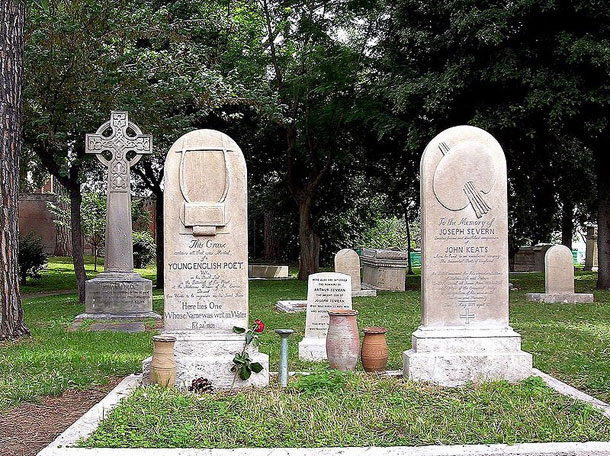
The deli is called Volpetti, on Via Marmorata. It really is great -- great cheeses, wonderful snacks. I got a spinach and ham calzone, then headed down the street to the cemetery. Not hard to find, as it is also the site of Rome's very own ancient pyramid. "Ancient" is a relative term where pyramids are concerned. Compared to the Egyptian variety, this one still has that new-pyramid smell. It dates from about 16 BCE, the tomb of a prominent Roman named Caius Cestius. The pyramid's back end juts into the old sector of the cemetery. This is where Keats lies, marked by one of history's most famous epitaphs: "This Grave contains all that was Mortal of a YOUNG ENGLISH POET, Who, on his Death Bed, in the Bitterness of his Heart, at the Malicious Power of his Enemies, Desired these Words to be engraven on his Tomb Stone: "Here lies One Whose Name was writ in Water." Feb 24th 1821."
It reads like the epitaph of a young man, a cry of anguish at the unfairness of early death. That's somewhat deceptive -- Keats requested only that last, memorable line. The preamble was added by friends. It seems the greatest anguish was reserved for those left behind.
Keats' friend Shelley was so impressed by the Protestant Cemetery that he called it, "The most beautiful and solemn I have ever beheld." He would be buried here in 1822, by the wall near the top of the newer, more crowded, most beautiful portion of the cemetery. There are tight rows of monuments, flowering trees, and stray cats, all well cared for. In the midst of noisy, chaotic Rome, the peace of this stone garden seems almost supernatural.
Representatives of many nations lie here. There's a Canadian flag on the grave of diplomat E. Herbert Norman; the 1899 tomb of Virginia officer Thomas Jefferson Page is decorated with fresh banners bearing the Confederate stars and bars.
Deadville
Inscriptions on the older monuments are carefully worded. Prior to 1870, when Rome was ruled by the Vatican, it was forbidden to make any mention of God or salvation on these stones, lest anyone think that non-Catholics might be bound for Heaven. So a favourite inscription reads: "Sacred to the memory of..." Beautiful as it is, the whole cemetery was intended to serve as a ghetto of the damned.
A beautiful cemetery can be a reassuring place. So many elegant monuments offer evidence that lives matter; people are remembered. But how many of the numberless dead are honoured this way? The tombstones here are the exception, not the rule. The real message of the beautiful Protestant Cemetery seems to be: Some lives matter.
Either way, the stones are full of implicit tragedy -- children, teenagers, English youths who died while making the Grand Tour. Most were luckier, laid to rest in good company in their beloved adopted city after long, distinguished lives.
Finding the entrance had proved tricky. I started at the pyramid and walked the perimeter wall, making it almost all the way around without finding the little gate. "How the hell do you get in here?" I was muttering, before catching myself. In fact, I had recently seen exactly how you get into a Roman cemetery. You simply step off a curb without looking.
'Un dottore!'
A couple of nights earlier, heading back to my hotel, I had come upon an accident. It seemed to have been recent -- no ambulance was on scene. I would later discover, however, that in Rome that doesn't tell you much.
There was a downed scooter and nearby, its rider, still helmeted, crying out in Italian to a sympathetic passer-by who knelt beside her. She was not happy, but at least she was speaking. The other victim was lying a few feet further up the road, doubled over, her face hidden from me. She neither spoke nor moved. A stream of blood ran to the gutter from somewhere close to her head. She appeared to be a young woman, her clothes suggesting an agenda of carefree clubbing. It was a Saturday night.
"Dottore! Un dottore!" a man shouted, as he felt for a pulse. Someone else suggested running to the pharmacy in search of help. A policeman was there, fiddling with a roll of yellow tape, but as the minutes passed no sirens approached. It seemed to me she was still breathing. But I had not seen her move. By the time I finally left, there was still no sign of emergency vehicles.
Next evening I passed by the same corner. Tied to a lamppost was a single bouquet, and a little hand-written sign: "Una morte ingiusto" (An unfair death). Like Keats' gravestone, there was no name. A waiter at the restaurant on the corner said the girl was only 17. But he didn't know who she was. Back at the hotel, the owner helped me search for a news story about the accident, but found nothing. No name -- not in ink, or blood, or the water of a fleeting online report.
Shelley would say of his future resting home in the Protestant Cemetery: "It might make one in love with death, to be buried in so sweet a place." He was not quite 30 years old when died -- still young, still in Rome. Like Keats. Like quite a few young people. ![[Tyee]](/design-article.thetyee.ca/ui/img/yellowblob.png)
Read more: Travel








Tyee Commenting Guidelines
Comments that violate guidelines risk being deleted, and violations may result in a temporary or permanent user ban. Maintain the spirit of good conversation to stay in the discussion.
*Please note The Tyee is not a forum for spreading misinformation about COVID-19, denying its existence or minimizing its risk to public health.
Do:
Do not: