


 SHARE:
Vancouverites have been known to grumble about arrogant Toronto. But imagine the plight of poor Lyon. When the topic is large French cities, does anyone even count up to two?
Even when you arrive here in France's second largest population centre, the first impression is almost of parody. Beside the huge Fourviere Basilica whose hilltop perch brings to mind Paris' Sacre Coeur, there is a structure that at first glance looks like the visible tip of another Eiffel. In fact, that tip is the whole of it. The Lyon tower is a small replica of its capital cousin, built four years later as an odd little imitation. Perhaps there are a few visitors to Vancouver who mistake the Harbour Centre for a poor man's CN Tower. But at least we built our poor man's tower first.
Since my arrival, Lyon has felt a bit like Vancouver in November. The city is a fair piece north of the southern French flood regions where 25 people recently died, but the weather has been similar -- frequently rainy, occasionally torrential, sometimes just mildly drizzly and damp. Still, Lyon is a lovely town. Once you get past the comparisons to that other French metropolis, you start to see this city's personality. For most visitors, that means its food.
Lyon is home to chef Paul Bocuse, and the prestigious Bocuse d'Or culinary competition. There's plenty of high-end cuisine on offer here. But the city is arguably more famous for the other end of the culinary spectrum -- the inexpensive regional joints that first sprang up to serve the local working stiffs. For reasons lost to history, these little Lyonnaise spots are known as bouchons (corks). Today, bouchons still serve regional specialties at amazingly low prices. How you will feel about those regional specialties may depend on your feelings about calf brains and pig intestines.
Heart dumb
Le Garet is a popular example. Reservations are supposed to book up a week in advance, but I was lucky and got a lunch date. It's cozy and crowded, the walls covered with pictures, soccer jerseys, and figurines. If you want more evidence that this is not some snooty Gallic bistro, check the drawing displayed behind the till. It features a rooster committing an unnatural act on a surprised bull. That sort of touch can lose you a Michelin star. The menu offers more proof that we are not in Bocuse country -- while lunch items can range up to about 16 euros, the daily special is only 10 euro.
Of course, it's easy to keep costs low when you cook body parts usually ticketed for cat food. Earlier in the week I had eaten an andouille, a haggis-like sausage tube filled with pig innards and served in a heavy cream sauce. The trick is not to think about it. But it's that much scarier when everything is in French. If my long-ago French classes ever covered livestock anatomy, I don't recall. But I recognize many of the names -- cervelle de veau is indeed calf's brains. Veal stomach and tripe are prominent too.
Lyonnaise cuisine is anything but light. Even the standard salade Lyonnaise is full of bacon and eggs. No little "Heart Smart" symbols on these menus. The closest thing to a vegetarian item at Le Garet would likely be the stewed digestive system of some large herbivore.
I am seated at a central communal table with several other diners. My meal begins with a complimentary appetizer -- basically a dish of pork rinds. I look at the daily special: Fricassee a rotaille a estragon. My French fails me. What bizarre agglomeration of obscure body parts might this be? The genial waiter switches to English to explain: it's chicken in a sauce of white wine, mushrooms, and tarragon. Plus a side dish of macaroni and butter. How very reassuring.
It is, of course, superb. In the end there's a bowl of cherries, and they're not even fried in pig fat. 10 Euros, all included. Un-scary on every level.
Feeling starchy
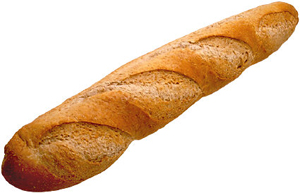
However, I have not entirely escaped the stressful aspects of French cuisine. One day I stop off at a local bakery to buy a couple of items. I want a flax baguette, but the clerk can't see which one I mean. I step around to a window at the side of the bakery, and pull one out of the basket. The clerk flips out. "NE TOUCHER PAS, MONSIEUR!" he says, eyes wide.
His co-worker attempts to explain. "It is... an inderdiction?" she says.
"But I'm buying it," I protest. "Doesn't that make a difference?"
They stare with grim incomprehension. What manner of man, they are surely wondering, cannot understand that one does not touch the baguette?
For my part, I may never understand the appeal of calf's brains in a lovely sauce. Perhaps our nations can never truly understand each other. But as long as I have the option of ordering the chicken, I feel that everything will be all right between us. ![[Tyee]](/design-article.thetyee.ca/ui/img/yellowblob.png)
Read more: Travel









Tyee Commenting Guidelines
Comments that violate guidelines risk being deleted, and violations may result in a temporary or permanent user ban. Maintain the spirit of good conversation to stay in the discussion.
*Please note The Tyee is not a forum for spreading misinformation about COVID-19, denying its existence or minimizing its risk to public health.
Do:
Do not: