- Ms Kaye is a Tyee Builder. You can be, too.
- Mary Carlisle is a Tyee Builder. You can be, too.
- Prem Gill is a Tyee Builder. You can be, too.
- Nancy Flight is a Tyee Builder. You can be, too.
- Justin Everett is a Tyee Builder. You can be, too.
- John Westover is a Tyee Builder. You can be, too.
- Nora Etches is a Tyee Builder. You can be, too.
- Edward Henderson is a Tyee Builder. You can be, too.
- Bharadwaj Chandramouli is a Tyee Builder. You can be, too.
- Dean Chatterson is a Tyee Builder. You can be, too.
- Marius Scurtescu is a Tyee Builder. You can be, too.
- Robert Parkes is a Tyee Builder. You can be, too.
- James Murton is a Tyee Builder. You can be, too.
- Susan Doyle is a Tyee Builder. You can be, too.
- Vincent Strgar is a Tyee Builder. You can be, too.
- Helen Spiegelman is a Tyee Builder. You can be, too.
- Subir Guin is a Tyee Builder. You can be, too.
- Kimball Finigan is a Tyee Builder. You can be, too.
- Joanne Manley is a Tyee Builder. You can be, too.
- David Leach is a Tyee Builder. You can be, too.
Private Land, Public Good, Texas-style
A ranch near Houston balances nature and commerce, to keep subdivision away.
BAYSIDE, Texas – If the Fennessey Ranch were in British Columbia, it would have been taken over by the Land Conservancy or the Nature Conservancy, or maybe even by some level of government. After all, it’s a high-profile demonstration conservation project, and high-profile demonstration conservation projects are the province of non-profit environmental organizations, if not the Crown itself.
But this is Texas, and the very thought of such a project being in public hands is anathema to Sally Crofutt, the ranch’s general manager.
“In Texas,” says Crofutt, “if you waited for philanthropy to preserve the environment, it just wouldn’t happen.”
So the Fennessey Ranch is privately owned, just as it has been for the past 170 years, and it’s run to make a profit, just as it has been for the past 170 years. The demonstration part of its conservation mission is, more than anything else, to prove to other ranchers and land-owners that it is in fact possible to make a profit while keeping intact the large tracts of ranchland so essential to Texas’s biodiversity.
The Fennessey Ranch is just 179 miles (288 kilometres) from the city of Houston, less than three hours drive on the Texas freeways, where 120 kph is the normal driving speed. Houston is now the fourth largest urban centre in the U.S. with Greater Houston’s population estimated at 4.7 million and sprawling further into the countryside every day.
The price of growth
The rate of growth, Crofutt says, means ranchers are being approached every day by developers who are interested in subdividing the historic large parcels of Texas land into subdivisions of five- or 10-acre hobby farms, much sought after as escapes from the city by those who can afford it. It’s always a tempting offer to ranchers suffering the vagaries of the beef market – the prices offered for the land are often more than they’ve been able to make in decades of ranching.
“But five or 10 acres won’t support the bobcats or the javelinas or a lot of the birds,” notes Crofutt. “They need the huge territories they’ve traditionally had.”
Complicating the situation in Texas is the huge percentage of the land in the state that is privately owned. Unlike B.C., where huge tracts of land are at least in Crown hands, available for timber harvesting but also for establishing a new park or reserve should the government of the day choose, more than 90 per cent of the state of Texas is under private ownership. It’s an historical anomaly, dating back to the end of the Mexican-American War when returning soldiers were all given large outright grants of land in return for their military service. But, as Crofutt notes, it makes it all the more important that ranch owners be persuaded to preserve their lands – there are simply no other means of preservation available.’
Crofutt’s job, then, is to find ways for a ranch to make money rather than just raising beef cattle in a bad market – ways to make enough money that ranchers can resist the developers’ blandishments. And her list of lucrative options is growing every week.
Texas tea always helps
She’s the first to admit that the Fennessey has one advantage that not all ranches have – a usable amount of oil and natural gas under the earth’s crust. A visitor to the ranch sees small oil derricks scattered throughout its 4,000 acres. The royalties bring in steady, year-round income, notes Crofutt – never a huge amount but always a cushion to support the other endeavours. The ranch insists, however, that the oil companies use environmentally sound procedures, and except for the towers themselves, their work is scarcely noticeable on the ranch.
The ranch also still maintains its herd of beef cattle, also managed to a high environmental standard. The cattle aren’t, for instance, allowed to graze right down to the banks of the Mission River, which borders the ranch on three sides. Crofutt explains that if you allow cattle to go right down to the river’s edge, their hoofs will wear away the grass and plants on the bank, and erosion will soon become a problem. So Fennessey’s cows have man-made ponds where they can drink, with water being pumped into the ponds if necessary during the dry season.
A ranch for the birds
Crofutt’s greatest enthusiasm, however, is reserved for the numerous projects she has begun in the area of eco-tourism. This, she points out, is one of the most rapidly-growing parts of the tourism market, and can be done with no or little harm to the ecology.
Bird-watching is one of the biggest parts of this operation. The ranch is in an area known as the Texas Coastal Bend, one of the best places in North America to see birds, especially in winter and spring. In the wetlands along the Mission River, birders may spot species rarely seen outside of Mexico, such as the secretive Green Kingfisher. The ranch offers special one-day tours providing expert guides who can identify birds by their songs without even seeing them. Later in the year, programs are offered to watch hawks and to see hundreds of hummingbirds moving through the ranch on their southern migration. A recent new partnership with another nature tour company allows keen birders to go out on a boat to see Whooping Cranes and other water birds for half the day, then spend the other half at the ranch.
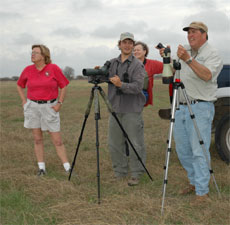
Photography safaris are another specialty with specially built blinds to allow the photographers unprecedented access to the wildlife without disturbing it. Top wildlife photographers are invited to the ranch to provide instruction.
For those with a slightly different view of the wildlife, there are opportunities for bass fishing in the lake, and even hunting for the deer that would otherwise threaten to overrun the property. Crofutt’s latest venture is astronomy evenings when telescopes are set up and astronomers help visitors pick out stars, constellations and planets in the wide-open Texas skies.
Crofutt is delighted to say that Fennessey is no longer the only ranch conducting such eco-tourism ventures. Several more are now taking steps in the same direction.
“This is the way of the future,” she says. “It has to be. It’s the only way we’re going to preserve what we have.”
Barbara McLintock is a contributing editor to The Tyee.
![]()


13
Login or register to post comments
BC Mary (not verified)
7 years ago
Nice story, Barbara. It gives hope to weary cowboys.
Windy (not verified)
7 years ago
What a wonderful way to operate a ranch. I hope to have an opportuntiy to go there, perhaps as a videographer.
BC Mary (not verified)
7 years ago
Nice story, Barbara. Can you imagine the Douglas Lake Ranch or the Gang Ranch star-gazing for profits?
Randy (not verified)
7 years ago
I thought private ownership was the root of all evil?
Ron Y (not verified)
7 years ago
Nice story and quite inspiring. Profit and responsibility need not be enemies. My cousin went organic with his apple orchard. I asked him why, he said that it's a better market and, as a new dad, he hated the thought of having any more toxic chemicals around the farm. I'm wondering about the bobcats and javelinas though. Why would they not be able to do their thing if the area is subdivided? They're talking about hobby farms, not putting condos on the land. Wouldn't the basic terrain be the same whether owned by one rancher or many?
Eric R. Green (not verified)
7 years ago
This response is a wide area perspective... Whether it is explicit or not, a sense of history, the current situation and a projected vision of what comes out of those two in the future are part of each and every attempt to portray 'the situation' honestly by journalists. That is: we are historians, accountants of current dilemmas, and futurologists. The very professional Barbara McClintock rates among the finest after an outstanding career in the puzzling field of contemporary journalism. When she writes, we should all have a look and consider what she says. I talk each and every day with a wide variety of people in business, politics and on the street. The issues of the day are often front and center in an open way, so the rolling issues of the dialectics of past, present and future are also front and center in control of what is claimed as 'fact' and what is obviously 'intepretation of fact'. In B.C. I gesture in the heat of discussion OUT THERE... and proclaim: "When I worked in the Ministry of Economic Development we controlled the statistics branch. Every professional of population growth made by government is LOW. It underestimates what actually happens." The point being made is that we must account for the popularity of our country to the masses who want a new start. Immigration and growth are directly related. We are now not replicating ourselves with fornication and baby creation. More startling is that we could DOUBLE B.C.'s population in 25 years if rates of growh continue to climb with positive international news about the value of natural resources. Look around you, folks. Place another body beside each and every person you encounter. Double the housing base, at least. Watch small towns and mid-sized cities in the Interior, South and North and eastern B.C. start to grow at startling rates as people sell out and banks some money, buying into equivalent or better homes in these places at half the cost of the property sold. Our history is a roller coaster ride. Our political commentators constantly ride the extreme in statements. Doom and gloom from the opposition gave the CCFers and then New Democrats excellent training in being critics. With Dave Barrett the New Democrats had to be 'the government of all the people' and all kinds of people had to learn the disciplined and law-defined processes of administration, which is management pure and simple. Now the replacement for the Socreds, the Liberals, is taking what it learned in opposition and trying to forget its absurd claims of disaster. The disjunction between statement and achievement is immense. The discussion of rational civic discourse requires us to ask large questions of the PUBLIC vs. PRIVATE dialectics we face and know so well, as the world does since the issue isn't set within neat borders and boundaries. It's global and philosophical. Careful conservation is not about ONE SIDE of the ideological framework winning or losing, and vice versa. It must always be about true CONSERVATION of precious land itself, however it is done. Righteousness is a poor substitute for fact, result and wisdom. Private solutions that work for the public good may well be good things. Historically owners of precious sites such as the one discussed by B. McClintock have not been just stewards that assured public interest. Often, as with government or public decisions about resource management, the conclusions have been disastrous as decades of mismanagement of fish stocks on eastern and western seabords displays clearly. Conclusions within political process always shape both individual effects along with collective effects. You cannot shape a society that has no individuals; any group of individuals makes a society. Obvious, of course. But a necessary corrective to the blind adherence to either/or. The grand diaspora described by anthropologists, as groups crossed the Bering strait or came by ship from Asia to North America, or even those that came long ago to Newfoundland's shores, interfered with 'the land'. Once here, with populations rising, there could be no return to pre-human presence. And yet we hear the wistful echoes of the wish to return in many comments about our interventions on 'the land', or land development. Social and economic development are not two things, but a single thing. A political party that genuinely confesses public rights and private rights will do better than one that claims only public officials can know what is good for us. And one that confesses this fusion of rights as inevitable will also do better than one that says private ownership is the sold legitimate and moral foundation for public and private decisions. Command and control models about land use that claim special rights for 'them that has' are no smarter than such models that claim only the general population has rights, as filtered by the thinkers of the day. Why not open up our minds and be freethinkers with people such as Christopher Marlowe and William Blake? Why not balance and judge with a view to historic fact and equity, instead of proclaiming special rights for one view over the other? Greed-driven private decisions have been disastrous to large blocks of 'the land'. Public decisions have authorized much of this, and often public decisions have been equally disastrous. Mistakes are mistakes. The results are toxic in both a technical sense and with reference to the impact on the commonwealth we presume to live in. Toxic? People assume they know what it means. Check it out. Too much water can be 'toxic', as scientists define the term. That is, a good thing can be a bad thing. It puts you in mind of the great puzzler Heraclitus who declared, "You can't step into the same river twice." And, "The way up is the way down." He might in our time have said something such as: "The private way is public; the public path is private." We have to examine much more closely this long-held battle in our civic discussions about EXACTLY what we mean when we use these concepts. History hates sloppy thinkers. Barbara McClintock is not one of them, and she is thanked for her efforts. erg
Eric Green (not verified)
7 years ago
Please change spelling of Barbara's name to McLintock in previous submission. thanks... factchecking deficient this morning...
Eric Green (not verified)
7 years ago
Please change spelling of Barbara's name to McLintock in previous submission. thanks... factchecking deficient this morning...
Jennifer (not verified)
7 years ago
This is exactly the kind of "out of the box" thinking we need to embrace more fully. Realize that private enterprise can be successful while embodying responsible corporate citizenry. Ninety-nine percent of what I see reflected in the media (Tyee included) is the left and right demanding one drop all of their ideologies and adopt the mantra of the other. It's time to stop pandering to and blindly following the leaders of either side. Instead we should be taking the best of both worlds, and finding innovative ways to advance everyone's interests.It's possible to achieve success in both business and conservation simultaneously.
Bailey (not verified)
7 years ago
Let's see if I got this right. A private philanthropist, referring to public protections of the commonwealth ecologies, calls it "philanthropy to preserve the environment". Then says, having taken all the trees and put em in a tree museum, that she can charge the people a dollar and a half just to see em.
Don't it always seem to go, that you don't know what you've got till it's gone?
I wonder if the eco- tourists will need a place to park?
Oh, right (not verified)
7 years ago
And I left out the best part. The paradise she's preserving is her own private oil patch. This is just too rich. It's too soon for April fools, guys.
TJ (not verified)
7 years ago
What About A conservation easement on the property?? You can get major tax benifits by establishing one, especially on a parcel of the described acreage.
Bailey (not verified)
7 years ago
Dear Ms. McLintock; I apologize for my snotty little dismissal above, Your story is an interesting report about an interesting phenomenon. It's a personality flaw of mine that once you feed me a straight line, I just can't resist it.
Now I read it, it's really quite unfair.