
Artsculture

The Princess Consumer

Women who yearn to shop, not grow up. They're 'Enchanted.'

By Dorothy Woodend, 7 Dec 2007, TheTyee.ca

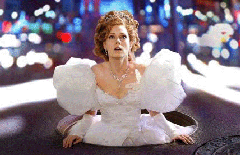
Amy Adams 'Enchanted' promo shot

Amy Adams as Giselle

Last Halloween, I was standing on the playground of my child's elementary school surrounded by a sea of princesses. Every little girl, it seemed, was dolled up in a froth of pink tulle and satin, topped off by a tiara. It was eerie, in a very frilly way.

Still, I can see the lure of princesses for little girls, sort of. But for fully grown women?

Director Kevin Lima's new film Enchanted is seemingly made for all the women who grew up on fairytale endings. But growing up is perhaps the wrong word to use. Permanently infantilized might be a better term. Giselle (Amy Adams), the heroine of Enchanted, has all the mannerisms of a demented eight-year-old. She flits between cloying and coyness, and occasionally bursts into song and tears. Sometimes both. Get this woman some mood levelling medication. She might be a Disney heroine in the old school tradition, but she also seems to be suffering from bipolar disorder

Just a bucket of sugar

The film begins with an extended zoom into Uncle Walt's Disney Castle, and before you know it the voice of old suckie-pants herself, Julie Andrews, is coating you all over with a spoon full of sugar. Make that a bucket full of sugar. Andrews narrates an age-old tale of young love and old power that begins, "Once upon a time in a far-away land called Andalasia lived a young maiden named Giselle. . . ."

Like all good girls, Giselle is patiently waiting for her prince to come. In the meantime, she's fashioned a rudimentary semblance of said creature to smooch with. This is not a giant sex toy, however, since sex doesn't actually exist in Andalasia. Alas, the stiff also lacks a pair of lips for true love's kiss, since, as Giselle trills, "Only lips can touch." Keep your other body parts to yourself, thanks very much. George Bush might want to adopt that line for his abstinence-only programs.

Giselle's warbling soon draws the attention of a real live cartoon prince (James Marsden), a handsome dolt. The pair meet, sing and get married the next day. Or at least they try, but true love's course never runs smoothly, thanks in part to a jealous old queen named Narissa. Where's Quentin Crisp when you need him? Susan Sarandon will have to suffice, and as Narissa, she works her evil eye shadow for all its worth. Next stop for Giselle: Times Square, NYC.

God apparently watches out for drunks, small children and fairytale princesses, and instead of getting beaten and shanked in a dark alley, Giselle bumps into a divorce lawyer named Robert (Patrick Dempsey) and his young daughter Morgan (who still believes in fairytales). They fall under her spell and the rest is history of the happily ever, chaste kiss on the lips, kind.

Fairy tale consumers

Sometimes you learn more about a film from watching the audience than you do by paying attention to the action onscreen, and that is the case here. Pity the poor slumped-over kids who came thinking it was Disney animation, and got suckered into some wretched excuse for romantic comedy. Most of them looked bored almost to the point of disgust.

Enchanted is not a film for kids at all, nor teenagers or the twenty-something porn generation, who might be hard pressed to get the shtick about true love waits. The film seems to appeal mostly to younger women of the kind who buy bridal magazines and watch Sex in the City without the icky bits. In the world of Andalasia, a fairytale kingdom of handsome princes, evil queens, and twittering forest creatures, of which Giselle is apparently the most twittering, love is instant and forever.

The twist is that the real world is governed by the same rules. Despite the fact that he's a downtown divorce lawyer, Robert is still a prince, as evidenced by his palatial New York apartment. Fairy tales can be about overcoming social barriers and superseding class divisions. But not this one. Giselle still ends up at the top of the heap, rich, beautiful and privileged, just like a real live American princess.

Much has been made of the fact that Enchanted is a Disney film that sends up the conventions of a Disney film, but the joke may actually be on the audience. Aside from a few instances of chest hair fondling, everything else is pretty much the same as it was in Cinderella's day, papered over with a very thin layer of irony.

It's not a new idea. Certainly The Princess Bride or the Shrek series demonstrated there's gold in rehashing, with dashes of irony, old stories for young minds. Even something like Beowulf takes an ancient tale and dolls it up with splashy stuff like CGI six packs and a golden Angelina Jolie. If we adapt fairy tales to suit our time and age, modern myth-making of the middle-class variety hammers gender divisions home with an iron fist. Films like 300 or Beowulf are to boys what Enchanted is to girls. Every girl is a princess and every boy a warrior king.

King Dollar

Just as the Brothers Grimm expurgated any sexual references in their collection of fairy tales, and the Victorians did likewise, Enchanted also takes out any real human emotion, and replaces it with sheer excess. Show-stopping sequences that make the entire city of New York into one enormous musical are so over the top they're exhausting. But the film wants to have it both ways. It wants to be both innocent and knowing, the full-on schmaltz waltz tempered by self-referential asides.

The product placement is so unabashed and shameless, it almost beggars description. As the camera carefully zooms in to frame individual logos for Calypso Perfume, or Jimmy Choo shoes, you can't help but feel any real feeling is completely undercut by the hard cold business of making money. It's not really a movie, just another extended advertisement for the fantasy world that only money can buy. And perhaps, that makes it more a Disney movie than anything else.

Maybe I harbour a lingering aversion to the entire Disneyland ethos, but the sense that this magical kingdom, like some enormous gossamer soap bubble, now extends to most of Western culture is more than creepy, it borders on malignancy.

Fairy tales were meant originally as a form of inoculation for young hearts and minds against the fact that life is nasty, brutish and short, a reality that holds true still in large sections of the world. In North America, stories like Enchanted do something else entirely. Every girl is a princess, and we all deserve a dreamy fairy tale ending. In this spun sugar fantasy land, where evil is vanquished, love never ends and shopping is so much fun, the moral of the story is keep sleeping, beauty.

Related Tyee stories:

 [Tyee]

11  Comments:

  • dorothy

    07-12-2007

    Too far to go

    "Even something like Beowulf takes an ancient tale and dolls it up with splashy stuff like CGI six packs and a golden Angelina Jolie. If we adapt fairy tales to suit our time and age..."

    Just to be sure it's understood, Beowulf is not a fairytale, or even a 'story'. It has numerous references to people, events, places and relations, which are parts of recorded history. The fairytale aspect comes in, because people far removed from the place and culture of the origin of the poem fail to understand the type of metaphorical language used, the 'kennings'. This is a culture, which would call the world tree the 'steed of the terrible one', or Yggdrasil, due to its alleged function as a shamanic device. Clearly, seemingly 'supernatural' concepts cannot be taken at face value. Just to clarify. Sorry, but this is one piece of writing I really treasure, and I am already hurting from Hollywood taking its hatchet of 'special effects' to it. Also an interesting point is, that the women in Beowulf, the original, were certainly not princesses in the 'enchanted' understanding, rather they would make one think of warrior queens. For sure, they were not little pieces of fluff, but powerful, charismatic figures.

  • Peter Dimitrov

    07-12-2007

    Consumed

    I regretably agree Dorthy that your analysis is more accurate then not, but why do you blame the victim and not point your finger at the perpetrator. Why not too make similar arguments for men and boys, the princes that many are. Then there are the leaders of governance and business, whether men or women, who poorly integrate the archetypes of King/Queen...and instead manifest the shadow aspects, as Tyrant King/Tyrant Queen...aka. Tyrant President/Tyrant Prime Minister/ Tyrant Premier..and we see that authoritarianism manifest in the world, along with the plethora of princes and princess who become the 'followers' of Tyrants/Authoritarians.

    Indeed, as Marx, might have said, the dominant mode of production, namely neo-liberal capitalism has considerably shaped the integrity, values, characters of children & men and women. The ad budget for ads directed towards children is in the 5 billion/year range..this is shameful abuse of corporate power. Is it any wonder that the market manipulates the needs, wants and identities of individuals, nay, whole societies. Is it any wonder that democracy is in steep decline as values are corrupted, adults are infantilized & beguiled by drugs, alcohol, prescription medications to softly ease the sufferings that are inherent in the human condition, as we are soothed by an endless stream of stupid goods, movies and music for dumbed-down adults, etc. Indeed the neo-liberal market has swallowed the citizen - now many are merely consumers - with eroded legal rights. Then there are the ecological impacts of this puerile market culture. In my mind the victims here, deserving protection from the excesses of the market and global Capital are children and also adults, and the local/provincial/national/global ecosystems ..which acts as a sink, a mere externality for Capital's excess. What can practically be done to reverse this trend line is a topic meriting thought and discussion?

    ...

  • nightbloom

    07-12-2007

    Great review & commentary,

    Great review & commentary, Dorothy.

    On the subject of princesses and heroes (and hero-princesses!), one of the interesting things I noticed about Golden Compass (the movie….I haven’t read the book) is that it attempts to re-cast the Hero’s Journey using a female cipher (i.e. she’s the hero executing the Journey itself, not the passive heroine who is an aspect of – and occasionally a reward for - the journey). It’s been done before, true, but this time they’re trying to get all the secret hot-buttons down right (including even the dark revelation concerning legitimacy and parenthood – typically a boy-thing in these stories, Luke & Darth Vader style).

    Some of it translates well, and some doesn’t. They still couldn’t quite transcend the static passivity of the Princess though (i.m.h.o.). Heroes must traditionally overcome threshold guardians (representing internal blocks to self-realization) and submit to the guidance of one or more mentors before they attain wisdom and advance on their quest for the Elixir (whatever that may be). Failure to meet and surmount these challenges is the mark of the tragic anti-Hero. The moviemakers (or the author, more likely) messed up this algorithm slightly, and presented a Hero who needs no such resolution, who tells the mentors how it is, and who derives her “wisdom” effortlessly and without growth or trauma simply by gazing passively into the Golden Compass to obtain answers to the mysteries around her. So unlike, say, Dorothy in the Wizard of Oz, the protagonist of the Golden Compass does not seem to transform in the way Heroes are supposed to, and will ultimately be the same person she started out as, and only external circumstances will be altered. At least that’s how I read it.

    Sorry for the tangent – I’m still working on it! BTW, I luved Beowulf (sexy!) but was intrigued by this Chronicle Review commentary on it:

    Never Mind Grendel. Can Beowulf Conquer the 21st-Century Guilt Trip?
    http://chronicle.com/temp/reprint.php?id=7wc3412n8vf2qhtz4hsdwzb86ffyzf67

    They’re basically saying that the pagan, almost Nietzschean Hero-archetype of the original manuscript was altered in a manner consonant with liberal, Christian and Tolkienesque influences to create a totally different, modern and "liberal" Hero paradigm.

    Thanks again for the great article!

  • alive

    08-12-2007

    so stop it!

    Yep, great stuff here, thanks Dorothy.
    But what is the conclusion?

    Do we still buy the same toys for Xmas?

    Do we still push the same agenda where little girls are dressed up as mature females long before puberty?

    Do we still reason that a tour in the armed forces will bring the man out of that boy?

    The way our society has developed is more of a joke than anything, not so sure if we can blame Disney altogether!

  • Peter Dimitrov

    08-12-2007

    U.K. Inquiry into impacts of Ads on Children

    Adverts impact on children probed

    The government is launching a major inquiry into the possible harmful effects of advertising on children.
    The probe, being announced as part of a wide-ranging 10-year plan for children, comes amid fears a commercialisation of childhood is fuelling social problems.

    It will look at evidence of links between adverts and dissatisfaction, anxiety, eating disorders and drinking.

    Children see some 10,000 TV adverts a year and recognise 400 brands by age 10, Children's Secretary Ed Balls says.

    'Sexualisation' of girls

    Speaking before Sunday's announcement, he said many parents were concerned about youngsters being bombarded with adverts and media images that encouraged the "sexualisation" of girls.

    Mr Balls said the inquiry would be carried out by leading child psychologists and academics, who would look at the cumulative impact of advertising on different aspects of childhood and well-being, to see whether commercial pressure had a "negative impact".

    "We need to look at the evidence around commercialisation before we jump to any conclusions," he said.

    Mr Balls said a ministerial group would examine the links between advertising and binge-drinking among children, including the effects of a "spike" of alcohol adverts on television between 4pm and 6pm.

    'Advertising controls'

    Mr Balls said he would not rule out introducing new regulations but stopped short of suggesting a ban on alcohol advertising before the 9pm watershed.

    It comes after a major study by Ofsted last month found that one in five 10 to 15-year-olds regularly got drunk.

    The BBC's James Westhead suggested that, rather than trying to ban adverts targeted at children, the government was more likely to try to foster a sense of responsibility among advertisers.

    There could be tighter controls on fast food and alcohol advertising, he said.

    The details of the inquiry and the rest of the 10-year children's plan are due to be announced by Mr Balls on Tuesday.

    Our correspondent said this would aim to look at all aspects of children's lives and could include changes in the design of schools, to include on-site medical and social services, as well as attempts to get parents more directly involved in school activities and to improve the provision of safe play areas.

    It is also expected to include a review of Sats tests and the primary school curriculum as well as an announcement of free nursery care for children as young as two from poorer families.

    The plan has been drawn up following a consultation process involving children.

    Story from BBC NEWS:
    http://news.bbc.co.uk/go/pr/fr/-/2/hi/uk_news/education/7134943.stm

    Published: 2007/12/09 05:20:27 GMT

  • catwinc

    09-12-2007

    This movie is worth watching

    I think it's worth noting a few things.

    The reason why shows up in NYC in an over the top white frou frou dresss was because she was just about to marry a prince.

    This movie wasn't just a homage to shopping, Giselle hand made two of her dresses in this movie.

    The "clean up" scene in the apartment was worth the price of admission! I would still recommend this movie.

  • The discussion for this story is closed. No more comments can be added.