Artsculture

Eastwood’s Right Hook at Bush

You’ve had enough time to see ‘Million Dollar Baby.’ So we can give away its ending, and politics.

By Michael Fellman, 5 Apr 2005, TheTyee.ca

milliondolloar babe

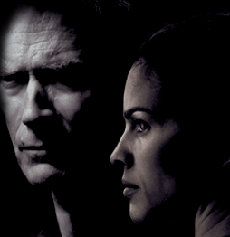
Director and star, Hilary Swank

The peculiar etiquette of movie reviewing—don’t give away the surprise ending—has meant that there has been little discussion in print of the deeper themes of Clint Eastwood’s Million Dollar Baby. But the film has been around a long time now and so I feel free to violate that rule in the name of analysis. I will get to that ending several paragraphs below.

In his last three films, Eastwood has inverted genre films as well as his own career. Unforgiven was Eastwood’s anti-Western; his critique of the assumptions of heroism depicted in American Westerns, including his own earlier efforts. Thirty years ago Eastwood celebrated the silent, violent, solitary macho hero who rode the range in Italy-as-Mexico, coming into town and blowing away the bad guys without any discernable affect on his face or doubts about his actions. In Unforgiven, he rethinks and recreates this type as an anti-hero, who, called back from retirement into his violent trade, ends up by destroying everything of value in a kind of self-blinding and wildly destructive nihilism.

In Mystic River, Eastwood deconstructs the socially marginal urban tough guys of the type he had portrayed in his Dirty Harry movies. Harry was famous for his line “make my day,” as he prepared with considerable sadistic pleasure to blow away an evildoer, using the biggest pistol in the armory. In Mystic River, his anti-hero, brilliantly realized by Sean Penn, blows away an old friend whom he suspects had killed his daughter, only to find out that he had been wrong in drawing this conclusion. So much for the vigilante tradition, Eastwood is saying. It seems pretty clear to me that in Eastwood’s mind Dirty Harry was as much a mistaken hero creation was the gunman of The Untouchables, as complex and ultimately evil a figure to use to negotiate American society.

(Professor’s aside: The best analysis of the isolated killer in American mythology is the magisterial three volume work of the literary scholar, Richard Slotkin, particularly Gunfighter Nation, which deals with the sorts of figures Eastwood used to celebrate and now rejects.)

Close your eyes for the ending

Million Dollar Baby, a much weaker film than its predecessors, mainly due to a cliché-ridden script, takes apart the rags-to-riches fable, the up-from-the-wrong-side-of-the-tracks tale so dear to American legend makers. His hero is now a heroine, though she is definitely a tough guy from the American rural outback, making her way with her fists. Her manager and her trainer are crusty old coots who have been in the fight game for several decades too long. Once again, Eastwood is a loner in a world of violence. There are some odd and unconvincing turns in this version of the story—Eastwood’ old coot reads Yeats and is a hyper-pious Catholic obsessed with sins committed decades ago—but he essentially suffers in a very private way.

(Film Buff’s aside: No actor since Gary Cooper has been able to convey so much pain in his eyes when words always fail him. I think that Eastwood has gone to school on Cooper, who played similar roles many times.)

Now to disclose the secret. After punching her way to a championship fight, The Tough Girl gets clobbered in the back of the head as she walks to her corner at the end of a triumphal round, cracks her head on the stool Eastwood has placed in her corner and falls into a coma, only to awaken eventually as a quadriplegic. Interestingly enough The Tough Girl is white and the dirty fighting champ is half-German, half-black, probably born as the by-blow of an affair of an African-American soldier and a German prostitute. Nothing more is made of this sort of racial inversion, but the champ is clearly evil by nature while The Tough Girl is a bit innocent despite her violent trade.

The other part of the secret. Eastwood nurses The Tough Girl, who, when she realizes what the rest of her life will become, begs him to disconnect her breathing tube and kill her for the sake of mercy. After much internal agony, as shown in those Gary Cooper eyes, knowing as a deeply believing Catholic that he is committing a mortal sin (and no other religion would have done), Eastwood disconnects the tube and shoots poison into The Tough Girl’s IV. He then takes off for the territory, where he will live out his days in solitary and isolated pain.

So much for rags-to-riches. So much for the self-made-woman. Realistic human suffering trumps legendary triumph.

Clint’s right stuff

I would argue that all three of these remarkable films are the creations of a conscious and highly intelligent auteur. Eastwood knows exactly what he is doing with the genres dearest to the hearts of the American public, and he is at the same time committing acts of contrition for his earlier promotion of virulent values that he had once embodied. He is by far the most interesting mainstream American filmmaker, the most significant director/actor of anti-triumphalist schlock.

But it is also clear that Eastwood’s critique of American myth comes from the right, not the left. His films are still grounded in individualism and toughness of the independent spirit; they are not in any way collectivist or liberal-minded.

In this context, Million Dollar Baby is Eastwood’s clarification of just what sort of right wing critique he is making of American society. He knew full well before he started that the religious right would violently reject the denouement of his film—they hate euthanasia as a violation of the sacred Right To Life. As the current terrible Schiavo story in Florida is also demonstrating, the American right is divided over euthanasia—as it is on abortion. The religious right, including the Catholic right, believes all life should be preserved, as a public good more important than private choice. Haters of the state when it comes to things like paying taxes and helping poor people, the religious right embraces the state when it comes to right to life. With keen insight, Eastwood has an obsessively Catholic figure make the choice of private over governmentally reinforced public morality. His position is far more Barry Goldwater than George W. Bush. Individuals must make decisions of conscience, even if (or especially if) those choices go against collective moral codes, whether of the state or of a political movement. Eastwood thus attacks the religious right from the libertarian right.

Ironically (or not), this film probably won the academy awards because liberals in Hollywood embraced Eastwood when the religious right attacked him. What Eastwood makes of this turn of events no reporter has asked—not that any one would mind winning the prize no matter who voted for him. He may even have been a bit cynical about some of the likely inferences others would draw about the politics of the film in order to stir up debate and win new friends.

White hats?

It doesn’t really matter what motivated Eastwood, who I suspect is a pretty complex guy. What might matter to me at least is that Eastwood has shown a way to drive a wedge between the forces of the right, a wedge that the obtuse Democrats might actually learn to exploit by 2008 (though John McCain is perhaps better positioned to drive in the stake, and George W. Bush himself is backing away from the Right-to-Lifers after reading in the polls over the Schiavo case that 63 percent of Americans want the state out of private life).

In the meantime, I find Eastwood’s critical individualism a significant political move in the realm of mass culture. His is the best currently available critique of the worship of American violence. In his three films he has developed a deeply thoughtful undermining of the abiding and utterly self-righteous faith that Americans always wear the white hats when employing mass violence against each other and the rest of the world.

Historian Michael Fellman is Director of the Graduate Liberal Studies Program at Simon Fraser University.  [Tyee]

18  Comments:

Login or register to post comments

  • Korky Day

    6 years ago

    Comments on "Eastwood’s Right Hook at Bush"

    I haven't seen the movie, so I won't read this yet.

  • PEZ

    6 years ago

    I believe "The Untouchables" was a gangster movie starring Sean Connery and Kevin Costner.

    Perhaps the movie referred to in the article is "The Unforgiven", a western starring Clint Eastwood and Gene Hackman.

  • lynn

    6 years ago

    I love the originality of this review. It speaks to an honesty that is often not present in depictions of a left-right view of the world, to the hypocrisies that course through both sides. Eastwood is clearly on the side of thoughtful consideration about the complex meaning of being human, and how willing we are to face our contradictions. Contradictions that exist for example, in the religious right's fervent belief in right-to-life while at the same time zealously endorsing the death penalty...and then there's the left...and our pretense of niceness, a kind of self-righteous timidity that tempers our true force and betrays our real values.

  • Michael Fellman

    6 years ago

    Yes of course, the first film of the trilogy was "The Unforgiven."

  • Coyote

    6 years ago

    An excellent film I thought. And your observation about Gary Cooper and Eastwood was very insightful.

    And then there's Lynn's insight into the left. A really good one, woman. Really good.

  • Yammer

    6 years ago

    "Acts of contrition"? Of his entire oeuvre, the only one that is more or less clearly self-referential is Bronco Billy, the story of a shoe salesman who dreamt himself a circus cowboy. A less polemical filmmaker than Eastwood could scarcely be imagined. Eastwood is attracted to material of all sorts. He's done science fiction adventure with "Firefox" and "Space Cowboys," romance with "Bridges of Madison Cowboy," kinky thrillers with "Play Misty For Me" and "Tightrope," military action with "Heartbreak Ridge," buddy action with "The Rookie" and the orangutan movies, and of course westerns and cop flicks.

    If he's a foremost example of anything, it would be "thrifty businessman," having set up Malpaso largely out of disgust with the budgetary excesses he observed on "Where Eagles Dare." Given the staggering diversity of material put out by his company, the most consistent theme you can point to is that his shoots are famously disciplined and generally well under budget.

    As a critic, I understand the temptation to pluck out a consistent trope to the work of a particular director, but in Eastwood you have one of the least cooperative examples of auteurism.

    For far more obvious examples of current Hollywood directors who use the consequences of violence to repudiate the white-hat mentality, consider Martin Scorsese (Taxi Driver, Casino, Goodfellas, Gangs of New York), or the underrated Paul Verhoeven (especially Flesh and Blood, Robocop, and Starship Troopers).

    Lynn - your remark about the self-defeating timidity of the left is something that's always bugged me. For a musical examination of this theme, check out "Fight Test" by The Flaming Lips.

  • mbjc88

    6 years ago

    I don't like to see the right to life mixed with the death penalty.

    When someone rapes a girl repeatedly, then tortures her a bit and finally puts a gun in her mouth and shoots her ... i don't have any trouble with the state executing him.

    He made his choices and now there are consequences.

    Whereas one who can not speak for themselves, one who has done no outrageous act against another, it is these ones the right for lifers speak for. Someone else is deciding whether an innocent one can live or die.

    I think they are very distinct groups.

    I am waiting for the day when everyone over the age of 72 will be greatly encouraged to end it all with a simple injection. The reasoning will be so simple. After all you are a drain on society. Wouldn't you really like to end it all now? Look at the world population. There are limited resources in this world. Do the right thing. Don't be selfish.

    I can see the possibility of that scenario coming and no one being terribly upset with it.

    Man who said he could never fly continues in a tailspin descent.

  • Truman Green

    6 years ago

    Eastwood's contrition films don't cut it with me having had a sibling shot to death by a fan of mindless violence of the kind Eastwood is famous for celebrating. (I Think I once saw him shoot twenty-eight guys out in the desert somewhere--on film, of course.) Why Fellman's elevated him to philosopher-auteur is beyond me. The guy's a businessman, eh. He made his first fifty mill making stupid films and his second pretending that he's sorry.

  • Fii

    6 years ago

    I haven't seen it yet...

    So I've skipped the article and all the comments (a first for that), and I'd better go to another thread now... hi Coyote!

  • lynn

    6 years ago

    It is interesting though that Eastwood in these films could have gone for the "Rocky" moment, the one George Bush plays to and counts on - crowds cheering on their feet, music ignites, and the american spirit once again prevails. America the Good triumphs over all that stands in it's way.

    In a more radical move he brings the focus down to the simple human element where individual choice and it's more difficult grey areas must battle the grand but simplistic arena where George Bush and the religious right reign.

    Anyway, that's The Tyee for you, somehow I've found myself defending Clint Eastwood films and listening to The Flaming Lips. (Thanks Yammer, I found their website, great song.) All the same, I enjoyed Fellman's review and it's orginal take.

  • lynn

    6 years ago

    that should "original" take

  • Truman Green

    6 years ago

    Hi,lynn. Seems we disagreed on this one but I always read your comments because I know you're going to write something interesting. So anyway...I thought I'd mention that "it's" is an abbreviated form of "it is" and "its" signifies possession, as in "its original take" and "its way". This is not to be critical or smartass. (I have a lot of free time) I bet you could pick out errors in my comments, too. Heaven knows, I often do after it's too late.

  • Yammer

    6 years ago

    Lynn - which Rocky? Rocky lost in "Rocky." His victory is that he was able to hang in there with Apollo Creed, winning his respect and his own self-respect. Stallone didn't invent a winner, but a survivor, inspired by Chuck "The Bleeder" Wepner, the boxer known for leading with his face.

  • lynn

    6 years ago

    Okay, now for my own acts of contrition: Truman, I stand corrected on the "its", my typing is even worse than my punctuation! (notice my correction on my correction). I am not disagreeing with you on the violence of Eastwood's previous movies, only that I do agree with Michael Fellman that he has become an interesting director for his shift of focus towards a closer and more revealing study of the human choices we make as they come up against the stridency of certainty as embodied in ideology and religion.

    Aside from that, and just based on nothing more than woman's intuition, the little I've seen of Eastwood in interviews, he seems so totally self-effacing, with an outsider's generosity of spirit, that I think his contrition is genuine. Why can't we change, evolve in another direction after all?...Anyway, I believe him, quite a lovely man, I think.

    Yammer: Another mea culpa from me and the day is not even over. You are right, I am wrong. I was really just thinking of that "winning" crowd scene you see a thousand times in american movies, the waving of the flag for the american dream, and somehow Rocky popped into my head and evidently stayed there. I actually liked that movie a lot. You're sure Rocky Balboa lost?:-) It is Balboa isn't it?:-)Never go up against a movie reviewer...

  • Yammer

    6 years ago

    Lynn - Don't apologize! I am a film geek! With a big mouth! Don't be like me!!!

  • Yammer

    6 years ago

    As for "feminist" themes in Eastwood's work, I think we can see them as early as The Beguiled and The Outlaw Josey Wales. He does seem like a cultured and reasonable fellow at times, but then there's his jocular threat to kill Michael Moore, and all of those ex wives. They might think he was a bit of a prick!

  • Truman Green

    6 years ago

    Hi lynn. I must lead a very karmic life. After correcting your its and it's I made the same mistake in another thread, and had to correct myself. Anyway, I think you're naive on Eastwood, eh. I think he's a phony.

  • RickW

    6 years ago

    To Truman Green:

    Quote:
    I Think I once saw him shoot twenty-eight guys out in the desert somewhere

    I think that was Bruce Willis.....

    From the article:

    Quote:
    The religious right, including the Catholic right, believes all life should be preserved, as a public good more important than private choice

    It's not so much the religious right believes all life should be preserved, as the RR is much in favour of military "solutions". It's just that the RR believes death should be more of a "crapshoot", where one has a chance, however small, of surviving.

    • No best comments selected by an editor for this story yet. To see all comments, click the All Comments tab, above.
    • The discussion for this story is closed. No more comments can be added.