

- Heaven Cracks, Earth Shakes: The Tangshan Earthquake and the Death of Mao's China
- Basic Books (2012)
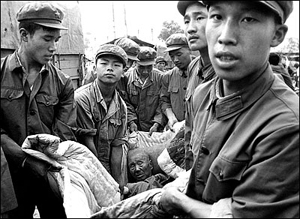
At 3:42:53 in the morning of July 28, 1976, the industrial city of Tangshan in northern China was struck by an earthquake. Twenty-three seconds later, it was over.
As James Palmer says in his fascinating book, "The 23 seconds of the earthquake were probably the most concentrated instant of destruction humanity has ever known. In Tangshan alone it did more damage than either Hiroshima or Nagasaki, more damage than the fire bombings of Dresden or Hamburg or Tokyo, more damage than the explosion of Krakatoa. It took more lives in one fraction of north-east China than the 2004 tsunami did across the whole Indian Ocean. The actual scale of the earthquake itself was not remarkable -- 7.8 on the Richter scale, terrifying but not that rare. It was the speed, timing and placing of the quake that made it so devastating."
Palmer makes it clear that Tangshan was a political event as much as a seismic one. Metaphorically, this was one quake too many after decades of upheaval. It prepared the way for today's China -- the world's sweatshop, America's banker, and a market capable of making even Stephen Harper's Conservatives kowtow to Beijing like any other foreign barbarians.
Palmer's book, a combination of disaster story and political thriller, reminds us of how quickly foes turn into friends (and sometimes back again).
Like North Korea on steroids and crystal meth
If you were born after Tangshan in 1976, you cannot imagine how we used to regard the People's Republic of China. Even my bolshy dad (who once served as Norman Bethune's driver), thought Mao's China was creepy. Mao had humiliated General Douglas MacArthur in Korea, funded and equipped the Vietnamese against France and then the U.S., and built his own nuclear weapons. His Cultural Revolution looked like 800 million people going violently insane.
By 1976, China resembled today's North Korea on steroids, LSD and crystal meth. In the 17 years since the founding of the PRC in 1949, it had scared the daylights out of everyone, including the Soviet Union.
Yet Canada had recognized the PRC. I well recall seeing a can of green beans, imported from China, on the shelf of a North Vancouver grocery store circa 1971. As a recent immigrant from the U.S., I bought it for the sheer subversive thrill of Trading With the Enemy.
Nixon's trip to China in 1972 had built a tenuous link to this strange and dangerous giant, but the Gang of Four seemed to be in charge while Mao rapidly declined. Palmer makes it clear that the Communist Party was divided at the time.
The death of Premier Zhou Enlai early in 1976 sharpened the divide between the far-left Gang of Four and the more moderate faction supporting Deng Xiaoping. Praise of Zhou was a disguised criticism of the far left, which the Gang understood very well. They tried to suppress the grieving for Zhou, which made matters worse.
Anticipating an earthquake
At the same time, Chinese seismologists faced a political problem of their own. They had predicted an earthquake with uncanny accuracy, which Beijing turned into a propaganda campaign. Now the scientists were expected to predict them all, and some believed a magnitude 5 or 6 quake was imminent in the Tangshan region.
But they were hesitant to make a firm prediction. Evacuating the region would be a blow to production in the city, which was a major industrial centre. And if the quake didn't come, the government would be worse than furious.
So when the 23-second quake did come, it was without warning in the middle of the night. Palmer thinks 650,000 deaths is a reasonable estimate for the city and surrounding regions.
The shock was felt in Beijing as well, where Mao -- dying of Lou Gehrig's disease but still in power -- was moved to a more secure building in the Forbidden City. And while the Cultural Revolution had thrown out much of the old China, the concept of the "mandate of heaven" was still ingrained: the idea that heaven sanctioned an emperor only as long as he ruled justly.
As Palmer explains it, "The legitimacy of the Mandate of Heaven was not judged by the mere occurrence of natural disasters, which were inevitably frequent in as huge a country as China. The disasters themselves didn't show that the rulers were doomed; the failure to manage or anticipate floods or earthquakes did."
A botched recovery
So the government's response to Tangshan was critical. Mao's apparent successor, Hua Guofeng, actually went to Tangshan, which no other leaders did. This was a smart move, but government relief was a mess. Vast rural areas never saw any help at all. The focus was all on the city's industrial production, which resumed within three days.
Foolishly, Beijing rejected offers of foreign help. Thousands trapped in the rubble may have died as a result, and the city was not to be fully rebuilt until the mid-1980s.
The government of the day had clearly botched the recovery, and the mandate of heaven looked increasingly shaky.
Mao died just a few weeks later, on Sept. 9. Hua took over while Deng stayed out of sight under house arrest. But as Palmer notes, Hua Guofeng lacked the power base and connections that Deng had built up since the days of the Long March in the 1930s. His proposals for the economic rescue of China were well known, one reason why he was periodically in disgrace. And clearly a lot of supposed communists liked his idea that "to get rich is glorious."
Freed from house arrest, Deng moved quickly to exploit his resources and to push Hua out. He sponsored the "Democracy Wall" movement in 1978 and encouraged people to talk and write about their sufferings during the Cultural Revolution. By 1979 Hua was out and Deng was in, and the Gang of Four went on trial in 1980.
The past 30 years of exponential Chinese growth are thanks to Deng Xiaoping. He committed plenty of errors -- a short, stupid, losing war against Vietnam to punish Hanoi for ousting the genocidal Pol Pot in Cambodia, and of course the violent repression of students in Tiananmen Square. But as Palmer says, his policies "let loose a gigantic flood of creative and economic energy."
A counterfactual China
The rise of Deng Xiaoping out of the dust of Tangshan was not inevitable. If the dying Mao had ordered Deng executed during one of his many periods out of favour, post-Tangshan China might have been a very different place.
It's easy to imagine a "counterfactual" China: ruled by Jiang Qing or one of her admirers, determined to stick with the old Maoist policies of brutal exploitation of peasants and workers.
Such a China would have remained hostile to the west. It would not have opened up "special economic zones" like Shenzhen, just north of Hong Kong, where foreign capitalists could create cheap manufactured goods. It would not have allowed peasants to leave their land in search of factory jobs (which would not have existed anyway). Foreign investment would not have flooded the country.
After the collapse of the Soviet Union, China might have collapsed also -- back into warlordism like the 1920s, or into a catastrophic civil war. Refugees would escape to Siberia or Burma, or migrate in rusty ships to Japan or Canada. They would need shelter, but they would buy no Vancouver condos.
Your clothes might now come from Algeria or Egypt. Your iPad might be made in Indonesia or Mexico. Who knows how the Americans would have financed their wars in Iraq and Afghanistan without China buying U.S. bonds? And if they went back to casting China as the villain of the week, where would they find the money for yet another Asian war?
Thanks to Tangshan and the political luck and skill of Deng Xiaoping, we don't need to know the answers to such questions. But when the next big quake hits, we'll see if the Canadian government of the day can hold on to heaven's mandate. ![[Tyee]](/design-article.thetyee.ca/ui/img/yellowblob.png)


Tyee Commenting Guidelines
Comments that violate guidelines risk being deleted, and violations may result in a temporary or permanent user ban. Maintain the spirit of good conversation to stay in the discussion.
*Please note The Tyee is not a forum for spreading misinformation about COVID-19, denying its existence or minimizing its risk to public health.
Do:
Do not: