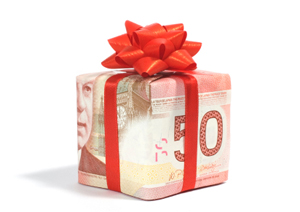
'Scroogenomics': Finally the Perfect Xmas Gift
Business prof Joel Waldfogel taught me why exchanging presents just doesn't make sense.
Cost of giving: poor choices for others hurt everyone.
- Scroogenomics: Why You Shouldn't Buy Presents for the Holidays
- Princeton University Press (2009)
Ever since some wily Dark Age monks with a flair for branding hijacked Winter Solstice to further the Christian cause, Christmas has been the holiday of social transformation. So it's no surprise that a practitioner of the contemporary dark arts (economics) has come up with a book that delivers a Christmas strategy for the End of Oil era.
Scroogenomics: Why You Shouldn't Buy Presents for the Holidays was published in late 2009 by Joel Waldfogel, a Wharton School business professor at the University of Pennsylvania, and I'm worried that it's not catching on as I had hoped.
Perhaps that's because, sadly, the title is a bit of lie. Prof. Waldfogel isn't opposed to all Xmas gifts. He just wants us to stop buying bad gifts. And really, who doesn't?
I was thrilled to get my freshly pressed copy of his book a couple of turkey roasts ago, since I appreciate gifts aimed at my hobbies, which include embracing irony and hating Christmas. In fact, that gift is just the sort Prof. Waldfogel would approve of since it delivered far more than the cover value (of about $12) worth of satisfaction, because the giver found something I would adore before I even knew it existed.
That is the economist's idea of the perfect gift: one that holds its value (or even gains value) in the transaction. As we embark on Shoppapalooza this year, I think it's worth taking Waldfogel's message with us about the financial consequences of choosing crappy presents.
Well, that's not quite how he phrases it. He argues that the way in which we pile up the duty-gifts for all and sundry is actually destroying value because the recipients appreciate these offerings at well below the price the giver paid. On average, 20 per cent lower. But if you're talking about things like golf-themed mugs, you might well drive the value down to zero. Add it up, factor in Hanukkah and Diwali, and he estimates the U.S. alone is destroying about $13 billion of value in the giving process.
Fancy wrapped stinkers
Waldfogel shows remarkable common sense for one of those practitioners of the dismal science and I was sure that his book would put a swift end to reindeer-festooned sweaters and those nasty antlers for cats.
Alas, not yet. Although he's been banging this drum on the true cost of giving since the early 1990s, when he first found that if people don't choose gifts for themselves, they rarely get the satisfaction equal to the money the buyer spends. The further removed the giver is from the recipient -- grandparents, in-laws, and coworkers are among the worst gift-givers -- the greater the likelihood of delivering a stinker under the tree. So gifting anyone outside of your immediate family and closest friends is likely to be an exercise in slapping a big shiny bow on a box of wealth destruction.
In the case of a $50 sweater, for example, it may be the wrong colour, the wrong fabric, or just not quite the recipient's taste. She might be willing to pay $40 for the satisfaction to be gained from that less-than-perfect object, so the remaining $10 of the price vanishes. Or she might hate it so much that it's never worn, leading to a dead weight loss -- that's what the economists call it when we spend money on something that returns no value. You know: like a Justin Bieber album.
When I first read his book, I hoped that just as Dickens invented a Christmas sensibility for the Industrial Revolution, Waldfogel would give us a road map for doing Christmas in an era when waste is an enormous problem.
Spendfest is over
It's a step in the right direction -- at least someone with financial sense is talking about this obvious conundrum and not raising that red herring about how retailers need our misspent Christmas dollars to survive. (Why? Do they have some god-given right to retail products no one wants?) But Waldfogel hasn't addressed the crux of the Christmas dilemma, which is that the whole wretched SpendFest no longer reflects who we are and how we live.
We inherited our style of Christmas from the Victorians, who resurrected the holiday that the Puritans killed (because they knew it was just paganism in a manger). Victorians were faced with factories cranking out excess stuff, and Scrooge's savvier colleagues were looking for ways to spur the fledgling consumer economy. They hit on the notion of connecting Xmas spending with all manner of virtues from love and charity to good citizenship. While encouraging buying for the sake of buying drove the 19th century economy (and led to their cluttered decorating style) it no longer makes sense in a time when landfills are overflowing.
Even more of a problem for us is that the Christmas Victorians imagined and romanticized was based on vague records of the medieval celebrations, which couldn't be further removed from our modern lifestyle. Medieval Christmases were a pre-Industrial affairs that followed the rhythms of farming communities, when they had to feast before the food spoiled and party to fill the long, cold, dark days.
Not since electricity arrived has anyone needed to kill time in December, which is the busiest part of the working year in many industries. And as you sit on the runway waiting for the plane's wings to be de-iced on about Dec. 23, consider just how much you'd rather be making that sentimental journey home for a grand family meal in July.
And speaking of medieval values, while it's true that our economic and political structure increasingly resembles a handful of lords enjoying luxuries at the expense of their serfs, I'm not so sure we want to be encouraging this sort of thinking.
Stop the madness
What we really need is a new concept of Christmas for the 21st century.
Unfortunately, like many an economist, Waldfogel is good on defining the problem, but he's not so hot on finding solutions. The obvious cure for disappearing value is for people to give each other money -- but that's a faux pas in Western cultures.
Waldfogel applauds the growing enthusiasm for gift cards -- which are just cash in a more socially acceptable form -- because they hold their value in the transaction. In theory, at least. A quick glance at the post-Xmas bargains on Craigslist and eBay reveal a host of gift cards being sold for 20 per cent off their face value, suggesting they have the same satisfaction levels as the average ill-chosen sweater. And he admits that about 10 per cent of cards are never redeemed, and suggests that retailers might be persuaded to have those unclaimed cards default to charities. (Yeah, that's gonna happen.) But he also seems to have forgotten how many card-issuing shops declare bankruptcy after Solstice sales prove disappointing.
The logical conclusion of Waldfogel's thesis -- despite the business prof's fervent denial -- is that we stop obligatory gift giving. But his research also shows that people view winter presents as a necessity, akin to toilet paper. So the trick is convincing Aunt Belle, your brother-in-law, and the coworker demanding one of those dreaded Secret Santa exchanges that we're not just over-burdening the environment and ourselves, we're hurting the economy with this blizzard of wealth destruction!
With that in mind, this year I'm killing two birds with one stone. I just did a bulk buy of Scroogenomics and solved a host of this year's gift-giving challenges, not to mention ensuring that Christmas dinner conversations will be really lively. ![]()


12
Login or register to post comments
Grania
11 weeks ago
Scroogenomics
Enjoyed this. I am amazed by my changing views on Christmas. It started with that awful video of masses of people grabbing waffle irons on Black Friday. Since then; I have had a growing sense of disgust with the material aspect of Christmas and also a sense of being smothered by all the STUFF I have accumulated over the years.I have been clearing my small home and giving things to charities and to friends just so I can breathe. However, I am still having a problem letting go of my books....
VivianLea Doubt
11 weeks ago
love Christmas...
But if I have to listen to one more middle-aged, middling-intelligent, harassed female earnestly inquire as to the state of my Christmas readiness, I shall throw up on her. Ah yes, Christmas and shopping, that apparently obligatory pasttime, except for some small group of us, I suppose. I wondered when everybody else was going to catch on: that the warmth and magic of the season actually can't be bought.
The wonder of it all is that the warmth and magic make an appearance, however token, in even the most blighted of lives and in our most blighted of cultures. Take heart, Shannon - it won't be long before the vulgarities of seasonal shopping fade away forever.
Amelia Bellamy-Royds
11 weeks ago
Interesting analysis
Although I'd never thought it through from an economic perspective, the conclusions match up with my own intuition based on experience as both a giver and receiver. If you're not sure that a gift is perfect for the recipient, it's probably not worth the money.
(On that note, I wonder what the cost to the economy of all the wasted hours of retail salespeople processing returns and exchanges after Christmas. Not that the retail stores ever complain, since people will rarely find something of the exact price to exchange, and so either end up forfeiting money or buying something more to avoid doing so!)
I do agree with Shannon that Waldfogel's endorsements of gift cards is misplaced. They are just as impersonal as cash, require the same explicit quantification of the dollar value of your relationship, but are much more difficult for the recipient to spend on something they like!
And of course, giving cash can be personalized with a little creativity, such as by offering to go shopping with the recipient, or by dressing it up as a personalized gift certificate: tape that grubby bill to a pretty piece of paper saying "Exchange this certificate for your favourite book, redeemable anywhere Canadian dollars are accepted" (or, "dinner at your favourite restaurant", or "that perfect sweater", etc.).
Moonbug
11 weeks ago
don't buy into xmas waste
Me and my significant other have never exchanged christmas presents, and she has told her parents "thanks, but no thanks" as well, while my family doesn't bother either with the exception of one relative who generally sends me a gift certificate for the evil empire of book stores.
What a relief! What a joy! How wonderful it is not to worry about finding the money to buy all and sundry a useless xmas trinket.
I highly encourage people to ditch the lame xmas tradition of wasting your money and the planet's resources. Just don't do it. You'll feel a million times better about xmas without the consumerist bullshiz smeared all over it.
OwlRol
11 weeks ago
Neither Scrooge, nor Christmas shopper
Other than Christian thanksgiving and some other sentimental remembrances, Christmas is for the kids. The excitement and fun they have has the potential to bring a smile to even the most dour elder.
But too many gifts and too much discarded wrapping paper surely spoils that fun.
I always enjoyed the toddler who was more interested in the container than what had been inside.
I don't go Christmas shopping, rather I run across items throughout the year that I know my loved ones will enjoy at Christmas, sometimes more, sometimes less, unpredictable and without expectations and so, often more appreciated.
I don't ask for anything, but provide hints to those relatives who feel obliged, of inexpensive and useful items. Its the caring of these people that counts, nothing more.
I take the time and effort to print out my own cards, not glossy but personalized with a short letter to those I don't often see. I know that they thoughtfully consider the message before tossing or recycling.
The joy and love to be with those one cares for, whether in person or long distance talk and imagination, that's what counts.
frank2
11 weeks ago
The hidden assumption of this
The hidden assumption of this work is that gifts "should" be "worth" at least as much to the recipient as the cash value.
Why? If that's the case, just give cash....
But gift giving (not only to younger people) can sometimes open recipients' eyes to things they might not otherwise have appreciated. Gifts of books, subscriptions to magazines or theatre performances, book store gift cards, may all help to open new horizons.
Sometimes, giving a donation to a good cause -- with the recipient receiving a "certificate of ownership" for a wildlife area, or thanks for supporting an orphan child for a year, for example, may lead the recipient to think of good works which need to be done -- perhaps by her/him in the future.
margot
11 weeks ago
Christmas lost and long gone,
Christmas lost and long gone, replaced with the gift wars and brag letters, replaced with plastic trees and "disposable" plates, turkey slaughtered too young (in turkey years) for kindergarten, I think I've hated Christmas more for fifty years because I once so loved it.
When I was five or six, I could play any carol requested, and it was unlike playing the piano any other time, because there were deep shadows, and coloured lights and candles and real dead birds stuffed with cotton wool on the tree and along the mantelpiece. People quietly gathered around and sang. I felt very special indeed.
A few times after puberty, I played other families' pianos and fleetingly got that power and magic back. Especially if there were deep shadows, and coloured lights and candles. Especially if some or all present were far from home.
The last thirty years, Christmas dinner became more and more a dreaded wrangle with bright lights and bizarre arguments. The prize fight was in code, seemingly over my refusal to eat turkey or sugar. God made mothers to cry, fathers to fume, and brothers to savour the fruits of their compliance. All I wanted was to be left alone to eat large helpings of vegetables. I remember the year my father got quite jubilant pointing out that if I didn't know it was S. African sherry I quite liked it.
Now, of course, I wish I had videos of all this. Now that it's fashionable not to eat turkey or sweets, now that the eccentric and depressed who held up white flags to get out of the gift wars, year after year, after year, the grinches and scrooges who withstood volleys of insults even in July, hey, we're the heroes, we were right all along.
But the wrongs ran deeper, didn't they. They were really about sex, church, status, real estate, politics, and compliance.
I laughed and laughed when a woman here wrote a letter to the paper suggesting that store employees who refused to return her cheerful "Merry Christmas" should be fired. Not everyone disagreed.
margot
11 weeks ago
best gifts may be accidental
I remember my mother listening to the radio as she serenely ironed all the wrapping paper after Christmas and birthday parties. We always had enough.
I think, however, the best gifts require no such wrapping.
They are the ones that do not get thanked for, or even recognized right away. Stuff that happened in the womb, a well lived example (possibly by a neighbour, a stranger, someone observed from a distance), a chance remark perhaps just overheard, strengths from crises risen to. A long remembered look, a peal of laughter, aha.
I've known a gloriously accidental aspect to gifts. My first bicycle, back when things were not thrown out and were rarely bought brand new, my first bicycle was probably hurled together from two or three discards on Christmas eve. It was red, freshly painted, and heavy and one-speed. It may have been a bit large for me, I was about to turn six. I was not to ride it outside the garden. I spent days and days learning to stay upright and go around corners. Much of this amounted to falling over and over again into the same rosebush as I tried to navigate a difficult corner in the pathways.
Once allowed to use the street, I found it very hard work riding uphill. I persevered and rode uphill, perhaps vaguely aware that other kids' bikes could be ridden standing up. My seat was too close to the handlebars for that stuff.
I eventually rode up that long hill on Central Avenue in Victoria twice every school day, sitting down. I could ride up, gasp, the Fort St hill from Cook, to get home from piano lessons. Sitting down on a clunker one-speed.
I am still great at falling, with all the mental advantages this offers, and I have the strongest legs of almost anyone I know.
Thanks, thanks, Daddy, for a truly shitty bike.
Youngest brother got a brand new bike, lighter than my old one, everything perfect. He was afraid to ride it for years, chose to run to and from school. He got so used to this, he astounded everyone on sports days by beating all the big boys in the long run event, several times around a big playing field, because it was the same distance to or from school. So he won the cup again and again. Especially when he was about seven, this was really funny to watch. He is still admirably slim and fit.
Strong legs and fearless falling have no price.
zalm
11 weeks ago
A nice riposte
The Vancouver Scum's editorial on Tuesday was Facile Mihlar's attempt to smear Adbusters' latest call to reject the mass commercialism of Christmas, by calling it Occupy Xmas and calling its adherents names. (You can always recognize Mihlar's editorials by the foul language he uses in a family newspaper.)
Thought about wasting half an hour penning a screed to him, but perhaps just a link to this article would be best - says it so much more politely than I would, and to better effect.
Bailey
11 weeks ago
Worth
We are such truncated people. Our souls still hope to break free, to grow back all those parts that were surgically removed after birth, and love each other again.
When your heart is bound in a space too small for it, you might be tempted to believe some poor benighted teacher when he tells you there is no value but financial value.
The next conclusion you might draw is that when you do want to show love, the only way is to slap a price tag on something, and then own it. Once it is yours, then if you place it in the hands of the one you would wish to love, and release your grip upon your possession, that must be the greatest gesture of love to which one such as we could possibly aspire.
Poor saps. Christmas traditionally arrived on the hearth, It was about feasting in a time of slim resource; showing ourselves to each other, singing our lives and joys into the rising smoke, so that it could rise swiftly to the ears of the Great Beard, who then would know us for who we truly are, and honor us as we have deserved.
Now it slinks in through the chimney, and has a price tag, so that we may show our value and be honored for what we have made ourselves. The Great Beard reduced to a delivery boy.
But Christmas still retains it's magic, though it's heart is bound in the same prison as our own. Escape is still possible, with honor regrown and love can still bloom in winter as it used to. It seems to happen more privately than it used to, maybe less often, or in smaller ways.
I suggest as a Christmas gift this year hacksaws would be appropriate, to cut the bonds that bind us, dismember the locks on the prison gates, To help us unloose our hearts and burst forth spewing love for each other in every direction.
OwlRol
11 weeks ago
Margot, so true
Oh yes, I know what they like, great music and humour from PBS and National Geographic books for kids, they thrive on it.
And that girl in Tanzania, she'll be overjoyed to have another year of school ahead.
Margot, I too remember the piano Christmas caroling, first flickering under candles, later colours.
As I said, Christmas is mostly for kids, but also the kids still in most of us.
VivianLea Doubt
10 weeks ago
oh, thank you
to all who have posted here, what a marvelous thread. But especially to Bailey, for your lovely words conjured up images of all that I remember and love and try to re-create every Christmas. Simple feasts, simple pleasures, enjoying the love shining in all those faces...