

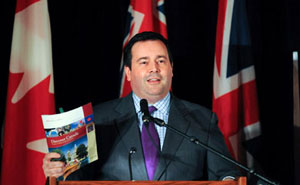
- Discover Canada: The Rights and Responsibilities of Citizenship
- Government of Canada (2011)
Last winter, when my partner applied for Canadian citizenship, an envelope arrived at our home containing the government study guide for the citizenship exam (the 2009 version rather than the one slightly revised in March 2011).
Like any document where a country describes itself, Discover Canada: The Rights and Responsibilities of Citizenship makes for revealing reading. Yet as my partner shared passages, I was gripped by the disconcerting feeling that the country this booklet evoked is not the Canada in which I, or anyone else, was raised. I soon realized that this fantasy was deliberate. If I did not recognize the land described in Discover Canada, that was the volume's intention: to drive a wedge between old Canadians and new Canadians; between me, who did much of my schooling in Canada, and my partner, who arrived here as an adult; between the liberal, statist, internationalist culture of the past and what the authors hope will be the conservative, decentralized, militaristic culture of the future.
The project of changing the ideological orientation of coming generations of voters was heralded by a government press release that proclaimed this booklet "should be in the hands of... every high school student in Canada."
High school students will not find the Canada they know in these pages. Medicare, the policy that Canadians sometimes identify as defining our country, is bypassed in a fleeting reference to the Canada Health Act. Tommy Douglas may have been voted "the Greatest Canadian" in 2004, but his name does not appear here. The CBC, government aid agencies such as CUSO and CIDA, the right to unionize, gay and lesbian rights all vanish. (Forced by legislation introduced by NDP MLA Olivia Chow to do so, the government placed this sentence in the updated guide published this spring: "Canada's diversity includes gay and lesbian Canadians who enjoy the full protection of and equal treatment under the law, including access to civil marriage.")
Refugees and revisionism
Peacekeeping receives one grudging mention, devoid of any reference to the Peacekeeping Monument in Ottawa that enshrines this heritage; in this volume, which uses the word "war" 35 times, Canada is a bellicose nation, adamant about its "Christian civilizations" and fixated on "the rule of law." Discover Canada is not so much Canada for Dummies as Canada for Spartans.
In spite of the volume's militaristic tone, its most radical revisionism appears in the Conservative policy of regionalism. Most people reared in Canada learned in school that our country is made up of 10 federated provinces with equal legal rights and two (after April 1999, three) territories. New Canadians will have to memorize the five regions of Canada, each of which is introduced as having a distinct culture. The delineation of these regions betrays the fact that the lines on this new national map were drawn by a party that is strongest in Alberta. Ontario and Quebec, for example, become a single region. My partner, having made the difficult transition from living in French in Quebec to living in English in Ontario, knows that these two provinces do not share a regional culture. The majority of residents of both provinces -- which is to say, more than half of Canada's population -- would also reject the notion that they form a single region. New immigrants, however, will be obliged to affirm that this is the case.
Discover Canada's militarism and its propagandistic presentation of history are intertwined. The only two waves of political refugees identified by the guide are Hungarians who "escaped Soviet tyranny" in 1956 and Vietnamese who "fled from Communism" after 1975. My partner, like other aspiring citizens, is acquainted with some of the tens of thousands of Canadians whose families fled military governments in Chile, Argentina and Uruguay in the 1970s, or right-wing death squads in El Salvador or Guatemala in the 1980s. She is aware that among my family's circle of friends are men who came to Canada from the United States as refugees from the Vietnam War, and women who accompanied them. These immigrations were just as transformative of Canadian society as those of the Hungarians and the Vietnamese, yet Discover Canada writes them out of history. To include them would be to violate the booklet's star-struck reverence for men in uniform. The dignity of General Pinochet takes precedence over an accurate account of the origins of Canada's population.
Canada as war epic
The bottom of the opening two-page spread on the rights and responsibilities of citizenship is emblazoned with photos of happy soldiers. The accompanying text concedes that military service is not a formal obligation of citizenship, but suggests that it is "a noble way to contribute to Canada and an excellent career choice." Web addresses are provided for both the Armed Forces and the cadets, a privilege that these pages grant to no other organization. Would-be citizens must study the names of all Canadians who have won the Victoria Cross, and are expected to be conversant with a little-known military unit called the Canadian Rangers. The volume consistently militarizes our history. When I was in high school, the two Riel rebellions were taught as a constitutional crisis that pitted Louis Riel against Sir John A. Macdonald in a dispute about representative government. Discover Canada tilts the emphasis toward the battlefield, summarizing the conflict with portraits of Sir Sam Steele, "Mounted Policeman and Soldier of the Queen," and Gabriel Dumont, "the Metis' greatest military leader."
The Canadian tradition of opposition to militarism is censored: the long sections on the two world wars contain no reference to the 1917 Quebec City anti-conscription riots, the division of Parliament along linguistic lines during the war years, the second conscription crisis or Mackenzie King's response to it. Various passages broadcast Conservative ideology: the first section on the economy, entitled "a trading nation" -- a phrase coined by Tory strategists for Brian Mulroney's 1988 election campaign -- makes free-trade deals a Canadian trait; by contrast, Macdonald's National Policy, which built the nation, is omitted. Tory gun-lovers can thrill to a photograph of a gun-wielding hunter (who, unassailably, is Inuit).
Discover Canada's effort to induct new Canadians into values that will lead them to support militaristic right-wing policies should be obvious to many who study the booklet. The most enduring lesson my partner and thousands of other citizenship applicants can learn from this volume is that Canada is a country whose government misrepresents its past in order to deprive them of the information they need to engage in debate about its future. ![[Tyee]](/design-article.thetyee.ca/ui/img/yellowblob.png)












Tyee Commenting Guidelines
Comments that violate guidelines risk being deleted, and violations may result in a temporary or permanent user ban. Maintain the spirit of good conversation to stay in the discussion.
*Please note The Tyee is not a forum for spreading misinformation about COVID-19, denying its existence or minimizing its risk to public health.
Do:
Do not: