
- The Shock of the Old: Technology and Global History Since 1900
- Oxford University Press (2007)
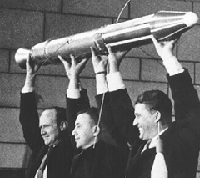
Fifty years ago this month, Russia launched Sputnik, the first artificial earth satellite. I remember it well, and the American hysteria that resulted. The U.S., after all, was supposed to be the most technologically advanced country on the planet. How could those Red peasants actually beat us into space?
The Red peasants were if anything more infatuated with hot high tech than North Americans were. (Canadians of a certain age still burst into tears about their lost love, the Avro Arrow fighter plane.) So Sputnik expressed a shared 20th-century faith in technology as a solution to all our woes.
David Edgerton begs to disagree.
Edgerton is a British historian of technology with a refreshingly skeptical take on both invention (the creation of a new idea) and innovation (the first use of that idea). In his view, our faith in constant technological progress -- futurism -- is not just naïve. It's passé.
Having been long enslaved to ever-better, ever-faster computers, I needed Edgerton's splash of cold water to stop my hyperventilation. When Steve Jobs introduces the next iMac, my current iMac suddenly looks antique but not charming. I make perhaps three calls a year on my cell phone, but an iPhone ad inspires dreams verging on lechery.
Living in a futurist world
That's not very becoming in an elderly gentleman, but for over 60 years I have lived in a futurist world. A popular comic-book hero in the 1940s was Captain Tommy Tomorrow, and the pulp magazines of that era foretold space flight in the company of gorgeous girls in brass brassieres.
The belief in progress has been almost universal in the past two centuries. "Progress" has been taken for granted. Emile Coué, a century ago, taught our great-grandparents a mantra: "Every day, in every way, I'm getting better and better." Communism, misunderstanding Darwin, saw itself as an evolutionary step ahead of capitalism, and many of today's liberals still call themselves "progressives."
If Edgerton is right, we've all been deluding ourselves. Technology does advance, but much more slowly than we realize. We tend to do our most essential work with old technology, often while wasting money on new gadgets.
The military has been a sucker for high tech for a long time, and World War II was supposedly won by technology. Edgerton thinks otherwise. He cites the air raids against German cities directed by Sir Arthur "Bomber" Harris, who claimed he was crippling the Nazi war effort. A postwar survey discovered that attacks on German cities had killed a lot of people but had little effect on Germany's war production. Sixty years later, Canadian veterans still get upset about this.
Air power or horse power?
The Germans themselves had bragged about their panzer divisions and dive bombers, but they really fought World War II with horses. Hitler's Wehrmacht started the war with 590,000 horses. It used 625,000 horses for the invasion of Russia, and thereafter seized every horse it could find in the conquered countries. At war's end, the German armed forces had 1.2 million horses --evidently not enough for victory.
But they too were suckers for modern weapons. Wernher von Braun talked the Nazis into investing in the V-2 rocket bomb. Built with slave labour, the V-2s cost 10,000 lives to build but killed only about 5,000 -- about one British death per rocket.
Edgerton calculates that the program cost a quarter as much as the Americans' Manhattan Project. The money and resources could have gone into building 24,000 fighter aircraft instead -- which could have thwarted Bomber Harris and saved hundreds of thousands of German lives.
Even the Manhattan Project, always portrayed as creating the technology that won the war, was in Edgerton's view a huge diversion from simpler technologies that might have won it faster. (The Nazis' top physicist, Werner Heisenberg, discouraged his bosses from building an atomic bomb. When it looked like a short war, he said the bomb couldn't be built in time to affect the outcome. When the war grew longer, he urged putting resources into weapons that could be built quickly and cheaply.)
Cannons and rifles trump A-bombs
Edgerton tells us that in all the wars fought in the first half of the 20th century, 18 million died from artillery and 14 million from small arms. Since then, 70 million to 100 million simple, low-tech Kalashnikovs have taken an uncountable toll of soldiers and civilians alike, delivering far more bangs per buck than cruise missiles and stealth bombers ever have.
Most industrial nations fret about being behind the leading edge of technology, but Edgerton points out that they much prefer to borrow or swipe such technology from other countries. Even then, they usually don't do much with it. The Russians were stealing U.S. technology even during World War II, but rarely applied it or improved on it.
The Americans themselves hardly know what to do with their own gadgets. When the Xerox Corporation's Palo Alto Research Corporation (PARC) developed the graphic user interface and the mouse, Xerox's senior management shrugged them off. Their wives, who'd often been secretaries before marrying, understood at once what an advance PARC had made, but couldn't make their husbands get it. But Steve Jobs and Stephan Wozniak understood it at once.
Living in the afterglow of the 19th century
And despite the glorification of research and high tech, the most inventive countries aren't always the most successful. Edgerton tells us that in the 1990s Japan was issuing three times as many patents as the U.S., and Korea was issuing twice as many. That doesn't make the Americans listen respectfully to Japan and Korea.
When I look back at the 1940s and its glorification of space travel and death rays, I realize I was actually in the afterglow of a remarkable burst of invention and innovation in the late 19th century and the very early 1900s: radioactivity, X-rays, automobiles, flying machines, movies, radio, typewriters. Charles Babbage and Ada Lovelace established the principles of computing in the 1830s. Konstantin Tsiolkovsky did the same for space flight in the 1890s, inspiring the Red peasants of the 1950s.
We have spent the last century working out the implications of those advances, at an enormous cost in human suffering and ecological destruction. Maybe it's just as well that we haven't matched the inventiveness of Edison and Roentgen, Pasteur and Hertz, the Curies and the Wrights.
If we had, we might not even be here any more.
![[Tyee]](/ui/img/ico_fishie.png)