- Ms Kaye is a Tyee Builder. You can be, too.
- Mary Carlisle is a Tyee Builder. You can be, too.
- Prem Gill is a Tyee Builder. You can be, too.
- Nancy Flight is a Tyee Builder. You can be, too.
- Justin Everett is a Tyee Builder. You can be, too.
- John Westover is a Tyee Builder. You can be, too.
- Nora Etches is a Tyee Builder. You can be, too.
- Edward Henderson is a Tyee Builder. You can be, too.
- Bharadwaj Chandramouli is a Tyee Builder. You can be, too.
- Dean Chatterson is a Tyee Builder. You can be, too.
- Marius Scurtescu is a Tyee Builder. You can be, too.
- Robert Parkes is a Tyee Builder. You can be, too.
- James Murton is a Tyee Builder. You can be, too.
- Susan Doyle is a Tyee Builder. You can be, too.
- Vincent Strgar is a Tyee Builder. You can be, too.
- Helen Spiegelman is a Tyee Builder. You can be, too.
- Subir Guin is a Tyee Builder. You can be, too.
- Kimball Finigan is a Tyee Builder. You can be, too.
- Joanne Manley is a Tyee Builder. You can be, too.
- David Leach is a Tyee Builder. You can be, too.
The God's Truth
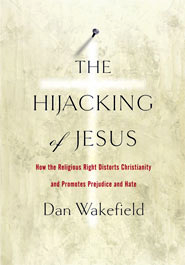
'Hijacking Jesus' argues the right distorts Christianity. But who doesn't?
- The Hijacking of Jesus
- Nation Books (2005)
- Bookstore Finder
It's become commonplace, in recent years, to describe religions as "changing," or "being hijacked," or -- in a lovely bit of irony -- "evolving." Yesterday's Hindu sweetheart of the New Age set is today's Hindutva BJP fascist. Former CIA darlings like the Dalai Lama wrap themselves in the colourful cloaks of sappy benignity (while sometimes slipping up, citing "karma" for disasters like Katrina).
Religious Jewish scholars like Dr. Marc Ellis speak of the emergence of a "Constantinian Judaism" -- a formerly stateless religion invoked in service to the Israeli government. Everyone from George Bush to left-leaning Muslims will tell you that Islam has been taken over by the Wahabi fanatics.
And, speaking for progressive Christians, author and journalist Dan Wakefield uses his new book, The Hijacking of Jesus: How the Religious Right Distorts Christianity and Promotes Prejudice and Hate, to remind us that less than 50 years ago, America's best-known religious political figure was the Reverend Martin Luther King Jr. As these religions "change," though, their foundational texts remain conspicuously static.
It seems fair to assume, then, that there is no "essential" Hinduism/Buddhism/Judaism/Islam/Christianity. What we have, instead, are texts and traditions -- deep (sometimes too deep) wells from which political actors across history can draw whatever it is that they're thirsty for. During the death squad era of Latin American politics, for instance, liberation theologians quoted the same Bible as the conservative Catholic hierarchy that acted to defend the continent's elites (and their northern benefactors).
Thorny church politics
Wakefield's book is an interesting exposition of Church dynamics in America, amassing a wide array of interviews with largely Protestant Christians, both "mainline" as well as hardline evangelical. Taking the Reverend Dr. Martin Luther King Jr. and the movement he led as the apotheosis of active, progressive Christian activism in recent American history, Wakefield helpfully delves into the world of inter- and intra-church politics to explain how it is we got from the gospel according to MLK to the depths of James Dobson, Jerry Falwell and Pat Robertson (though unlike the biblical Noah, Wakefield's narrative doesn't have much of an arc; the vicissitudes of the story can therefore sometimes be hard to follow).
Wakefield is an experienced journalist and practising Christian, and the engaging quality of his prose can be just as impressive as his access to religious figures on both sides of the mostly Christian religious debate in America.
Nevertheless, the essay doesn't quite work. The biggest problem isn't its arclessness. Nor is it the author's irritating penchant for passive-aggressive derision of secular atheists for our condescension towards the religious. (As though we weren't reacting reasonably to the condescension we'd received over the years -- from those unable to accept a Godless moral code as coherent, and occasionally even from those convinced that we're saps for believing in fossils.)
Paved with good intentions
Instead, Wakefield is undone by his naïve insistence on a "true" Christianity, epitomized, for him, in the proto-socialist Sermon on the Mount, which grounds The Hijacking of Jesus. The piece works in terms of the How the Religious Right...Promotes Prejudice and Hate part of the subtitle. That's certainly made very clear. The problem is that the Distorts Christianity portion is an unwinnable proposition, as unattainable as, oh, I don't know, some sort of Grail.
I can't remember which verse it is in Proverbs that said "Lo, and if ye roll in the shit with pigs, ye shall both get dirty, but the pig likes it." Megalomaniacs such as Falwell and Dobson want nothing more than to engage in a debate over the "true" nature of Christianity, because it feeds the notion that theirs is a politics borne of religion, and not the religion borne by politics we're truly dealing with.
The spirit that animates Wakefield's book is clearly one of good faith, some sound historical insight and useful reminders about the role that religion has played in American politics. In short, he clearly has the best of intentions. But we all know where that sort of paving leads to, don't we?
Charles Demers is a regular contributor to Tyee Books. His recent contributions include "Who Knows the Muslim Mind?" and "'Terrorist' Offers Islam for Dummies." ![]()


45
Login or register to post comments
nightbloom
5 years ago
Comments on "The God's Truth"
Great critical review.
Booker
5 years ago
I would disgree with the idea that the Christian right's ideology is somhow not valid according to scripture. I think that just about any ideology can be backed up by a passage in the bible. The Jerry Falwells of the world can cite the passages they like, and so can the Martin Luther Kings and Desmond Tutus.
America is in need of a serious dose of rationality, and the validity of non-belief in deities needs to be recognized in their debate. The authority that their society gives to the collection of bronze age myths and stories that is the bible, needs to be challenged.
Recent books by Daniel Dennett, Richard Dawkins, and Sam Harris will at least put the idea of "non-belief" out there to be talked about. The fact that "The God Delusion" (by Dawkins) and "Letter to a Christian Nation" (by Harris) are on the Amazon.com top 10 bestsellers, is at least a reseaon for hope.
Booker
5 years ago
And in this morning's Globe & Mail we find that Harper is bringing forward the Defence of Religions Act. It is time we stopped giving religion, as a mode of thougt, special dispensation. Asserting that a public official (in this case, a Justice of the Peace performing marriages for same-sex couples) can refuse to do his or her duty on religious grounds, is no different than saying they can refuse to do it on political grounds. Would it be okay to say that I won't give you a government service because you voted Conservative and you therefore insulted my political values? So, I guess I should not have implied, in my previous post, that religious authority is an American problem. It's on the rise here too.
nightbloom
5 years ago
Booker - Exceptions have to be made for personal conscience and belief. For example, we no longer (to my knowledge) fire or otherwise punish nurses who for reasons of conscience choose not to be assigned to assist in the provision of therapeutic abortion services in hospitals. Rights are not abrogated by simply re-allocating labour as appropriate in order to accomodate a diversity of beliefs. In fact, I think keeping the public sphere secular is dependent on such accomodations. I should say that I haven't looks at this legislation, however.
On Dawkins and company, it's important to keep in mind that these guys often cross the line from science to conjecture and spin, and even into the realm of pure ideology. They're priests of a different kind, with their own orthodoxies and heretics, and even their own share of excommunications, so their idol-smashing must be seen in this light. I happen to like Dawkins' material, but there is something totalitarian in the way he pathologizes those who adhere to faith traditions. I've made this point pretty often, so I won't belabour it here: one of the reasons we're in a fundementalist evangelical upsurge is because moderate religion was driven out of the public discourse and then pilloried relentlessly (and often disingenuously) by the mainstream. Moderate religion was marginalized and silenced, and something else has stepped into the vaccuum.
However, I agree that Americans need to cool it with the gawd stuff - I'm reminded of the scene in Contact (the movie) where Jodie Foster is sidelined by the question of whether she is a believer. That question still wields far too much decisive influence over the careers of people in public life in the U.S.
Percy
5 years ago
Booker, if you go back and read the Supreme Court reference decision on same-sex marriage, you will discover that the Court declined to say whether the term "marriage" was mandated by the Charter. However, the Court did emphasize that, whatever the outcome, it would be subject to the constraints of freedom of religion. Mr. Harper's legislation, as I understand it, is merely following up on a Supreme Court determination of rights. Maybe you should be attacking the Supreme Court, instead......
rebel
5 years ago
For a Canadian version try the Oct issue of the The Walrus by Marci McDonald "jesus in the House" is the religious right taking overe Steohen Harper's government? Author of "The Man Behind Stephen Harper".
Booker
5 years ago
Percy, you are correct that it comes down to what does "freedom of religion" mean legally. Does it allow descrimination only in church matters, or does it allow it in society generally? I'm not an expert in constitutional law, and I won't venture an opinion on the legal aspect, though I certainly think that if people can't perform their jobs because of their religious beliefs, they should find more suitable employment.
Nightbloom, religion has certainly not been pilloried relentlesly by the mainstream. Nor has "moderate" religion been silenced. If Dawkins is a priest, what is his religion? He is just asking a very simple question, "what is true?". I think his point that supernaturalism, whether fundamentalist or not, is a big problem for our society, is correct.
rebel
5 years ago
sorrry for typos
Booker
5 years ago
Rebel, that's a good article, and this will be an interesting federal election. The Christian right is very organized, and, unfortunatly, trying to organize secular humanists is like trying to herd cats.
Percy
5 years ago
It's a very interesting question, Booker, and one which I think the law is not entirely clear on.
First, the Supreme Court has repeatedly affirmed that the BNA Act provisions dealing with Catholic schools contemplate that Church rules may be enforced on staff (can't be divorced etc.). Those constitution provisions precede and trump the charter.
However, this special protection (which needs a constitutional convention to undo) places the Roman Catholic Church in a privileged position vis a vis other religious groups, and that creates a question of parity (Can only Catholic schools discriminate?) Human rights tribunals have ruled differently with respect to non-Catholic schools, and that creates a dilemma. There's no one law for all.
Human rights tribunals have also ruled that religious organizations can be required to deliver their services (renting halls etc.) even when this is inconsistent with their religious beliefs. This line of jurisprudence is puzzling because it is inconsistent with general human rights decisions about discrimination and accommodation.
Unfortunately, human rights tribunals have decided for a quarter of a century that religious belief trumps other obligations, unless "undue hardship" arises. Nobody ever seems to have had a problem with that, until it involved fundamentalist Christians. In fact, people on the left lobbied long and hard for this result, so there's some irony here.
Maybe it's time for legislation which would clarify all this. Unfortunately, it is not going to be legislation enforcing the secular society. That horse is already out of the barn.
nightbloom
5 years ago
Yes, it was pilloried - look back when "Christianists" lost the battle over evolution in the school system (which they lost fair and square, and rightly so) - their opposition in the Northeastern media & culture establshment was beyond triumphalist - it was outright derisive of Christianity of any hue. Other examples abound. Generally, secular humanists are not very graceful winners, however much their victories are justified.
Yes, Dawkins and gurus like him are ordained 'priests' in the sense of Bertrand Russell's use of the term 'priestly power'. The use of doctrines, dogma and public suasion to control and police the use and flow of knowledge, and how that knowledge is applied to uphold legitimate authority. People like Dawkins now confer or deny legitimacy in the realm of ideas, and only them. Statistics and rational proofs are demanded, and those require specialization, and an arcane liturgy of specialized scientific in-group knowledge.
Again, to clarify: I do generally like his material, although I haven't read his recent one. But on the face of it his dismissal of the supernatural and what these belief systems and narratives reveal about human nature is shallow and potentiall dangerous in itself. You're always going to have outbreaks of mass hysteria or violence among desperate or frustrated populations, quite apartment from religion. Religious narratives are just another outgrowth of human nature and human creativity. Like gun power and electricity, it's social value depends on what use we make of it.
Which brings me to the last point - the uses of religion. There are many good uses, and most of them go unheralded. If moderate religion is not marginalized in secular society, then why do we hear so little of the good works people are up to all over the place. Why not (as I've said before) write something positive about the Catholic anti-war movement, or Christian charitable work with refugees, or the uncounted millions of unremunerated working hours which people from all walks of life devote to helping others because of their faith?
Booker
5 years ago
Percy, thanks for the clear exposition of an unclear issue. It's remarkable that in the 21st century religious beliefs legally trump others, but that's a story as old as the hills. Ironic also that the most religious country, the U.S., is the one with constitutional church/state separation. Perhaps we in Canada are "blessed" to have state sanctioned religion (in the form of publicly funded religious schools). It's been said that T.H. Huxley's defence of church involvment in education was his biggest contribution to agnosticism.
Booker
5 years ago
Nightbloom, to require statistical proof and a high level of expertise seems perfectly reasonable to me. How could one do good science without a high level of training, and without empirical data? To be demanding is not to be unfair. Anyone who has enough talent and tenacity can join this "priesthood", as you call it. It's a meritocracy. Scientists vigourously try to poke holes in each others work, so the idea that there are gatekeepers trying to keep out unacceptable, true, evidence, is just not correct. He rightly dismisses the supernatural because there is no evidence for it.
It's true that some religious people do great good, as some do great harm. Some non-believers do great good, and some do great harm. Would Martin Luther King have done bad things if he hadn't been raised a Christian? No, he was a good person, and he would have done good things if he'd been raised without god-belief.
I didn't see any mainstream Northeastern media being derisive of Chirstianity in general after the Dover case. They we're rightly derisive of the creationists though, who were completely dishonest and, in the judge's words, "utterly inane".
nightbloom
5 years ago
Scientific Rationalism is good. Especially on the minority of occasions when it’s fruits are actually applied rationally ;-)
At its best science is indeed a meritocracy – but on most days it’s a toxic soup of careerism and internecine jealousies, just like every other learned in-group is. I’ve met world class scientists who were at the top of their field -well…one for sure! - who also happened to be an unmitigated tyrranical sociopath with the emotional maturity of a five year old. Few such "great men" have the whole package.
And you don’t *know* that about Martin Luther King. Few people have the insight to plumb the depths of another person’s conversion experience. Your supposition is pure unscientific and unproven conjecture ;-)
Let me try a different avenue, and I hope this isn’t too tangential:
When the Americans dropped the Bomb on Hiroshima and Nagasaki, the American and allied (including Canadian) chattering classes were jubilant…nay, orgasmic. The media and other members of the learned intelligentsia launched into delirious panegyrics that extolled the nukings as definitive proof of the superiority and exceptionalism of the American spirit, and what better proof was there than this marvelous technological product of American science and American know-how. Supremacy was merited. Divine Right by science.
Now, in the immediate aftermath of the bombings, while the euphoria of victory was still at a fever pitch, and the mainstream secular humanist media continued its orgy of self-congratulation, this is what the editorial staff of the leading U.S. Roman Catholic publication has to say. It speaks for itself:
(cont'd...)
nightbloom
5 years ago
(...cont'd)
For days and weeks after the dropping of the first atomic bomb on Japan, there was a landslide of comment, scientific, pseudo-scientific and fantastic, opinions, explanations, rejoicings, and even of thanksgiving to God. Somewhere in the enormous mass of matter dislodged, as it were, by the bomb, there may have been a moral judgement, apart from the Pope’s. If so, I confess I did not find it though I searched diligently. What I hoped to discover was an expression of the conviction that we the people of the United States and perhaps with us the people of Britain, have struck the most powerful blow ever delivered against Christian civilization and the moral law. I would call it a “crime†were it not that the word implies sin and sin requires consciousness of guilt. Even more deplorable than the act itself is the fact that those who prepared the bombing, those who carried it out, and the whole nation – or two nations – which welcomed the news of it, seems to have had neither doubt nor scruple about its morality. It is pathetic and tragic that people whose civilization is called Christian, presumably founded on the Gospel, had to all appearances no doubt that what was done was permissible and laudable.
I do not delude myself that my opinion is of importance. But to relieve the pressure on my conscience, I here and now declare that the use of the atomic bomb in the circumstances, was atrocious and abominable: and that civilized people should reprobate and anathematize the horrible deed. Some time ago in this magazine (May/August 1944) we carried a discussion of the morality of indiscriminate or “saturation†bombing, the kind that is done for the primary purpose of destroying civilian morale without regard to what is known as Moderamen inculpatae tutelae. Or as expressed in two sentences: First, it is morally permissible to bomb objects of military importance, railroads, bridges, munitions dumps, factories producing instruments of war, even if in doing so, one kills innocent persons. Second, it is not morally permissible to bomb innocent people directly or purposely. Readers of that discussion may remember, without repeating the argument, I saw no distinction in favor of an atomic bomb over any other kind of bomb. Rather the contrary. The more destructive the instrument, the more grievous the crime. Nor will it do to say that the population of Hiroshima was warned by bulletins dropped by planes in advance. No honest person would say that he thinks 350,000 people can vacate a city. When the bomb destroys all life within a circumference of 200 miles or more, it would be adding insult to injury to say that the inhabitants of that city should have got out of the way.
Here we come upon the essential evil. The American people have for some years been indoctrinated with the heresy that there is no such thing as a universal everlasting law. Professors of ethics say there is no Absolute, that is to say, no God and that if there were, we have no means of knowing His mind or even if He is a person and has a mind. That there is no such thing as natural law; that laws are temporary and arbitrary, made up, so to speak, as we go along; that the law that served our ancestors may be obsolete in our days. If that kind of ethics prevails, our Christian civilization will dissolve in gas like the bodies of the 100,000 to 300,000 victims of the first atomic bombing. No discussion of this question can neglect the argument that the atomic bombs were used to bring about a quicker surrender of Japan and thereby in the end, to save lives. The end does not justify the means. It is not permissible to do evil that good may come. If obliteration bombing is evil – and this is the question – it cannot be made good by the supposition or even the certainty that it will in the long run be more merciful that a surely legitimate way to make war.
Percy
5 years ago
Booker, like you I disagree with placing the dictates of personal conscience above the general law. But that was an extremely popular position even before human rights tribunals adopted it. You may recall that in Ontario the Liberals and NDP enthusiastically lobbied for the extension of religious control over the school system. The NDP even recommended a system of private Sharia law for arbitration of individual disputes. Go figure, eh, that the left would be the torchbearers for sky gods......
By now, if Seventh Day Adventists don't have to work Fridays, Sikhs can refuse to wear regular police uniforms or hard hats, and Wiccans can demand paid holidays from work to celebrate their faith, why should fundamentalist Christians ask for anything less?
Actually, the Supreme Court decision clearly specifies that "religious officials" would be constitutionally protected from being be obliged to officiate same-sex marriages, if that was against their conscience. The question is, how broad is the term "religious official"? Probably it only refers to members of the cleargy or religious orders, however the Court pointed out that broader protection with respect to freedom of religion could be contemplated by provincial legislation.
I think discussion on this issue is handicapped by a huge amount of just plain false information the media about what the court decision said (the Toronto Star comes to mind). You would have thought the Court ruled in favour of a constitutionally mandated single definition of marriage, but in fact it didn't.
To all my NDP friends, I hate to say, I told you so, but I told you so!
Booker
5 years ago
All I can say, Percy, is that I know what you're saying, and I wasn't one of them (obviously)!
Nightbloom, that is pretty tangential. I don't want to get in a tit-for-tat and supply you with a list of Christians who have done evil, as easy as that would be. Demers above says that Wakefield's problem is his claim for a "true Christianity". What the heck is that, and why should I care?
IAMC
5 years ago
Let's here it Booker. Who can you put up against the non secular tyrants who have slaughtered BILLIONS, like Stalin, Mao, Pol Pot, Saddam , Chavez, who dictators who are only interested in a murderous regime, with no regard for the citizens. Yeah, great lets embrace these idiots.
I just don't think there is any comparison between religious and secular kill numbers. Religion was far behind, until, a group of hard to understand, fully motivated hard liners, decided to go after some of western culture, mainly us.
By 'us' I mean us. Western capitalist culture.
You and me. The group of criminals ( that's the way Clinton would put it ) should be brought to trial as criminals. This is not a bad idea, except that the
adversary doesn't recognize our laws, as we don't respect theirs.
So where do do you o from there?
There won't be a meeting of the mind anytime soon on this one. I can only hope we can all be reasonable.
Booker
5 years ago
Hi IAMC, I'll give you a Hitler (Catholic) for your Stalin and a Franco for your Saddam, and Pinochet for your Chavez, and GOD HIMSELF for all the massacres and murders in the holy book. Shall we talk about the residential schools, or am I pulling ahead? That was fun.
Frank
5 years ago
Oh let's not forget Aztec priests ripping the hearts out of tens of thousands of people. Nor can we forget how a religous war (The Thirty Years War) wiped out 1/3 of the population of Germany over whether they'd be Catholics or Lutherans. Nor should we dismiss those that died as a result of a Pope declaring a crusade against people who believed in the wrong things, whether in Palestine, France or Lithuania. Nor should we overlook what happened to the Hugeunots and the Moors and the Inca.
Religion is probably okay, I just don't think we've developed enough as a species to take it on.
nightbloom
5 years ago
Booker - I'm sorry you missed the point. I was responding to your celebration of scientific rationalism. As the use of the bomb demonstrates, the ascendence of scientific rationalism is no guarantee that it will be used rationally or in a "good" (ethical, moral, just, whatever) way. The religious response against the nukings during the V-day euphoria demonstrates that it's still important to have a voice of conscience around, particularly when that conscience is absent from media, science, academia and popular sentiment.
The example of the Bomb is far less tangential than, say, Frank's Aztec priests or the Thirty Year's War (which was driven by political factors). Secular humanist love to glibly cite the Crusades or the Inquisition without acknowledging the mass murder for which science is "responsible" (if we follow the same logic). Of course, I don't accept that science or religion are directly responsible for destruction.....I believe that the destructive impulse is part of the dark side of human nature, irrespective of religion or creed or political persuasion.
Booker
5 years ago
Nightbloom, of course rationality doesn't guarantee that people will behave in a moral way at all, but it's a better starting point than irrationality. I'm not clear on why you think secular humanism as a philosophy (if that's not to grand a word for it) is bad. Regarding glibness, it's difficult to top the Believers, as Demers notes:
"Nor is it the author's irritating penchant for passive-aggressive derision of secular atheists for our condescension towards the religious. (As though we weren't reacting reasonably to the condescension we'd received over the years -- from those unable to accept a Godless moral code as coherent, and occasionally even from those convinced that we're saps for believing in fossils."
nightbloom
5 years ago
Secular humanism is a noble philosophy - but not the only one going, As I said, there's a certain totalitarianism inherent in pathologizing religious belief right across the board...which, if I understand correctly, is what Dawkins and others are doing. The problem is that secular humanism, scientific rationalism and utilitarianism now exercise a near complete monopoly on mainstream thought. Condescension against a godless moral code is impolite, although I wouldn't equate critique with condescension. Umberto Eco and the famous scholar-bishop Cardinal Martini had an epic and highly civil exchange on this exact issue (godless morality).
Frank
5 years ago
nightbloom, although France fought on the protestant side my point was simple. Religion is just one more thing used by humans to divide us into "us" and "them".
Germany's population wasn't put to the sword because of power politics, That's not going to create any bloodlust within the average guy. It was because those on the pointy end were no longer seen as fellow Germans (even Swedish armies were mostly German) and therefore you were not only allowed but actually encouraged to kill, rape and pillage with the knowledge you were doing what religous leaders were calling for. There weren't enough battles to create all those casualties, it was civilians getting killed for the most part.
As for the Aztec priests, not tangential at all. It was killing made in the name of religion by priests, what could be more central to the discussion than that?
We can all point out killing done in the name of jesus, technology, ideology or whatever till the cows come home. As you know I'm not even anti-religion, I just think the history of it is overrated or ignored.
Booker
5 years ago
Nightbloom, certainly in the U.S (which is Wakefield's milieu) supernaturalism reigns supreme in the media and elsewhere. The authority given to religion (which is my main peeve) is hardly in retreat. 50% of the U.S. population think the world was created in it's current form a few thousand years ago, just as an example. I don't think that's a trivial problem. If you check out the article in Walrus that Rebel refers to above, it will be apparent that the supernaturalist way of thinking is not in retreat in Canada by any stretch of the imagination. To say that secular humanism exercises a complete monopoly on mainstream thought is insupportable. Look at the U.S. Congress, the President, and our own Prime Minister and his caucus, 70 of whom are conservative evangelical Christians!
dolphin
5 years ago
Yesterday, a CBC reporter called to ask if I could comment on the proposed Defense of Religion legislation, as I have personally been "pathologized", suspended disciplined, etc. etc. for representing the Christian point of view in the public square. I had to tell him that I have been muzzled and would be fired if I expressed my opinion--which is exactly why religious minorities need this legislation. Believe me, being on the receiving end of totalitarian silencing of opinion makes me wonder just how committed the secular humanists are to freedom of speech. Well, they are...as long as your speech happens to agree with theirs.
Booker
5 years ago
Dolphin, I don't know your situation, but I'm not free to say whatever I want to in my job. And, since I am known, I practice a lot of self-censorship so as not to alienate those I do business with. It's not just like that for Christians.
Frank
5 years ago
Try testing the boundaries of free speech by telling your employer you think unionization would be an improvement
Booker
5 years ago
Right on, Frank.
nightbloom
5 years ago
Booker - I think we need to make a few distinctions. There's an irrational "seige mentality" sometimes when liberal talk about the rise of evangelism (which, as I've said, is their own fault). U.S. media, particularly the Northeastern media and cultural establishment, as well as the West Coast entertainment establishment, is entirely secular. True, politicians pander to their mobilized hard-core, but it's hardly an indicator of mainstream sentiment. The appeal of evangelical Christianity, especially its it latest admittedly unpalatable incarnation (televengelists, etc.) is noxious, but it bears no ressemblance to the vast majority of Christians. No Catholic, Anglican, Eastern Orthodox, Lutheran or other mainline Protestant is going to insist that the world is only 5000 years old (or whatever the figure is), or that adulterers should be stoned, or what have you. Well, maybe one or two per million. The brand of evangelism that we associate with hard core cases is actually a slim majority of evangelists, from what I understand.
If the 50% figure holds true (I find it dubious) then I wonder if this is an indicator of general illiteracy and lack of numeracy rather than an indicator of an immininent popular groundswell in hard-core theocratic fundamentalism. I also wonder about how truly dangerous these 70 so-called evangelicals in Parliament are to the secular order or the separation of Church and State. I just don't see it - So what if we have another row over same-sex marriage. No gay person I know particularly cares either way, so let the politicos have at it and wake the rest of us up when it's over. I don't see little danger and a lot of paranoia because for the first time in a long time the other team is in the driver's seat.
nightbloom
5 years ago
...that should have read "slim minority" of cases...and the last line should say that I see little danger in the current crop in Parliament....Apologies for the sloppy writing.
nightbloom
5 years ago
Here's a good example of moderate Christians publicly applying the breaks to the evangelical hard-core in the realm of public policy. It's reminiscent the splash of cold water which the Pope sent across the Atlantic last year at evangelical "intelligent designers" in the U.S. It illustrates once again why it's important to have moderate self-policing believers around:
As you know, there's a public row in the U.S. right now over legislation concerning prayers at ecumenical military services. The Roman Catholic Archbishop for the U.S. Archdiocese for the Military Services is now at loggerheads with his Evangelical counterpart, who is supporting the legislation (which is a blatant Republican attempt to pander to hard-core evangelicals).
The issue revolves around generic reference to God (which, for "public" services, is the preferred mode of prayer for the Roman Catholic, Jewish, Islamic, Episcopalian and Lutheran chaplaincies...who are all okay with just "God" or "The One God"). The Evangelicals want to be able to invoke Jesus by name, which they are prone to do ad nauseum throughout their services. They're saying it's a First Amendment free speech issue. The Roman Catholic archbishop disagrees. This is his eminently moderate, rational and sanguine reason for opposing the hard-core evangelicals:
"Our military is a pluralistic society that relies heavily on unit cohesion," he wrote. "When military chaplains, who are assigned as chaplains for the entire unit, are called upon to deliver public prayer to mandatory attended gatherings, they are speaking with some form of command sanction.
"This legislation would appear to give the 'right' to a chaplain to decide independently to use denominational-specific prayer in any setting," Archbishop O'Brien added. "To avoid the obvious adverse effect on unit cohesion that such activity would cause, it is entirely possible that commanders, who are ultimately responsible to protect the free exercise of religion for all their people, would decide to dispense with public prayer entirely. Our military would not be well served by this turn of events."
Archbishop O'Brien said military chaplains will continue to have the right to pray as they see fit at voluntarily attended worship services.
Bluenose
5 years ago
Dolphin writes:
"Yesterday, a CBC reporter called to ask if I could comment on the proposed Defense of Religion legislation, as I have personally been "pathologized", suspended disciplined, etc. etc. for representing the Christian point of view in the public square."
"THE" Christian point of view? You mean there's only one? You might have been representing "A" Christian point of view, but you could not have been representing "THE" Christian point of view. You were not representing the Christian point of view of the United Church of Canada, or the Universalist Unitarian Church, or the Religious Society of Friends, for example, or a host of others. Would you deny that these communities are, in fact, Christian?Many self-described Christians seem to bear false witness against other self-described Christians as casually as they change their clothes. One of the ways to avoid doing this is to admit that there are multiple points of view which can each lay claim to being a Christian point of view.
This is an extract from "Misquoting Jesus" by Bart Ehrman:
"I suppose when I started my studies I had a rather unsophisticated view of reading: that the point of reading a text is simply to let the text 'speak for itself,' to uncover the meaning inherent in its words. The reality, I came to see, is that meaning is not inherent and texts do not speak for themselves. If texts could speak for themselves, then everyone honestly and openly reading a text would agree on what the text says. But interpretations of texts abound, and people in fact do not agree on what the texts mean ... Texts do not simply reveal their own meanings to honest inquirers. Texts are interpreted, and they are interpreted (just as they were written) by living, breathing human beings, who can make sense of the texts only by explaining them in light of their other knowledge, explicating their meaning, putting the words of the text 'in other words.' ... Once readers put a text in other words, however, they have changed the words. This is not optional when reading; it is not something you can choose not to do when you peruse a text. The only way to make sense of a text is to read it, and the only way to read it is by putting it in other words, and the only way to put it in other words is by having other words to put it into, and the only way you have other words to put it into is that you have a life, and the only way to have a life is by being filled with desires, longings, needs, wants, beliefs, perspectives, worldviews, opinions, likes, dislikes -- and all the other things that make human beings human. And so to read a text is, necessarily, to change a text."
dorothy
5 years ago
Text:
Let us not forget that JTM himself gave us the key, he was nobody's fool:
something about the Heathens, who expected to have their prayers heard because of their many words, i.e. talk is cheap.
And then the notion about recoginzing the tree from its fruit, i.e. action speaks louder than words.
Together, these point to the methodology of applying sound pragmatic evaluation. If you wish to know what a religion stands for, what it means, look to the time-tested consensus, the track record of its followers. Time is not important here. Christianity today must answer for all the atrocities perpetrated in Saxony and Scandinavia in its namein the 800'sand 900's, and so on, all the way up through the middle ages. There are other religions, equally old or older, which have never pulled such vicious stunts.
amen.
dolphin
5 years ago
Bluenose: You are correct that I was not representing the United Church point of view, a church which has warped the scriptures to validate immoral behaviour and who had some previous moderators who did not even believe in the divinity of Christ. This is an apostate church in my view and undeserving of membership in the Church of Christ. Although both my parents were United Church ministers/missionaries and I was married in one, it is, as one wag put it, a Rotary club with an organ. My mother, a lifelong member, quit the church in disgust after they decided to ordain sexually immoral persons. If you would prefer an more accurate statement, I was representing the evangelical/conservative Catholic point of view (both groups have actively supported me).
nightbloom
5 years ago
`"Time is not important here. Christianity today must answer for all the atrocities perpetrated in Saxony and Scandinavia in its namein the 800'sand 900's, and so on..."
How so - How must Christians today "answer for" the mixed history of civilization (which is nothing if not the product of human nature), and *to whom* must they anwer...the readers of the New York Times perhaps? Secular nihilist inquisitors? The liberal-Left professoriat? To whom are these 'answerings' "owed"?
It's a peculiar new rendition of "collective guilt". What it translates as is 'carte blanche' for any self-annointed jackass to verbally harass believing Christrians going about their business about anything from inquisitions to crusades to all the other baggage in between. I'm not even a believer, and look how even the most innocuous defence of moderate religion on these threads brings on the standard littany of perceived "crimes" of Christranity as a faith (as opposed to crimes of human beings in a totally different hisotrical context). It's banal and absurd...not to mention ahistorical and irrational.
dorothy
5 years ago
“How must Christians today "answer for" the mixed history of civilization..â€
In choosing to follow the postulated tenets of Christianity, Bible in hand, they must answer the question as to how people down through the ages, with the same Bible in hand, committed atrocities in its name.
A faith is not the same as your regular old toolbox, where everything is easily replaceable at Canadian Tire, and you don’t use your hammer or drill bits in guiding your actions towards others. Faith is something that determines your entire outlook on life, and guides all your actions. It is an inherent part of ‘human nature’, such as you have decided you wish to project it. Therefore one cannot separate or oppose the two.
“..and *to whom* must they anwer...the readers of the New York Times perhaps? Secular nihilist inquisitors? The liberal-Left professoriat? To whom are these 'answerings' "owed"?â€
Why, to themselves, of course. Otherwise they would be stuck with cognitive dissonance, and that, I hear, can be painful to say the least.
self-anointed jackasses do not thereby gain any rights. I feel that you see what I have said through the lens of hierarchic thinking, but I don’t have any use for hierarchy. I merely point out the necessity of reconciling the whole truth with one’s own conscious choices. Is there any way around that? And why would you want to find it? Are you not the one person you are going to live with for the duration? So would you not consider yourself above all worthy of accountability?
Guilt is not in my vocabulary. I am a pragmatist. Wallowing in guilt means you feel sorry for yourself because you weren’t perfect. Boo hoo. If you injured someone unjustly, you make reparations the best you can, and you analyze your screw-up to not see it repeated, and then you get on with your life.
“ahistorical and irrational “ - ? I think you must be specific about these, you can’t sling epithets without backing them up in fact or argument. At least not, if this isn’t the K-end of K-12.
nightbloom
5 years ago
You're right that they must answer those question for themselves, recognize destructive patterns, and adjust their thinking and 'doing' when it comes to their faith. Every generation should learn the history of their civilization, and every generation of believer should digest the atrocities as well as the accomplishments of their tradition in history.
My shot about ahistoricism and irrationality was just a relection of my own exasperation with having to re-hash the Inquisition or the Conquistadores on a continual basis with opportunistic critics who *haven't* read the history, and who don't see all the histroical factors that were in play, and who are content to lay it entirely at the feed of Christianity, or the Papacy, or the Jesuits, or what have you. Mass hysteria, popular rampages/progroms, inquisitorial abuses, burnings and lynchings.....these all exist, and still do exist, independently of religion. Human don't seem to need elaborate excuses based in religion to motivated such behaviour. That isn't to minimize the role which hijacked religion has played in historical abuses, but these abuses are part of the dark side of human nature.
The Bomb was not only the creation of absolute scientific rationalism, but its use was the product of absolute rationalization unmitigated by moral compunction. The gas chambers were also a highly systematized, rationalized, technocratic and utilitarian method unfettered by moral compunction. No religious doctrine was needed to legitimize these decisions - they were decisions taken by popularly supported secular governments.
So this is why I don't buy into the notion that our historical development would have been utopian from the get-go if only we'd been atheists or Buddhists or Confucians rather than Christians for much of our history. Our brutality is not a reflection of the idealism expressed in our faith traditions, arts, mythologies - it's a reflection of our own schizephrenic natures as toilet-trained jungle beasts. We're still animals driven by primitive survival (individual and group) impulses, as well as creators of universities and cathedrals and parliaments.
Bluenose
5 years ago
Dolphin writes:
"You are correct that I was not representing the United Church point of view, a church which has warped the scriptures to validate immoral behaviour and who had some previous moderators who did not even believe in the divinity of Christ."
This is an excellent example of how self-described Christians continue to spit in the face of Jesus whenever they bear false witness against other self-described Christians with whom they have serious doctrinal disputes. It is not enough for them to argue that they have a different interpretation of the scriptures (which themselves have been corrupted by scribal errors since their inception): they must assert that those Christians with whom they disagree are not even Christian. It is not that those with whom they disagree simply adhere to a different interpretation of the gospel: no, their fellow Christians are seen as opponents who follow another gospel altogether. Little wonder that secular society gives short shrift to institutional Christianity, for which organizational maintenance is paramount.
And the divinity of Christ? This bit of Hellenism, so completely alien to the Semitic foundations of the primitive Christian community, was never an issue among the earliest Christians, since they lacked the philosophical framework to conceptualize it. It was excavated from the New Testament by some Greek theologians with imperial shovels.
I am sympathetic to some of the comments made by Nightbloom above, but I don't believe the argument is sufficiently nuanced. I believe that there are substantive distinctions between the communities created and the values transmitted by the Amish or the Quakers with their "peace testimony" on the one hand and the historical, liturgical churches with their variant testimonies on the other hand; just as there exist similar distinctions among widely divergent forms of Buddhism, for example. Particular kinds of individuals tend to create and perpetuate particular kinds of religious communities and spiritual value systems; whether they are Buddhist or Christian or Confucian without regard to their internal distinctions and definitions is less important than what form those distinctions and definitions ultimately take. Religious communities that are committed to pacifist principles do not own guns or go to war. It doesn't get much more basic than that.
From Ehrman again: "Originally the Christian churches were what we might call charismatic communities. They believed that each member of the community had been given a 'gift' (Greek: charisma) of the Spirit to assist the community in its ongoing life: for example, there were gifts of teaching, administration, almsgiving, healing, and prophecy." By comparison, the superstructure of the imperial church came much later, as did bishops and priests, deacons and subdeacons, ministers of the word and ministers of the eucharist, feast days and vestments, doctrines and dogmas, etc., etc., etc.
Truman Green
5 years ago
Jeez, nightbloom if religion can't stop a couple genocides, what the f...'s the use of it.?
That's what's always missing from your apologetics You have no morals.
Maybe think: "The proof of the pudding is in the eating," eh.
nightbloom
5 years ago
Truman, believers are truly damned if they do and damned if they don't with you. If they're not out there causing genocides, then they're out their failing to prevent them. Don't you think human nature (in which we all - non-believers and believers - partake) has something to do with it...?
nightbloom
5 years ago
Another example of moderate Christians applying the breaks to the hard-core Christian fundamentalists as only they can. We're finally starting to see the Christian Left find a voice for itself again as a mainstream voice of conscience.
http://news.ucc.org/index.php?option=com_content&task=view&id=689&Itemid=54
Truman Green
5 years ago
Nightbloom, if there is anything I've learned about you and your relationship to the Catholic church, it is that you do not really care if the Jesus stories are literally true or not. And for this I make the claim that you have exactly zero morals.
You're just having fun with religiosity.
I think you should be ashamed of yourself.
Truman Green
5 years ago
Just read your last strawman post about "human nature" having something to do with it."
Do you ever have a good clean thought, nightbloom?
You know perfectly well that implicit in my suggestion regarding the usefulness of religion is the question of whether it has enough of an effect upon human nature to prevent the human need for revenge and violence from progressing in genocides.
And you know this, but you prefer to pretend that you don't, saying something evasive like: "Doesn't human nature have something to do with it?"
You see, the question of whether god is good, or important, must revolve around the question of whether god does good things, and foremost among them must be the ability or willingness to prevent the innocent from being victimized by the cruelty, seflfishness and brutality inherent in the natures of most human beings.
But then, you already know this.
It's just not an important question for you.
Therefore, you have no morals.
Reading your goofy apologetics of the Christian religion is like watching Peter Pan dangling from thin wires ove a hollywood set. There's nothing to connect your words to a real sense of decency or idealism.
It's indecent; it's obscene.
nightbloom
5 years ago
Truman, if I got a $5 bill each time you claimed I had no morals, and/or each time you, Alcibiades, Gwest et. al. calimed that I should be ashamed of myself, I'd not only have paid off my student loans by now, but would be halfway towards making the downpayment on one of those expensive tiny glass boxes in the sky that all my friends (the ones who quit university for BCIT) now own.