Will We Ever Eat Well Again?
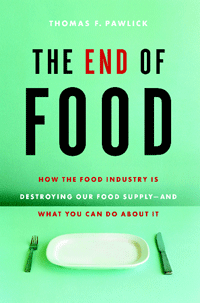
End of Food author Thomas Pawlick believes there's hope if we begin with ourselves.
- The End of Food
- Greystone (2005)
- Bookstore Finder
Thomas Pawlick believes "the food industry is destroying our food supply." He also believes those who eat responsibly can not only become healthier but also provide some small impetus toward a system that serves us better.
In The End of Food, the science reporter and journalism professor from eastern Ontario makes the case that today's produce lacks the nutritional sustenance it had 50 years ago: meat is higher in sodium and fat and lower in protein and vitamins, and the genetic modification of some foods is wreaking havoc. "You can't eat a tomato or a potato or a carrot or anything now without it having either a whole lot of toxins in it or very little nutrition in it compared to the old days," Pawlick told The Tyee, during an interview last week in a Vancouver restaurant.
Pawlick's book offers chapter after chapter of appetite-suppressing information about the nutritional worthlessness of the tomato salads and roast chickens we prepare with the best intentions. He offers only the slightest expression of regret for the onslaught. "It's a little bit of overkill, but I think it was necessary because there are so many people out there who are kind of skeptical" about anyone sounding the alarm on our big-food-business diet. He feels most of us still haven't been driven to action by books like Eric Schlosser's Fastfood Nation and movies like Supersize Me.
Pawlick does set out some solutions. But for many people, his escape route from the corporatized, low-nutrition, high-fat, bland-tasting, poorly ripened, heavily treated, over-engineered produce from the local grocery store has some significant obstacles.
If you don't make friends with local farmers, grow your own veggies, or can't afford the sometimes prohibitive expense of organic food, you're options are limited. No solutions for the overworked and underpaid, especially those who lack a green thumb.
In an interview with The Tyee, Pawlick discussed the reasons North Americans should forsake grocery-store convenience and explained why the price of the alternative, which may seem high, is at least sometimes right.
On price gouging for organic, locally grown foods:
One of the big problems is that the supermarkets, when they sell organic produce, boost the price way over what it should be. It's just like when there's a little dust-up in the Middle East, and the oil companies double the price of gas. It's whatever the traffic will bear, and this is also true for some small farmers. They say, "Look, the supermarkets are tripling the price when they don't need to, we'll do the same thing." They're getting a little greedy. It's just human nature. But the only way people are going to convert to eating organic food and take the trouble to drive down to the farmer's market, instead of going to the local mall, is if they get a break in price.
So use your head, [small farmer]. It's a simple marketing thing. And if you know that you can still make a profit and lower your price below what the supermarket's charging, well then do it. It's common sense.
On Italians, who know the meaning of enough:
The Italians have a great expression, "eh, basta," which means "that's enough." And if people say, "eh, basta" and say, let's get together, let's get a group, let's find some farmers and hire them and say, "we'll buy everything you produce, we'll give you a contract, and we'll guarantee you a market provided it's organically grown and it's no more than 50 miles away and we're going to get fresh stuff."
And, for at least the growing season, which is, in B.C., almost seven months a year, you can get really good quality food. And you can go to people who raise free-range chickens and get healthy eggs and healthy poultry, and you can find people who raise grass-fed beef in both Alberta and B.C., and if you get a big enough group together it's not that hard. If you live in an apartment building, just go and talk to all the people in the apartment building -- or your neighbours in a block of single-family homes.
If the family farmer has a guaranteed market with one or two buyers' groups in their municipalities, right away that introduces stability into their lives. And if they get to know these people personally and can come to a meeting and discuss with them what their problems are, people will understand, and maybe they'll be willing to give a little bit more price to the farmer because they understand the situation.
On being too busy to eat better:
There's a big force of inertia there. People do want convenience. Even knowing what I know, and even having written the damn book, sometimes I'm in a hurry and I just don't have time. So I go buy something at the grocery store. What people have to realize is that they should make it the rule to eat well and make eating badly the exception. The best motive they can have is for their kids. Allergies, diabetes, asthma, obesity -- these are all due to diet.
On whether Wal-Mart will bring organic food to the masses:
I think Wal-Mart will do it badly, simply because their priority is not to produce a healthy product. Their priority is to make the maximum profit, and at a certain point they'll cut corners because it'll make money for them. It's just the nature of the beast, you know.
On whether corporations and natural, healthy food can find some common ground:
It's like saying "Can Jesus Christ and Satan find a middle ground?" I don't think Satan wants to.
On growing food in the most unlikely places:
In Montreal, especially in the older sections, there used to be these wrought iron balconies on the front of the apartment buildings. And people spent most of their summer and spring months out on these balconies because it was cooler, and they would visit with the neighbours, shout down at them, shout back up at the others. And in some of the neighbourhoods, especially the Italian neighbourhoods, people would run strings between the balconies and they would plant a plant on the ground and it would be like a pole bean or a vining tomato or grapes, and they would let the plants run up the strings, up to the roof. And the whole front of the building was covered with growing things.
You can do stuff like that. There's no reason why people can't do that anywhere, if you have an apartment with a balcony and you have some pots for flowers. Don't plant flowers, plant beans. Grow your own in the kitchen, inside, in the winter. You can grow bean sprouts on the kitchen counter.
On good governments and bad governments:
I don't think national government will do a damn thing about it until the grassroots have already organized and put up overwhelming pressure. Simply because the national government is made up of people who are on the payroll of the big corporations. But on a local level, municipal politicians respond very quickly. Much more quickly than anyone in Ottawa ever will. I can tell you. I live on a farm in Ontario. Extremely responsive. They react very quickly.
There's a little town near me called Tamworth. And a guy wanted to bring in an industrial hog farm. The people of Tamworth said "We know what these industrial farms are like. It'll be a horror. It'll contaminate our water wells, and it'll create terrific air pollution, and on top of that, the pigs this guy's raising will be literally living in a pig Auschwitz, and we don't want this." They got really pissed off and they went to the local tavern and about 200 people got together and they said, "We're going to stop this." And they went out and organized and they drank a lot of beer that night at the tavern, and they felt good afterwards and they had a lot of fun, and then they all went home and got on the telephone and the e-mail and they organized the whole damn county in a very short time. And at the next municipality meeting the decision was: "Nope, sorry. We deny your application, there's not going to be a pig farm here." Because these people cared.
On the choices that confront us:
If people won't listen and want to commit suicide, I can't stop them. So I figure, here's the information [pats the book]. Use it or don't use it. If you don't, it's on you, man.
Kendyl Salcito is a staff writer at The Tyee.
Related Tyee stories: Michael Pollan talks about the organic food business's fatal flaws in Pity the Poor Omnivore, J. B. MacKinnon and Alisa Smith explore the challenges of eating locally in The 100-Mile Diet, and Eve Johnson explores the avian flu crisis in Ducks in the Henhouse. ![]()


20
Login or register to post comments
RickW
5 years ago
Comments on "Will We Ever Eat Well Again?"
People say that Malthus is wrong, but is he?
http://www.chp.ca/arc-CHP-Communique/CHPCOMM_Oct22_2001.htm
http://www.pcdf.org/Meadows/malthus.html
Or are the nay sayers refusing to think that, in the midst of al this "plenty", we are actually at risk of starving ourselves?
Fiat lux
5 years ago
Pawlick is correct. The food in the supermarkets is garbage, tastes like garbage and makes people sick. Those of us who grow and eat real organic foods can immediately tell the difference between the natural taste of vegetables, eggs and meat, against the chemically pumped up produce.
There's no reason why organic foods, especially meat, should cost more, rather less than the feedlot junk, pumped full of grains, antibiotics. steroids and hormones. We can sell our organic meats for far less than the supermarket junk, but there's no market for it and where there is, the prices are daylight robbery. Yet people rather pay $10 or $20. for a pound of organic meat to Pattison, than $3.50 to a farmer, because poor Jimmy needs the money.
It is interesting that doping is outlawed in sports for humans and horses, but has the blessings of governments when it is fed to humans, making them fat and sick with all kinds of illnesses, putting an unbearable burden on the health systems. The explosion of diabetics and cancers in young people are the best examples. There were no such things 50 years ago, except in a very few and virtually unheard of cases. Cancers in children and breast cancers in young women are totally new phenomena.
The Europeans refuse to buy our cattle and beef pumped full of growth chemicals, so our government's answer is to sue them under WTO rules, trying to force that junkfood on them, instead of banning the practice and sell good, healthy meats, because the drug and chemical companies hold them by the neck with donations to their parties.
Some of our ideologically warped friends are objecting when I call these practices criminal, because they support the communistic expropriation rights and control of our food supply in a few multinational hands in the name of "free enterprise",
Well, if these practices and the profits derived from them are not criminal, what are they ?
Ed Deak, Big Lake.
bbb
5 years ago
Pawlick's book might contribute to an ongoing debate, but the far more informed voice at the moment is Michael Pollan's The Omnivore's Dilemma. He looks at the issues of government subisdies around the food industry and the importance of knowing where your food comes from. Before criticizing local farmers for the prices they charge, you have to understand what the true cost of producing quality food is. Organic isn't necessarily better (environmentally or economically) than conventional when both are farmed using industrial processes. I don't think Pawlick is ignorant of this, but he doesn't do a very good job of explaining the history or nuances of the industry. I come from a farming family -- only one relative continues to farm (conventional grains and pulses) and he does so at a loss every year, hoping something might change next season (lower input costs, a government payout or anything to get by). But the same is true for many organic grain growers seilling into larger markets (these stories are profiled weekly in the agricultural newspaper The Western Producer). I would much rather pay more to a small-scale, local farmer any day when I know it's support actual costs plus at least some income to live off of.
Truman Green
5 years ago
Everybody knows what the problem is: the entropy in our democratic capitalism, greed, that is, has destroyed our food. It's mostly garbage. I try to eat as little of it as possible without slipping into anorexia, but why not just stop eating meat; surely that'll help. As Ed Deak says, it's pumped full of steroids, hormones and antibiotics and some of it even the bacterial vestiges of feces, like E-coli. And those animal farms are "animal Auschwitzes," as Pawlick says. And with all that saved money, when you stop eating dead pus-filled animals from the supermarket, you can afford to be more selective in the plant stuff you eat. Sounds like a plan. No?
Skookum1
5 years ago
Actually, Fiat Lux, doping is outlawed, period, for humans, except when it's called "hormone therapy". They both mean the same thing, but one is acceptable, the other is not. What's the definition? A set of poorly-written laws that know little about the medical science involved.....
As with other "illegal drugs", the extension of criminality into Schedule 4 substances (steroids) has criminalized a whole group of people who hitherto had had little do with other forms of crime; and making it illegal both increased prices and profit margins, as well as caused clinical problems with such matters as faked or contaminated product. There's no "four pillars" approach for "doping", and there should be; just because competitive sports people "cheat" (supposedly) by using the stuff doesn't mean that anyone else who uses it should be "criminal". What's cirminal is the mark-up that the pharmaceutical companies charge on the same products they sell overseas for less than 10% of the prices billed to "legal" users (MS, MD, AIDS, growth therapy, severe injury and muscle wasting). But what's criminal has to do with what set of laws Parliament passes, not with what's right and wrong.
Not that this was your point, but there's a lot of parroted stuff about "doping" and flippant use of "steroids" and such that for someone "in the know" it's all really irritating to read. Especially in what is theoretically a liberated, open-minded publication such as The Tyee. There may or may not be valid reasons to condemn biomedical science as used in competitive sport - er, which kind of biomedical science, huh? - but to juxtapose from that small interest group the "need" for criminal convictions. To prove what? That Barry Bonds trained hard enough (because you don't get strong just by juicing alone) to slam all those homeruns, while all Babe Ruth took was too many beers and whiskeys to get his. Take your pick. I'd rather drive home from the ballpark with Barry Bonds, that's for sure.
Name
5 years ago
Ed, many city dwellers would love to find a reliable source of affordable organic meats. The few places you find them--occasionally at the local farmers market, the odd frozen chicken at Superstore, or more reliably at Choices and other upscale venues -- it costs 2 - 3 times as much as non-organic and/or you need to order half an animal and/or all they've got is the choicest cuts of beef or chicken.
Most people wouldn't mind paying a bit more, but the marketers have equated "organic" with "premium" so it's all about chic rmarkets in chic neighbourhoods, right next to the exotic imported cheeses and with prices jacked sky-high.
Ever seen anyone bothering to market as "organic" such humble cuts as pork shoulder or stewing beef?
zivjo
5 years ago
Name:
I live in Vancouver's West End and buy grass-fed stewing beef directly at the weekend market beside Nelson Park. There are two stalls that sell everything from prime rib to ground beef (the last is being disputed by the health board). Everything is competitive dollar-per-pound to what would pay for the crap at the grocery store and much tastier and healthier. All the cheap cuts are available.
Pork is harder to find. I bought some pork chops from an organic beef producer at the Trout Lake market who normally only grows the animals for her own family. They are not organically-certified yet.
Jay Springs Lamb is at both markets twice a month. There meat is also well recommended.
I live in the city and eat only organic meat and wild, sustainably farmed fish and seafood. Last market season I bought enough at the end to last me through the winter and spring, but I only eat meat about once a week.
Fiat lux
5 years ago
Name...........
Here in the Cariboo you could buy all the non registered, organic beef to feed whole cities, butchered in goverment inspected facilities to specifications. The rub is that you'd have to buy by the half calf, or say, between 150 to 200 lbs at a time.
\
Why don't you get a small friends and family based food co-op together and buy in bulk? The freezer transport to the Lower Mainland is not too costly and people in other parts can find locally grown beef at many farms and ranches. What you could save in a few months would buy a decent sized freezer to store the meat in.
There used to be all kinds of small food co-ops 20-25 years ago, but they died when people found it more convenient to buy the chemical stuff in the supermarkets.
We just got home from our shopping in town. How about this label we saw on some bottles of red liquid " Imitation strawberry flavoured syrup" When you look at the ingredients of cans and packages, some contain enough chemicals to build bombs with.
This is the price people pay for the destruction of the family farm system and its expropriation by multinational agribiz crooks.
Ed Deak. Big Lake.
anarcho
5 years ago
I started growing my own this year, and what a difference in taste! I have also cut down on eating meat to once a week.
RickW
5 years ago
Fiat Lux:
"Yet people rather pay $10 or $20. for a pound of organic meat to Pattison, than $3.50 to a farmer, because poor Jimmy needs the money. "
____________________________________________________________
People think that the government is protecting them from all sorts of vile diseases when food goes through a "respectable" grocery chain........
And I heard on the news today (28 June) that some town in BC, which has celebrated Canada Day by having a town picnic, has been prohibited from doing so by Food Canada because a cat may have walked on the counter of the home that prepared the potato salad. Though I may have the details scrambled (as I caught but half the newscast), essentially Food Gestapo Canada is saying the town residents are not allowed to share food, "for their own good". If this isn't a foot in the door to prohibiting market gardens and small enterprises, I don't know what is.......
Truman Green
5 years ago
With the greatest of respect, Ed Deak, but why doesn't everybody just stop eating dead animals. Imagine, no cholesterol problems; no five or ten types of cancers; no imprisoning animals in death camps and butchering cattle when they're still alive. Cut down on super-bug, resistant bacteria.
It'd be a way nicer world! Not to mention that 35% of all the grains grown on the planet are fed to animals so that rich people can have a totally unnecessary luxury food that gives them heart attacks.
RickW
5 years ago
http://www.thepaleodiet.com/
Fiat lux
5 years ago
Truman,
Meat is food. Most humans have developed omnivorous bodies that need certain amounts of meat proteins.
I won't get into any useless arguments about the pros and cons of vegetarianism. It is a personal choice, I respect those who practice it and expect the same respect from them. When we have vegetarian friends visiting us, we make sure they're happy with the foods we serve them, and we eat with them, but never argue over the pros and cons of their, or our beliefs
There are millions of acres in Canada, including here, where no other food than beef can be produced. Yes, we have organic garden on a small scale and produce most of our vegetables, but if we didn't raise beef, basically our whole land would be wasted for food production, together with all the lands around here.
With starvation growing all over the world and a child dying from it every 5 seconds we can not waste any possibilty for growing healthy foodstocks. It is our duty to do our best.
On the other hand, the growing of incredible amounts of grain to fatten our calves on the feedlots is another crime of and against humanity. There's no need for it, all it does to the meat is filling it with fat, tallow, which the fools call "marble" and then wonder why we have an obese population and the resulting health problems.
Neither is there any excuse for the fast food joints filling people with unhealthy hamburgers and chickens fried in overused, burned out fats, with whole neighbourhoods reeking from the smell. I can't even remember when I last had one of those hamburger crimes against humanity. Only had one MacDonalds' hamburger in my life, around 40 years ago, and would never enter a stinking Kentucky joint.
In our case, we could have a steak every day, but we eat probably less meat than most city people. At the same time we enjoy eating the small amounts , because we have gone through long periods of starvation in our lives and value every bite we eat. Including meat. So do most people and no philosophising will ever change this. If we'd stopped eating meat, our bodies would go down the drain, because they are used to absorb and survive on animal proteins.
Also, our cattle grazing in the forest and on the meadows is highly beneficial to the land, as they eat off the grasses, keeo the forests clean, their hoofs create indentations to stop the rain runoffs and their manure fertilizes the soil.
So, what would be the vegetarian solution to the millions of acres taken out of food production for philosophical reasons?
Don't you think these constant references to "eating dead animals" is getting a bit obsolete, ridiculous and time worn? Couldn't the vegetarian propagandists come up with something more logical ?
When the war ended I was an 18 year oldm wounded POW in a MASH hospital, 5'11" tall, weighing 103 lbs. Never missed a meal since and never want anybody to expererience what it does to somebody's head. .
Ed Deak.
Chicken Slinger
5 years ago
Thoughtful book, article and responses on an important subject that looks like it holds the potential to creep up and bite us all in the butt. Tasteless strawberries low in nutrients laced with artificial strawberry flavoring to pork juiced up on a questionable chemical cocktail and kicked around mini-pens that rarely see the light of day are troubling indeed. Our fine economic system in conjunction with the status quo on morality is a dangerous concoction; an explosive mix that tick… tick… ticks away towards both wondrous advancements and catastrophic change. Among the ranks of decent men/women of affairs lurk mavericks missing pillars of virtue that enable them to effectively serve the people they build for and sell to. Government is a sluggish outmatched mechanism missing the agility and strength necessary to manage fast moving industry and its power. A gummy yellow puss pours out from barrels blandly branded with the label Necessary Evil and trickles down the side of our high-rises and the adorned stone of our government buildings onto, in this case, the farms that grow our food and eventually into our mouths.
Name
5 years ago
Thanks for the suggestions. Organizing a co-op is probably more than I can take on, but the demand is clearly there so hopefully someone else will provide some more farm/city connections. As for vegetarianism, the family won't go for it more than once or twice a week, but stews and mixes do help in terms of meat being the seasoning rather than the centrepiece.
Truman Green
5 years ago
Ed Deak proclaims:
"Truman, meat is food."
For which I got into the greatest laughing spell because it reminded me of a conversation between Plaxon and Plasmidian, two alien spaceship officers on the way to earth on a protein expedition, in the science fiction story, "Smart Animals," by Truman Green. Plaxon's having second thoughts about killing all those "semi-conscious Chonpsians" for protein. (Guess who)
"Well, according to the radicals, the Chonpsians have rights."
"Rights? What rights? Who gave them rights?"
"Well, there is a line of thought going around, at least in some circles, that rights are inalienable."
"Inalienable, eh. You know, Plaxon, you're beginning to sound a bit like them yourself."
"Like Chonpsians, sir?"
"No, free radicals?"
"Well, to be perfectly honest, sir, I do kind of feel a bit sorry for them sometimes, especially with their big millennium celebrations coming up and all; our timing does seem a bit unfortunate. I mean.. lots of us keep abducted Chonpsians for pets and we wouldn't want to, I mean, uh..eat them, sir."
"Right. We don't eat our pets. Never have and never will. What's your point?"
"Well theoretically speaking, sir, it could be said that it's a little hypocritical eating the Chonpsians you don't know and building heated shelters for the ones you keep as pets."
"Really? I think you need a holiday, Plaxon You've been thinking too much. Look, pets are pets and food is food, get it? Besides, our people are getting bored to death with chemosynthetic tubeworms and aromatic hydrocarbons. We have to get some variation into our diet. It's a fact of life. You knew it when you signed on. We all knew it. You designed the cutting blades yourself. Meat is food."
Fiat lux
5 years ago
Truman,
Your story brings back another one from the early postwar years.
A missionary went to a cannibal tribe and was preaching them the horror and sin of eating human flesh.
The chief spoke up : "You're telling us Father that it is a sin to eat human flesh, yet you white people just had a big war, where you killed and ate lots and lots of people!"
"Oh no, my son - said the missionary- it is true that we had a big war and lots of people were killed, but we didn't eat them!"
"White man big fool- said the chief- if you don't want to eat them, why kill them?"
So they ate him.
Cheers, Ed.
Truman Green
5 years ago
Your story showed promise, but was somewhat anticlimatic, eh, Ed. I thought it was going to be a brilliant satirical comment, but by the time I got to the end I wasn't sure about the message. What exactly was it? Whites are hypocrits?; cannibals eat people? cannibals are mean? Cannibals don't let whites finish their sentences before they eat them? Cannibals are excellent war correspondents?
Will you let us know?
Also, what war are you referring too? From what country does this story originate? What was the name of the cannibal group? And who told the story if the cannibals ate the missionary? And if it was one of the missionary's aides, why didn't the cannibals eat the aide, too? And lastly, what kind of condiments did the cannibals use when they ate the missionary? And if they had a salad, what kind of dressing?
It also seems that you're satirizing the missionary for saying that there's something wrong with eating human flesh, which begs the question: Do you eat human flesh? Your story really confused me, eh.
I have this theory that you made up this story, and that it didn't really come out of the "early postwar years," as you claim.
Not that there's anything wrong with that.
Fiat lux
5 years ago
Come now friend, it was a joke that circulated after the war, satirizing the killing of people for any reason. That's all. I posted it because it was about eating flesh.
There were a lot of similar stories during and after the war about the futility of war, certain nationalities and all the leaders. I've lived under 3 of the big names, Hitler, Stalin and Churchill, so I have very few illusions left about politicians, ideologies and their followers.
Cheers, Ed.
Truman Green
5 years ago
Okay, Ed, I admit anyone who's ready this is thinking; that Truman Green guy is losing it. (Or worse) Nitpicking or what! Who cares?
However, I've got the most persistsent curiosity gene. And I'm trying to imagine your story being real and it doesn't come across as such for the reason that I can't imagine the character who would be satirizing killing after 60 million or so had just been killed. Okay, if the speaker was on the Japanese, , Italian or German side, I don't get their perspective. Everyone knows these countries went insane with militarism and murder. (So they wouldn't be laughing at themselves. Right?) If it was spoken from "our" side I doubt if there were many who didn't figure that the Nazis had to be stopped regardless of how nasty killing is. (So they wouldn't be laughing at themselves, Right?)
I'm really interested in satire and irony and humour. My story was written as an attempt to do my own "A Modest Proposal." (Jonathan Swift, I'm sure you know).
I can't see any possible "point of view" for your story, especially as "a joke that circulated after the war." In fact "point of view" is a huge indicator of the believability and appropriateness of humour--especially in satire. And I can't identify any possible point of view for your story. So I don't believe it came out of the war, but rather out of your imagination
Not that there's anything wrong with that--kind of!
Unless of course you're satirizing eating human beings. Which is really weird because I didn't know that anyone was arguing that cannibalism's okay.
And you can't really do humour on a subject about which everyone is in agreement? Am I missing something? And don't say, yeah, brains.