
Pop Rocks Turns Robson Square into Sea of 'Otherworldly' Blobs
Hoping to stop people in their tracks, three designers have transformed the heart of Vancouver.



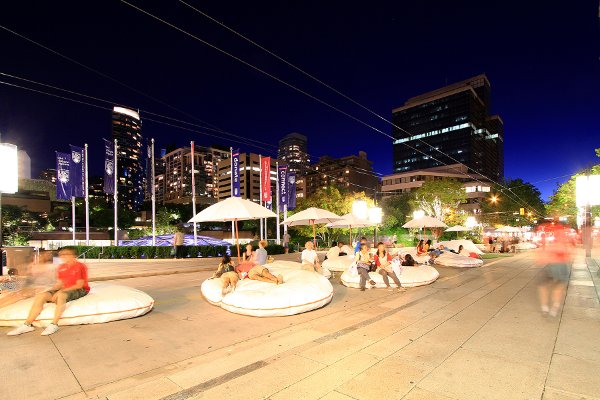
Robson Street denizens stretched out on Pop Rocks like urban lizards on a warm night. Photo by Krista Jahnke.
Robson Street denizens stretched out on Pop Rocks like urban lizards on a warm night. Photo by Krista Jahnke.
When the designers of a new Robson Street installation arrived for their grand opening Wednesday, they found their yellow caution tape already torn down, and their amorphous, misshapen white blobs literally covered in people.
Some artists might consider it a disaster: no speeches, no symbolic ribbon-cutting, no laudatory acknowledgement. But in the case of Pop Rocks, a three-week interactive collection behind the art gallery, the public's enthusiasm for the project was exhilarating.
"In a sense, they just sort of moved in when we left to change our pants!" laughs Joe Dahmen, with AFJD Studio and an assistant professor of design and sustainability at UBC's School of Architecture and Landscape Architecture.
"We had all the caution tape up, we'd wiped them all and fluffed up the pillows," recalls another of the Pop Rocks creators, Matthew Soules, another UBC architecture assistant professor and owner of an eponymous architecture firm. "We left to go home and change.
"We were going to come back, take the tape down, and unleash it. As I approached the site coming up Hornby, I could just see one of the taller forms, and I saw a child with a mother, playing on it. Just two people went under and played on it –- no big deal. But when I turned the corner, there were like 200 people. I guess it already opened!"
Partnering with a third designer, Emily Carr University associate professor Amber Frid-Jimenez, also a founding partner at AFJD Studio, the trio crafted a dozen soft bean-bag chair-like forms -– but up to five metres long –- out of the recycled old sails of Canada Place, stuffed with recycled industrial polystyrene on loan from a plastics factory.
Their vision: a thought-provoking hybrid of art, architecture, sustainability and social statement that would be comfy enough for Vancouverites to lounge upon, share snacks, bounce and slide down, and meet one another. When the installation comes down, it won't be sent to the dump, but rather redistributed to community centres and spaces.
"People have adopted a love for this thing," Soules told The Tyee, as we lounged with the project's creators on one of the plush plastic mounds. "It was successful for that.
"They just broke through and started occupying it in ways we couldn't have imagined!"
A few metres away, one of the taller Pop Rocks -- more than a metre high -- is covered in about five children. Two of them haul a third up by the feet, suspending him upside down. Another child slides down the other side, as a full-grown bearded adult leaps onto another form nearby as if it were a trampoline. A mother watches comfortably from under an umbrella's shade, seated on one of the lower Pop Rocks.
"Is this an art project?" she asks. "It looks really cool.
"I like the umbrellas for shade, and people walking around. (The kids) seem happy. There is quite a bit of (public art in Vancouver), but this is very unusual and different. It gives a funner, funkier, up-beat feeling. It's not something you see anywhere else."
'Like a living room here'
Set up from Aug. 15 until Sept. 3, the Pop Rocks opening featured a live DJ spinning records, and gave visitors a chance to meet the architectural experiment's designers. Even the suppliers of the polystyrene foam pellets giving the installation its soft texture were on hand, lying back on their own reconfigured products.
"It's a good use of the recycle expended polystyrene," says Hussam Kaddoura, from Mansonville Plastics Ltd. (MPL), lounging in the shade with his wife, Duaa Riyal, and co-worker Jack Liu. "It's great to see they have a new way of using waste material -- to have a new life for it.
"It's like we're in a living room here – usually people use bean bag (chairs) in their living rooms. To me, it's a very comfortable environment for people to sit and relax."
One thing Soules has noticed about Pop Rocks is the difference between tourists' and locals' reactions to what he describes as the project's "undersea, pulpy, kelp-like" shapes. Tourists, he observed, tended to be remarkably accepting of bizarre public art. The locals took some convincing, it seemed.
"When locals learned it was the fabric from Canada Place, something clicked," he told The Tyee. "A light went off, and they said, 'Wow! It was really the fabric from that iconic sail structure and found its way here?!' It embedded it in the local reality -- it made something foreign more familiar."
'Something to do with being provoked'
Not all the reaction to Pop Rocks has been positive, Soules added, but the project in fact aims to provoke both comfort, and also difficult questions about our city.
"Over the course of the day, as the installation progressed, it was the cranks and naysayers, saying, 'They look hot and uncomfortable,' 'These are just beds for homeless people,' " Soules recalled.
"People were like, 'What happened to the tables and chairs?!'
"It provokes a kind of questioning, an engagement with the city. We get so used to things being a certain way, it's so easy to become blasé. When you come across something that doesn't fit into regular categories, it's invigorating. How does Vancouver -- how do all cities -- become increasingly dynamic, increasingly inclusive, increasingly sustainable? It has something to do with being provoked."
Pop Rocks Turns Robson Square into Sea of 'Otherworldly' Blobs: Page 1 of 2
What have we missed? What do you think? We want to know. Comment below. Keep in mind:
Do:
Do not: