
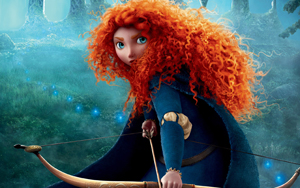
Today's kids yearn for movie heroes who ditch the parents and fly solo, as in 'Brave'. Let's take a hint.
Merida of Pixar's 'Brave,' the latest in young quiver-wielding heroines.

-
Note to Wes Anderson: Puppy love is a sharp-toothed thing that nips and bites.
-
So decrees 'The Hunger Games'. A tall order given the seduction of Netflix.
-
A brilliant, beautiful film about marriage, cages and one's own inescapable nature.
It's a little like clockwork. Every few months or so, someone comes out with a new book or article about the decline and fall of the next generation. The gist of it generally goes like this: "Kids these days, they don't know how to work, they're lazy, they're sassy, addicted to screens of all shapes and sizes, they're just generally all round no good!"
The most recent addition to this trend is a New Yorker article from the excellent Elizabeth Kolbert called "Spoiled Rotten: Why do kids rule the roost?" The piece is currently occupying the top spot on the most-read list on The New Yorker, and frankly I am not surprised by this fact. It is a fine essay, but more importantly, it taps immediately into our most fundamental feelings about our children: a) that we love them; and b) that we're failing them.
Writes Kolbert, "With the exception of the imperial offspring of the Ming dynasty and the dauphins of pre-Revolutionary France, contemporary American kids may represent the most indulged young people in the history of the world. It's not just that they've been given unprecedented amounts of stuff -- clothes, toys, cameras, skis, computers, televisions, cell phones, PlayStations, iPods... In many middle-class families, children have one, two, sometimes three adults at their beck and call. This is a social experiment on a grand scale, and a growing number of adults fear that it isn't working out so well: according to one poll, commissioned by Time and CNN, two-thirds of American parents think that their children are spoiled."
The point that Kolbert comes to is that a large share of the blame can be laid at the feet of parents, but that it's not nearly that simple. We're all products of our society, children and adults alike, and I use the term "products" advisedly since this is what a great deal of modern life is about. It is most explicitly what kids movies are about. Even the kids know it: they troop off to see the latest offerings, be it Madagascar 3 or the latest Spiderman reboot with a dead look in their eye, knowing already that there is nothing there. The lack of any genuine feeling isn't surprising. What is, is that we still expect it to be. Occasionally though, something curious rustles about in the bushes. When this happens, it behooves you to part the undergrowth and take a closer look.
Parents just don't understand
The most recent Pixar film Brave does not deviate much from lockstep formation of most other kids films, concerning as it does the conflict between parents and children. It's an old fight, one that's in almost every fairytale every written and then adapted to the screen by a committee of film executives. So it is with Brave, where the well worn plot concerns the Princess Merida, groomed and trained by her mother Queen Elinor to be a lady. Aside from a faint whiff of feminist empowerment (Brave was the first Pixar film to be directed by a woman, Brenda Chapman, although she ended up having to share the directing credit with Mark Andrews), the film doesn't have much to offer that is new. Merida wants her freedom and independence, and her mother wants the mantle of adult responsibility upheld. The battle lines are drawn or in this case computer animated, and away we go. The story unfolds as expected, the eventual order of things is established, happily ever after etc. But watching it I noticed something.
The very first thing that is critical in films aimed at kids is the need to rid oneself of those ponderous bleating accoutrements called parents. Oh to be free of such drapery! In Brave, Merida shucks off her mother and heads for the hills atop a giant Clydesdale named Angus. This is where the film genuinely comes to life, lush, dappled, gorgeous life. Deep in the forest Merida is free to do as she pleases, whether that means shooting arrows, climbing cliffs or drinking from the cold clear foam of an alpine waterfall. Watching this I was reminded of the one film that seemed to most excite the small set lately, namely The Hunger Games, where the idea of being alone in the woods, relying on your native instincts, armed to the teeth, free to hunt and kill with impunity sets off fireworks in young minds. So too Wes Anderson's latest outing Moonrise Kingdom comes to life when the kids take to the woods, running for their lives from the grey dreariness of adult responsibility. I cannot help but think that a phenomenon like The Hunger Games is a response from some synapses deep in the human brain that recall the pleasures derived from messing about in the woods, unfettered and free. Not only free but self-reliant, depending only upon one's skill and intelligence for survival.
Let them loose
This is a point that Kolbert also makes in her New Yorker piece, that much of modern childhood's dissatisfaction comes from the fact that life is a little too easy, there is too much stuff, too many distractions, that the real meat of survival has been so far removed, that we miss it and mourn it in some deep corner of our mammalian brains. Whether depression or anxiety or bullying behaviours are the result of this is unclear, but certainly there is something big and fundamental missing. That big missing piece is summed up beautifully by author and scientist E.O. Wilson, the granddaddy of biophilia, who states in an interview with NOVA: "Soccer moms are the enemy of natural history and the full development of a child."
Love that man...
In her article, Kolbert draws comparisons to different modes of parenting, specifically those of Amazon tribe the Matisgenkam to modern day Los Angeles. In Matisgenkam society, children's self-sufficiency is not only praised but more importantly practiced. Ms. Kolbert writes: "by the time they reach puberty Matsigenka kids have mastered most of the skills necessary for survival. Their competence encourages autonomy, which fosters further competence -- a virtuous cycle that continues to adulthood. The cycle in American households seems mostly to run in the opposite direction. So little is expected of kids that even adolescents may not know how to operate the many labour-saving devices their homes are filled with. Their incompetence begets exasperation, which results in still less being asked of them (which leaves them more time for video games)."
Wilson also has much to say about what modern life has done to humanity (he's written one hell of a book about it called The Social Conquest of Earth), but one point that particularly jumps out and bites you on the bum in the NOVA interview is this: "Psychologists and psychiatrists themselves seem in agreement on the benefits of what's called 'the wilderness experience.'
"To be able to [give this to] young people who may have gotten themselves all tangled up with their concerns about ego and peer relationships and their future and are falling into that frame of mind and becoming very depressed because they have such a narrow conception of the world. The wilderness experience is being able to get into a world that's just filled with life, that's fascinating to watch in every aspect, and that does not depend on you. It tells them that there's so much more to the world... The dire comparison I make is between children brought up in a totally humanized, artificial environment, urban or suburban, and cattle brought up in a feedlot. When you see cattle in a feedlot, they seem perfectly content, but they're not cattle."
Feedlot bovines is an interesting comparison to draw between contemporary kids and the culture they inhabit, but it rings true, like a piece of lead pipe against a gong sending wavy lines of recognition that reverberate in your brain. In removing the struggle to survive, the domestication of kids has resulted in a generation of lambs to the slaughter, stultified, bored out of their tiny minds and prone to bad behaviour. We're a little afraid of our precious darlings who have been raised on a diet of cultural meanness, from Jackass to Family Guy. The reason that a grandmother from Long Island is now some $700,000 dollars richer is perhaps partly because of this very idea. But before you launch into a stirring rendition of "Gee, Officer Kruptke," let's pause for a second. Are kids these days really that much different from kids in those days?
Maybe they are, but if their fascination with escape is any indication they're not that far removed from kids of yore. The winnowing down of experience to a screen, be it movie or computer or iPhone has left a big old hole in our heads where bigger things used to live. It is little wonder that hollowness echoes through this particular cultural moment. As Wilson points out in The Social Conquest of Earth, "We are an evolutionary chimera, living on intelligence steered by the demands of animal instinct." In other far less elegant words, we built our Space Age society overtop of a Stone Age brain, but in the deepest recesses of our human selves the need to go home endures. It is interesting that even when penned up and corralled so effectively, some inner wild instinct, coiled deep inside our genetic code, unfurls itself and calls for freedom. Let the children lead the way. ![[Tyee]](http://thetyee.cachefly.net/ui/img/ico_fishie.png)
Dorothy Woodend writes about film every other weekend for The Tyee. Find her previous articles here.
13
Login or register to post comments
miguel
45 weeks ago
Years ago...
I'm 56 years old. When I was 6-7 years old, my father gave me a knife and a lesson with a whetstone, and told me to be careful, and turned me loose. I was at home in the woods, and comfortable - more so than in an urban environment.
But being poor was what saved me. I had to be able to care for myself at an early age.
Today, many kids get goods more than personal involvement with their affluent parents.
Hakuin
45 weeks ago
yup
http://freerangekids.wordpress.com/
DonnaJordan
45 weeks ago
This article is quite good at
This article is quite good at explaining the problem. Now it is up to us to find a solution. So what do we do now?
Perhaps make sure the kids have lots of chores to do. Perhaps give them goals but let them figure out for themselves how to accomplish them (such as "get that bag of rabbit pellets from the back of the car to the garage"). Perhaps go camping a lot, or fishing, or hiking... Maybe don't watch every one of their ballet classes or soccer games. Maybe let them decorate and arrange their own rooms. Give them fewer gifts and indulgences. Make them work for anything they want. Help them set goals and save money. Let them know (respectfully) when something they've done isn't quite good enough, and praise exceptional effort. Expose them to causes where they can contribute or even organize, and to careers that will challenge. Inspire them and then get out of their way.
Well, it is all easy to SAY, but DOING all this is the challenge, isn't it?
Leonasha
45 weeks ago
Farm Girl
I've always been fascinated with city life. my parents tell me that whenever we drove into the city from the farm, I would pester them to get me to "the Toronto buildings" faster. I've now lived in one city or another for over 20 years, since I was 16, and can't imagine living anywhere but downtown. still, whenever I contemplate what I would do if I found myself pregnant, my first impulse is to get back out into farm country, because I don't see how a child could possibly learn to be proficient anywhere else.
sure, you can learn in summer camp how to paddle a canoe, light a fire, observe nature, challenge yourself physically, but it's not the same as perfecting skills year after year because they are your livelihood. I haven't chopped wood, harvested a crop, mucked out a stall or driven a tractor in decades, and didn't think much of those chores while I was doing them, but without those experiences, I would feel like I'm floating through my current concrete and steel life. I wouldn't feel like part of the world, but rather a consumer of it.
kids need to root their feet in the earth. it's really sad that so few will get the chance, be they urban poor or privileged suburbanites. not sure what the solution is...
lynn
45 weeks ago
Where the Wild Things Aren't
Maybe we should start with freeing the spoiled parents...
I live in a wilderness area where my memories are of families who could actually 'do' things. Many of them built their own homes and did a lot of the finishing work themselves. Their children could build a good fire, and learned how to chop wood to make a good fire. They could handle a boat safely. They could build a raft. Both parent and child knew how to plant a decent garden, make meals themselves, and clean up afterwards. They learned how to improvise - in both practical and artistic ways.
Now that Big Spoiled Money has sadly discovered the appeal of wilderness - they come in droves in big SUV's. Money buys everything for these neo-colonialists...everything but independence and freedom...and the simple pleasures derived from that. Their code: Never touch a hammer, nail or shovel if you can pay someone else to do it for you.
They have their dream citified homes built replete with two-car garages. They hire landscapers to landscape their property and gardeners to garden for them. Driveways are paved. Anything that reminds them remotely of the messy earth is pebbled over and cemented into regimented tidiness. They put in the obligatory lawn even though they already live in a forest. Inevitably they get bored.... with winter....with the usual rainy June, with a lack of things 'to do'...and they become bored, too with the social cliques they feed on in lieu of naturally developed friendships.
It's the British in Calcutta all over again.
The domestication of kids is the result of tamed, domesticated parents, who think they can buy life in gift-sized, risk-free, packages.
The only problem I have with the lauding of "the wilderness experience" is that that, too has become packaged and priced for consumption.
Fii
45 weeks ago
"Contemporary American kids
"Contemporary American kids may represent the most indulged young people in the history of the world" says Kolbert.
It's not just American kids. I had a (not American) student ask me how he would go about finding a part time job- keep in mind he is 18- and I gave him some ideas but a couple weeks later he said he wasn't going to bother since he and his family were returning to their home country for a couple months. Then he mentioned a parking ticket he got, showed it to me (wasn't sure how/where to pay it) and I noted the make of the car was a Mercedes Benz. I asked if his mum was angry he got a ticket while borrowing her car.
He looked at me and said "It's my car." bahahahaha- oh right, silly me. Because in the world I grew up in an 18 yr old gets a brand spanking new upscale car as soon as he gets his license.
It became suddenly clear why he really had no use for a part time job. He already owns a car I'll never see in my lifetime. Indulged indeed.
UNreal!
Glen Murtz
45 weeks ago
@miguel "But being poor was
@miguel
"But being poor was what saved me. I had to be able to care for myself at an early age."
That's a good short story that rings true. Thanks for that.
There's a fine book called Mediated: How the Media Shapes Our World and the Way We Live in It, by Thomas de Zengotita.
In a passage in the book, he talks about the difference between the natural world and the one most of us inhabit. He challenges the reader to imagine being stuck in the wilderness with no phone access and having to sit and wait for help. He suggests that it can be a trying experience because unlike the hyper-mediated environment we're immersed in on a daily basis, nature does not exist *for us*. Taken a bit further, he makes a pretty convincing argument that all our toys vindicate and encourage a narcissistic attitude because we know, for example, that all media is meant for *someone* - and it might as well be us. Contrast this to a large boulder sitting in the middle of a large alpine stream - well that's not there for you. It exists regardless of whether we're there or not. It doesn't "care" about you. Neither does that stand of birch trees or that mountain range. It's the sheer indifference of nature to our existence that makes it so different from how the majority of us live. That difference is often rendered as either terrifying because of our ignorance of it, or as a quaint, convenient accoutrement to our civilized existence, since it's chock full of nice photos for our laptops.
Media on the other hand, has a purpose that's immediately recognizable as an effort by one party to communicate to another. Zengotita makes the point that surrounding ourselves in an environment like the one we do can't do anything less then make us more self-absorbed and self-centred, because everything is meant for us.
We live and have acquiesced to a relentless world of marketing that never sleeps. What's ironic to me is that so many of the people I know who have media jobs - whether positioned on the left or right politically - don't see their production of media as problematic. "We're trying to educate people" can be used at either end of the political spectrum. And before someone pulls me up short for commenting on an article that discusses media - I *get* the paradox, okay?
Everything in modern society has been configured to an on-demand life that wants to talk to *you* and in that light, I don't see how we could expect young minds to forego much. After all, who wants to be the office "nut" who doesn't give a s**t about TomKat, can't be bothered to blather on endlessly about Game of Thrones or hasn't heard the latest trade rumours on Luongo? It's all for you to know.
Glen Murtz
45 weeks ago
I missed this...
"That big missing piece is summed up beautifully by author and scientist E.O. Wilson, the granddaddy of biophilia, who states in an interview with NOVA: "Soccer moms are the enemy of natural history and the full development of a child."
This is why I read you Ms. Woodend. When you can pull in an E.O. Wilson quote in a review of Brave, you is just the fricking cat's meow.
Jean
45 weeks ago
Don't overfocus on rural, farm life
It's not realistic that one should expect children should know well skills of farm life. After all, a good part of population lives in cities worldwide.
A better more inclusive angle on this is simply teaching certain skills of do-it-yourself activities that lead to something fixed/cleaned or a new object: a sewn garmet (or duvet cover), jewellery-making, small container garden, cooking from scratch (several times a wk.), grocery shopping for parents (how many older teens do this for their parents???! and how often?), raking leaves (not leaf-blowing), etc.
I would agree that sometimes childhood poverty does instill necessity of do-it-yourself activities --as long as the parents don't make it a huge deal / lesson. It simply needs to be done..without much fanfare..because daily living includes alot of chores and activities that no one else aknowledges but does result in a healthy living home environment/neighbourhood.
Also the experience if one is an immigrant or has immigrant parents, most definitely is a major life teacher for children on how to cope for life the hard way in a new country. This alone can be a great leveller for any "spoiled" child --as long as the parents approach things to be learned with child in a lighthanded way.
Part of giving a child "rootedness", is developing in them, a slow understanding of their family roots and celebrating the positive parts. Child begins to understand the universe does not revolve aroundt them, that instead they are a tiny grain of sand in a much bigger tree/universe.
Jean
45 weeks ago
And by the way, movies that
And by the way, movies that banish parents: Honest, fairytales and popular children's books in the lst half of the 20th century, don't feature parents much either while the kids are having a great adventure in another world.
duffybear
45 weeks ago
Ah, the good old days...AGAIN
One can wax romantic about the days when parents threw their children out of the house into the woods at sunrise, and did not allow them to return until sunset (my girlfriend's parents did that), or who made their kids help them with every bit of physical labour in the house (my uncle did that to one of my cousins, a sensitive boy - and later, gay man - who my uncle berated for not being "manly" enough). But really - do you think most parents did those kind of things because they were "good" for their kids? In my experience, a great many parents (although not all) from the good old days spent a lot of time getting rid of their kids - the old "we've had you, we've fed you, we've clothed you, now go away and LEAVE US ALONE". I think a lot of parents today are too involved (and frequently in the wrong ways), but let's not glorify the often neglectful parents of the past.
Tiva Quinn
45 weeks ago
Brave
I enjoyed this article and it touches on a lot of interesting subjects - but I have to quibble with the description of what's going on in Brave. I saw it just a few days ago and came out of the movie quite pleasantly surprised that the mother has her own character arc.
She's shown as a mom who means well even when her actions frustrate Merida the most, and who's still capable of growing and changing. I thought that was a HUGE departure from the usual cartoon mother, who is generally a gentle angel, a conveniently dead angel, or a terrifying monster - and stays that way from start to finish because she's purely a plot device. In a lot of ways this main-character-mom was far more radical than having a "feisty" heroine.
Lots of good discussion here about the other issues, but don't let this stop you from seeing Brave on your own or with kids. By about 1/3rd of the way in the general plot is predictable, but there's so many well done bits along the way that I still laughed and cried, and I can hardly ever say that about live action films these days.
Sally Bowles
45 weeks ago
Good old bad old days ...
Dorothy, by the time they reach about 8 or 9 years of age, kids have always craved stories where they, for one reason or another, are basically allowed to run amok, solving their own problems, facing the consequences of their decisions. Off the top of my head, I can think of the Prydain Chronicles, Pippi Longstocking, Swallows and Amazons, Edgar Eager's Half Magic -- all of which feature orphans or kids whose parents are either too busy handling the family's survival to look after them closely, or who trust them to roam at large without killing themselves, or destroying other people's property, or ending up in drug gangs or other criminal pursuits. When my daughter was 4 years old, her favourite movie was Kiki's Delivery Service -- a nod to Jean's comment about contemporary society being primarily urban. Orphan or 'half-orphan' stories (Elliott's mom in E.T.) have always been hugely popular with kids. I'm sure if I put some energy into it, I could come up with dozens of other examples.
As to whether children in this day and age get enough chances to experience similar extent of liberty, I tend to think not, but I don't get that there's a special correlation between Brave's popularity and the stifled desire for self-reliance and personal liberty -- more than has always existed, I mean. Those themes have always been around.